



Quick Summary
MuleSoft Dev Agent, now rebranded as MuleSoft Vibes, is an AI coding assistant built into Anypoint Code Builder that generates Mule flows, API specs, DataWeave transformations, and MUnit tests from natural language prompts. It delivers ~90% syntactic validity but has documented gaps in environment-specific configuration, API governance, and complex enterprise business logic. Accelirate's FlowAgent for MuleSoft adds the methodology layer that is pre-loaded with patterns from 100+ real MuleSoft implementations that make Vibes output enterprise ready.
You say to your integrated development environment: "Build me a Salesforce-to-SAP order sync flow with error handling and logging" and it generates production-ready code in seconds.
Sounds unreal and futuristic concept?
This is MuleSoft Dev Agent (Vibes), and it is currently revolutionizing how MuleSoft developers create APIs, flows, and integrations.
However, very few articles are there which will cover this concept for you. When it comes to MuleSoft and artificial intelligence (AI), what matters the most is guardrails. In this guide, we'll explain what the MuleSoft Dev Agent (Vibes) really is. Take an in-depth look at all available MuleSoft AI capabilities, what the enterprise-level support looks like and how FlowAgent for Mulesoft can help you in your complete development lifecycle.
What is MuleSoft?
MuleSoft is the integration and API management platform offered by Salesforce that is based on the Anypoint Platform, which is essentially a comprehensive environment for building and managing APIs and integrations within an organization.
In essence, MuleSoft integration is at the heart of the connected enterprise. It can involve everything from synchronizing CRM data with ERP to running pipelines in an event-driven fashion, or even publishing internal systems as governed by APIs. Developers use Anypoint Studio for local development, deploy to CloudHub or on-premise runtimes, govern everything through API Manager and use API Exchange as a centralized repository for single source of truth.
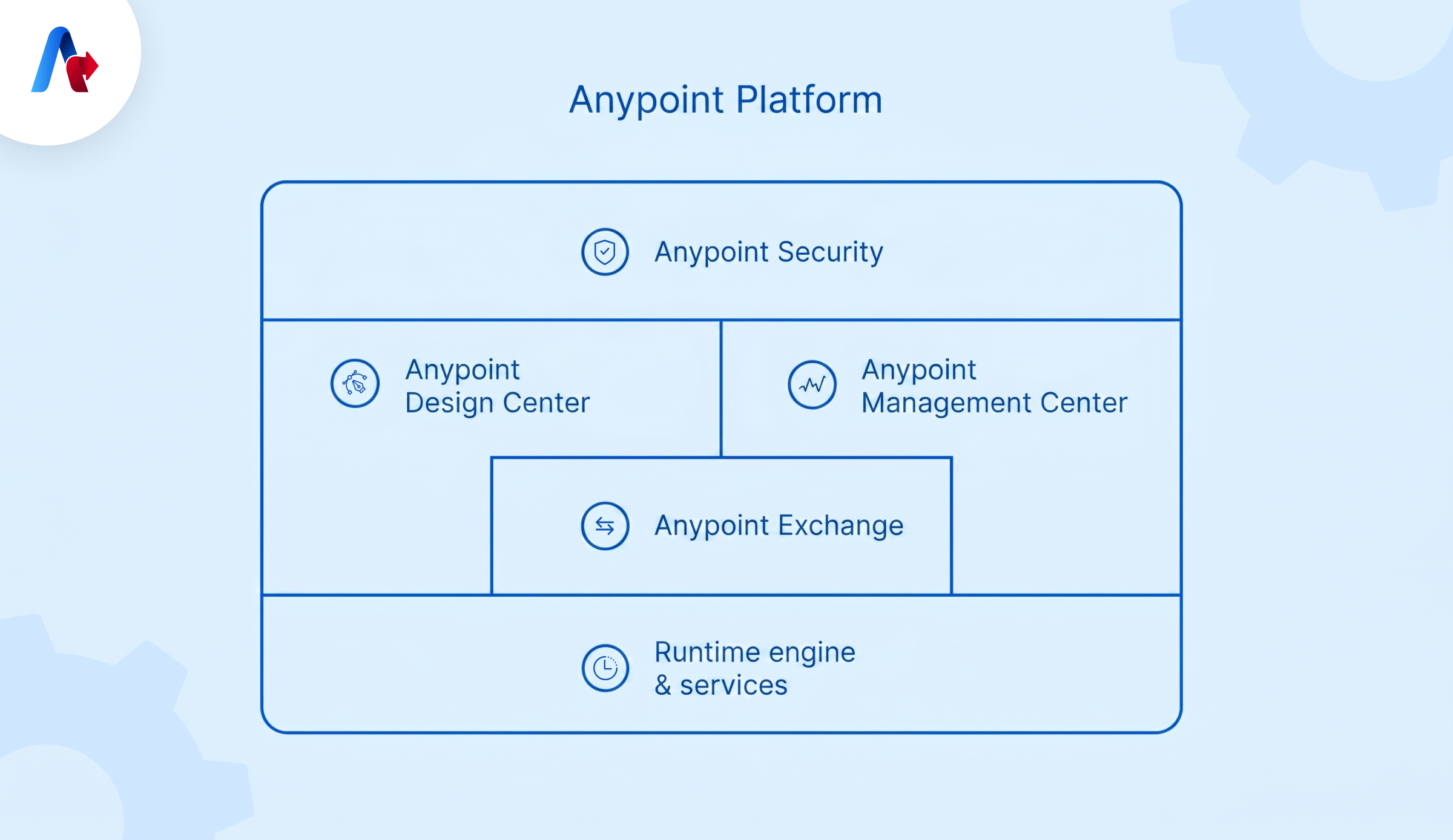
API lifecycle Complexity
The complexity, however, has grown significantly. API lifecycle complexity, from design and versioning to testing, documentation, and governance, demands enormous developer bandwidth. DataWeave transformations alone can consume 20–25% of a project's developer hours. Add RAML spec design, MUnit test writing, error handling, and documentation, and you've got a delivery bottleneck that no amount of headcount fully solves.
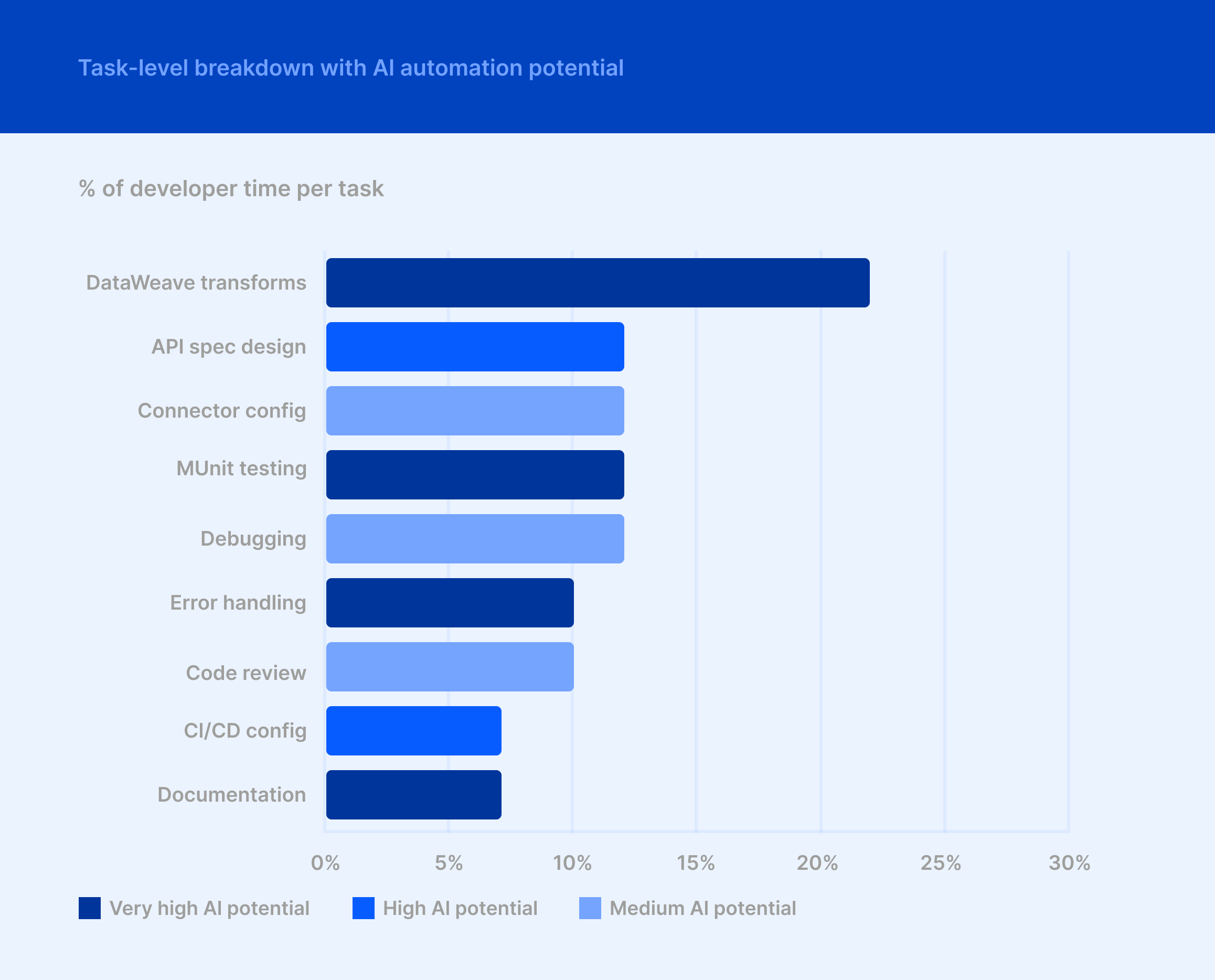
That's the exact problem MuleSoft AI is designed to address. With generative AI maturing rapidly, MuleSoft developers now have tools that can write code, generate specs, build tests, and draft documentation, all from natural language prompts.
What is MuleSoft Dev Agent and what can it actually do inside Anypoint Code Builder?
Dev Agent Inside Anypoint Code Builder
MuleSoft Dev Agent is an AI-powered coding assistant embedded directly inside Anypoint Code Builder, MuleSoft's cloud-based IDE, often referred to as "builder with Einstein." Launched in October 2025 under the MuleSoft Vibes brand, it brings vibe coding to the MuleSoft development lifecycle.
Instead of manually configuring flows, connectors, and DataWeave scripts, developers describe what they need in plain English. Dev Agent interprets the prompt and generates syntactically valid, contextually relevant MuleSoft code, directly in the IDE. This is AI-powered code assistance purpose-built for MuleSoft, not a generic copilot retrofitted for integrations.
Think of it as a MuleSoft development AI agent that inherently knows the terminologies and architecture of MuleSoft, such as API-led connectivity, Mule flows, connectors, DataWeave, MUnit, and more than just programming languages.
Let’s clear the confusion between Vibes and Dev Agent: Vibes is simply the rebranded MuleSoft Dev Agent with same capabilities and functionality, just a new name aligned with Salesforce’s latest direction.
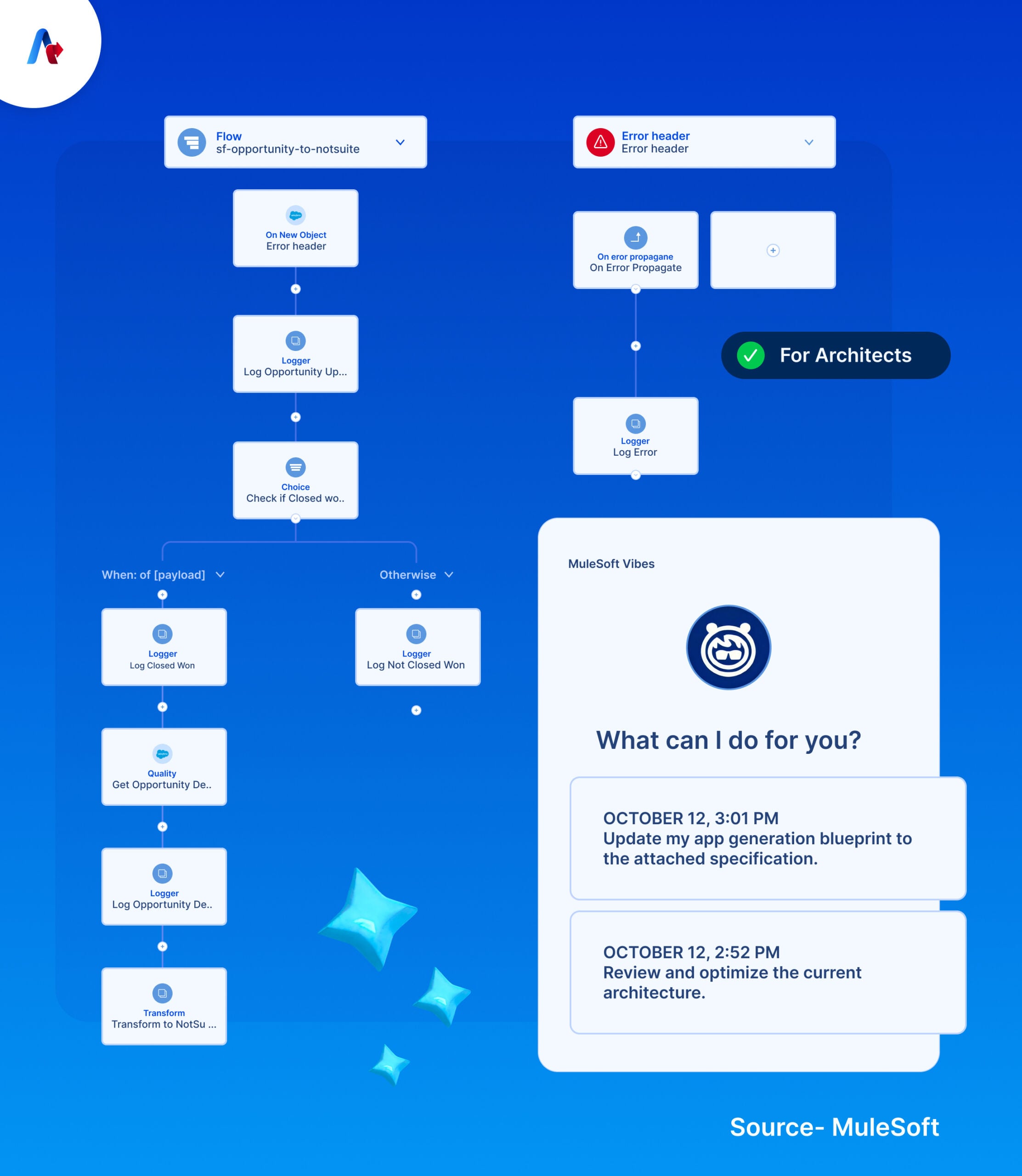
MuleSoft Dev Agent Capabilities
Here's what MuleSoft Dev Agent is capable of right now:
- Generative AI for API specification: Generate RAML or OAS API specs from natural language business requirements or Jira tickets
- Mule flow generation: Build complete flows including HTTP listeners, Salesforce connectors, database connectors, and transformations
- DataWeave using AI: Generate DataWeave transformation scripts from sample input/output data or schema definitions
- AI-driven API testing: Auto-generate MUnit tests from completed flows
- Automated documentation: Generate inline code documentation and API docs, reducing manual documentation effort to near zero
- Agent Fabric integration: Connect with MuleSoft Agent Fabric and Agentforce/Einstein to leverage org-wide context in code generation
This combination makes MuleSoft Vibes documentation and delivery significantly faster for teams already working within the Anypoint ecosystem.
Right out of the box, however, these features are deliberately broad and tenant-aware: MuleSoft Dev Agent takes into account what you have done on Anypoint Platform, and from that information, it plans and generates your code. The one thing that Vibes does not come with is a specific idea of how to deploy things cross-customer, nor the experiences that dozens of other MuleSoft customers have had.
What Is MuleSoft Vibe Coding?
Vibe coding is the concept at the heart of Vibes: developers describe an integration in natural language, and the AI generates the implementation. You're not writing code line by line, you're directing the agent with intent.
In MuleSoft terms, it means describing: "Create a REST API that accepts an order payload, transforms it to SAP IDOC format using DataWeave via the SAP connector." The agent handles scaffolding, transformation logic, and connector configuration.
It involves agentic AI in MuleSoft, where AI agents comprehend the entire workflow within MuleSoft and the complete software development process, rather than just focusing on snippets of code.
All MuleSoft AI Tools
Dev Agent/Vibes is the most visible piece, but it's part of a broader MuleSoft AI strategy. Here's what the full landscape looks like:
- MuleSoft Dev Agent / Vibes: AI code generation inside Anypoint Code Builder (available with Anypoint subscription)
- AI Connector: Pre-built connector for integrating AI models (OpenAI, Einstein, etc.) into Mule flows without custom code
- AI Integration Agent: MuleSoft's native agent that can autonomously orchestrate integration tasks across systems
- Agent Fabric / Agent Networks: Infrastructure for coordinating multi-agent workforces across Salesforce's platform, enabling Agentic Transformation at enterprise scale
Together, these tools form a powerful, AIenabled integration stack: Dev Agent/Vibes in Anypoint Code Builder, AI connectors for model access, AI Integration Agent for orchestration, and Agent Fabric to govern agent behavior at the platform level. What they do not provide by default is a partnerspecific delivery methodology that spans multiple clients, environments, and past incidents – so a layer that uses these native tools but steers them according to proven integration playbooks is needed.
Introducing FlowAgent for MuleSoft
MuleSoft Vibes achieves approximately 90% syntactic validity and around 80% correctness across nine LLMs in controlled scenarios. For most simple use cases, that's impressive. But enterprise MuleSoft projects rarely live in simple use cases.
Here’s where gaps appear in practice and where independent evaluations of Dev Agent have also highlighted limitations in complex, multisystem MuleSoft projects:
- Environment-specific configuration: Dev Agent generates code, but it doesn't know your dev, staging, and production environments. Credentials, API policies, property files, and CI/CD pipeline configurations still require a human, or a standards layer, to handle correctly.
- Complex business logic: API-led connectivity patterns, cross-system orchestration (Salesforce + SAP + legacy Oracle), and migration scenarios from platforms like IBM ACE or TIBCO involve nuance that generic AI can miss. Getting it wrong the first time is expensive.
- API governance and security: AI-generated code can create what practitioners call "API sprawl", inconsistent naming conventions, missing logging standards, hardcoded credentials, or inadequate error handling. Without enforced API governance, technical debt accumulates fast.
- Full API lifecycle: Dev Agent is strongest at the code generation phase. Planning, non-functional requirements (performance SLAs, throttling policies), long-term maintenance, and architecture decision records are outside its scope.
None of these gaps mean Vibes is flawed – MuleSoft explicitly positions it as an AI assistant within the developer experience, not as a complete replacement for architecture, governance, and project methodology. The missing piece is a standards layer that knows how your team designs APIs, writes DataWeave, configures environments, and tests integrations in the real world.
What is FlowAgent for MuleSoft and how does it complement MuleSoft Vibes?
Accelirate’s FlowAgent for MuleSoft is an AI-powered development companion that is available as a VS Code extension, helping teams deliver integrations faster enabling up to 2x throughput with the same team size
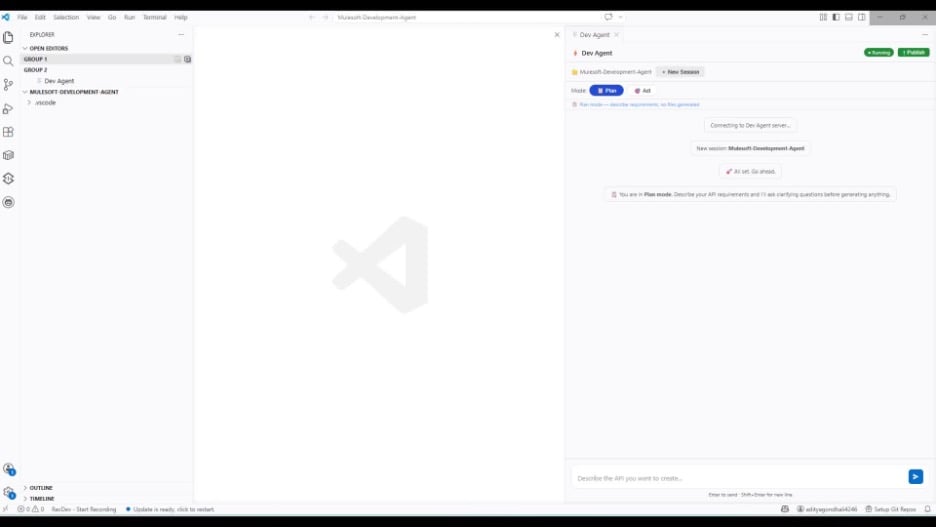
FlowAgent’s Plan and Act mode
In Plan Mode, you can collaborate with the agent to refine the design, align with standards, and finalize the approach.
Then in Act Mode, the agent generates production-ready assets based on that prompt.

From a single prompt, FlowAgent can generate API specifications, Mule flows, DataWeave transformations, MUnit tests, and documentation all aligned with API-led connectivity standards, naming conventions, and security best practices.
It leverages proven patterns from real-world projects to ensure consistency, quality, and governance across the entire development lifecycle.
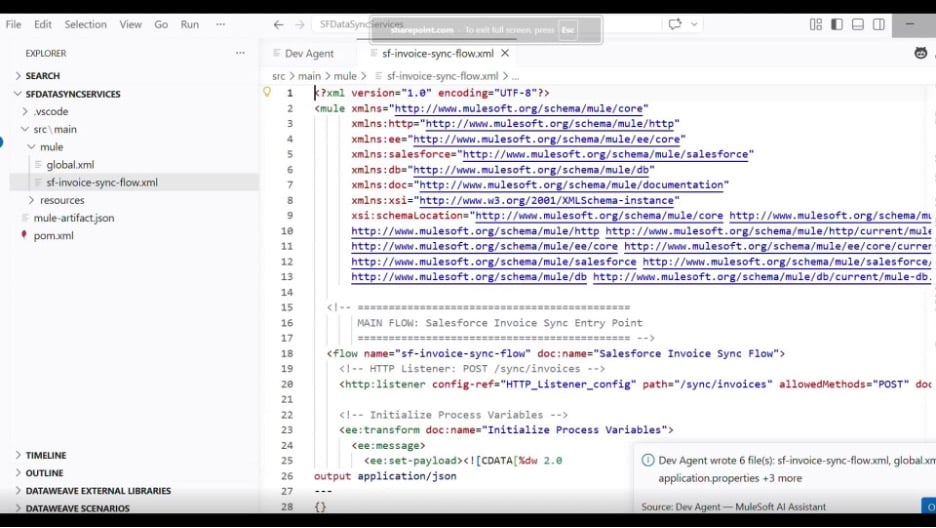
Accelirate’s FlowAgent for MuleSoft gives you a seamless way to move from prompt to fully implemented integration with the platform doing the heavy lifting, while you stay in complete control of every final decision.
How FlowAgent for MuleSoft Complements MuleSoft Dev Agent
FlowAgent as a Methodology-Aware Dev Agent Layer
FlowAgent for MuleSoft is an agent that runs alongside Dev Agent/Vibes. MuleSoft Vibes is delivered as a generalpurpose, tenantaware coding and operations assistant inside Anypoint Code Builder and the broader platform. FlowAgent, by contrast, is practiceaware: it is preloaded with Accelirate’s APIled connectivity standards, naming conventions, DataWeave libraries, errorhandling patterns, logging standards, and test heuristics learned from more than 100 MuleSoft implementations.
In other words, Vibes helps you generate something that compiles and aligns with the assets already in your Anypoint org; FlowAgent helps you generate something that complies with your organization’s preferred way of designing, building, testing, and operating MuleSoft integrations across many different projects and clients.
FlowAgent for MuleSoft Development lifecycle
FlowAgent operates as a suite enabled to target specific phases of the MuleSoft development lifecycle:
- API Spec Generator: Generates RAML/OAS specs from business requirements while enforcing organizational naming, versioning, and security standards
- Flow Builder: Creates complete Mule application flows referencing proven patterns (not starting from scratch every time)
- DataWeave Engine: Handles complex transformation scenarios: nested flattening, conditional mappings, null handling, format conversions, backed by 100+ proven patterns
- Test Generator: Auto-generates MUnit test suites including edge cases derived from real production failures, not just standard patterns
- Quality Gate: Reviews AI-generated code against firm standards before human review, catching hardcoded values, governor limit risks, non-compliant naming, and security vulnerabilities
- Documentation Agent: Produces technical docs, API documentation, runbooks, and deployment guides automatically from the codebase
This collaboration intentionally mirrors MuleSoft’s own Agentic Transformation and Agent Fabric vision but while Agent Fabric governs agents at the platform level, FlowAgent governs how those agents behave for our delivery practice: which patterns they prefer, which mistakes they avoid, and which quality gates they must pass before a human reviewer ever sees the code.
What does a full MuleSoft delivery look like when FlowAgent and Vibes work together?
Imagine a team receiving a project to build a SalesforcetoSAP order integration. A developer uses MuleSoft Dev Agent inside Anypoint Code Builder to describe the desired flow in natural language, then generate the initial Mule application: HTTP listeners, Salesforce and SAP connectors, and the core DataWeave transformation.
Used thoughtfully, Dev Agent already accelerates common tasks like API specification, flow scaffolding, and MUnit test creation, while benefiting from MuleSoft’s own grounding, validation, and AI Quality Pipeline for basic correctness and security.
FlowAgent for MuleSoft does not replace that AI assistance – it wraps it in Accelirate’s delivery methodology. For the same project, FlowAgent can recommend the appropriate RAML template, enforce your naming and logging conventions, highlight gaps against your standard errorhandling pattern, and suggest additional MUnit scenarios based on edge cases we have seen across 100+ MuleSoft implementations.
Over the course of a full delivery, that means developers spend less time reinventing patterns and more time refining business logic, while architects and leads get consistent APIs, tests, and documentation that align with how your organization prefers to build MuleSoft integrations.
Conclusion: AI in MuleSoft Is Here, But Delivery Still Requires Discipline
MuleSoft Dev Agent (Vibes) represent a genuine shift in how developers interact with the Anypoint Platform. The ability to generate API specifications, build flows, create DataWeave transformations, and auto-document, all from natural language, is not a gimmick. It is a real productivity multiplier.
But productivity without governance creates a different kind of problem: faster code that still fails in production, inconsistent APIs that create long-term maintenance debt, and AI-generated sprawl that undermines the very standards MuleSoft was built to enforce.
The teams that will win with MuleSoft AI tools are those that combine the speed of Dev Agent and Vibes with the discipline of proven delivery methodology. That's precisely the role FlowAgent is designed to fill, not as a replacement for MuleSoft's native AI capabilities, but as the methodology layer that makes them safe, consistent, and enterprise-ready at scale.
Explore Accelirate’s MuleSoft Consulting Services and discover how our experts can help you build secure, scalable, and AI-ready integration ecosystems.
Ready to accelerate AI-powered integration with confidence?
Schedule a ConsultationFAQs
MuleSoft Dev Agent is an AI-powered coding assistant embedded in Anypoint Code Builder. It uses natural language prompts to generate Mule flows, API specifications, DataWeave transformations, and MUnit tests. It is rebranded into MuleSoft Vibes experience and is included with Anypoint subscription.
MuleSoft Vibes is the rebranded evolution of the MuleSoft Dev Agent, retaining its core capabilities while introducing enhanced AI-driven assistance, improved developer experience, and deeper alignment with Salesforce’s Agentforce ecosystem for more autonomous and efficient integration development.
Vibe coding in MuleSoft means describing your integration intent in plain English and letting the AI generate the implementation. Instead of manually writing DataWeave scripts or configuring connectors, developers direct the agent with natural language, and the agent handles the code. It is the core interaction model behind MuleSoft Vibes.
Agentic AI in MuleSoft refers to AI agents that can autonomously execute tasks across the MuleSoft development lifecycle, generating specs, building flows, writing tests, and producing documentation, without constant human input at each step. MuleSoft's Agent Fabric and multi-agent workforce capabilities extend this across the broader Salesforce ecosystem.
MuleSoft Dev Agent works well for standard flow generation and transformations, but has gaps in environment-specific configuration, complex enterprise business logic, API governance enforcement, and full lifecycle management. Teams need a standards layer, like FlowAgent, to bridge these gaps in production-grade delivery.
FlowAgent is Accelirate’s AIpowered delivery agent for MuleSoft that generates and reviews DataWeave, RAML, and MUnit code using real project patterns, so teams can speed up MuleSoft development without sacrificing governance and quality.
MuleSoft Vibes provides powerful, builtin AI for the Anypoint Platform: it understands your existing APIs, assets, and governance rules and uses them to generate and operate integrations from natural language. FlowAgent does not try to replace that; instead, it adds a layer of delivery methodology and crosscustomer experience on top. It encodes patterns and antipatterns from 100+ MuleSoft projects – how we design RAML, structure flows, write DataWeave and MUnit, and avoid common production issues and uses those to review and enrich what Vibes generates.
MuleSoft Vibes is MuleSoft’s native AI assistant inside Anypoint Code Builder. It is designed to generate MuleSoft assets such as flows, API specifications, and DataWeave transformations based on the APIs, assets, and governance already present in your Anypoint org. FlowAgent, by contrast, is a methodology-aware agent built around Accelirate’s delivery practices, including API-led connectivity standards, naming conventions, DataWeave patterns, and test heuristics gathered from real MuleSoft implementations. In practical terms, Vibes helps generate code that fits the platform, while FlowAgent helps ensure that the code also fits your organization’s preferred way of building and operating MuleSoft integrations.
MuleSoft Vibes is available at no additional cost for Anypoint Platform users. The AI feature itself is not charged separately, but any platform activity it triggers, such as deployments or workflow operations, still consumes normal MuleSoft platform capacity and can affect your usage-based costs. So, the right way to think about it is that Vibes is included, while underlying compute and entitlement consumption still matter.