



Quick Summary
AI agents in life sciences are actively deployed across three workflows: clinical trial data management, pharmacovigilance case triage, and drug discovery literature synthesis. The highest-impact entry point for most enterprises is pharmacovigilance — specifically adverse event case processing, where agentic AI reduces average case closure time from 10+ days to under 3 days and handles 70-80% of cases without manual intervention. Clinical teams report the fastest ROI within 60 days, with the least disruption to existing regulatory workflows.
Key Takeaways:
- Pharmacovigilance teams reduce case closure from 10+ days to under 3 using agent orchestration
- Agents handle protocol design, site feasibility, and data query generation in a single connected workflow
- Adverse event triage, MedDRA coding, and regulatory submission tracking run without manual handoffs
- Literature synthesis and candidate prioritisation that takes weeks manually completes in hours
- Maintain compliance through auditability and traceability
- Agents process free-text safety reports, scientific literature, and clinical notes that RPA cannot handle
- Scientists and safety officers shift from data processing to decision-making and strategic review
Ever thought about how life sciences teams manage work across so many disconnected steps? Trial data sits across different systems; safety cases go through manual reviews, and research teams spend weeks pulling information together before making decisions. This is where AI agents in life sciences help. It helps to connect these steps by understanding context, using the right tools, and managing workflows across multiple stages. These agents help to make the process much faster and organised by linking clinical trials, pharmacovigilance, and drug discovery together.
Ready to simplify your life sciences workflows with AI agents?
Book a DemoWhat is agentic AI in life sciences?
Agentic AI in life sciences refers to AI systems that go beyond just generating responses. It actively performs tasks within complex workflows that can understand context, use domain-specific tools, retrieve and validate data, and take actions across multiple steps. These agents can actually support clinical trial design, triage pharmacovigilance cases, and refine literature searches in real-world scenarios. It also compares assay results and guides next actions based on connected data and prior outputs, which makes workflows more structured and execution driven.
Why are AI agents gaining traction?
Agentic AI has been gaining a lot of traction in 2026 because of two main challenges that the teams are facing today, which are manual clinical trial operations and high-volume safety case processing. Clinical teams are facing delays with protocol design, site start-up, and data review, whereas pharmacovigilance teams are finding it difficult to manage thousands of adverse event reports manually. This ongoing operational burden has made organisations switch to agentic AI to reduce delays, connect workflows, fast-track execution, and maintain compliance. Recently, McKinsey has also predicted that around 75-85% of pharma workflows are going to be automated or augmented by AI agents in the coming years. In Accelirate's 2025 life sciences deployments, pharmacovigilance case triage and clinical data query handling were the first workflows to show full automation potential, with teams reporting 60-70% reduction in manual processing time within the first 90 days of deployment.
Why AI Agents Are Critical for Life Sciences
As the operational load across clinical and safety workflows continues to grow, agentic AI in life sciences is becoming critical to address these challenges at scale. It is not just about automation anymore; it’s about improving how workflows are executed, decisions are made, and systems are connected across the value chain.
This is where AI agents play a key role:
- Reduce workflow fragmentation: Agents reduce delays caused by manual handoffs by linking disconnected systems and processes together
- Handle unstructured, high-volume data: It helps to process literature, clinical data, and safety reports at scale
- Improve speed without compromising compliance: By automating documentation, triage, and validation steps, agents speed up execution while keeping the process open to audits.
- Enable end-to-end process automation: Agents automate end-to-end workflows across clinical, pharmacovigilance, and R&D functions.
- Free up expert capacity for high-value work: AI automates routine tasks, allowing scientists and operators to concentrate on high-value jobs.
These challenges directly impact core life sciences functions, like clinical trials, pharmacovigilance, and drug discovery, which directly affect care and revenue.
Accelirate's AI Governance Framework applies five pillars to every life sciences agent deployment: Authorisation, Audit, Data Boundary, Escalation, and Drift Detection. In a regulated environment like pharma, all five need to be in place before an agent touches production data.
Key Applications of AI Agents in Life Sciences
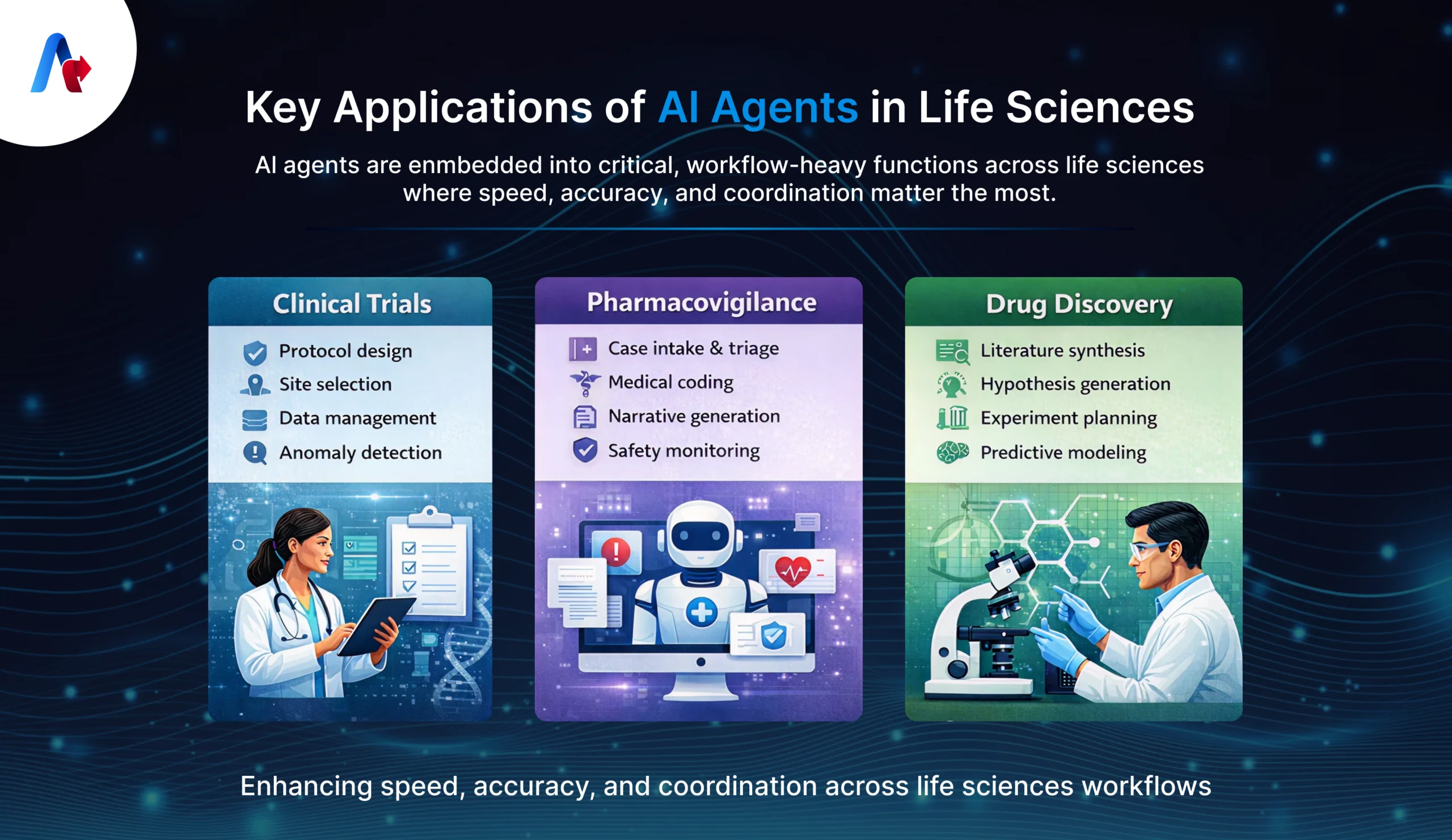
Understanding agentic AI use cases in life sciences becomes easier when you look at how these agents are applied in real, high-impact workflows across the industry.
Here are three key areas where AI agents are making a significant impact:
Clinical Trial
Clinical trials often get delayed due to manual processes and constant back-and-forth between teams. With agentic ai teams are now able to automate tasks related to protocol generation, site selection, and clinical data monitoring by using previous trial data and detecting errors or missing information, which helps to make trials faster, organised, and easier to manage while ensuring compliance
Pharmacovigilance
Pharmacovigilance has always been a manual and resource-intensive function. From case intake to signal detection and regulatory reporting, all processes are highly manual and time-consuming. Pharmacovigilance automation helps to interpret data, make context-aware decisions, and adapt to new information exactly like a human, which helps agents to tackle multistep tasks across different systems. This brings speed, consistency and compliance to the workflows
Drug discovery
Scientists spend a lot of time going through research papers, combining data from different sources, and planning experiments for drug discovery. Integrating agentic AI helps team automate steps related to literature review, data integration, target identification, and experiment planning. It helps to run predictive models to evaluate factors like toxicity and effectiveness, which speeds up the entire process and helps to identify promising drug candidates faster.
Want to see how AI agents can improve your clinical workflows?
Book a demoAgentic AI in Clinical Trials: Automating Patient Recruitment and Monitoring
AI agents are mainly used in clinical trials to reduce delays across design, start-up, and data management functions. It helps to coordinate workflows by connecting trial data, documentation, and operational steps in a structured and traceable way, rather than supporting isolated tasks.
- Protocol design and optimization: Analyse past trials and benchmarks to improve study design.
- Site selection and study start-up: Evaluate sites and automate feasibility and document generation.
- Clinical data management and query handling: Detect data issues and generate queries for faster resolution.
Agentic AI in Clinical Trials: Use Cases
- Patient recruitment and eligibility screening: Follows inclusion/exclusion criteria to scan patient data and find eligible participants faster.
- Regulatory document preparation and submission support: Creates and organizes the documents needed for approvals and submissions.
- Trial monitoring and risk detection: Continuously tracks trial progress, flags risks or deviations, and supports proactive decision-making.
AI Agents for Pharmacovigilance: Real-Time Drug Safety Monitoring
From intake to submission, AI agents are reshaping the drug safety process. It helps teams to reduce time and manual workload by interpreting data, making context-aware decisions, and adapting to new information, almost like a human. It also carries out multi-step processes across systems, which brings speed, consistency, and compliance.
- Case intake and data extraction: Creates structured data from emails, reports, and scientific literature sources.
- Medical coding and narrative generation: Suggests medical codes like MedDRA and creates accurate, compliant case narratives.
- Case triage and signal detection: Sorts cases by severity and tracks new safety signals in real time.
Agentic AI in Pharmacovigilance: Use Cases
- Literature monitoring: Scan scientific publications regularly to identify potential safety signals early.
- Regulatory submission tracking: Tracks deadlines, checks data integrity, and generates regional safety submissions.
- Audit and compliance support: Maintains audit trails, documentation accuracy, and supports regulatory inspections.
Start identifying drug candidates faster with AI-powered workflows
Book a demoAI Agents in Drug Discovery: Accelerating Drug Discovery with Autonomous AI Agents
AI agents in drug discovery automate research processes involving multiple steps by integrating data, models, and experiments to reduce time spent on literature review, hypothesis development, and decision-making. This speeds up the process and helps to make informed decisions.
- Literature synthesis and data integration: Gathers and summarizes insights from multiple scientific sources.
- Hypothesis generation and experiment planning: Suggest targets, compounds, and next-step experiments.
- Predictive modeling and analysis: Run models for toxicity, efficacy, and molecular properties.
Agentic AI in Drug Discovery: Use Cases
- Drug repurposing: Finds new uses for existing drugs by analyzing biological and clinical data.
- Assay design automation: Designs and optimizes experimental assays based on research objectives and data.
- Candidate prioritization: Ranks potential compounds based on predicted efficacy, safety, and success probability.
Benefits of AI Agents in Life Sciences
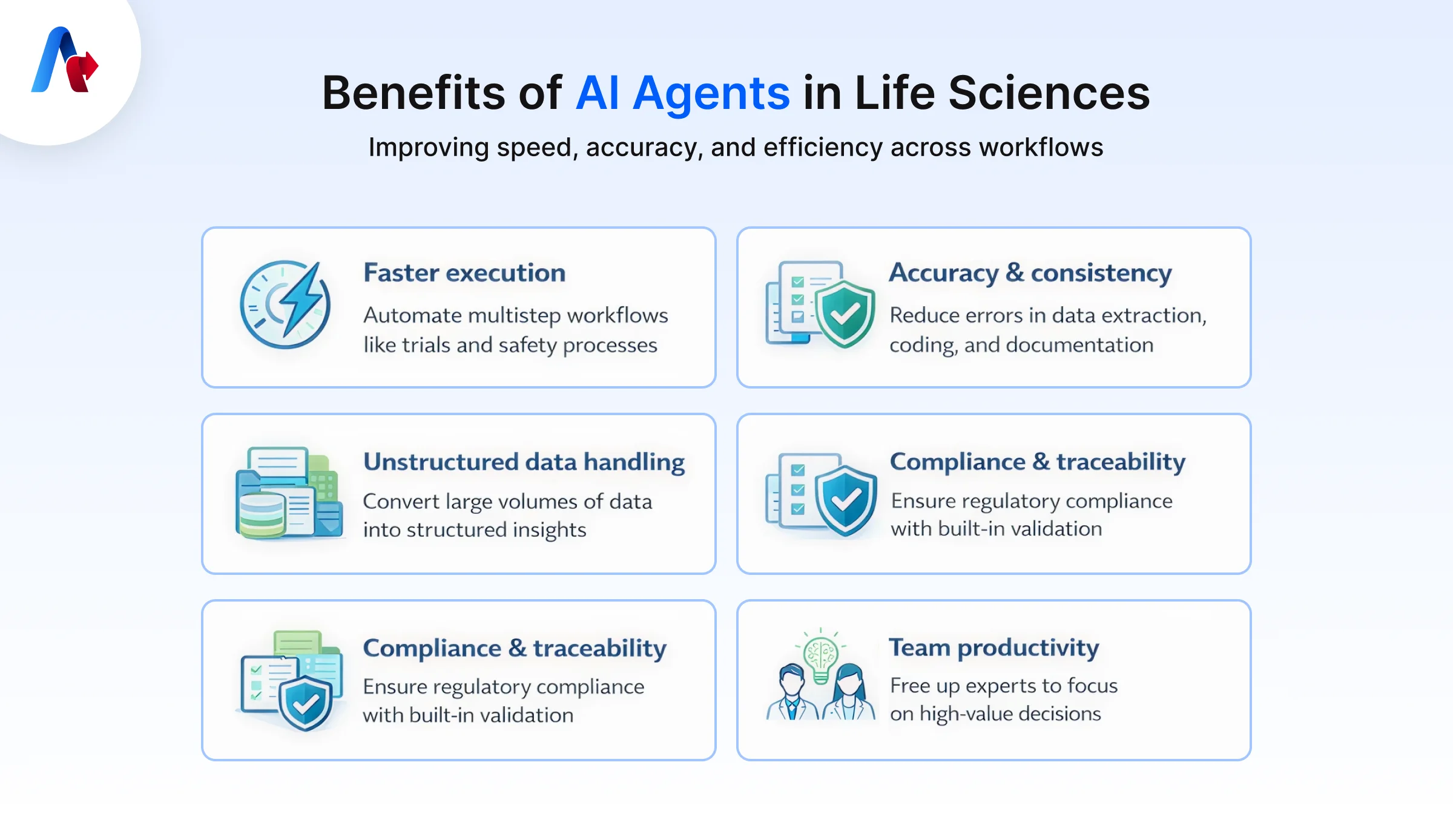
Now that we’ve seen how AI agents are used across the key workflows, let’s look at some core benefits that they bring to the overall life sciences function:
- Improved decision-making: Agents collect data from multiple sources to help teams make faster and more informed decisions.
- Continuous workflow visibility: It helps to track processes in real time and gives teams clear visibility into every step.
- Faster turnaround time: By reducing back-and-forth between teams, agents help complete tasks and workflows more quickly.
- Scalability without adding resources: AI agents can handle excessive workloads without needing team expansion.
- Streamlined cross-team collaboration: Agents act as a bridge between various systems and teams.
Challenges in Implementing AI Agents
While AI agents bring strong potential, implementing them in life sciences is not as easy since it involves technical, operational, and regulatory challenges that needs careful planning and execution.
- Data fragmentation and quality issues: Data is spread across systems and formats, making it hard to ensure consistency and accuracy.
- Regulatory compliance and validation: Lack of monitoring and auditing can lead to misuse of sensitive data and confidential experimental results.
- Integration with legacy systems: Older systems are not designed for AI, making integration and smooth workflow automation difficult.
- Risk of inaccuracies and hallucinations: AI outputs can sometimes be incorrect, which is very serious issue especially in drug discovery
- Change management and skill gaps: Teams needs proper training and alignment to effectively adopt and work with AI agents.
Struggling with implementing AI agents in your life sciences workflows?
Talk to our expertsHow to Implement AI Agents in Life Sciences
Implementing AI agents in life sciences is not just about deploying new tools; it requires a strategic, organisation-wide approach that triggers a shift in workflows, roles, and human-agent collaboration
- Align strategy and identify high-impact use cases: Operational leaders should focus on aligning AI potential with corporate strategy and set bold vision and goals across functions. They should start by identifying high-value work that can incorporate agents, like clinical trials or safety processes, and prioritize areas where these agents can significantly increase speed and efficiency.
- Invest in people and build scalable foundation: Implementing AI agents will trigger a change in organisational structure and many roles and processes will become hybrid. This will require employees to learn new skills and tools. Organisations should also invest in flexible interconnected networks of AI agents that enable their rapid development, deployment, and management.
- Establish robust change-management and set risk management: Organisation should implement change management strategy that includes role modeling by executives, a compelling change story, training, ongoing coaching, and incentives to encourage adoption. They should also establish strong governance rules to ensure compliance and ethical use of these agents and prevent unwanted consequences.
- Foster a culture of continuous learning: Leaders should establish a strategy for continuous learning, adoption, and safety as implementing AI is a long-term learning challenge for both employees and the company. Organisations should regularly monitor new advancements and capabilities to improve their own implementation
- Mobilize an agent factory: Organisation should also make a small, centralized group with leadership that can ensure impactful AI deployment. They can start by collaborating with domain leaders, contributing relevant technology expertise, monitoring impact and adoption metrics, and removing blockers to attain the full potential of agentic AI.
What will AI agents in life sciences look like by 2027?
The future of AI agents in life sciences is already moving towards a fully connected, intelligent system where in multiple agents work together across clinical, safety, and research workflows. Instead of supporting isolated tasks, agents will continuously coordinate, learn, and improve decision-making in real time.
“AI agents will fundamentally shift life sciences from fragmented, reactive workflows to connected, decision-driven systems—where humans focus on strategy and innovation, and agents handle execution at scale,” says Shahzad Khokhar, Global Head of Platforms at Accelirate.
We are already witnessing early signs of change with multi-agent systems, digital lab environments, and autonomous research workflows that can integrate data, simulate outcomes, and guide next steps almost instantly. As adoption grows, the focus will shift from automation to orchestration, that let agents interact across functions, adapt to new data continuously, and help organizations operate faster, smarter, and more competitively.
Start automating your life sciences workflows with AI agents today
Get StartedConclusion
AI agents are helping life sciences move from being isolated to more connected, end-to-end workflows across clinical trials, pharmacovigilance, and drug discovery. As adoption continues to grow, the focus will shift from just improving efficiency to fundamentally changing how decisions are made and how work is executed at scale.
Looking to integrate AI agents into your life sciences workflows? Let’s explore how
Accelirate can get you startedFAQs
AI agents are used in clinical trials to design protocols using past data, support site selection, generate study documents, and monitor trial data for issues, which helps the team reduce delays, improve coordination, and keep workflows more structured.
AI helps in pharmacovigilance by automating case intake, triage, medical coding, and narrative generation. It helps to monitor safety signals and makes the process faster and more consistent, making it easier to scale with proper oversight.
Traditional automation handles basic tasks like data extraction or coding, but agentic AI helps to manage end-to-end workflows by understanding context, adapting to new data, and making faster decisions.
Enterprises use centralized governance models to control agents' actions and create a network of connected agents that can coordinate tasks, monitor performance, and validate compliance.
Yes, but only when organizations have proper governance, audit trails, validation controls, and clear accountability for agents' actions.