



Quick Summary
AgentOps is the practice of managing, monitoring, and improving AI agents across their entire production lifecycle. It is what sits between deploying an agent and trusting it in a live environment, covering everything from observability and governance to cost control, evaluation, and human oversight. As enterprises move AI agents out of pilots and into workflows that touch real data and real decisions, AgentOps becomes the operational backbone that makes that shift safe and sustainable. This blog breaks down what AgentOps means in practice, why it matters now, and how enterprise teams can build a framework that actually holds up in production.
AI Agents Are Everywhere in Production. But, Who’s Really Running Them?
AI agents are no longer sitting inside innovation labs. They are being connected to CRMs, ERPs, ticketing systems, knowledge bases, finance workflows, healthcare processes, customer support queues, and internal APIs. That changes the conversation.
When an AI agent only answers a question, the risk is limited. But when an agent can read data, call tools, trigger workflows, update records, escalate cases, or make recommendations that affect real business outcomes, enterprises need a different operating model.
The question is no longer, Can we build AI agents? The better question is, Can we run them safely, reliably, and at scale? That is where AgentOps comes in.
What Is AgentOps?
AgentOps, short for agent operations, is the practice of managing the full lifecycle of AI agents after they move from prototype to real business use.
In simple terms, AgentOps helps enterprises answer:
What did the agent do?
Why did it do that?
Which tools did it call?
What data did it use?
Did it follow the policy?
Did it cost more than expected?
Did it complete the task correctly?
Should a human have reviewed this?
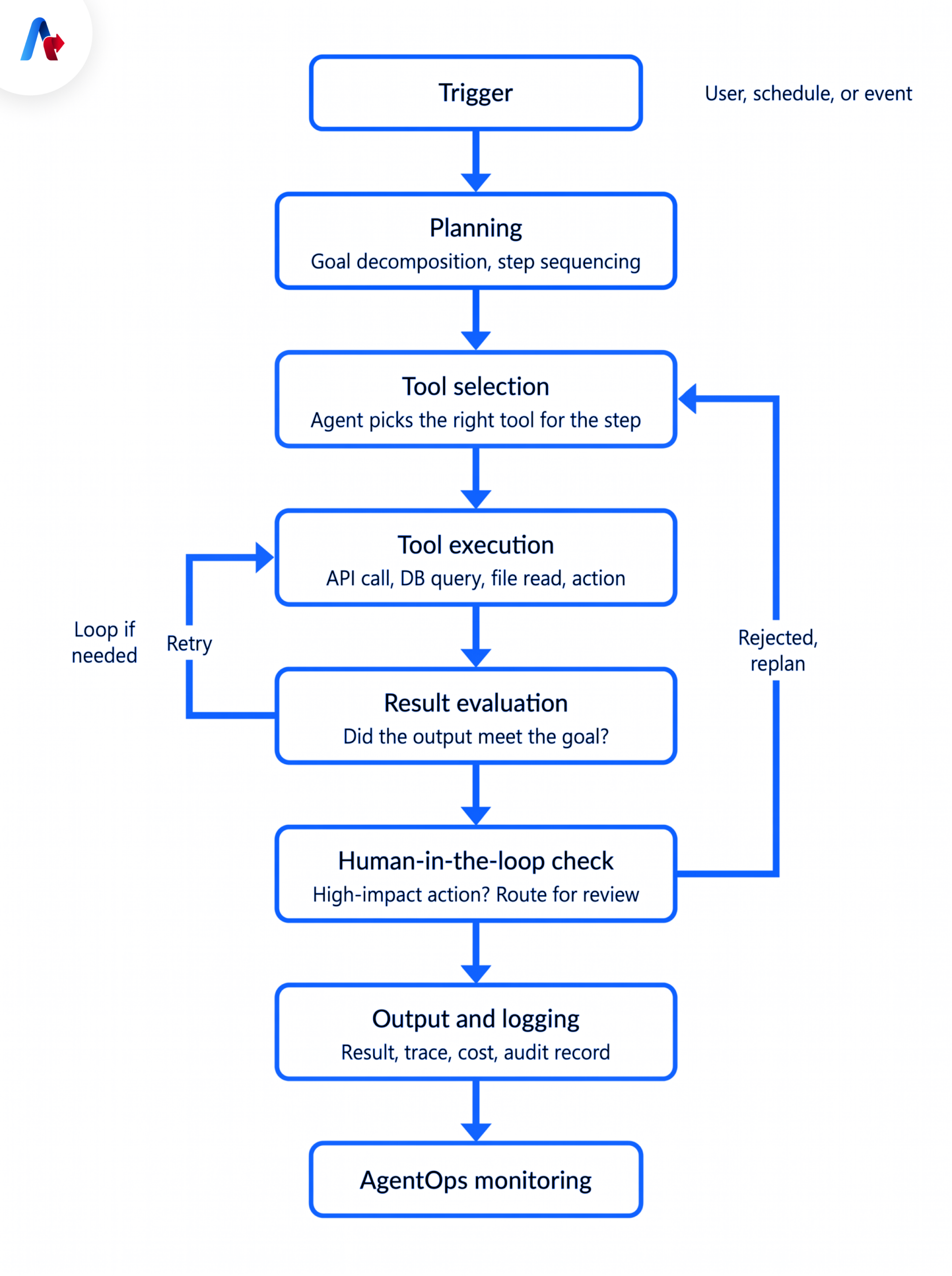
AgentOps brings structure to agentic systems. It combines ideas from DevOps, MLOps, AIOps, LLMOps, governance, observability, security, and automation operations. But it is designed for one specific challenge: AI agents that reason, act, use tools, and behave differently depending on context.
A traditional application follows fixed logic. An AI model predicts an output. An AI agent goes further. It decides what steps to take, which tools to use, when to ask for more context, when to retry, and when to escalate. That makes agents powerful. It also makes them operationally harder to control.
See how AgentOps works inside a real enterprise workflow
Request a live walkthrough
Why AgentOps Is Necessary & what makes AI agents operationally different?
Let’s take a simple example. A customer support agent receives an email from a customer asking about a billing issue. In this process the agent’s role is to read emails, check CRM, search the knowledge route, validate invoice data, create a support ticket, draft a response, and route the case to finance if the amount crosses a threshold.
This sounds awesome. But in production, many things can go wrong. The agent may use the wrong customer record. It may call an API too many times. It may use outdated policy content. It may expose sensitive data in a response. It may retry a failed tool call repeatedly and increase cost. It may close a ticket that needed human review.
Without AgentOps teams cannot just see final result, they can inspect the full journey. They can replay the session, review each tool call, check the agent’s reasoning path, measure latency, calculate cost, detect drift, and understand whether the agent followed the approved operating rules.
That level of visibility is not optional in enterprise environments. It is the difference between experimenting with AI and running AI as a business capability.
The Three Core Principles of AgentOps
AgentOps is built around three practical principles.
1. Observability
Every important agent action should be traceable. Teams need visibility into prompts, responses, tool calls, API usage, data sources, errors, retries, latency, and cost.
This is deeper than simple logging. AgentOps observability shows how the agent moved from request to result.
2. Governance
Enterprise agents today should have governance as their top priority. So, they need to define what each agent has access to, which set of approval protocol is to be followed, what is restricted data and what needs to be escalated to humans. These clear boundaries through governance turns agents from uncontrolled assistants into managed enterprise assets.
3. Continuous Improvement
An agent is not finished after deployment. Business rules change. Data changes. Models change. User behavior changes. Tool performance changes.
AgentOps creates a feedback loop where evaluation, monitoring, user feedback, and production telemetry help improve the agent over time.
The Ops Evolution: From DevOps to MLOps to AgentOps
Every major technology shift creates a new operational challenge. The pattern is consistent: a new capability emerges, teams adopt it at scale, and the existing tooling breaks down under the weight of production reality.
DevOps
DevOps addressed the friction between software development and infrastructure management. Before it, developers shipped code and threw it over the wall to ops teams who had no idea what was coming. The fix was cultural as much as technical: shared ownership, automated handoffs, and continuous delivery pipelines that made deployment a routine event rather than a quarterly ritual.
MLOps
MLOps followed when machine learning moved from research notebooks into production systems. Training a model is the easy part. Keeping it accurate six months later, after the world has changed and the data has drifted, is where things get complicated. Models need more than code versioning. They require data validation, experiment tracking, training pipelines, and ongoing monitoring for drift and degradation. MLOps built the operational discipline around that entire lifecycle.
AIOps
AIOps applied machine learning to infrastructure operations itself. Instead of building AI products, it used AI to run the infrastructure. Teams stopped drowning in alert noise and started getting signal, with anomaly detection, log correlation, and incident analysis happening at a scale no human team could match manually.
LLMOps
LLMOps emerged as enterprises stopped experimenting with large language models and started depending on them. That shift created an entirely new class of operational problems: prompt management across dozens of teams, evaluation frameworks for outputs that are fluent but not always accurate, retrieval architecture, safety filtering, and cost governance that existing frameworks were never designed to handle.
AgentOps
AgentOps is the next layer in this stack. Agent-based systems introduce a fundamentally different operational profile. These systems do not just process inputs and return outputs. They plan across multiple steps, select and invoke tools, delegate tasks to other agents, and make sequential decisions where an error at step two quietly poisons everything that follows. By the time something looks wrong on the surface, the failure is already three layers deep. AgentOps does not replace the disciplines that came before it. It inherits all of them and extends the stack for a class of systems that previous frameworks were never designed to handle.
AgentOps vs MLOps vs AIOps
| Discipline | Main Focus | What It Manages | Key Limitation |
|---|---|---|---|
| MLOps | Machine learning lifecycle | Models, datasets, training, deployment, monitoring | Not designed for autonomous tool-using agents |
| AIOps | IT operations intelligence | Logs, alerts, incidents, infrastructure signals | Focuses on IT systems, not agent behavior |
| LLMOps | LLM application lifecycle | Prompts, models, retrieval, evaluation, safety | Covers LLM apps, but not full agent execution |
| AgentOps | AI agent lifecycle | Agents, tools, actions, traces, governance, cost, human review | New and still evolving as a discipline |
Not sure which ops framework fits your AI setup?
Talk to an agentic AI specialist
What Is the Difference Between LLMOps and AgentOps?
LLMOps is mainly about managing applications powered by large language models. It helps teams handle prompts, model choices, retrieval quality, token usage, evaluations, and safety.
AgentOps includes those concerns, but goes further.
An AI agent may use an LLM, but it also performs actions. It may call a CRM API, trigger an RPA workflow, search a database, summarize a document, send a message, or hand work to another agent.
So LLMOps asks, Is the model response good?
AgentOps asks, Did the agent complete the task correctly, safely, and efficiently across every step? That is the real shift.
The AgentOps Framework: 6 Core Components Every Enterprise Needs
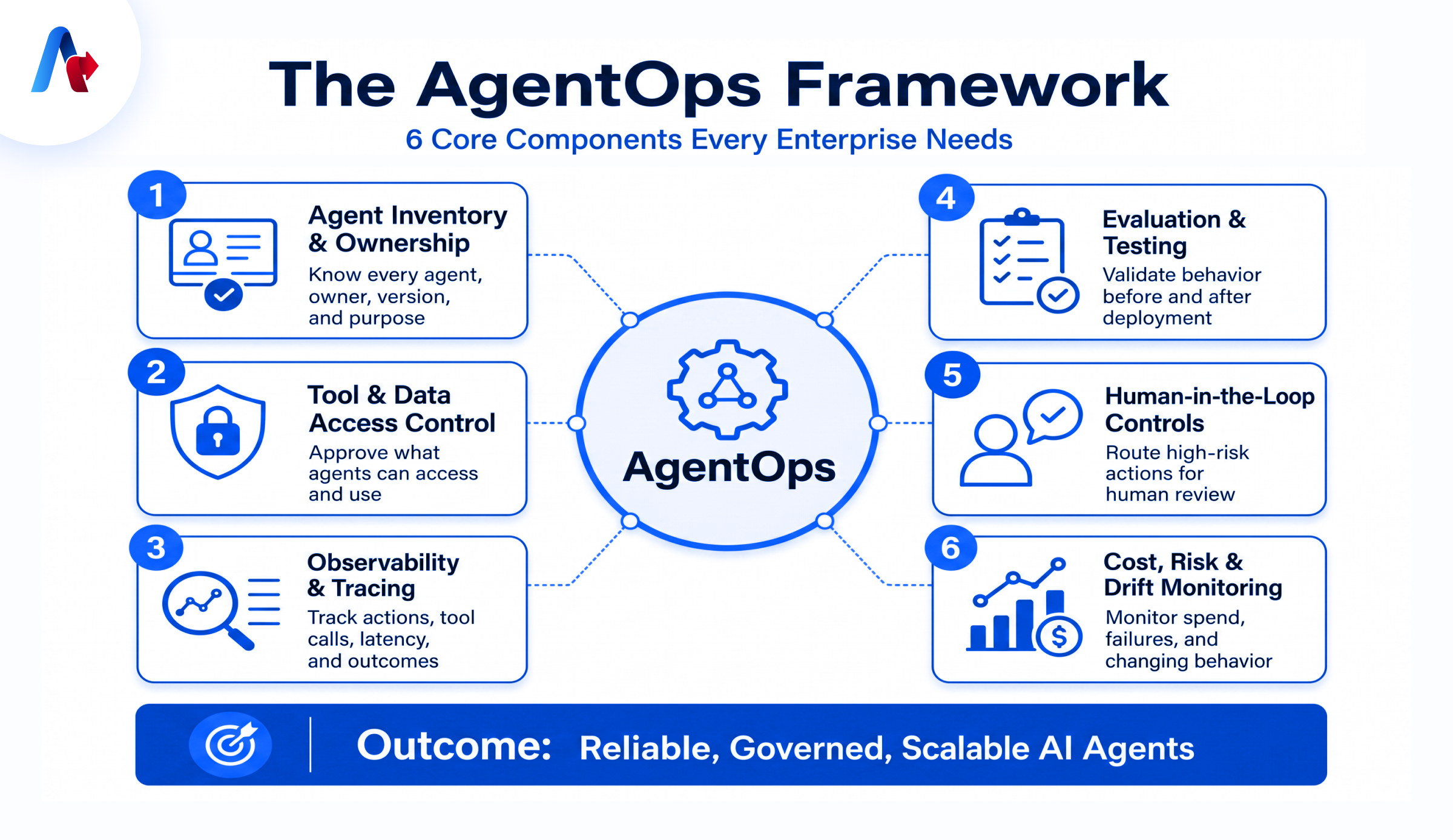
A production-ready AgentOps framework rests on six components. Get five right and cut corners on the sixth, and that is exactly where things will unravel.
1. Agent Inventory and Ownership
If you do not know what agents are running in your environment, you are already behind. Every agent in production needs a registered owner, a clear purpose, a version, an environment tag, a risk classification, and a tie to the business process it supports. When something goes wrong, and at some point, it will, you need to know who is responsible and what was at stake.
2. Tool and Data Access Control
Agents should only touch what they are supposed to touch. Every tool needs defined inputs, outputs, permissions, validation rules, and a proper audit trail. Wide open access is a shortcut that works fine in a sandbox and quietly becomes a serious problem the moment it hits production.
3. Observability and Tracing
The final output tells you very little. What actually matters is how the agent got there: every tool call, every intermediate step, the latency, the cost, the errors, and the decisions made along the way. In a multi-step workflow, failures rarely announce themselves. They hide in the middle of the chain.
4. Evaluation and Testing
An agent that reaches the right answer through a broken process is still a broken agent. Testing needs to cover the reasoning path, not just the result. Real-world scenarios, edge cases, and adversarial inputs should all be part of the evaluation before anything goes near production.
5. Human-in-the-Loop Controls
Automation should not be the default for every decision. In finance, healthcare, legal, HR, and regulated industries broadly, consequential actions need a human review step before execution. Autonomy is something you dial in deliberately, not something you hand over all at once.
6. Cost, Risk, and Drift Monitoring
Agent behavior changes over time, sometimes subtly, sometimes not. Costs accumulate in ways that are easy to miss until they are not. Continuous monitoring across cost per run, tool usage, retry rates, failure patterns, and policy violations is what separates teams that catch problems early from teams that explain them after the fact.
Why Every Enterprise Needs AgentOps in 2026
By 2026, many enterprises will have moved past AI agent pilots. The focus will shift from building isolated agents to operating agentic workflows across departments.
That is where the real complexity begins.
A single agent for summarizing documents is manageable. But a network of agents supporting revenue cycle, claims, IT service management, sales operations, finance, HR, and customer support creates a different level of operational risk.
Without AgentOps, enterprises face five common problems.
First, they lose visibility. Teams may not know which agents are active, what systems they access, or why they made a decision.
Second, costs become unpredictable. Agents can generate repeated model calls, oversized prompts, unnecessary retries, and excessive API usage.
Third, governance becomes weak. Without clear rules, agents may access sensitive data, take actions without approval, or behave outside policy.
Fourth, debugging becomes slow. When something goes wrong, teams need to reconstruct the full agent path manually.
Fifth, trust breaks down. Business users will not adopt agents if they cannot understand, challenge, or control what the agent is doing.
AgentOps solves these problems by creating a clear operating layer for agentic AI.
AgentOps in Action: Enterprise Use Cases by Industry
Healthcare
Revenue cycle management is one of the most process-heavy areas in healthcare. Denial classification, appeal preparation, prior authorization checks, claim follow-ups, coding support. Agents can handle a significant chunk of this work. But these workflows sit at the intersection of sensitive patient data, complex payer rules, and real financial consequences. One wrong move on an appeal or an authorization check is not just an operational error. It affects patient care and revenue at the same time.
AgentOps gives teams the traceability this environment demands. If an agent prepares an appeal for a denied claim, you should be able to see exactly which payer policy was referenced, which documents were pulled, what recommendation came out, and whether a human reviewed it before anything was submitted. That level of visibility is not optional in healthcare. It is the baseline.
Insurance
Claims intake, document review, fraud flagging, policy validation, customer communication. Agents are a natural fit for the volume and repetition that insurance operations involve. The risk is consistency. An agent that flags fraud differently on Tuesday than it did on Monday, with no clear reason why, is a liability in a domain where decisions get scrutinized and disputed.
AgentOps keeps decision paths visible, tracks how tools are being used across runs, and makes sure final claim decisions stay in human hands until there is enough confidence and evidence to change that.
How InsuranceOps Agents Deliver 70% Faster Prio Auth Healthcare Claims for a Leading Insurer?
Banking and Financial Services
KYC reviews, transaction investigations, loan document validation, onboarding workflows, compliance checks. Banking has no shortage of rule-heavy, high-stakes processes where agents can add real value. It also has regulators who will ask pointed questions about how a decision was made and what data was used to make it.
AgentOps answers those questions before they become a problem. What data was accessed, which rules were applied, why a case was escalated and to whom. All of it needs to be on record, not reconstructed after the fact.
Retail
Retail moves fast and the consequences of getting it wrong show up quickly. Inventory gaps, misfired promotions, supply chain delays triggered by stale data. Agents can monitor stock levels, generate pricing and promotion recommendations, handle customer service queues, and kick off supply chain actions. The challenge is that retail data changes constantly and an agent working off outdated information can confidently do the wrong thing.
AgentOps controls what tools agents can access, flags when inputs look stale or inconsistent, manages costs across high volume runs, and keeps operational actions from going through without proper validation.
How RetailOps Cut Inventory Lag by 90%, Save $3.8M per Quarter in Losses for a Global Retailer?
IT and Shared Services
IT teams deal with a constant stream of tickets, incidents, and service requests. Agents can triage, diagnose, suggest fixes, trigger automations, and route what they cannot resolve. Done well, this reduces workload. Done poorly, it adds another layer of noise on top of the noise that already exists.
AgentOps gives IT teams the visibility to tell the difference. Failure rates by agent and tool, session replays for incidents that went sideways, error detection across integrations, and clear signals for when an agent is making the queue longer rather than shorter.
Our industry has its own compliance risks. Let's map them together
Book a 30-minute consultation
AgentOps Best Practices: How to Implement It Right From Day One
1. Start With a Clear Agent Charter
Every agent should have a defined business purpose. What is it responsible for? What is it not allowed to do? Who owns it? What systems can it access? Which actions need approval?
This should be decided before development, not after deployment.
2. Design Guardrails Before Connecting Live Systems
Do not connect an agent to enterprise tools without boundaries. Define allowed tools, input rules, output validation, retry limits, timeout rules, escalation paths, and restricted actions.
The safest agent is not the one that can do everything. It is the one that can do the right things within controlled boundaries.
3. Test the Full Path, Not Just the Final Output
Many teams test whether the final answer looks correct. That is not enough.
AgentOps testing should validate the path: which tool was selected, what data was retrieved, whether the agent followed policy, how it handled missing information, and whether it escalated correctly.
4. Build Human Review Into the Workflow
Human-in-the-loop should not be treated as a fallback only when the agent fails. It should be part of the design for high-risk actions.
Approvals, reviews, exception handling, and override options create confidence for business users and risk teams.
5. Monitor Cost Per Agent and Per Run
Agent cost is not just model cost. It includes model calls, token usage, tool calls, retries, orchestration time, API calls, storage, and human review effort.
Track cost at the agent level so teams can identify inefficient workflows early.
6. Create Continuous Evaluation Loops
Agents should be evaluated before and after deployment. Use production traces, user feedback, exception data, and business outcomes to improve prompts, tools, policies, memory, and orchestration logic.
7. Treat Agents as Enterprise Assets
Agents should have owners, versions, permissions, release notes, audit logs, and lifecycle status. If an agent is connected to real business systems, it should be governed like any other enterprise application.
How Accelirate Builds AgentOps into Every Agentic Deployment
At Accelirate, AgentOps is not treated as an afterthought. It is built into the way agentic solutions are designed, deployed, and scaled.
Our approach starts with process understanding. Before building an agent, we map the workflow, decision points, systems involved, exceptions, compliance requirements, and human roles. This helps define where AI reasoning should be used and where deterministic automation should remain in control.
Then we design the operating model around the agent. That includes clear role definition, tool access, data boundaries, escalation rules, logging, evaluation criteria, approval flows, and performance metrics.
For enterprise environments, Accelirate focuses on combining agentic AI with proven automation foundations. Agents can interpret, reason, summarize, classify, and decide the next best step. Automation workflows can execute repeatable actions with consistency. Human users can approve, correct, or intervene where judgment is required. This balance matters.
A well-designed agentic system should not be a black box. It should be observable, governed, measurable, and explainable. Accelirate also helps enterprises create reusable AgentOps patterns. These may include standard templates for agent evaluation, exception handling, tool governance, audit logging, cost monitoring, human approval, and production support. The goal is not just to launch one agent. The goal is to create a repeatable model for scaling agentic automation across the enterprise.
Moving From Agent Experiments to AgentOps-Ready Deployments
Many organizations are already experimenting with AI agents. The challenge is turning those experiments into production systems that IT, security, compliance, and business teams can trust.
Accelirate helps enterprises design, build, and operationalize AI agents with the right AgentOps foundation from day one.
This includes:
- Agent opportunity assessment
- Agentic workflow design
- Tool and system integration
- Governance and guardrail setup
- Human-in-the-loop workflow design
- Testing and evaluation frameworks
- Production monitoring and support
- Cost and performance optimization
- Enterprise rollout planning
Whether the use case is healthcare revenue cycle, insurance claims, IT operations, finance operations, customer support, or shared services, the operating model matters as much as the agent itself.
AI agents create value when they can act. AgentOps ensures they act safely.
AgentOps is becoming a required discipline for enterprises adopting agentic AI
DevOps helped teams ship software better. MLOps helped teams manage machine learning models. LLMOps helped teams manage large language model applications. AgentOps now helps teams run autonomous, tool-using AI agents inside real business processes. The core idea is simple. If an agent can act, the enterprise must be able to observe it, govern it, test it, improve it, and control it. That is how AI agents move from promising pilots to trusted production systems.
AI agents create value when they can act. AgentOps ensures they act safely.
Let Accelirate build yours
FAQs
MLOps manages machine learning models. AgentOps manages something more complex: systems that reason, pick tools, take actions, and operate across multi-step workflows. Same operational instinct, very different problem.
Agent inventory and ownership, tool and data access control, observability and tracing, testing and evaluation, human-in-the-loop controls, and continuous monitoring for cost, drift, and policy compliance.
AIOps handles IT operations, infrastructure monitoring, and incident detection. AgentOps is what you need when AI agents are operating inside business workflows, touching enterprise data, and making decisions that have real consequences.
The ecosystem covers observability, tracing, evaluation, orchestration, and governance. The right stack depends on how your agents are built, what they connect to, and what your compliance requirements look like.
It creates a complete record of what agents did, what data they accessed, which tools they called, and where humans were involved. In regulated industries, that audit trail is what makes agent deployment defensible.
An ops agent is an AI agent doing operational work, like ticket triage or incident response. AgentOps is the discipline that manages, monitors, and governs all agents in production, including those.