



Quick Summary
LLM agent orchestration is the system that coordinates multiple AI agents to execute complex, multi-step workflows efficiently. It breaks tasks into smaller actions, assigns them to specialized agents, and combines outputs for accurate results. Using architectures like sequential, parallel, hierarchical, and event-driven models, it enables scalable enterprise automation. Popular frameworks such as LangChain, AutoGen, and CrewAI support this approach. LLM orchestration is widely used in IT, healthcare, finance, and HR to improve efficiency, reliability, and decision-making across business operations.
Enterprise AI has moved well past the stage of single models answering single questions. Today, the organizations driving real operational impact are the ones that have figured out how to get multiple AI agents working together, each handling a different function, sharing outputs, and completing end-to-end workflows without falling apart midway. But here is the question most teams do not ask early enough: what actually holds all of that together?
The answer is orchestration. Research suggests that AI deployments fail not because of model limitations, but because of how poorly the surrounding system is designed. Over 60% of enterprise AI initiatives that stall does so due to inadequate coordination architecture, not the underlying model itself. So, if an organization is building AI systems that need to operate at scale across real business workflows, the conversation has to begin with orchestration.
What Is LLM Agent Orchestration?
LLM Agent Orchestration is the process of coordinating multiple AI Agents, which are powered by Large Language Models (LLM) in order to perform complex tasks within its AI system. It works like an operating system for the AI workforce. It involves structuring workflows where AI Agents acts as the core decision maker or orchestrating their operations based on insight, platform context and integrated external data. It involves multiple steps along with multiple AI tools. Hence, the process needs the orchestration.
The orchestration layer is responsible for deciding which agent runs, in what sequence, what inputs it receives, and how its outputs are used together; they become an ecosystem.
Why Orchestration Is Essential for AI Agents
Without this orchestration layer, even the best AI agents struggle to maintain the minute their workflows get complex. In these processes, we have branching, looping, and overlapping pulls from multiple sources. There isn’t a single model that can handle all these scenarios in a clean manner. Orchestration provides your agents with structure, reliability, and visibility, allowing them to work in coordination instead of falling apart the minute something unexpected happens.
Confused about where to start with agent orchestration?
Get a personalized roadmap tailored to your enterprise workflowsLLM Orchestration vs Single-Agent Architectures
LLM orchestration and Single-Agent Architectures enable different purposes. Understanding where one ends and the other begins is crucial before developing any enterprise AI system.
| Factor | Single-Agent Architecture | LLM Orchestration |
|---|---|---|
| Task Complexity | Limited to single-step execution | Handles complex, multi-step workflows |
| Specialization | Generalist with no role distinction | Purpose-built agents per function |
| Scalability | Performance degrades at scale | Designed for concurrent enterprise workloads |
| Failure Handling | Single point of failure | Built-in retry logic and fallback mechanisms |
| Enterprise Fit | Suitable for proof of concept | Production-ready for operational deployment |
The LLM orchestration is not just building upon the single-agent setup. Instead, it replaces the entire architecture and adds a coordination layer to allow the AI systems to work at scale.
Why Multi-Agent LLM Orchestration Is Becoming Critical for Enterprise AI
Enterprise workflows are already complex fundamentally, which often involves different systems such as CRM systems, knowledge management systems, ticketing systems, and billing systems. Managing the dynamic relationship between the workflows through a single AI system would cause performance bottlenecks, a lack of transparency, and the possibility of errors. The above scenario is where the use of multi-agent LLM Orchestration can provide a more structured approach by breaking the workflow into smaller tasks and providing different agents for the workflow and the orchestration system for controlling the interactions between the agents.
However, the performance benefits provided by the orchestration system are only one side of the impact. Orchestration is also a key factor for governance and compliance. A high level of visibility is required for the decision-making process and the execution of access control and human involvement. Orchestration systems provide this capability for logging and controlling the performance of tasks. In the financial services, healthcare, and insurance industries, this capability is a key factor for regulatory compliance and the responsible use of AI technologies.
How LLM Agent Orchestration Works
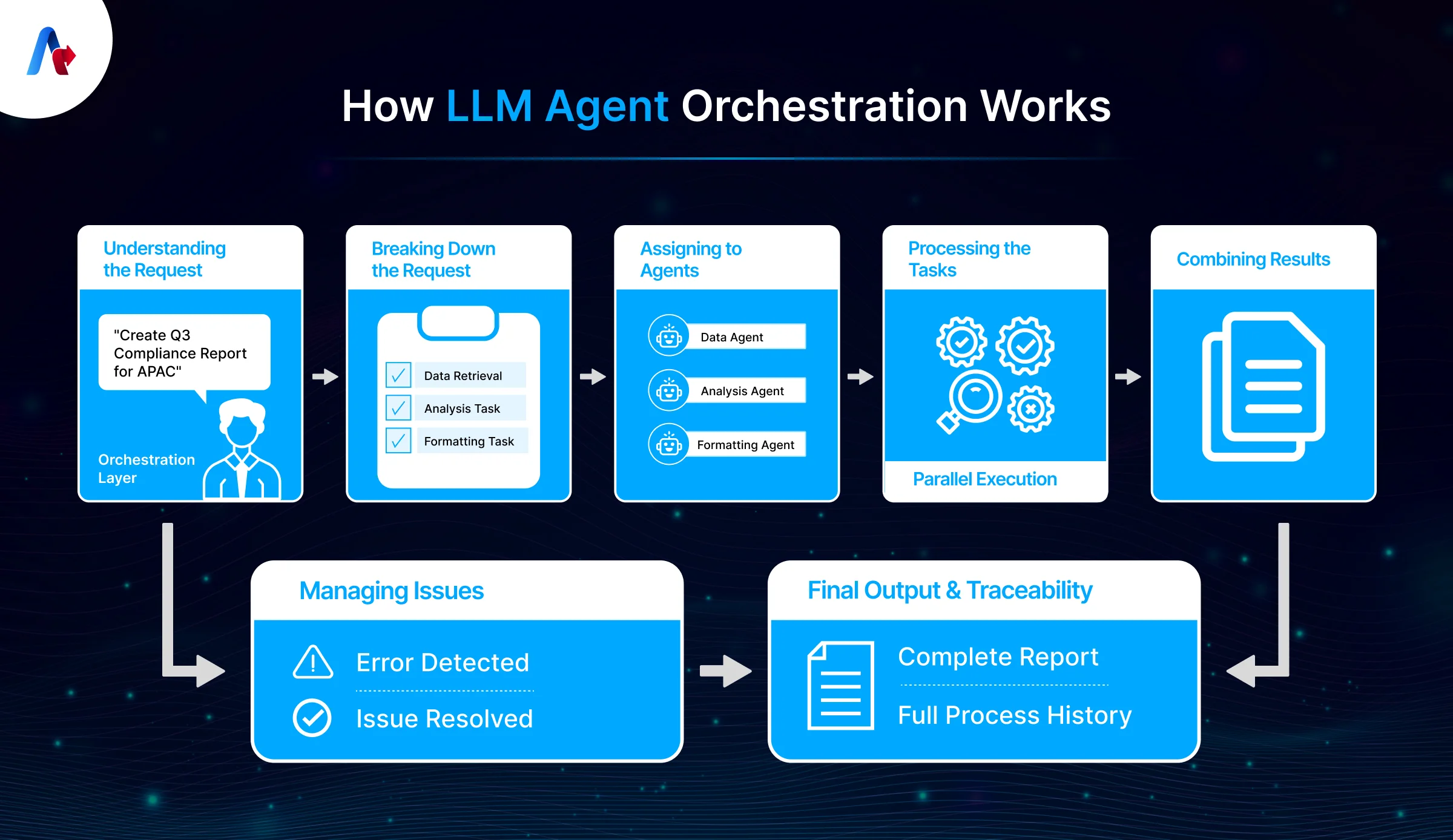
The orchestration process is typically triggered by a goal, which means that a user request is made to a system or by a user, and then that request is broken down into a series of tasks. The orchestrator then identifies suitable agents for each task and how to execute them parallelly.
- Understanding the Request - It begins with a business need to perform a task, for example, creating a Q3 compliance report for APAC entities. The request is interpreted by the orchestration layer.
- Breaking Down the Request - Instead of dealing with the entire task at one go, the request is broken down into smaller tasks. Tasks are assigned to specific agents, such as one for data retrieval and another for formatting.
- Getting the Right Inputs - Each agent is given the necessary tools and information required to perform the task.
- Bringing It All Together - Once all agents have completed their work, the orchestrator combines the results in a structured output. This process could be done in a step-by-step method or through a combination of parallel outputs.
- Managing Issues – In the process, if there are any issues, the orchestrator will address them, and the process will continue smoothly.
- Final Output and Traceability - This output is sent in the appropriate format, along with a complete history of how the output was produced.
What makes this architecture particularly effective is that the individual agents can use different tools, different systems, and even different underlying models. The orchestrator does not control the inner workings of the individual agents. It controls the overall structure of the process.
Core Components of an LLM Orchestration System
Every strong LLM agent orchestration system is built on a consistent set of foundational modules. Understanding what each one does is important for analysing or designing an orchestration architecture.
The Orchestrator
The role of the orchestrator is to make decisions. It understands the goal, creates a plan, and allocates tasks to the relevant agents. In this case, it could be a dedicated orchestration module or a reasoning LLM.
AI Agents
Agents are the execution units of the system. An agent is typically dedicated to a single capability. It could be a web crawler, a code runner, or a data crawler. The agent receives an input, uses the tools at its removal, and sends output to the orchestrator.
Memory
Agents need to be context-aware to make sense of their tasks. The memory module has two aspects. The first is short-term memory, which is usually session-based or conversation-based. The second is long-term memory, which uses a vector database to allow knowledge extraction.
Tools And Integrations
The value of an agent is also dependent on the tools it can use. Tools can range from using RESTful APIs, databases, browser automation, file systems, or even using platform-specific tools like ServiceNow, SAP, or Salesforce.
Routing And Planning Logic
It is responsible for defining how the next step is calculated for the orchestrator. This can range from fixed routing logic, using a dynamic model, or even using an LLM for decision-making based on the best possible route based on live data and intermediate results.
Observability And Logging
Operational visibility is critical for any business. A successful orchestration system should also have good observability and logging, which helps in diagnosing issues, performance metrics, and even compliance.
LLM Agent Orchestration Architecture
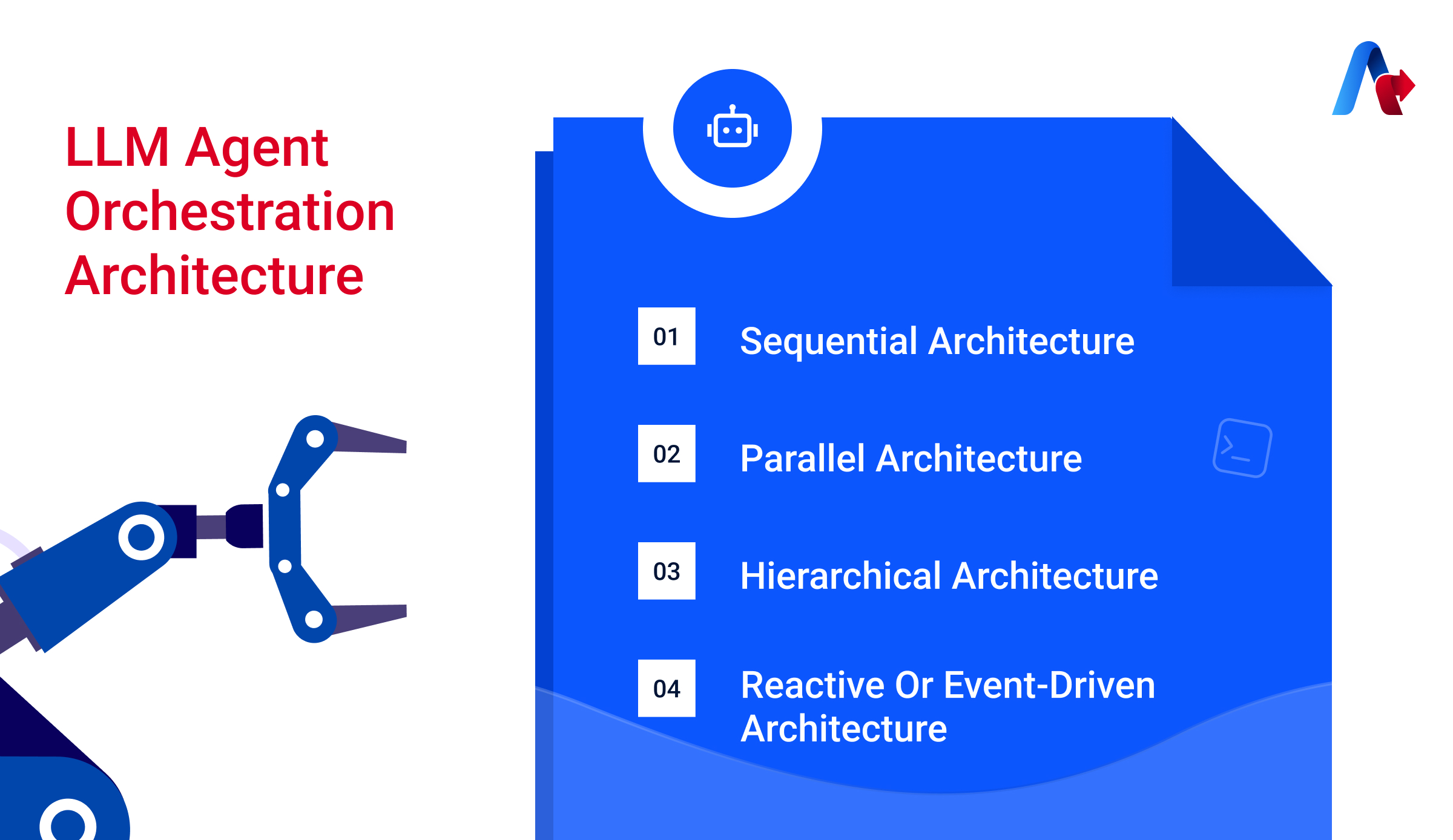
No particular architecture is appropriate for all enterprise use cases, and most production systems will use one of the four established patterns, or a combination of them, depending on the particular workflow.
Sequential Architecture
In this architecture, agents operate one after the other in a linear sequence. The output of one agent is the input for the next agent. This architecture is easy to implement and is linear in nature. It can be effectively used for document processing and other linear workflows.
Parallel Architecture
Agents can operate parallelly and their respective outputs are combined by the orchestrator. This can be effectively used for workflows where tasks are independent of each other. Agents can perform tasks like data lookups simultaneously.
Hierarchical Architecture
Primary orchestrator is present in this one, which can have a number of sub-agents. Each sub-agent can further have a number of agents under it. This is the most powerful architecture for LLM agent orchestration. It can be effectively used for complex workflows where different segments of the workflow need different types of coordination.
Reactive Or Event-Driven Architecture
Agents respond to system events or triggers rather than following a predefined sequence. This pattern is well-suited to monitoring, incident response, and customer-facing automation scenarios where workflow inputs are unpredictable and immediate adaptability is essential.
In most of the use cases, the execution of the enterprise ultimately follows the hybrid approach, where hierarchical orchestration is deployed at the system level, along with the use of sequential or parallel patterns at the level of individual workflow segments, depending on the process requirements of the tasks involved.
Key Features of LLM Agent Orchestration Platforms
Not all LLM agent orchestration platforms are created at the same standard. When analysing a platform for enterprise deployment, the following capabilities are the ones that decide whether a system can support production-level operations.
- Multi-agent coordination with well-defined role boundaries and structured handover logic between agents
- Complete tool utilization and API integration support for various enterprise systems and data sources
- Memory management for both short-term session context and long-term knowledge extraction
- Human-in-the-loop capabilities for sensitive critical decision points
- Complete transparency, shared monitoring, and structured audit logging for compliance purposes
- Strong error handling capabilities with structured retry logic and fallback execution paths
If the platform can't deliver the majority of these functions prebuilt, then important custom engineering will be required to overcome the weakness of the platform. At scale, this cost grows drastically and represents a significant risk to the deployment of the solution as well as the consistency of the solution itself.
Best LLM Orchestration Frameworks for Building AI Agents
The ecosystem of multi-agent LLM orchestration frameworks has grown significantly over the last two years. The ones that see the most wide-ranging enterprise execution are the following, each having different strengths depending on the use case and environment.
LangChain
It is one of the most popular frameworks in the space, offering a range of components for chaining calls to LLMs, integrating external tools, and managing agent memory. The abstractions it offers are broad-ranging, making it a beneficial option for teams that are developing orchestrated workflows. LangGraph is an extension of LangChain that expands its capabilities to include cyclical multi-agent LLM orchestration patterns and conditional execution logic, making it a good option for developing enterprise-grade workflows that have dynamic decision-making capabilities.
Pricing - Open-source and free. LangGraph cloud plans start at $39/month
AutoGen
It is a framework developed by Microsoft that is specifically designed for multi-agent LLM orchestration. It allows for the development of a network of agents that interact with one another, validate each other's output, and work collaboratively on complex tasks. It is particularly useful for tasks that involve code generation and dialogue between agents.
Pricing - Open-source and free. No paid cloud tiers currently available
CrewAI
This takes a role-based approach to designing an orchestration framework for multi-agent LLMs, where agents are based on their function like Researcher, Analyst, Reviewer. This is an easy-to-understand model that allows for building agentic workflows with moderately little overhead compared to lower-level frameworks.
Pricing - Free open-source library. Professional plan starts at $25/month
LlamaIndex
LlamaIndex is a well-known model for its capabilities in retrieval-supported generation and has adapted to accommodate agentic orchestration. It is particularly suitable for workflows where agents need to engage in tasks such as intensive document understanding, structured data ingestion, and knowledge base retrieval.
Pricing - Free open-source library. Starter-hosted platform from $50/month
Semantic Kernel
This is a framework developed by Microsoft that is built with enterprise deployment in mind. It integrates natively with Azure products and services and supports a plugin-based model for tools. It also offers structured patterns for building AI agents to be used within existing enterprise software stacks.
Pricing - Free and open-source. Available as part of Azure AI services with enterprise pricing on request
Future Trends in Multi-Agent LLM Orchestration
The multi-agent LLM orchestration space is growing at a rapid pace. The following developments are shaping how enterprise AI systems will be designed and operated in the near term.
Agentic AI becoming the default enterprise deployment model
Single-model deployment is now considered a transitional approach. In the near future, multi-agent LLM orchestration is likely to be the standard deployment model for enterprise AI.
Deeper native integration with enterprise platforms
LLM orchestration tools are likely to become more native to enterprise platforms such as ERP systems, ITSM tools, and CRM tools, reducing the integration effort required to connect agents to core business systems.
Maturation of observability tooling
With the increasing complication of orchestration tools, the ability to understand the behavior of agents and debug decision logic and other issues is likely to become a key differentiator for enterprises platforms.
Standardized agent communication protocols
Connectivity between agents built on different frameworks remains a significant technical challenge. Emerging standards such as the Model Context Protocol (MCP) are beginning to establish the foundation for cross-framework agent communication.
More sophisticated human-AI collaboration models
The future of LLM agent orchestration extends beyond agents communicating with each other. It contains systems that recognize when human judgment is required, surface relevant context at the right moment, and execute continuous handoffs between automated and human-driven processes.
Orchestration Is Where Enterprise AI Gets Real
LLM agent orchestration is the architectural foundation that transforms AI from an isolated capability into an enterprise-wide operational asset. It is the difference between a collection of intelligent tools and a coordinated system capable of executing complex business processes reliably and at scale.
The frameworks, patterns, and architectural standards that define this space are maturing rapidly. However, deploying orchestrated AI effectively in an enterprise context demands more than framework selection. It requires deep workflow expertise, rigorous system design, and a clear-eyed understanding of how these systems perform under real operational conditions.
If you are evaluating where to begin, the most productive starting point is a structured assessment of which workflows stand to benefit most from agentic automation. That is precisely where Accelirate can add value. Explore Accelirate's agentic AI capabilities to understand what is achievable for your organization.
FAQs
The four primary patterns are sequential, parallel, hierarchical, and event driven. Most enterprise deployments combine these within a single workflow, applying each based on the operational requirements of that stage.
Enterprise teams use LLM orchestration to automate complex, multi-step workflows across systems like CRMs, ERPs, and ITSM platforms. It is most impactful in environments where workflows require coordinated decision-making across multiple data sources, including IT operations, finance, healthcare, and customer service.
Traditional AI workflow automation follows fixed, pre-programmed logic. LLM orchestration introduces dynamic reasoning, allowing agents to assess context, adapt to unanticipated conditions, and determine the most appropriate next action in real time.
LangChain is a strong starting point, especially with LangGraph for stateful and cyclical workflow design. For enterprise-scale deployments, most teams augment it with additional tooling for observability, security, and deeper system integration.
Proven use cases include IT incident response, healthcare prior authorization, financial compliance monitoring, and employee onboarding. These are multi-step, multi-system workflows where orchestrated agent architectures deliver measurable gains in speed, accuracy, and scalability.