



Quick Summary
Many companies are moving away from bots and copilots to AI agents as AI agents can handle complex things. Bots are good at doing the tasks repeatedly. Copilots are good at helping people work faster. Both bots and copilots have trouble with complicated situations that change a lot. Organizations are making this change as AI agents are more helpful, than bots and copilots. This migration requires careful planning, including clear use cases, data quality, and security considerations. The shift from bots to AI agents marks a move from task automation to true agentic intelligence, transforming how businesses operate and deliver value.
Most enterprises in 2026 are transitioning from bots and copilots to AI agents, but this change didn’t happen overnight. Enterprises began to hit their limits. Bots helped enterprises complete repetitive tasks, while copilots focused on increasing speed. Both were useful. But as operations got more connected, data got more dynamic, and expectations rose, those tools only started to solve some of the problems. Businesses don't need more help right now. They need automation that can plan work, change course in the middle of it, and take responsibility for the results. That's what is making enterprises migrate to AI agents.
Bots vs Copilots vs Full AI Agents
The main reason people get confused about bots, copilots, and AI agents is that they think they are all the same things. No, they're not. Each one is at a different level of automation maturity and solves a different type of problem.
Bots were made to reliably follow a set of steps. Copilots came about to help people make decisions more quickly and better. AI agents go even further by being responsible for results, not just actions or suggestions. This difference becomes very important as businesses grow across systems, regions, and rules. Choosing the wrong model doesn't just make automation less valuable; it also causes problems, extra work, and a need for human help.
For any dedicated enterprise AI strategy, especially for companies that are comparing AI agents and bots in real-world production environments, it is important to know where bots stop, where copilots help, and where agents take over.
| Dimension | Bots | Copilots | Full AI Agents |
|---|---|---|---|
| Core purpose | Execute predefined tasks | Assist human decision-making | Own and complete objectives |
| Decision-making | None | Human-led | Agent-led |
| Adaptability | Low | Moderate | High |
| Context awareness | Minimal | Contextual suggestions | Deep, multi-system context |
| Workflow scope | Single-step or linear | Guided, human-driven | End-to-end, multi-step |
| Exception handling | Fails or stops | Flags and escalates | Replans and continues |
| Cross-system orchestration | Fragile | Partial | Native and resilient |
| Learning over time | No | Limited | Continuous within guardrails |
| Best suited for | Repetitive, stable tasks | Knowledge work and guidance | Complex, dynamic enterprise workflows |
Not sure if bots or AI agents fit your current workflows?
Get expert guidanceWhen Bots and Copilots Are No Longer Enough (Enterprise Use Cases)
Most businesses don't know that bots and copilots have reached their limits until they start to slow teams down instead of speeding them up. What used to make things easier is now making them harder. More exceptions are made. Intervention by people quietly becomes the norm again. This usually happens when business processes get too big for simple help and linear execution.
In large enterprises, work doesn't usually stay in one system. A single process can involve CRM, ERP, data platforms, external portals, and compliance layers. Bots can do things inside a system. Users can be guided through those steps by copilots. But neither can be held responsible for what happens when the workflow breaks, changes, or needs to be judged in the middle of it. Here are some enterprise use cases when bots and copilots are no longer enough:
1. Multi-System, End-to-End Workflows
Think about order-to-cash, claims processing, or getting permission ahead of time. These processes involve many applications and depend on timing, the quality of the data, and conditional decisions. Bots take care of single tasks. Copilots tell you what to do next. Both stop when a dependency fails or the data changes in the middle of the process. AI agents keep going by thinking about the situation, picking the next step, and checking that the results are the same across all systems.
2. Exception-Heavy Operations
Industries including healthcare, insurance, banking, and logistics often deal with unpredictable and exceptional cases. Here, bots stop functioning when inputs don’t follow expected patterns, and copilots escalate problems to people. AI agents, however, step in as a saviour, transforming workflows by making new plans without the need for constant human oversight.
3. Asynchronous and Long-Running Tasks
A lot of enterprise workflows take more than one session to get to the end goal. To keep an eye on changes in eligibility, shipment delays, unpaid invoices, or compliance triggers, you need to be constantly watching. Triggers make bots wait. Copilots wait for signals. AI agents keep an eye on things, act when certain conditions are met, and close loops on their own.
4. Scaling Without Linear Headcount Growth
People are more productive when they have copilots. Bots make it easier to do tasks. But neither of these things changes how work scales. AI agents do. Agents let businesses increased throughput without having to hire more people at the same rate because they own outcomes instead of steps.
These scenarios are where enterprises stop asking how to make bots or copilots better and start looking at ai agents and bots from a strategic point of view. The change isn't about getting rid of the automation that is already there. It's about adding an agentic layer that can manage work from start to finish.
More enterprises are using platforms like Agentforce because they make this change possible without having to rebuild, making it easier for businesses to move their AI agents.
Migration Checklist: From Bots and Copilots to AI Agents with Agentforce
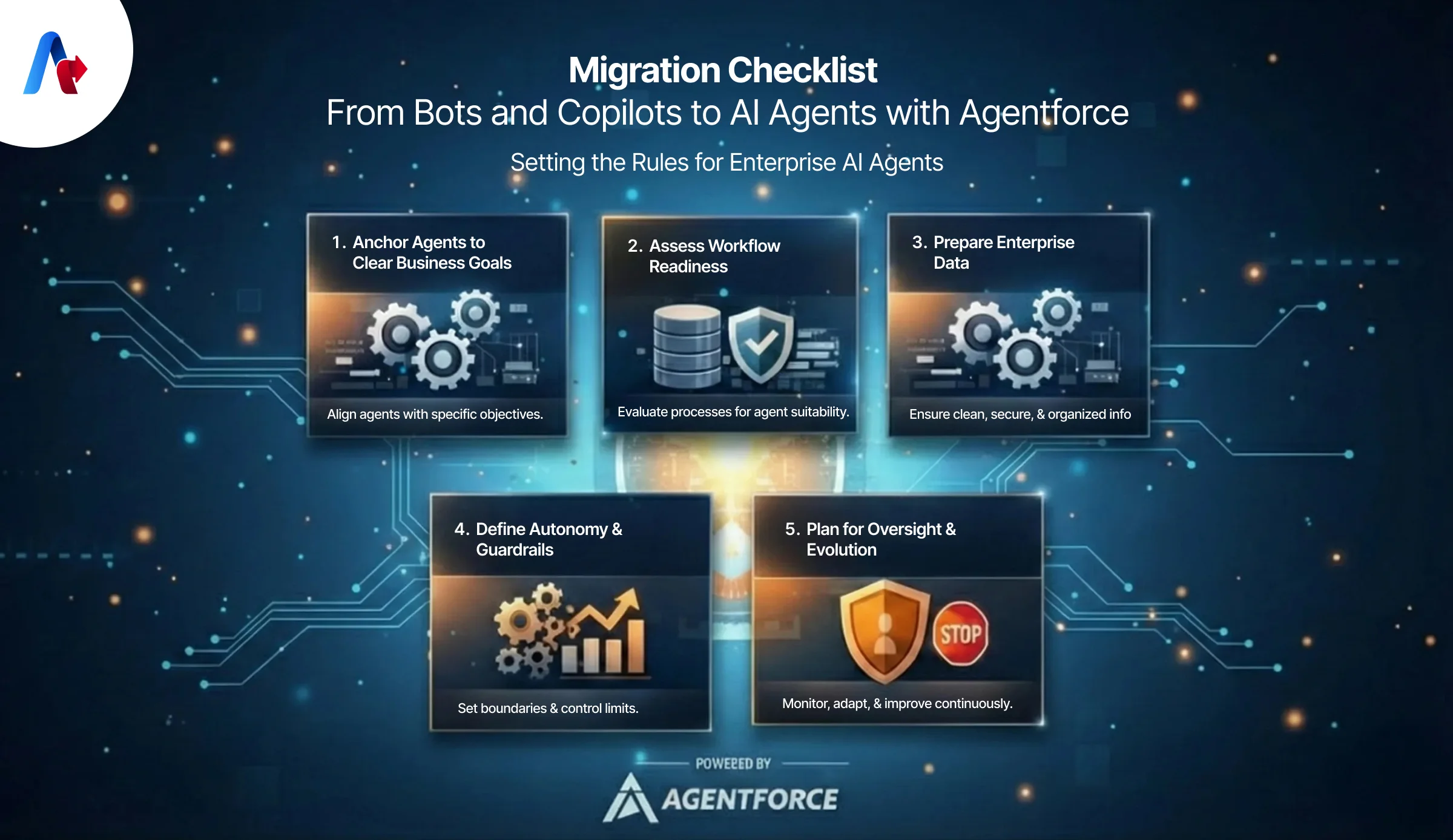
Enterprise AI agent migration never fails because the technology is not good enough. When companies give people freedom before they have the systems, in place it does not work. This is where Agentforce comes in it makes it possible for Enterprise AI agents to work properly. The thing is, how well these Enterprise AI agents work depends on how carefully they are designed and managed and scaled. Enterprise AI agents need to be done so they can do what they are supposed to do.
Enterprises need to decide on some rules before they start using full AI agents instead of bots and copilots. This is important for businesses to do before they make the switch to Artificial Intelligence agents. Businesses should all be on the page and agree on these rules, for Artificial Intelligence agents.
1. Anchor Agents to Clear Business Goals
AI agents should be responsible for the results they get not the things they do. When you use Agentforce the agent must have an idea of what it is supposed to do for the business-like taking care of a service case all the way through or getting a lead ready, to a certain point. It is hard to get things done when the goals are not clear like trying to make things more efficient or work faster. When you cannot measure how well something is working, giving the agent freedom to make decisions just causes more problems instead of helping. Agentforce and the agents using it need to be able to measure the results they get to be useful.
2. Assess Workflow Readiness
Not every workflow is improved by using agents to execute tasks. Robots are really good at doing things that're simple and always happen in the same order. Tasks that need a lot of understanding and human decision making probably still need to be done by people. Agentforce make the difference when workflows have a lot of unusual situations rely on many different systems and need people to make decisions at certain points. If you use agents in situations where the problem is getting everything to work together not just getting things done it will have an impact that will last longer.
3. Prepare Enterprise Data for Agentic Execution
AI agents do not just follow what they are told to do they also make decisions based on business information. When AI agents can make their decisions the risk of something going wrong increases very quickly if the information they are using is incomplete, old or not organized properly. Companies that start using AI agents of automated programs often do not understand how important it is to have good control over the information and to make sure the AI agents are only allowed to do certain things. To be able to think and act safely when working with systems AI agents need to have a clear understanding of what is going on be allowed to do only certain things and have access, to information that is always consistent. AI agents need this to work well.
4. Define Autonomy Boundaries and Guardrails
Agentforce allows people to work on their own. You must make some rules first. Businesses should be upfront about what Agentforce systems their agents can use, what these agents are allowed to do and when these agents need to get permission from a person. When things get tricky or are important it is crucial to have a plan in place for what to do. If you do not set some boundaries giving Agentforce agents freedom will not help them do their jobs better it will put businesses in danger of having problems, with how they operate and following the rules. Agentforce needs to have these rules to work properly.
5. Plan for Ongoing Oversight and Evolution
AI agents are not things you only use once. Agent behavior needs to change as workflows, policies, and data do. Successful businesses see agents as long-term operational assets and keep an eye on results, improve logic, and performance over time. To keep value after the first deployment, you need to have this lifecycle mindset.
Common Pitfalls When Migrating from Bots & Copilots to AI Agents
A lot of companies migrate from bots and copilots to AI agents because they think it will provide them greater independence. But the most dangerous things are often not being ready, not having clear goals, and not having strong administration. These are the most typical mistakes that organizations make that keep them from deploying AI agents and how to avoid them.
1. Starting without a clear goal for the business
Many migrations fail because businesses try to automate things without knowing what they want to achieve. AI agents should work toward clear, measurable business goals, like speeding up the cycle time or making consumers happier. Without these goals, agents might not be able to deliver true value.
2. Giving agents too much access or using data that is hard to read
Providing agents too much freedom or providing them old, unstructured material might pose huge security risks and make things not work right. AI agents need to have limited access to only the data they need and inputs that are of high quality and are always the same.
3. Confusing Intents and Poorly Defined Workflows
When tasks and procedures are unclear, agents may misunderstand what they need to do and act inappropriately. To ensure that agents understand what they are supposed to do, each task and step in the process should be properly defined.
4. No monitoring after launch
Once AI agents are put to work; they must be constantly monitored to ensure that they meet corporate objectives. Agents who do not receive regular checks may use outdated knowledge or make poor decisions, reducing their value.
5. Automating only small tasks rather than entire workflows
AI agents aren't very beneficial if they're solely used to automate limited, isolated jobs. The true value comes from automating intricate operations that involve multiple departments. Instead of dividing automation down into smaller activities, firms should attempt to automate processes from beginning to end.
Planning your move from bots to AI agents?
Explore the most common Agentic AI pitfalls enterprises face—and how to avoid themBest Practices for Enterprise-Grade AI Agents with Agentforce
Using a planned approach is the best way to make sure that the project works well and is useful for a long time when you are using Artificial Intelligence agents like Agentforce on a large scale. These good methods can help organizations stay away, from problems and start using Artificial Intelligence agents because they are based on many years of working with Artificial Intelligence agents.
1. Start with quantifiable, explicit use cases
To get the most out of an AI agent you need to find a problem that it can help with. Do not try to use it for things that're too vague or hard to understand. Instead focus on things that you can measure and see results from. For example, you might want to make your customers happier or spend money on operations or automate certain tasks. It is very important to set goals for yourself like what exactly you want to achieve. This gives you something to work towards. Helps everyone know what to expect from the AI agent and from each other. The AI agent can then really help with things, like customer satisfaction or operational expenses or specific processes.
2. Begin modestly and expand gradually
Do not start with tasks right away. It is better to begin with a pilot project that focuses on one specific thing, like a single use case. The pilot project lets you try things out learn from them and make changes a little at a time.
3. Clearly state the subjects and activities
You need to be clear about what the topics are, so the agent does not do things you do not expect. It is an idea to try out different ways of setting up the topics. Do not make the topics too general. You must find a balance between being flexible and being clear. This way the actions are easy to use. Can be used again. Try out the topic structure. Make changes based on how people use the topics from Agentforce. Keep making changes to the topics, from Agentforce to make them better.
4. Create well-structured and understandable directions
Natural Language Processing is used by Agentforce. If your instructions are not clear you may not get what you want. You should give instructions that're easy to understand and say exactly what you want to happen. These instructions should tell Agentforce what you want it to do how it should respond and what to do if some information is missing.
Agentforce is good at dealing with things that're not clear. You should not give it instructions that are too strict. If you give it some freedom to make decisions it will work better. Agentforce will do a job if you find a good balance, between telling it exactly what to do and giving it the freedom to make some choices. Natural Language Processing and Agentforce will work well together if you do this.
5. To expedite deployment, use pre-built activities
Agentforce has actions that are already made for you to use. These actions can help you get things done faster and make development easier. For example, actions like "Identify Record by Name", "Call any API" makes it easier to make workflows and add new things to them.
6. Assure Robust Security and Adherence
We need to make sure that AI agents follow the rules and keep our information safe. It is an idea to use security systems like Salesforces Einstein Trust Layer. This system keeps our data hidden allows us to check what is happening and does not lose any of our data. AI agents need to have security and compliance built in so AI agents can be trusted.
7. When required, include human oversight
Agentforce lets AI agents work on their own. That does not mean they should make every decision. We should have human check on the AI agents especially when it comes to things that affect customers or money. This is also true for things that have to do with the law. People will trust the system more because they know that important decisions are looked at twice.
8. Carefully Pack and Tailor
When we are talking about Agentforce components we should think carefully about what we want to make available, to AppExchange partners. We do not need to package every Agentforce component for them. You must decide which Agentforce components to replace after we install them and which Agentforce components to bundle so we can use them again. This makes Agentforce components easier to work with. You can make them bigger if you need to. It is also easier to take care of Agentforce components. This helps people use Agentforce components in a way that works best for them and their own needs.
9. Over time, enhance prompts and outputs
AI agents are different, from the software. They need to be improved all the time. You should test the AI agents with information and change what you tell them based on what you learn. To make things easier to understand you can use ways to check how the AI agents are doing. These methods can show you the important things and what the AI agents are actually doing.This way of trying and fixing things helps the AI agents get better and better over time. The AI agents become more reliable. They can do their job well.
10. Be mindful of change management and user uptake
If humans don't employ AI agents, even the smartest ones won't function. Pay attention to attractiveness, viability, and feasibility to ensure that the solution satisfies user wants and company objectives. Establish a feedback loop, concentrate on short-term successes, and provide adequate training. Monitoring adoption indicators in existing workflows may also assist ensure that improvements continue.
How Accelirate Helps Businesses Create and Grow AI Agents
We at Accelirate help businesses use Agentforce to adopt AI agents in a way that makes sense. Here's how we make sure we succeed:
- Aligning Business Objectives: We help your team set clear, measurable goals, such as making processes more efficient or simplifying workflows.
- Designing Custom Solutions: With Agentforce, we create AI agents that work perfectly with your business processes and help you make better decisions.
- Scaling Up Gradually: We begin with small pilot projects and grow them as we improve the agents' skills. This makes sure that the deployment is low-risk and high-impact.
- Ensuring Governance and Compliance: We use security frameworks like Salesforce's Einstein Trust Layer to make sure your agents are safe and follow the rules.
- Continuous Monitoring & Optimization: We keep track of performance and do audits in real time to make sure agents keep up with the needs of your business.
Planning your AI agent journey in 2026?
Get connected with Accelirate’s AI & Agentforce expertsElevating Agentic Intelligence with AI Agent Shift
The transition from bots and copilots to Agentic Intelligence with AI agents signifies the subsequent advancement in automation. AI agents can do complicated tasks on their own, learn, and change, unlike simple task automation. Agentic Intelligence is the future. It uses AI agents to help enterprises improve, come up with new ideas, and beat their competitors, which makes operations smarter and more efficient.
Agentforce helps enterprises grow and make better decisions more quickly. Accelirate helps enterprises go from simple automation to fully automated processes that run themselves adding true value to the enterprises.
FAQs
Yes, many enterprises have successfully migrated from RPA bots to AI agents, especially in complex workflows that require decision-making and adaptability beyond rule-based tasks.
Yes, AI agents can replace bots, particularly for tasks that involve handling exceptions, making decisions, and adapting to dynamic situations, where bots fall short.
Rule-based bots are usually used in AI agent workflows. They do the tasks. The AI agents do the things like making big decisions and handling exceptions. This way the rule-based bots and the AI agents work together in the workflows.
Consider defining clear use cases, ensuring data quality, setting appropriate boundaries, and ensuring governance and security to enable seamless integration and scalability.
AI agents may break if they are not provided with clear, structured instructions, lack proper data context, or are placed in scenarios they were not trained to handle.
Success can be measured by evaluating the AI agent’s ability to meet business objectives, such as reducing processing time, improving decision-making accuracy, and driving operational efficiency without human intervention.