



Quick Summary
RPA is still there with automation, but in a different way with new abilities that unify AI agents and APA. This reading is going to help you with the evolution of RPA, how it is reinventing automation with techs and going beyond the rule-based intelligence. From human + artificial intelligence to AI agents, this unification brings cost-cutting, error mitigation, and frees up humans for problem-solving and empathy-related tasks.
RPA (Robotic Process Automation), a champion that helps enterprises to alleviate their mundane tasks, is moving to a new era with the combination of artificial intelligence. The birth of this tool, with screen-scraping software, later evolved into an imperative tool for essential jobs.
In the era of AI agents, if you ask a question, Is RPA dead, the answer is no, because AI is strengthening this tool with its new abilities. The togetherness is leaving us opportunities where RPA handles the daily tasks, while the AI functions as a brain that needs to think, plan, and decide to achieve the high-level goals.
This article is going to answer several questions, such as the evolution of robotic process automation, why it is not dead, and how the AI combination will take your automation to the next level. We also discuss success stories, myths, human combination and more.
Is RPA Dead?
Every time a new technology emerges, what you have seen in the last year gets a new face. A question arises commonly in everyone’s mind: Is the old one dead? The same question came to people’s minds in the case of robotic process automation (RPA) after the arrival of artificial intelligence (AI). The truth is the opposite of what some thought.
RPA is moving to the next level, from automated repetitive, rules-based tasks to deliver more intelligent, adaptable outcomes that were once difficult. Instead of fading away from use, RPA is becoming the foundation for the automation effort.
Organizations are combining RPA and AI to work with unstructured data and to move an end-to-end workflow. This shift is clear evidence that RPA is not replacing but moving it forward with its new mission with intelligent automation and APA.
The Evolution of RPA: From Basic Automation to Intelligent Workflow

The advancement of technology has an impact on Robotic Process Automation (RPA). This innovation has come a long way from basic automation to the present level of agentic AI. The five phases will let you know how it reached the level that we see now.
1. RPA Phase One
The first phase in 1990 focused on doing the complicated and repetitive daily tasks to save humans for other jobs. It just mimics the human action and completes the rule-based functions, and reduces human efforts a lot.
Core Benefits
- Perform structured repetitive tasks.
- Speed up work and mitigate human error.
- Improve work speed and help with compliance.
Practical Applications of RPA
- Finance & Accounting: RPA in finance and accounting can handle invoice processing, reconciliations, and accounts payable/receivable.
- Human Resources: HR applied it in payroll automation, employee onboarding, and data management.
- IT & Telecom: IT leaders reset their passwords, monitored the system/network, and performed routine maintenance.
- Healthcare: Updated patient record, processed claims, and scheduled appointment.
- Manufacturing & Supply Chain: RPA processed orders, managed inventory, and tracked logistics.
2. Smart Automation Phase
In this phase, engineers added cognitive skills by using AI and ML. With automation, systems became adaptable and handled unstructured data, not following only strict rules.
What You Gain
- Analyzes and interprets unstructured data, such as emails, documents, and images.
- Learns and improves accuracy.
- Improve decision-making with predictive insights.
- Provides autonomy for complex business processes.
Applications of Smart Automation
RPA and AI analyze medical images (X-ray and scanning), patient risk prediction, and offer personalized treatment recommendations. For manufacturers, automation forecasts demand, predicts maintenance, and assists with resource allocation.
When it goes retail, you can provide personalized product recommendations, special pricing, and tracking and forecasting of inventory. In banking and insurance sectors, AI can assess claims, credit risk scoring, and customer intent.
3. Digital Assistants Phase (Intelligent Assistants)
When it reached the third level, engineers combined the strengths of RPA and AI-driven automation to create a system that supports decision-making and complex processes. These assistants don’t just follow instructions but also interact, analyze, and respond in real time.
Why it Matters
- Integrates RPA, AI, and workflows for your automation.
- Improve your decision-making skills with contextual intelligence.
- Enhances user experience (UX) through conversation.
- Provide more support to customers and support employees.
Applications of Digital Assistants
- Customer Support: The AI chatbot here can resolve queries and handle complaints 24/7.
- Human Resources (HR): Automation in HR manages document verification, schedules meetings, and answers employee FAQs.
- IT & Support Area: The helpdesk bots you hire can reset passwords, perform diagnostics, and troubleshoot your system.
- Health Sector: The digital assistance RPA in healthcare can ask about symptoms and guide the right care, remind of an appointment, and follow up on communication.
- Manufacturing: In manufacturing, it monitors production, ensures quality checks, and schedules maintenance.
4. Autonomous AI Agents Phase
The fourth phase jumped into autonomous AI agents with the power of Generative AI (GenAI). They did not just do what their ancestors did but created content, generated insights, and made independent decisions. It is not just where it differs, but it needs only minimal human input to do these jobs, even to support low-code/no-code platforms.
Benefits at a Glance
- AI Agents combine automation with advanced GenAI capabilities.
- They can generate content, provide solutions, and become part of strategies.
- You can deploy them to the workflow quickly by using low-code/no-code tools.
- Highly adaptable and makes decisions based on the data.
Applications of AI Agents
In this phase, marketing teams used this to offer personalized campaigns, content creation, and even for trend analysis. Customer support benefited from RPA evolution due to its capabilities to handle complex queries and provide on-the-spot insights.
There are other sectors, including healthcare, that have benefited from personalized patient care, predictive diagnostics, and telemedicine bots with this addition. The fourth phase helped to predict machine maintenance, process optimization, and forecast demand that occurs for various reasons.
5. The Next-Gen Autonomous Agentic AI Phase
The fifth phase of AI agents has more freedom compared to other phases. That happens due to their ability to generate independent solutions, manage processes, and learning from the past. This is the place where engineers combined generative AI, automation, and low-code/no-code platforms, which helped to operate them with minimal human intervention.
Core Advantages
- Inclusion of AI in RPA produces new content, ideas, and solutions for your needs autonomously.
- It manages and optimizes processes without human oversight.
- They are highly adaptable with more data and improve their performance through continuous learning.
- Free humans, so they can utilize their ingenuity and creativity to produce high-value works.
Applications of the Next Gen AI
- Product Development: AI agents design prototypes of any product, simulate performance, and suggest improvements.
- Legal & Compliance: Agentic AI in compliance reviews contracts, identifies risks, and ensures regulatory adherence.
- Supply Chain: Digital assistance adjusts logistics, supply routes, and manages supplier performance.
- Energy & Utilities: Equipment may fail, and this is predictable when there is artificial intelligence. Here, it alerts humans, helps to manage resources, and optimizes energy usage.
- Research & Innovation: Research is another area where AI analyzes your datasets, generates insights, and gives new solutions.
Curious to know why the latest technology is not completely coming out of the RPA? The following section will explain it.
Got questions in mind? Our experts clarify them and guide you through the right process.
Get a free consultation nowWhy AI Is Not Replacing RPA but Reinventing It
The arrival of AI is not replacing robotic process automation but augmenting its capabilities. An innovation like this is crucial for companies to get their competitive edge in the market. Instead of replacing, the RPA and AI unification can handle your emails, documents, and other regular tasks.
Acquiring such abilities helps any organization go beyond repetitive tasks, such as compliance, accuracy and saving valuable time. New technology integration, such as hyperautomation, is reinventing the bots rather than replacing them. It is transforming the traditional intelligent system with more powerful end-to-end solutions.
Intelligent Automation: Scaling Beyond Rules-Based Tasks
Automation combined with AI and RPA performs complex tasks, such as checking unstructured data and making decisions. How do they work and complement each other? RPA collects the regular bills, but it is impossible when they are scattered.
At the time, intelligent automation steps in with its skills and finds out the clues, such as bill no, date, vendor details and more. It even finds the discrepancies that may be missed by the traditional system and sends them to human validation to avoid loss.
It is moving towards more accuracy, speed, and scalability, which is indeed difficult to achieve with RPA alone. Automation is necessary as it can alleviate the need for frequent human intervention. Data from Deloitte explains that industries using this technology experienced a 32% cost reduction, while others achieved up to 70% in some areas.
Essential read: Exploring the Power of Intelligent Process Automation: Advantages, Implementation Steps, and Key Technologies
Now, let’s enter the age of AI agents and see how it works well for companies with its new abilities.
Enter AI Agents: The New Digital Workforce
AI agents are like an agency that autonomously plans, decides, and executes complex goals. You can think of it as a problem solver rather than completing daily activities.
Just set a goal for them, they execute it with maximum perfection, coordinate with other agents, and adapt when required.
What are Their Capabilities?
If you would like to know what AI agents can do, this section will give you some actions that give some ideas about the topic.
- High-level Autonomy: The focus is different between the RPA and AI agents, where the former follows only scripts and the latter focuses on outcomes. Agents take their own decisions and look forward to fulfilling them.
- Learning and Adaptability: Agentic AI is adaptable to change. When a change occurs, it understands the intent, but traditional bots cannot handle any change.
- Better decision-making: Contextual awareness decision-making is an advantage of this AI, where it moves forward with limited human action. In customer care, this can understand the context and problem and give solutions that cannot be followed by other bots.
- Collaboration: AI agents with their autonomy can work with people, RPA bots, and systems to achieve end-to-end results. The partnership brings cost savings, free time, and increases the productivity of your team.
- Scalable problem-solving: The job they perform does not consist only of repetitive tasks but includes complex, multi-step processes across departments. It is almost impossible to do them with basic automation.
- Continuous improvement: Agents are built with intelligence so they can carry out work better than other forms of automation. It learns from the past and becomes smarter in the future.
Want to know the difference between AI agents and other bots? Watch this video by Jeff Su’s that gives you a clear picture of this tool, its evolution, and examples.
Just learning about the benefits is not enough, but you need real RPA use cases that give complete details on how it achieves its perfection with AI.
Inspired by the benefits? Let’s automate your process today.
Get StartedBusiness Impact: Real-World Success with AI + RPA
RPA is the first level of automation, and with AI, you can take its abilities to a new level where they reduce costs and save human agents from boring and repetitive tasks. Do you feel it like a theory? If yes, walk with us to these AI+RPA case studies that clarify your doubts about the abilities and bring more trust.
$ 1 Million Savings for an American Retail Chain
A popular American retail and gas service struggled with operational challenges that limited its growth. The real problems lie in their manual processing, limited data visibility and hindered by efficiency and decision-making. The results of these integrations led them to a different result. Here they are:
- Saved $1M through automation.
- AI involvement in invoice processing, inventory and other areas mitigated their errors and increased accuracy.
- It avoided repetitive manual jobs for employees and increased satisfaction.
- Intelligent automation supported company growth, reduced operational costs and improved workflows.
Automation Saves 2.5K Hours and Cuts Invoice Reconciliation Time by 70%
The finance department of a Professional Employer Organization (PEO) continued with a manual, time-consuming invoice process that eroded their time and money. The delay occurred due to the manual dependency, which also led to a greater chance of committing errors. The final takeaway from the automation was like this:
- 95% cut in manual monitoring.
- Over 50% cut in the reconciliation time.
- Saved 2,500+ hours annually for other vital work.
- Real-time payment processing without delays.
- Mitigated the risk of human errors.
Myths are part of some, and here, let’s dive into some of them and learn whether it is true or not.
Overcoming Challenges: RPA Myths and Misconceptions
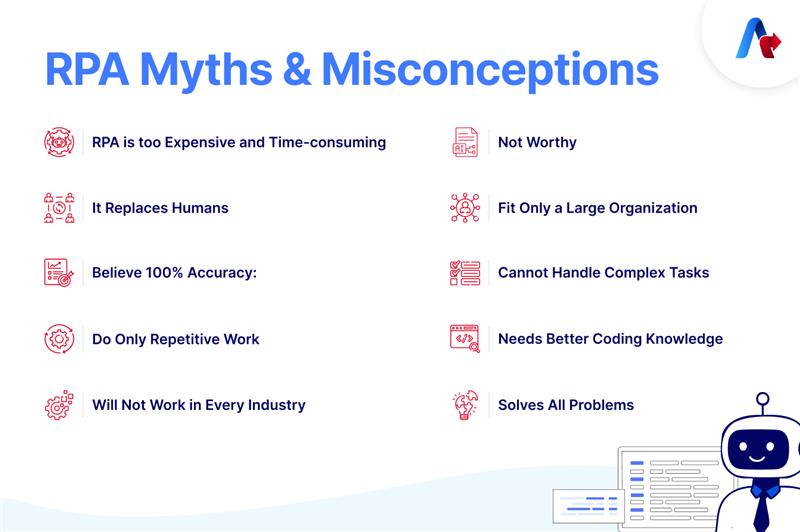
Robotic process automation is helpful in many organizations in their daily tasks, and many are still using this technology with AI integrations. Despite its promises, there are many myths affecting its adoption.
- RPA is too Expensive and Time-consuming: Like every technology implementation, the initial stage is costly for this system too, but ROI can give you satisfaction when you move forward. RPA evolution is paying back to the organization by reducing the time, improving accuracy and employee satisfaction.
- It Replaces Humans: It’s not the right time to discuss how robotics and automation replace human workers. Most of these technologies can improve productivity and workflow by automating repetitive and time-consuming tasks. Humans are still relevant to every process, as AI cannot handle cognitive skills.
- Believe 100% Accuracy: No technology is 100% correct, and RPA also falls into that category since they have no intelligence like humans. It doesn’t mean that it makes mistakes, but it reduces the chances. When you give a rule, it follows, and if that is a mistake, it continues with it, so monitoring is necessary.
- Do Only Repetitive Work: This myth is common among people because in this initial period, they followed only mundane tasks. Later, it gained more ability with AI (artificial intelligence) and evolved into a new automation that can go beyond daily tasks, such as content creation, decisions, and more.
- Will Not Work in Every Industry: There is a misconception that RPA is only valuable for industries such as finance and customer care. The reality is that it can do jobs in various sectors according to the needs. It is helpful in any place where there are repetitive, rules-based, and high-volume tasks.
- Not Worthy: It is a common misconception that RPA is not worthy in this AI world. The truth is that this tool is the foundation for automation, and artificial intelligence can add more value to it. Together, they not only complement each other but bring measurable results. So, it is still valuable to many organizations.
- Fit Only a Large Organization: Another myth is that this bot is exclusively for large enterprises with complex processes. You must understand that it is customizable for all sizes. Whether you are a small or medium-sized business, RPA takes tasks such as data entry, report generation, and invoice processing.
- Cannot Handle Complex Tasks: The arrival of cognitive automation is contributing more to the future of RPA. Through such intelligence, any business can handle difficult jobs and free its human force for decision-making and problem-solving.
- Needs Better Coding Knowledge: If you are one with programming knowledge, it is an advantage for you in implementation. If not, it is also possible to handle such tools as they come with user-friendly options, like drag and drop functions and prebuilt modules. So, little to no coding experience also helps here with usage.
- Solves All Problems: Even today, after RPA evolution with AI, it has its limits with poor processes and other highly complicated workflows. If you have a clear strategy, integration and implementation, you can reap the best, but do not solve every problem.
The RPA tech is still alive and moving to the next level with other integrations. Wondering how?
The Next Step: From RPA to APA
Now, the interest is more about AI-driven automation and agentic automation, but RPA can do many strategic jobs within organizations. At the beginning, it took structured data and processed data such as invoices, but later faced hurdles in the unstructured area.
At the time, smart automation came to the rescue with the help of AI. With that, companies can move with unstructured data by understanding order number, vendor details and other essentials. If there are any discrepancies, it corrects them and if it is complicated, flags them for human intervention.
The basic automation is not ideal for today's challenges. This was the time when engineers thought of a new concept, autonomous process automation (APA). Through its human-like intelligence and other integration services like RPA, LLM and agentic AI, it can give more accuracy than others. RPA interacts and connects with people, but APA allows agents to move further with collaboration and complete entire workflows.
Nothing is 100% perfect, which is why humans and AI should work together.
Humans + AI Agents: Redefining the Future of Work
There is a rumor about AI that it is going to whip out most of the jobs humans have. This is not entirely true at the moment, as it elevates our productivity and frees up time for other vital issues. It happened when the internet came, but later, many new businesses arose based on that.
When AI and people work together, it leads to a new perfection that improves productivity, reduces costs, and mitigates errors. Technologies like machine learning and RPA automate, and later, a human agent could pick up and correct them. If you have anything related to cognitive skills, your employees can take it, and AI works in the background to do repetitive jobs and decisions.
RPA at the Core of the Autonomous Enterprise
You can ask yourself, Is RPA dead? The answer is no because it is improving day by day with the power of agentic AI. Every technology must evolve, and this is what happened here to help organizations build on something that they have to create a more creative workplace.
With APA by the side of RPA, there are plenty of opportunities for people to use their intelligence on what really matters. The final result of this is a business that drives innovation with growth.
At Accelirate, we build RPA combined with Agentic AI that helps you save money and thousands of hours for your workers. With AI agents, we are now automating what was once impossible.