



Quick Summary
Before implementing an AI agent governance framework, an enterprise should ask 10 questions to avoid hurdles. These questions are: who owns them and is accountable for their action, classification of risks, policies, how do we audit agents' actions, what are the regulations to follow, how to prevent agent sprawl, what does technical enforcement look like, how do we detect drift, which standards apply, and how multi-agent systems work. An organization that finds answers to these questions will face fewer problems and can concentrate on scaling agents.
Imagine a situation in which two companies introduce AI agents simultaneously in the same industry. The first one strictly follows the AI agent governance framework from the beginning. After six months of deployment, the automation is helping with claims processing, customer issues, and vendor approvals. Tracking and reviewing everything is easy now for the company.
On the other hand, the second one takes a different approach. After approving a wrong refund, the company limits its service to provide only recommendations. When top leadership seeks to understand how the mistake happened, no one has a clear idea.
Both organizations used the same technology, but the results were different. It is not a matter of which type of technology you use, but of how you manage oversight and accountability from the beginning, not after a problem occurs.
A Deloitte survey of more than 3,235 business and IT leaders found that only 21% of organizations have a mature governance approach for AI agents, while others do not, even as adoption is increasing. It means that nearly 4 out of 5 organizations are using artificial intelligence without controls, AI compliance, and they cannot identify issues before they happen.
From this blog, you will understand the 10 important questions a company should ask before using AI agents with governance frameworks. These questions should not come after the issues, but before you put them live.
Why AI Agent Governance Framework Matters Before Operationalization, Not After
Many organizations still treat AI governance as software documentation. It was a habit that followed the traditional automation available at the time. Now, with agentic automation, these situations are difficult and risky.
The old governance framework and compliance were built with one thing in mind: there is a human for the decision-making. AI agents break this assumption as they can access sensitive information, approve, modify documents and send emails with limited human support. The risk is higher than in the old days, as agents fail silently and nobody notices until something goes wrong.
According to McKinsey's 2026 AI Trust Maturity Survey, around two-thirds of companies say security and risk are their biggest concerns as they expand the use of AI agents. This shows that they are not held back by what technology can do, but they do not trust their own ability to control AI agents.
As per our report, the State of Agentic AI and Automation in Enterprises, Accelirate sees the failure immediately. Our delivery and automation teams find that enterprises struggle most with three things: unclear ownership, lack of guardrails, and compliance risks that only surface after something has gone wrong.
This is what Accelirate SME Sharad Rastogi says,
What's hardest to detect is silent failure — when the agent gives a plausible but incorrect output that moves forward without noticing for weeks or months.
That's exactly why governance is built before deployment, not after the complete deployment. This is a reliable defense you can use today.
When Is Your Enterprise Actually Ready to Operationalize AI Agents?
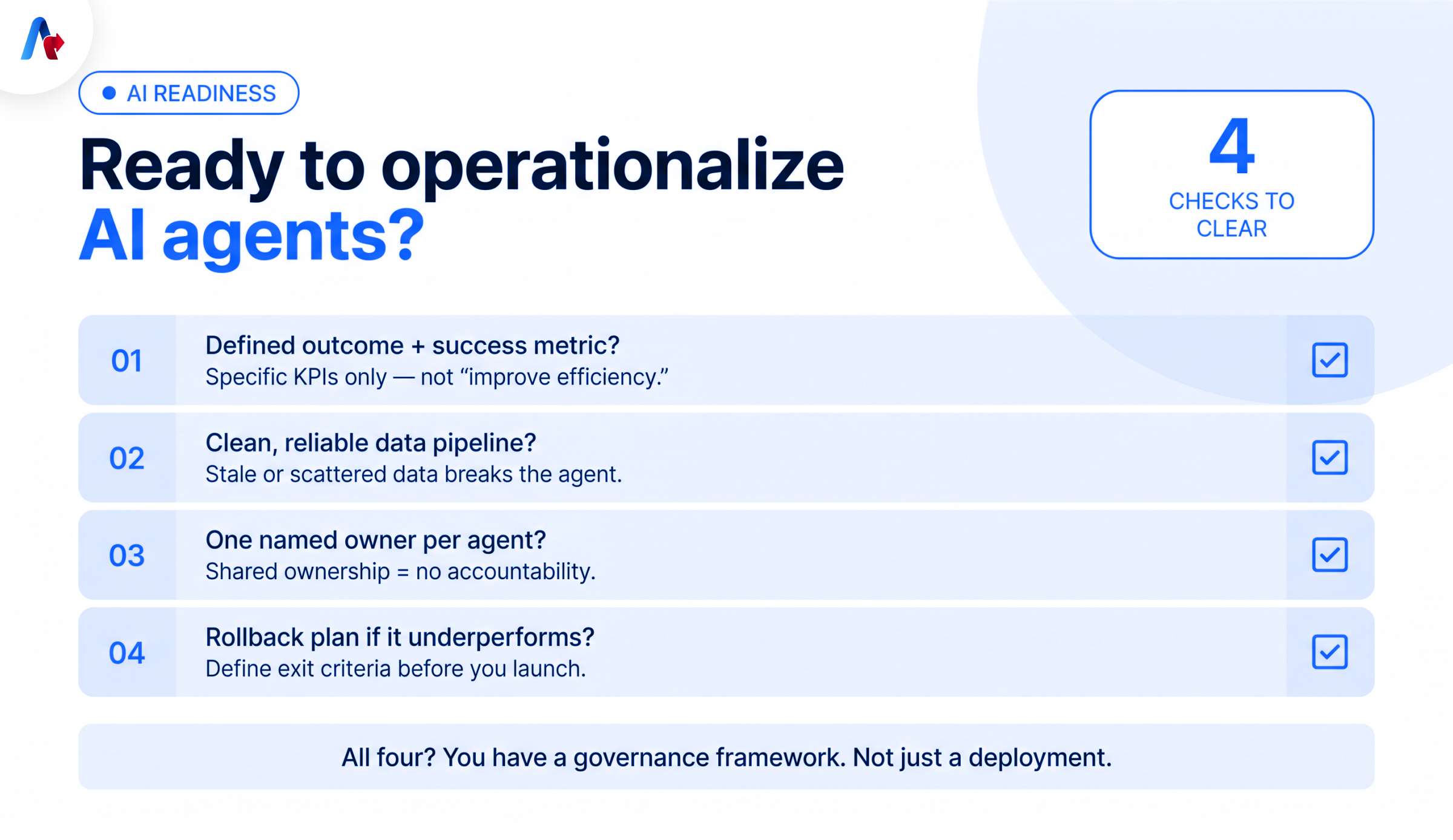
Readiness is not something that you have a licensed, impressive model that worked perfectly in the pilot. This is something that you can do with organizational and governance maturity. It can be the people, policies and the monitoring system about how a company can handle if something goes wrong with the model.
Let’s see some of the readiness checklists you need to be careful about before scaling:
Can you clearly define the business outcome each AI agent wants to improve, and how you will measure success?
Deploying agents with broad goals is common, such as reducing costs and improving efficiency. However, a successful project focuses on specific and measurable goals. It can be anything like improving response time, reducing customer escalation, and producing accurate data.
Do you have reliable and systematic data feeding for the agent?
The quality of an AI agent is based on the quality of the data you feed it. If the data is incomplete and outdated, agentic AI may produce incorrect results. In many cases, the data is old, scattered and needs purification before leaving it to the automation.
Is there an owner for each outcome AI agent in production?
A specific person must be accountable for the decision. It will be a problem if the ownership is not clear or shared by a group of people. A single person is the best choice and avoids conflicts.
What will you do if the automation is not producing better results in a particular period?
There are reasons to deploy automation to your workflow, but only a few plans for what to do if it is not producing effectively. If you have a clear plan with this, it can avoid confusion and retire it peacefully.
Having answers to all these questions can help your enterprise build strong AI risk management and scale better in an agentic world. A structured AI agent governance framework is valuable and helps organizations to avoid uncertainty while deploying agents.
The 10 Questions Every Enterprise Should Ask Before Operationalizing AI Agents with Governance Frameworks
While adopting an AI agent governance framework, a company should ask ten of these questions about accountability, risk, policies, audit maintenance, compliance with regulation, EU act requirements, agents sprawl, governance imposing technically vs only on paper, model drift finding and response, aligning with major acts, and multi-agent coordination.
Let’s drive to the questions enterprises should check for any AI agents’ governance from pilot to production.
1. Who Owns the AI Agent and Who Is Accountable When It Fails?
This question looks basic to you, but most of the time, there is no answer to it. Ask five people in an enterprise about it, and you may get five different answers, such as whether the IT department built it or a business unit requested it. Here, no one is sure about who is responsible when something goes wrong.
Ownership comes when an individual accounts for the performance, behavior and failure. This person should be responsible for monitoring agents' day-to-day activities, answerable for their actions and pause them when it is necessary.
McKinsey's research found that organizations with clear responsibility for AI, such as a governance leader, audit team, and ethics function, will have an average AI trust maturity score of 2.6 out of 4, but without that, the score will be only 1.8. There is a real gap between companies that are responsible and those that just feel that the problem will never come.
2. Do We Have a Risk Classification Framework for Our AI Agents?
Not every AI agent is risky for your business, and treating them all the same way is a governance failure. Think about two chatbots: one is just responsible for drafting internal meeting summaries, and the other one has access to the financial system and customer data. The first chatbot does not need more security, but the second one needs it, as it affects the whole company.
A risk classification framework can be based on:
- What data can the agent access: Public, internal, sensitive, or regulated?
- What actions it can take: Just read, take human approval or be completely autonomous.
- What systems does it touch? Will the agents just touch isolated tools or core business systems?
- What happens if it's wrong: Can we reverse it, or does it create any issues with regulation and affect us financially?
This classification will give a clear idea of where you must go with the AI governance framework. Skipping them will really affect your business and reputation.
Not sure which AI agents need stricter controls, and which do not?
Connect with Accelirate to build the right risk framework.
3. What Policies Govern What AI Agents Can and Cannot Do?
The above risk categories are vital to understand the need for oversight, but while operationalizing AI agents, create a policy on what it can touch and what it cannot. It includes the policies, such as boundary, escalation, access, and restricted actions. Without it, it will be difficult to manage them as they are naturally autonomous. It is not human that thinks what it does; instead, it will do what it is capable of.
A simple language AI policy should clearly explain the AI in its area of work, with what it does and doesn’t do. The good policy also explains when humans should step in for review or approval and which tasks automation can take on its own. The restricted areas are essential and explain how the agentic AI should react to such situations.
Instead, if you give a vague rule like the agents should act responsibly, it is not enough. For example, "the agent can approve refunds up to $500, but anything more than that must be sent to humans. This is a clear policy, and test it before you enforce it completely.
4. How Will We Maintain a Complete Audit Trail of Every Agent Action?
An agent handling a financial section takes an action today, but you have to answer it to regulators or the legal team after one year. For most companies, the answer is no at the moment.
A proper audit trail should document the entire decision-making process to avoid such situations. It must include everything, including what triggered the agent, the tools used, the logic behind the action, and the result.
Deloitte has found that most organizations deploying enterprise automation still lack a strong AI agent governance framework. Those companies are not sure about the decisions, audit trails and the actions. It means there is little control over AI, leading to compliance risks and limited visibility into its performance.
A company that is not sure how its agents reach conclusions will find it hard to identify problems, improve performance and build trust with customers.
5. How Do We Ensure AI Agents Stay Compliant with Regulatory Requirements?
Reviewing agents' scope and decision, scope changes triggers, and regulatory monitoring are the three things you need to be careful to ensure regulatory requirements.
Compliance for AI agents should not be a one-time check. Regulations are evolving, so you must be careful, as what was once compliant today may no longer be after six months. At this time, enterprises may get exposed.
For example, an AI agent starts with a simple claims processing workflow. Later, it may get access to more sensitive data, connect with other systems, and make more important decisions. These changes by the AI can create new compliance risks for your organization.
So, it is vital to keep up with three things at the same time: what agents are doing, which system they use and the regulations they must follow.
According to our agentic AI and automation report, most of the time, the AI agent governance framework and compliance gaps rarely appear at the beginning. After six to twelve months, they expand beyond AI's original scope. Agents may start accessing data that was not first approved to use and make decisions that now require human review.
At this time, the original compliance may not be enough. To avoid this, there should be a compliance checkpoint in the full agent lifecycle. This means the compliance review is not just for the launch but also tracks the agent’s scope and decision authority changes. In simple terms, the compliance must move with the agents, or we will face the consequences.
Want to know what compliance gaps look like before they surface?
Start with a governance readiness check.
6. What Does the EU AI Act Require for High-Risk AI Systems, and Do Our Agents Qualify?
The EU AI Act, especially Regulation 2024/1689, applies to organizations outside the European Union. Even if your AI is used by the EU customers or one way or the other, it relates to people in the EU, so you need to follow it.
As part of this Act, if any AI-connected biometric identification, critical infrastructure, education, employment, migration, and border control systems come under the high category. It means that a company must have ongoing risk management, documented data governance processes, human controls, and compliance.
Some parts of this law are already in effect. Rules banning certain AI practices and requirements for AI training and awareness are effective from February 2025. Another one for managing and governing general-purpose AI models also came into effect from August 2025 onwards.
For some other high-risk areas, the deadline has been extended to December 2027. However, transparency rules will still start in August 2026.
7. What is Agent Sprawl, and How Does a Governance Framework Prevent it?
Agent sprawl happens when different teams in an organization use their own AI for tasks without central oversight. Here, one team may build one for customer support, another for reporting, and the third one for procurement. They all solve different issues, but later companies may lose visibility on everything, including the data they access and who is responsible for their actions.
These may seem helpful in the beginning, but soon they create security issues, and the cost of that is more than you think. AI agent governance for enterprises is vital here to prevent agent sprawl, and it is possible by making a common rule for approval for each agent before deployment. This includes assessing risk, reviewing policies, and defining access permissions.
More than that, every AI must have its owner for its actions, and everything must be documented for future auditing. Importantly, every agent must have a clear owner and a documented business purpose. This is unavoidable as agents need visibility, accountability, and control over their actions.
8. What Does it Look Like When Governance is Enforced Technically vs. Only on Paper?
This is where many enterprises go off track. Many AI agent governance frameworks look good on paper, but companies take less effort to enforce them. But engineers build AI agents that do not address and prevent real problems.
An operationalizing AI agent must have these rules embedded from the design stage. It means that the AI cannot access data without approval, and logs will be created automatically. Not only that, but high-risk actions also take place only after human approval. As part of that, monitoring also takes place, where you can identify unusual behaviors to avoid big consequences.
This concept is very simple: paper governance is good for people to follow, but technically enforced rules will make artificial intelligence follow them from the beginning onwards.
9. What Is Our Process for Detecting and Responding to Model Drift or Agent Errors?
AI agent governance for enterprise processes should answer three clear questions to identify the model drift.
- First, how do you detect drift early? An organization should not want customers or employees to notice. Instead, there should be a method to check for this in advance.
- Second, an alert needs to come when something unusual happens. If there is any error or any unexpected actions, the right team should be notified immediately.
- Third, what happens next if the team gets a notification? There are options: pause, roll back to previous versions, or block the AI from taking certain actions. The action must be decided early.
Automation AI agents will not stay the same after they go live. It means that the data they use can change, and the business unit connection can get updated. At this time, the AI agent’s accuracy will also be affected.
In Accelirate’s AI agent Governance Framework, this falls under drift detection, audit, escalation, and human oversight. Our goal is simple: avoid these issues in advance, and that’s exactly what you can expect from our service.
Understand how to secure every stage of your agent's life with Accelirate, from design to decommission.
Talk to our team
10. Do We Need to Align Our Governance Framework with NIST AI RMF, ISO 42001, or the EU AI Act — or All Three?
In most cases, you can consider more than one AI agent governance framework. All three of these are not competing with each other, but they serve different purposes to work together.
For example, the NIST AI Risk Management Framework is a voluntary framework that assists organizations in managing AI risks. It is helpful as it can provide a practical guide for building an enterprise AI governance program.
The second one is ISO/IEC 42001. It is an international standard created for AI management systems. If your company is certified in it, you can show your AI governance maturity to your customers, partners, and regulators.
The EU AI Act is different from others as it is a legal requirement. This is important if a company serves the EU market. It is unavoidable even if you serve EU-related markets and individuals.
| Framework | Purpose | Mandatory? |
|---|---|---|
| NIST AI RMF | Helps organizations build and manage AI governance programs | No |
| ISO/IEC 42001 | Provides a certificate for the AI management system | No |
| EU AI Act | Sets legal requirements for AI systems in the EU | Yes, where applicable |
Want to know the questions to ask before connecting AI agents with old systems?
Then, you must read: 10 Questions to Ask Before Integrating AI Agents with Legacy Systems.
Common Governance Mistakes Enterprises Make When Scaling AI Agents
A company may find several loopholes while scaling the AI agent governance framework. Most failures stem from treating governance as a one-time task, applying the same level of control to every agent, deploying without central control, relying heavily on vendors, and treating AI governance only after incidents.
Considering Governance Only Initial Time
This is one of the most common issues found as companies care about governance only before the launch, but think that they have moved on with the changes. Companies create policies, get approval and then move on.
The problem is that the agents are autonomous and adaptable, so they might access forbidden data, handle more tasks and support more functions. At this point, a business must review and update governance that clearly defines the agent’s role.
Using the Same Controls for Every Agent
Not every AI agent creates the same level of risk for your business. For example, if a company is using AI for just answering QA, it does not need the same level of review that one would handle when handling financial data or customer data. The concept is simple: review less for the first one that handles only queries, but give more priority to the one that handles sensitive information.
When an enterprise spends more time on simple agents, it becomes slow in all aspects, but giving more time where it is necessary can avoid risk and protect confidential information.
Deploying Agents Without Central Oversight
An enterprise consists of several teams building and launching AI on their own without central control and governance. A situation like this will lead to agent sprawl, where companies lose track of the total number of agents running, what they are doing, and the type of data they are accessing.
There is also confusion about who is handling what, which certainly leads to accountability issues. One of the biggest problems without a Center of Excellence (CoE) is that we find problems only after something goes wrong.
Taking Only Vendor Safety
A vendor can provide safety, but doesn’t think of it as a complete AI agent governance framework. Every enterprise is unique with its systems, data, approval rules, compliance needs, and business risks. Vendor safety is useful, but it cannot replace the company’s own policies, access rules, checks, and tracking processes.
Waiting for an Incident to Invest in Governance
Waiting is sometimes a costly affair, especially in the case of AI agent governance . By the time you wait, the AI automation will already be working with the real data and making its own decisions that may affect the company’s goodwill.
Gartner predicted this earlier, and it says that 40% of the enterprises will shut down their AI because of the governance gap alone, especially the gaps found after an incident occurred.
In short, this is not a technological failure but a timing issue. Governance must be established before, not after a problem comes to the surface.
Build Governance Before Your AI Agents Scale
These 10 questions are not created to slow down your AI agent’s implementation. They are built to scale their automation in a proper way without affecting business and customers.
Many AI agents look impressive in a demo, but the real problem comes when they are integrated with your system and processes. That is where a business needs control, ownership, monitoring, compliance and governance.
The truth is that most enterprises may not be able to answer all 10 questions confidently today. It does not mean that you have nothing, but it is where you start a new journey.
The AI agent governance framework should not be idle but needs to grow with your AI program. A clear framework is essential to understand who owns each agent, the risk management, tracking and explaining the review policy before anything goes bad.
This is what Accelirate does, helping companies build a foundation for a governance framework. Are you an organization planning to scale your AI agents? This is the right to find the gap in your governance before they find you.
Not sure where your governance gaps are? Our governance team helps you find and fix them before deployment.
Talk to our team
FAQs
A governance framework for an AI agent is a set of rules, policies, and accountability structures. This is where we can find what agents can do, who is responsible for it, and how a company can monitor their actions. It is vital for any organization that uses automation today, as it covers many things, such as risk classification, audit trail, escalation rules and other compliance-related requirements before any errors.
The main reason is that traditional governance doesn’t cover what agents do. They can make calls, access vital data and act autonomously with limited human review. Without agentic AI governance, you may face problems with accountability, compliance, and silent failures that will affect your entire organization.
Operationalizing agents means a process moving from pilots into production. It is where AI handles real data, decisions and workflows with better oversight. A method like this is different from simply deploying an agent. In this process, a company must explain the ownership, policies, and governance structure that are necessary under regulations.