



Quick Summary
Replacing Rule-Based Bots with AI Agents is a good idea, but there are important questions a company should ask before doing so. It includes your current needs, benefits, training, reliability, security costs, human control, monitoring, and scaling. Once these questions are clarified, you will know whether to move forward with AI agents or use existing bots. In this way, a business can avoid risk, reduce cost and make better decisions that support its ROI.
There was a time when enterprises used rule-based bots for answering customers’ questions. That method worked effectively before since the workflow was very simple. Today, queries are different and complex, so a standard bot cannot handle them properly. The customer's request is changing, documents are in different formats, and the decision needs contextual support.
For this reason, many organizations are seriously considering replacing rule-based bots with AI agents. If you think this shift is part of hype, you are wrong. AI automation with agents is smart and needs only limited human support that adapts and scales according to the context.
A global survey by McKinsey found that 88% of businesses used AI in at least one business function in 2025. This shift shows that many are moving from testing to real operation. It does not mean every bot should move to agentic automation, but you need to add where speed matters, reduce risk and cost.
Important questions to ask before moving with AI agents
- Do We Actually Need AI Agents or Are Rule-Based Bots Still Enough?
- Which Business Processes Truly Benefit from AI Agents?
- Do We Have the Right Data to Train and Support AI Agents?
- Will AI agents replace our existing bots completely, or work alongside them?
- What Level of Accuracy, Reliability, and Risk Can We Accept?
- How Will We Ensure Security, Compliance, and Data Governance?
- What Is the Total Cost of Ownership vs Maintaining Existing Bots?
- Can We Maintain Human Control and Oversight in AI-Driven Decisions?
- How Will We Monitor, Audit, and Improve AI Agent Performance Over Time?
- Can AI Agents Scale Across the Enterprise Without Increasing Complexity?
Why Enterprises Are Moving from Rule-Based Bots to AI Agents
Companies have several reasons to adopt this technology. Some of the common reasons for this shift are:
- One of the main reasons is that the old method follows only fixed scripts and doesn’t do well with today’s needs. When people ask difficult questions or the data is unstructured, bots have their limitations.
- AI agents are getting more attention today because they can perform multi-step tasks, use tools, and respond flexibly, which you cannot expect from rule-based bots.
- Another reason is that enterprises evaluating AI agents vs rule-based bots are looking for automation that goes beyond basic tasks. Agentic automation is perfect for this, as it can understand context, retrieve the correct information, and support several actions without any rules.
- Cross-system work is another area where the old method struggles. Many of our tasks are connected to CRM, ERP, and ticketing systems. This process is easy when you have an intelligent system by your side.
- Decision speed is important today to keep up with the pace, but it is limited by traditional bots. The new automated method can support decision-making, handle cases, and prioritize tasks based on requirements.
Many organizations have reached the point where the script-based system alone cannot address today’s challenges. The main idea is not to replace everything, but to identify where AI automation is needed so you can use it as needed.
Want to learn whether RPA is dead or evolving?
Read: RPA’s Next Frontier: Why AI Agents Are the Core of Next-Gen EnterprisesWhen Does It Make Sense to Move Beyond Traditional RPA Bots?
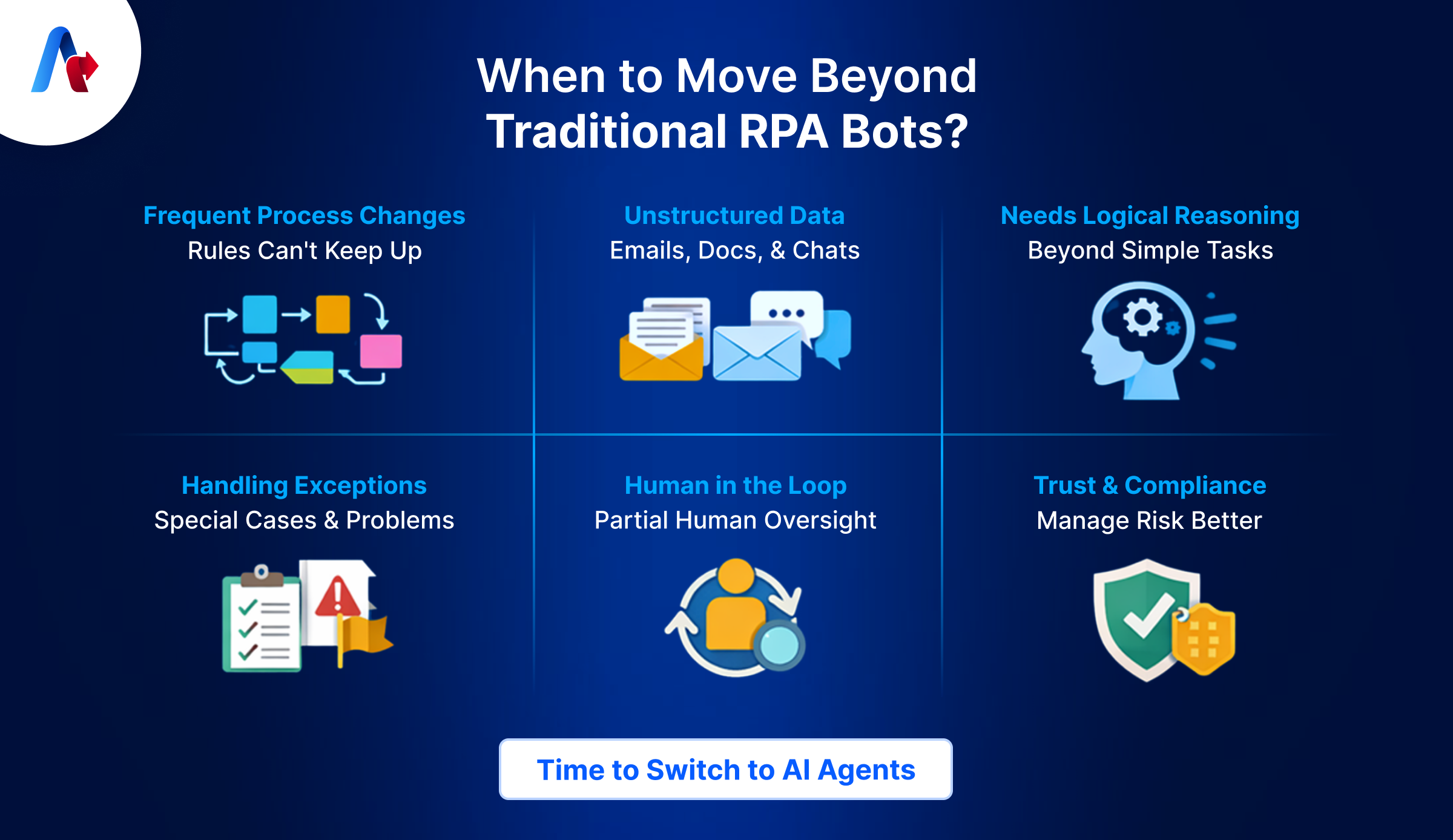
As a leader, you find several signs for replacing rule-based bots with AI agents. Let’s move to some of the points where you feel it.
- The Process Changes Too Often for Fixed Rules to Keep Up: Think about a situation where your team keeps updating flows, adding exceptions, which is one of the strong reasons to move with innovation.
- The Workflow Depends on Unstructured Inputs: This is another reason to move with agents because RPA cannot do well in this work. If the tasks are connected to emails, documents, chat messages, and images, then it is a strong reason to move.
- The Work Needs Reasoning, Not Just Execution: Traditional bots are created to follow instructions, but AI differ in that they analyze information, choose the next action, and work across different platforms.
- Handling Exceptional Tasks: If the real work is no longer supporting standard flow but handling special cases, escalations, and incomplete information, that is another reason to compare AI agents vs. rule-based bots.
- You Need Humans in the Loop, Not for the Whole Job: There is a misunderstanding that moving away from RPA means avoiding human oversight. If you think your old method is taking too long, consider switching to agents.
- Managing Trust, Risk, and Governance: When it comes to managing risk and trust, it is difficult with the conventional method. Once you start replacing rule-based bots with AI, companies can improve trustworthiness and comply with regulations.
Not sure if your workflow is ready for AI agents? Our expert can analyze everything and provide you with the right approach.
Let’s find out for freeThe 10 Questions Every Enterprise Should Ask Before replacing rule-based bots with AI agents
As a business, you should have several questions before adopting AI agents. It is a new technology that is better than its predecessor, but is it helpful for your work? Some may benefit, but others can still work with rules-based automation. So, a careful evaluation is necessary to avoid unnecessary costs.
Let’s thoughtfully evaluate some of the essential questions to ask before adopting AI agents.
1. Do We Actually Need AI Agents or Are Rule-Based Bots Still Enough?
Understanding what you need to complete tasks is vital for a business. Many already use robotic process automation tools, but not all cases need AI agents. For many tasks, the old method can still do better, especially for repeatable, stable jobs built around clear steps.
This option is better because it can offer more control, reduce costs, and pose less risk than others. On the other hand, if the bots are behaving unpredictably, it is better to adopt new methods. In a work environment, workers sometimes need to move with unstructured documents and contextual decisions, and change is inevitable.
Using agents works only where things are creative and adaptable, so don’t use it to just sound like you are using more advanced tools. The other matter is that these autonomous agents are more independent in acting. It means that they are riskier in some cases due to their autonomous character.
So, the real question is: what is essential for your work? If RPA is sufficient, continue with it; if you need a more advanced outcome, replacing rule-based bots with AI agents is the better option.
2. Which Business Processes Truly Benefit from AI Agents?
Most advanced AI agents for workflow automation are fit if you are handling cases that change from one to another. If you have document-heavy operations, cross-system workflow, and need to produce research-based work, AI automations are unavoidable.
Examples
- Changing Request: This area covers many things, including support tickets, service requests, and internal help workflows. In this case, you need context, exceptions, and intent to provide a smart answer.
- Heavy Documents Work: It includes review claiming, expense validation, and policy checks. Document work usually starts with emails, PDFs, receipts, or unstructured forms.
- Cross-System Workflows: Some tasks are not limited to one app but span CRM, ERP, ticketing, email, and internal knowledge systems. Normal bots cannot take these cross-system works.
- Knowledge-Based Work: A few works require research, summarization, and deeper recommendations. So, in that condition, a conventional bot struggles, but agents provide valuable information.
Want to see how this works in practice? Read: How an AI Agent-Driven Healthcare Assistant Enables 90% Automated Appointment Scheduling and Seamless Patient Interactions.
3. Do We Have the Right Data to Train and Support AI Agents?
Data is a gold mine, but if they are scattered, outdated, and hard to govern, your AI will struggle. In most enterprise settings, the real issue is not “training” a model from scratch. It is a problem with trusted business data that helps the intelligent agent to give the right context at the right time.
How Should Your Data Be?
- Your data should be easy to find, so agents can process it without any errors. Instead, if it is scattered across email, PDFs, and CRM systems, the automation AI can miss context.
- The data available must be clear. Many companies have the data, but if it is unusable or outdated, the output will be poor. AI sounds confident, but its accuracy is a major problem without clear data.
- Not only that, but the data must also be controlled. It means that automation should be restricted from accessing confidential data.
- Data should also match the job, or the output will be flaky. It means a customer support agent needs different grounding than a financial agent.
- Testing data is also another area to be careful about. If you cannot verify whether the agent used the right source, followed the right policy, or produced a correct answer, you are not ready. It is important because of evaluation, verification, and validation as part of AI risk management.
4. Will AI agents replace our existing bots completely, or work alongside them?
No, enterprises are not replacing rule-based bots with AI agents. Instead, they are taking a practical approach, working together to achieve specific goals. Automation can handle situations where judgment, context and adaptation are essential. On the other hand, standard automation is well-suited for repetitive, rules-based tasks.
Most companies already have automation investments spanning RPA, workflow engines, and integration. Throwing them away quickly creates more disruption than value. Bringing together humans, agents, and legacy automation can be very helpful rather than giving every task to the agents.
Example:
Let the AI agent for workflow automation decide and coordinate, whereas the existing bot executes fixed actions. It means agents read incoming requests, understand the intent and choose what is next. On the other hand, let the normal RPA automation handle data transfer and approvals.
Want to know which bots to keep and where AI agents should step in?
Schedule a call with our team5. What Level of Accuracy, Reliability, and Risk Can We Accept?
It is one of the most essential questions teams need to ask before replacing rule-based bots with AI agents. The goal of implementing new technology should not be to work smarter, but to ensure it is useful for every task. AI has its risks on trustworthiness, impact, and failure, so teams need to separate the three things, such as:
- Accuracy: Did the agent produce the right answer?
- Reliability: Does it provide consistent output?
- Risk: What happens if it gets it wrong?
How Can You Ensure Acceptance?
- For low-risk work (internal drafting and summarization), the agent can take greater freedom, since the human will review the output later, before any important delivery.
- If it is medium-risk work (customer communications, workflow routing, and document interpretation), the approach should differ. Here, you need to test agents against realistic scenarios, trusted data, and monitor continuously before trusting.
- The autonomous agents may respond well, but as a critical process, companies should have a backup plan if something goes wrong. There are high-level risk areas, such as financial decisions and compliance, where you need to build human-in-the-loop action.
What Team Should Define Before Launching AI Agents?
Before adoption, enterprises should write down:
- What success looks like.
- How is the failure going to be?
- Which errors are acceptable?
- Which errors trigger human review?
- Which actions should the agent never take on its own?
6. How Will We Ensure Security, Compliance, and Data Governance?
Since AI agents work with business data and take autonomous action on behalf of users, enterprises should be careful about security, compliance, and data governance. It means the risk is higher than with the old chatbot. The following actions can help you avoid these problems.
Start With Access, Not Intelligence.
Before asking what an agent can do, ask what it is permitted to see and touch. The safest method is to give access only to the tools, systems, and data needed for the job. Always draw clear boundaries around where agents can operate and what data they can access.
Make Compliance A Workflow Requirement.
If the process touches financial records or customer information, it is important to adopt compliance from day one. Ensure privacy, security, and trustworthiness throughout design, deployment, and use.
Human-In-The-Loop for the Higher Risk
Some actions should not go directly to the customers. Instead, they need review, approval and escalation from the real agents. These actions are critical, so it is vital to have clear ownership, auditing, and transparency to avoid serious consequences.
Plan for New Attack Paths
Intelligent agents are more powerful at taking actions and completing tasks, but this advantage attracts new threats, such as prompt injection, misuse of tools, and sensitive data leakage. A strong oversight and action plan is necessary to avoid such issues.
Set a Real Standard
If you are replacing rule-based bots with AI agents, it should be possible to govern them as you did with the old ones. This is where enterprise AI agent governance comes into play. With proper control, a business can improve trust with its customers.
Use Only Approved Data.
AI in workflow doesn’t need access to all data. It means the agents use only what is approved instead of pulling everything. To avoid this, ensure you build this rule directly to maintain data and policy control.
7. What Is the Total Cost of Ownership vs Maintaining Existing Bots?
The cost of AI agents vs. existing bots is a strategic question to consider before replacing rule-based bots. Companies usually focus on external costs, but there are hidden costs to run, govern, and scale. Keeping this in mind, teams should use this only where they can justify the cost.
Two Cost-Related Questions to Ask Before Replacing Rule-Based Bots with AI Agents
- What you already pay to maintain existing bots: Traditional bots are not free. As an enterprise, you need to spend money on updating rules, fixing exceptions, maintaining integrations, testing changes, and handling breakdowns. Understand exactly how much you are paying for this.
- What AI agents add on top: Bringing AI agents adds new costs. These include model inference costs, orchestration layers, evaluation, monitoring, governance, security controls, data preparation, and human review for specific tasks.
What Do You Really Want to Look at When Comparing AI Agents Vs. Rule-Based Bots?
Analyze work processes, and if you see most of your work is repeatable, stable and predictable, existing bots are better. There is no need to incur any additional cost by spending on other tools.
On the other hand, if things are getting hard to manage due to frequent changes, complexity, and frequent fixes, don’t think about the costs. In those cases, replacing rule-based bots with AI agents is a better option because you can avoid repeated tasks, manual work and reduce the cost that you spend on old bots.
What Should We Include in the Real TCO Calculation?
- Platform and usage costs
- Integration work
- Data preparation
- Security and governance controls
- Testing and evaluation
- Human oversight
- Ongoing maintenance.
- Cost of failure or rework
McKinsey says many companies are still struggling to see value from agentic AI investments. In some cases, they are retrenching or rehiring where agents didn’t produce output.
It clearly shows that AI agent ROI depends on workflow design and fit, not just the technology itself. The agent’s cost may be higher in the initial stage, but in the long run, it can produce better value.
Wondering what AI agents will cost your business? Let’s have a discussion and see the total cost to move from the old to the new.
Talk to our AI agent's expert for free8. Can We Maintain Human Control and Oversight in AI-Driven Decisions?
Yes, you need to control in many use cases. Many organizations are confused about this, but having shared control helps avoid consequences. AI decisions are faster and scalable, so when you use them together, a better outcome will come out of that. Especially in high-risk categories, human approval is unavoidable.
What AI Agents Can Do in Real Work?
- Collect information.
- Summarize a case.
- Suggest the next step.
- Prepare an action.
What Can a Human Do While Working with Agentic AI?
- Approve or reject that action.
- Handle unclear cases.
- Step in when confidence is low
- Review sensitive decisions.
Where Human Oversight Matters Most
Human review is unavoidable when the decision affects:
- Customers directly
- Cost money
- Attract compliance issues
- Regulated data
- If it affects the business approvals
9. How Will We Monitor, Audit, and Improve AI Agent Performance Over Time?
An enterprise can audit, monitor and improve agents’ performance through task completion, accuracy, tools called success, safety and cost. Production-ready agents should not be evaluated based on their final answers. Instead, evaluate them based on quality and efficiency in each step.
Three steps to monitor autonomous AI
- First, watch the business outcome. Check that this implementation actually resolves more cases, reduces manual effort, and improves consistency.
- The second one is to check the workflow by using these questions. Did the agent follow the right steps? Did it choose the right tool? Did it send the correct input to that tool?
- The third step is to watch risk signals. For this, you need logs, traceability, and review paths for failures, unsafe outputs, unusual behavior, and sensitive actions.
For auditability, a business can ask the following questions:
- Can you explain what the agent did?
- Why did the agent do so
- What data is used
- What happened next?
If you get a clear answer, it is positive. If not, it is hard to trust.
Read this case study to see how monitoring improved ROI: How Accelirate’s AI Agent Automates Faulted Job Log Analysis for IT Teams, Enabling Faster Root Cause Diagnosis, Cleaner Log Visibility, and 99.9% Uptime SLA.
10. Can AI Agents Scale Across the Enterprise Without Increasing Complexity?
Yes, it is possible only when the company scales the operating model along with the existing technology. Scaling must be a priority before replacing rule-based bots with AI agents. If every team starts launching agents one by one without coordination, rules, and shared ownership, it will increase the complexity.
It is important that an organization has clear responsibilities, governance models, and team structures to support scaling. Without that preparation, there is a risk of isolated experiments and inconsistent security practices, which leads to an inability to scale automation.
Don’t think that appointing more agents will help your workflow. It means you have more systems to monitor, to grant permissions, review, and control. So, how can you scale agents without trouble?
- Prepare a shared foundation, not in isolation. A central team is necessary to govern, establish guardrails, and ensure security. A Center of Excellence (COE) with AI agents can prevent problems and help with monitoring and accountability.
- Creating a standardized way for agents to connect to data and tools is another area you should consider to avoid complexity. A unified integration method avoids duplication, simplifies maintenance, and lowers costs. and tool integration reduces duplication, simplifies maintenance, and lowers operational costs.
- Another method for scaling is to create central visibility. It means an organization needs a full inventory of agents, centralized logging, cost tracking, and clear ownership to stay in control at scale. This visibility can help you see existing agents, their activities, cost and who owns them.
A simple, practical answer for this question is: Yes, but only with a foundation, centralized oversight, and keeping human judgment in the loop for important decisions that directly affect the company and the customers.
Common Mistakes to Avoid When Replacing Bots with AI Agents
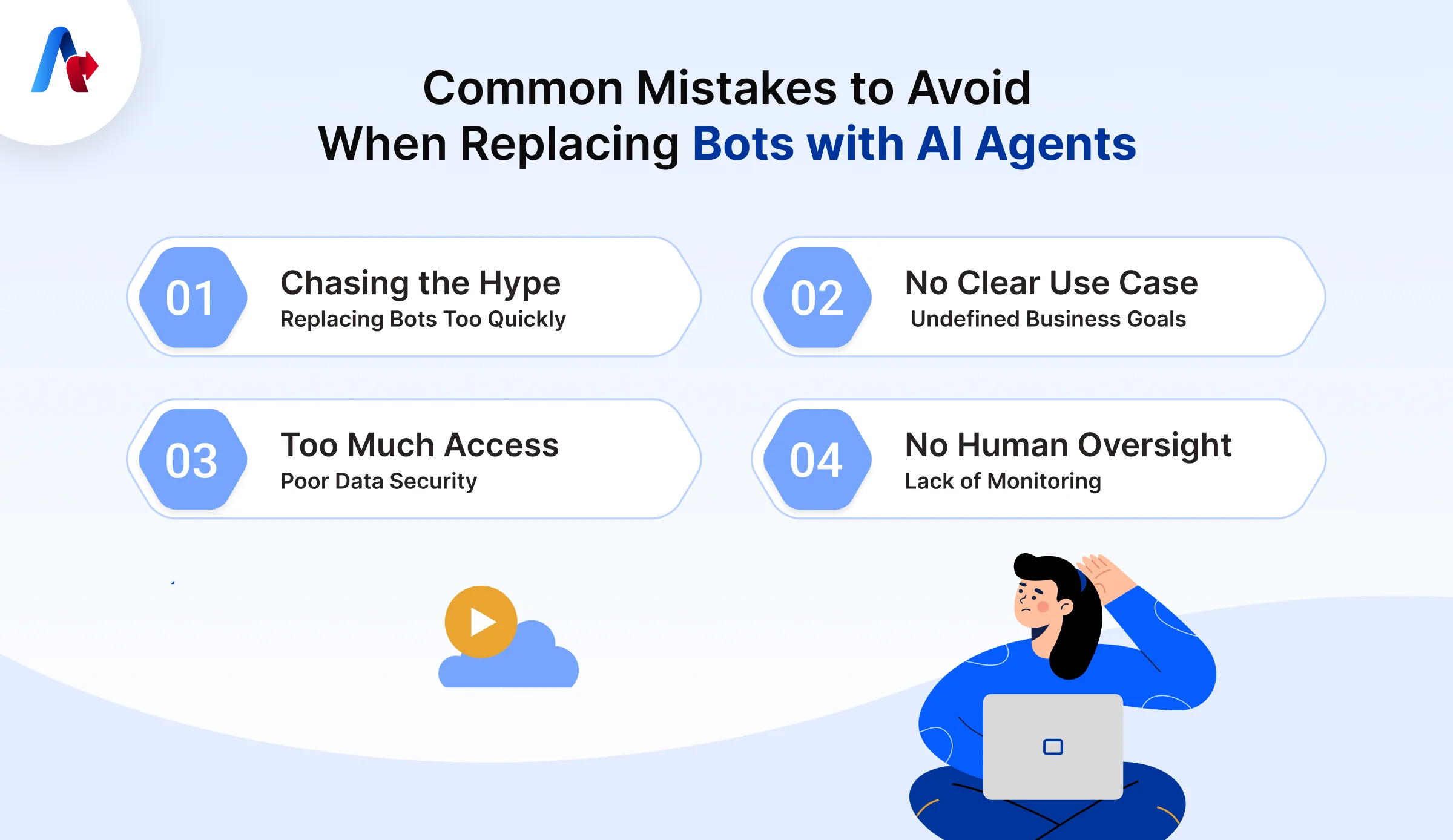
Enterprises often make mistakes when replacing bots with AI automation. Sometimes, they move fast with the trend, choose the wrong workflow and treat agentic automation as a direct swap for the existing bots.
8 common mistakes to avoid while replacing RPA bots with AI agents?
Mistake 1: Replacing Stable Bots Just Because AI Agents Are More Advanced.
Don’t go with the trend alone. If the current bots are doing the job, why prefer something else that would increase costs and complexity based on a trend that attracts more cost and complexity?
Mistake 2: Starting With Technology Instead of a Real Business Problem.
An innovation like AI agents must solve your problems. Without defining the right use cases, the AI agent ROI will not be visible.
Mistake 3: Assuming Automated AI Should Replace Everything End-To-End.
Agents are good at reasoning, context and coordination, whereas the existing bots can execute repeatable steps. You should know when to use AI agents instead of bots and where humans should step in.
Mistake 4: Giving The Agent Access to Too Much Data or Tools.
More access does not make an agent smarter, but it is riskier as they are autonomous. It may also expose sensitive data, creating compliance and security issues.
Mistake 5: Treating Governance as a Later Work.
Enterprise AI agent governance must start early during the design phase. If it starts late, you don’t get control, create ownership issues, and it is harder to scale.
Mistake 6: Forgetting That Human Oversight is Part of the Design.
For higher-risk work, human review and approval are unavoidable. It can create transparency and accountability in the decisions it makes.
Mistake 7: Measuring Success with Demos Instead of Production Results.
A demo is not proof of value, but we need to focus on measurable outcomes. This includes task success, tool accuracy, quality, latency, safety, and cost.
Mistake 8: Underestimating Complexity When Scaling.
In this initial stage, everything looks good with a few agents. The complexity increases as you adopt more agents and systems, making everything more complex while scaling.
Replacing rule-based bots with AI agents at full speed is not a good choice. Instead, see how it works with your workflow. Once agents prove their control and value, you can move with them completely or go for a hybrid method.
How Accelirate Helps Enterprises Transition from Bots to AI Agents
As a business, you cannot move to an agent in one night. Here, you need a better strategy, analysis, and expert support to avoid disruption to current functions. While coordinating with Accelirate, you can identify where AI agents fit, where existing automation is, and how you measure values.
Our expert also focuses on finding the right use cases, designing agentic AI around real workflow, integrating with existing systems, deploying with enterprise AI governance and ensuring optimization.
We also take security seriously and ensure nothing affects your workflow. For customers who want a quicker pilot and to prove value, we have a 5-Week AI Agent Activator Program to explore.
What makes our service different is that we build AI around your current workflow, maintain human oversight, focus on outcomes, scale, and build governance from the design onwards. We also provide a Center of Excellence (COE) with AI agents that will focus on standardization, oversight and scaling without complexity.
Should You Replace, Upgrade, or Combine Bots and AI Agents?
The answer to this question will be different for each enterprise. Some workflows still fit with rule-based bots. Others are ready for AI agents. And many will deliver the best results by combining both.
Understand that replacing rule-based bots with AI agents should not be based on trends alone; it must support operational decisions. If the present automation is stable, structured, and less costly, keep the existing bot. If your process is messy and contextual, AI agents are the top choices.
As an enterprise, your goal is not to bring advanced AI to your workflow. Instead, ensure automation is practical, governed, and worth investing in. A good strategy is not to replace everything soon, but to choose workflows carefully, scale appropriately, and keep the human in the loop for important decisions.
Still unsure whether to replace, upgrade, or combine them both? Start with our exclusive plan and see real results before scaling.
Get StartedFAQs
There is a huge difference between these technologies. Normal bots are good at following fixed rules and work well for stable, repetitive jobs. AI agents are smarter because they can understand context, handle unstructured inputs, and take autonomous action. If your work is complex, you can choose agents, but they are more difficult to govern compared to old-type bots.
Not always. The intelligent replacement comes only when the workflow needs reasoning, adaptation, and context that traditional automation cannot handle well. In many cases, the hybrid model works well, with AI agents working alongside existing bots rather than replacing them completely.
Many factors should be considered when replacing old bots with new agents, such as workflow complexity, data quality, compliance requirements, human controls, and long-term operating costs. The goal is not to replace bots for modernization. With the upgradation, the outcome should improve by reducing risk and complexity.
AI agent ROI is based on the business outcomes, not just technical performance. That includes faster output, reduced manual effort, better exception handling, greater accuracy, and improved scalability. Enterprises must also compare those gains against the costs of governance, monitoring, integration, and human review.