



Quick Summary
The COE is not new to automation. Companies used this standardized method with RPA bots. Today, AI agents are smarter and make decisions autonomously, so a better version is necessary to manage them. A modern automation center of excellence 2.0 with AI agents can clearly define governance, standardization, security and scaling. With AI in workflows, a COE offers better monitoring, procedures, and accountability to support intelligent growth.
Traditional automation centers of excellence mostly concentrated on RPA. They initially standardized bot development, reduced duplication, and helped with automation programs. This method was effective earlier. The situation has changed now with the arrival of AI agents.
Today, agentic automation systems are smarter than their predecessors. They can understand a situation, learn from data and context and coordinate workflow across systems. A rule-based COE simply cannot manage autonomous decision systems due to its different nature. That’s why enterprises are moving to an automation center of excellence 2.0 with AI agents with intelligence and adaptability.
“According to Gartner research, agentic AI will take part in one-third of enterprise applications by 2028.” That shift is a reminder that automation governance must evolve according to the situation. In the agentic era, teams should not ask whether they are using AI or not, but focus on whether their COE is ready for AI.
What Is an Automation Center of Excellence (COE)?
A COE team is responsible for everything from managing to scaling automation across an organization. The primary goal is to bring structure, governance, and consistency to automation initiatives without duplicating work.
In the previous RPA wave, many enterprises launched bots in isolation. For example, the finance team uses automated invoice processing, and the HR team brings AI onboarding. Since they worked in isolation, duplication increased, and the standards varied across the bots.
At that time, COE solved this problem. With this, an enterprise created a better strategy and prioritization, improved development, managed tools and infrastructure efficiently, ensured compliance, security and risk and measured ROI and performance.
But this structure was rule-based automation, not autonomous. And that’s where developers thought about a new system with limited human intervention.
Why Traditional RPA COEs Are No Longer Enough in the Age of AI Agents
Enterprises built RPA COEs for control and standardization before. They helped them a lot with rule-based automation safely, but with the introduction of an AI agent, the situation became very complex.
1. RPA Is Rule-Based, but AI Agents Are Autonomous
We are aware that RPA follows predefined instructions. The problem is that a small change will need manual updating here. Autonomous AI is smarter as it can understand the context, adjust decisions and process unstructured data with limited human effort.
2. Governance is More Complex than Ever
The arrival of an agentic AI system is changing everything, and because of this, governance is becoming more complex. Now, there are many questions about transparency, explainability, bias detection, ethical safeguards, data privacy compliance and monitoring.
“A report by Forrester says that organizations that lack structured AI governance frameworks will struggle in many ways. Mostly, without governance, the AI effort does not move from pilot into enterprise-wide impact.”
3. Scale Requires a New Operating Model
The old COEs method focuses on bot lifecycle management. This is not the case with autonomous agents as they require cross-functional oversight, continuous training, optimization and enterprise-wide orchestration.
At this time, leaders may ask: Should we integrate AI agents into our existing automation COE? The integration alone is not enough, but the model should evolve to directly lead to an automation center of excellence with intelligent AI.
Do you have a COE with RPA? Let’s analyze it to ensure its readiness for AI agents.
Talk to our expertsWhat Is an Automation Center of Excellence 2.0 with AI Agents?
COE agents are an enterprise operating model built to manage intelligent automation and improve decision capabilities while scaling. It goes beyond coordinating RPA bots and introduces orchestration and ROI for AI-driven systems. At a strategic level, this model directly aligns with business outcomes. The difference is simple with artificial intelligence (AI).
Governance is another area where businesses can benefit from this model. Intelligent AI introduces concerns about transparency, bias, compliance, and data security. A better COE 2.0 can avoid these issues in every phase, from design and testing to deployment and monitoring.
Operationally, this method manages agent orchestration and ensures AI automation collaborates across workflows, adapts to inputs, and continuously improves through performance monitoring.
Most importantly, the automation center of excellence 2.0 with AI agents measures business impact, such as hours saved, decision quality, cost reduction, and enterprise agility.
Types of Automation Centers of Excellence
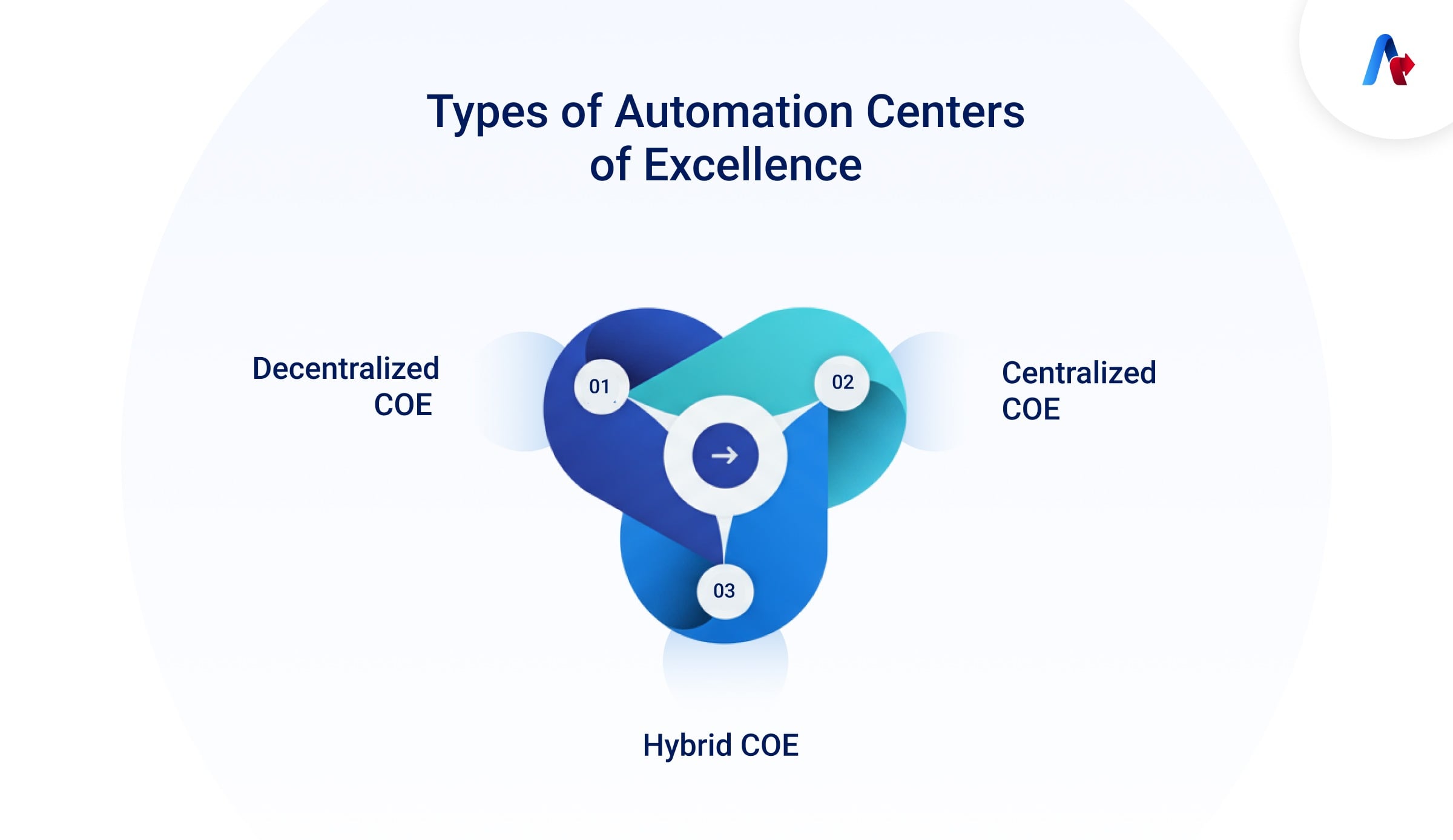
The decision-making structure is the real purpose of creating a COE in an enterprise. So, before building one, you should know how to structure them. Understand that there is no universal model for this, but the structure depends on size, model and maturity of automation.
1. Decentralized COE
In this model, you can see multiple COEs operating in different business units. Here, each department manages its own automation initiatives. This structure is good and works well when teams have unique processes and need agility.
The decentralized method is much faster because automation teams sit close to business stakeholders. However, the main disadvantages of this method are duplication of work, automation silos, an inconsistent framework, and limited visibility.
If you are an organization adopting AI agents, this model poses challenges for governance and risk management.
2. Centralized COE
This method is different from the above as they work under a single body. All the automation efforts flow through this central team.
A centralized model can offer transparency, improve standards, and help with scalable deployment across business units. When implemented, it avoids confusion and simplifies maintenance. If collaboration among teams and departments is weak, implementation can be slow.
For any enterprise building an automation center of excellence 2.0 with AI agents, a centralized approach is the right choice, as it can improve AI oversight, compliance, and cross-system orchestration.
3. Hybrid COE
It is a combination of the centralized and decentralized models. A centralized COE controls standards, tools, and governance frameworks, while business units execute automation initiatives locally based on their requirements.
This approach is faster with a central control, allowing teams to innovate at the business level while maintaining enterprise-wide alignment. It fits for any business that is transitioning toward AI agents. A hybrid model is a practical method where you get scalability without compromising regulation.
COE Agents: How It Differs from a Traditional Automation COE
At first glance, both models may look similar. They both can scale automation, enforce governance, and deliver business value. The traditional method is rule-based, but the automation center of excellence 2.0 with AI agents is adaptive and intelligent. It is also the shift from automation management to intelligent orchestration.
Shift 1: From Task Automation to Decision Automation
The traditional COE for automation focuses only on rule-based tasks. This method has completely changed with the automation center of excellence 2.0 with AI agents. Here, the focus completely changed from decision improvement to autonomous execution. Through agentic automation, companies can evaluate context, interpret data, and choose actions.
Shift 2: From Control-Based Governance to AI Governance
Earlier COEs mostly emphasized bot access control, version management, and infrastructure stability. Now, governance and standards must include transparency, bias detection, data compliance and continuous performance monitoring.
Shift 3: From Linear Lifecycle to Continuous Learning
RPA bots just follow a build, deploy and maintain cycle. AI automation requires ongoing validation, performance drift monitoring, retraining cycles and cross-agent orchestration. The lifecycle becomes dynamic with a new method.
Shift 4: From Cost Savings to Strategic Value
The conventional COEs measure hours saved, but the automation center of excellence 2.0 assesses decision quality, risk reduction, business speed, and impact on the business. It moves from a support function to a strategic capacity.
Traditional COE vs. AI-Driven COE 2.0
The role of the center of excellence has changed after the arrival of AI agents. If you want to understand the difference between traditional and AI COEs, the following comparison can provide clearer clarification.
| Aspect | Traditional COE | AI COE |
|---|---|---|
| Decision-Making | Rules based | Contextual and autonomous |
| Scalability | Limited due to its predefined logic | Scale dynamically with learning model |
| Governance | Process-level governance | AI governance with monitoring, risk controls, and compliance |
| Learning capability | No learning capability. Only manual updates | Learn from data and feedback |
| ROI | Quick wins but slow later | Compounding ROI through optimization |
| Risk management | Focus only on operational risk | Provide AI ethics, bias, compliance, and explainability |
Why Enterprises Are Redesigning Their Automation COE for Agentic AI
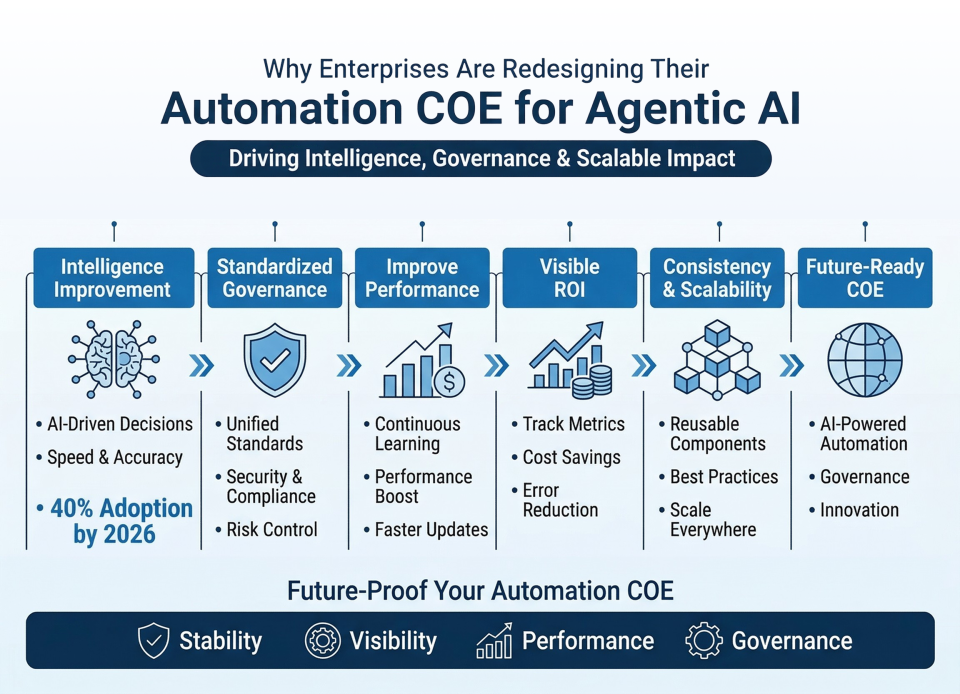
You might think, " Why should we move to reshape our existing COE as it works properly? The question is logical, and enterprises are not moving to the new since the old method is not working. The shift is happening because automation is evolving. Since agents enter the workflow, they play a vital role in today’s business decisions and offer greater stability, visibility, and governance.
Intelligence Improvement
Intelligent automation already proved its ability in many areas, such as finance, cruise, and insurance, with speed, accuracy and visibility. “Gartner predicts that 40% of companies will use task-specific AI agents in their applications by 2026, which was less than 5% in 2025”. It means that AI-driven decisions are not optional but a necessity to improve performance.
Standardized Governance
Supervision is a major challenge when companies use agents, and it becomes even riskier when multiple teams use them differently. COE automation can change this by providing standardized development, maintenance, and accountability, and by ensuring it meets all security requirements before production.
Improve Performance
An automation must improve over time based on the feedback, and it should be updated when a new version comes out. With the automation center of excellence, this practice will become a standardized process, so it can be improved in the next update. This continuous improvement helps improve performance and documents everything as a standard process.
Visible ROI
There is always a question from the leadership: What is the ROI of this COE with agents? This method helps you track value through metrics and other criteria, so teams can always defend themselves to the leaders. Now, it is easy to show the time saved, reduced errors, cost avoided and the level of accuracy in the results.
Improve Consistency and Scalability
Automation COE managers should understand that scaling is not about building more automations. It’s about building artificial intelligence and multiplying its value everywhere as we move on. This is where this method can help with reusable components, templates, and practices, and avoid creating similar automation that wastes time and money.
Core Components of an Automation Center of Excellence 2.0 with AI Agents
Building an automation center of excellence with AI agents is not a typical tool addition section. It requires many components that support scalability, intelligence, and measurable outcomes. Let's see the core pillars of this process.
1. Automation Roadmap
AI-driven automation needs a clear direction for scaling. With AI, it becomes more intelligent and sustainable. The COE begins with clarity on certain things, such as:
- Business automation vision and objectives
- Prioritization framework (value vs. complexity)
- AI agent deployment strategy across functions
- Budgeting and investment in governance and standards
- KPIs, cost, risk, and efficiency
2. Enterprise Framework for AI Agent Governance
AI agents are not like their predecessors, so they require structural oversight. This component defines:
- Role-based accountability
- AI ethics and compliance standards
- Model validation and performance monitoring
- Risk and audit mechanisms
“According to Deloitte, any organization with formal AI governance frameworks sees a 28% increase in staff use and experiences revenue growth of nearly 5%.”
3. Agent Development and Orchestration
This is the execution engine of the automation center of excellence 2.0 with AI agents. This coordination move shifts from single-bot production to orchestration that values more. And these details should include:
- AI agent design and lifecycle management
- Multi-agent coordination
- Integration with enterprise systems
- Continuous optimization and retraining
4. Value Realization and Maturity Tracking
A modern COE with agentic AI must measure more than hours saved. Here, it should have a clear performance indicator that tracks:
- Decision accuracy
- Business impact
- Replication across units
- COE maturity model for AI adoption
Building this model with agents requires the right structure, execution plan and expertise.
Let’s design your COE roadmapMinimum Team Requirement For the COE
A team of experts is vital for moving with the center of excellence (COE). Many organizations upskill existing employees through automation training and special capability programs. This capacity building must cover at least three areas, such as:
- Development – Process identification, documentation, optimization, and automation build (for RPA and AI agents).
- Operations & Support – Infrastructure management, performance monitoring, governance, and technical support.
- Communication & Change – Internal awareness, training, and adoption management.
How Many People Do You Need to Run a COE?
It is good to have 4– 5 COE team members in an organization that includes:
- Automation Strategist - Learn about relevant automation and close the gap between teams and COE.
- Automation Sponsor - Responsible for time investment and money based on the value proposition.
- Automation Architect - Design IT infrastructure for automation projects and checks tools and technologies.
- Automation Developer - A knowledgeable person in development who implements accordingly.
- Automation Manager - Take initiative to move from the COE to the department and help them with the transformation.
When it is for a mature organization, the team can expand to 10–25 or more members covering governance, AI oversight, architecture, security, and performance management. In short, it depends on your organization's size and maturity.
Enterprise Use Cases for COE with Agents
The value of the automation center of excellence 2.0 with AI agents becomes powerful when it moves beyond pilots. Automation is not built for repetitive tasks; instead, it can be used across different decision-making workflows in your organization.
Finance Decision Support
Finance is one of the areas where automation is greatly helpful. With a coordinated effort, agents support invoice validation, anomaly detection, cash flow forecasting, and policy compliance monitoring. Apart from these tasks, it can also analyze patterns and flag risks in real time to improve accuracy and reduce manual review.
IT & Operations Management
A smart AI agent in IT and operations sorts service tickets, identifies root causes, and triggers automated remediation. Automated coordination like this can reduce manual escalation and downtime.
Intelligent technology also looks across areas such as infrastructure, applications, and networks to detect hidden patterns that humans might miss. This ability of agents can predict maintenance and prevent incidents before they affect your business operations.
Customer Experience
This method is very helpful in customer handling. AI-driven systems categorize requests, recommend responses, personalize interactions, and escalate only if the problem is complex. Now, human agents do not want to spend more time on simple matters and instead focus on what is essential.
HR Workflow Orchestration
The human resources department can benefit a lot from the COE team. The team can streamline onboarding, track compliance, manage documentation, validate data, and guide employees with different actions and workflows. When it works with AI agents, it improves efficiency and productivity across departments with a coordinated effort.
ROI of Automation Center of Excellence with Agentic AI
Automation COE managers don’t invest in experimentation alone. They invest in time for measurable returns and value. The automation center of excellence 2.0 with AI agents delivers ROI through cost savings and smarter decisions. Let’s explore the benefits of COE with agents.
Reduce Operational Costs
You see many works in the organization that encroach on employees' time. That's where it really helps, reducing manual work. More than that, a team also uses AI agents to minimize rework and reduce dependencies when human intervention is frequent. When deployed strategically, this not only helps reduce costs but also saves time.
Faster Process Cycle Times
Working with cross-departmental teams takes more time, and that may cause a delay in deployment. Agent orchestration with automation avoids delays between departments, especially where multiple approvals are essential. This process can now be handled effectively by the agentic automation COE.
Reduce Risk and Strengthen Compliance
There is risk everywhere, but with the center of excellence and artificial intelligence, you can take proactive actions. A team can now continuously monitor transactions, flag anomalies, and enforce policy rules. Autonomous agents don’t skip any steps and provide maximum protection against risks and compliance.
Ongoing Optimization
A traditional COE automation cannot adapt, whereas an automation center of excellence with agentic AI can continuously optimize as it moves forward. They learn from the data and metrics and improve over time. Agents also provide reusable components and templates that are useful across business units.
Workforce Optimization
Optimizing the workforce is the most important part of a business. With the COE in hand, enterprises can reallocate the workforce to high-value tasks. Here, the routine work will go for agents, whereas the employees focus on strategy, innovation and customer engagement.
An enterprise gets the real ROI if it implements COE from the start. A strong foundation makes scaling easier and safer.
Start your AI COE journey todayFuture of Automation Centers of Excellence in the Era of Autonomous Enterprises
The discussion of the AI center of excellence is a valid point. This effort automates tasks, orchestrates decisions and improves the overall productivity of each enterprise. It is now working as a control tower for this transformation and boosting its adoption.
A Move from Automation to Autonomy
Traditional COEs with RPA-optimized workflows. The next generation of agents will manage intelligent ecosystems where AI works across all industries, including finance, IT, operations, HR, and customer service. COEs will shift from governing bots to governing autonomous decision systems. That’s a real change you can expect from this shift.
Human + Agent Workforce Models
The future of work is not fully automated enterprises. It’s human-supervised autonomy. A collaboration is necessary here, as AI can handle repetitive work, and humans will provide the necessary details and override if there is an emergency.
What AI agents can help with?
- Recommend actions
- Execute routine decisions
- Escalate exceptions
AI Governance Advantages
With the automation center of excellence 2.0 with AI agents, companies can get access to AI governance early. Those who don't use this face compliance exposure and trust issues.
This is where your COE becomes more essential because it is a:
- A strategy implementor
- A risk controller
- A value accelerator
Build Your Automation Center of Excellence with AI Agents Now
Companies are already using AI agents, and moving it to them will help with several benefits. If you are already using them, it is a good idea to use COE to improve scalability and reduce risk.
The center of excellence is an advantage for governing AI, scaling confidently, and unlocking the right business outcomes. Adding this model with automation means not adding a new tool to your list; it is a disciplined method in which AI operates with accountability, transparency, and responsibility.
If you’re serious about building a future-ready COE automation strategy, you are in the right place. With the Accelirate partnership, an organization can design an automation center of excellence 2.0 with AI agents that scale confidently. Take a step now and be an enterprise that looks beyond just implementing automation.
Ready to build your COE with agents? Connect to our team and learn how we can help you build one of your own.
Book a free call todayFAQs
Any Industry with high transaction volumes, strict compliance requirements, and complex workflows can benefit the most from the COE. Industries such as finance, healthcare, insurance, manufacturing, and retail achieve better results. With agents' support, these sectors can improve decision speed, reduce risk, and scale automation across their core operations.
It provides a structure, governance, and measurable accountability for automation initiatives in enterprises. Through this, you can standardize development, track ROI, and ensure security and compliance. An excellence center with AI agents goes further, strengthening enterprise strategy and creating better value.
A conventional method focuses on rule-based automation and task execution. This is completely when you use the automation center of excellence 2.0 with AI agents. This method of COE makes decisions on its own and adapts with limited human intervention. It also includes AI monitoring, risk controls, and orchestration, so it is better than a traditional COE.
The pilot is the first initiative of an automation effort. Once satisfied, companies move to a full-scale adoption, and then you can begin with the COE. Early adoption helps a lot, and companies get a standardized method for their use, handling, escalation and value measurement. COE 2.0 can prevent duplication, reduce risk, and ensure automation scales across the entire department without any problems.
Yes, in most cases you should do that. If your current COE manages automation standards, security, and performance, you can include AI. However, introducing AI agents needs monitoring, accountability, and clear governance. Many companies choose to upgrade their existing COE rather than create a separate team for autonomous agents.
Identify business goals first and ensure support from the leadership. Later, create simple rules for governance, security, and performance. Build a small team with 4 to 5 members and train them on the needs. Start with a few high-impact projects, track results, and improve as you scale. Make sure you have control, visibility and check the ROI.