



Quick Summary
AI agent sprawl occurs when organizations deploy AI agents across departments without centralized governance, visibility, ownership, access controls, or lifecycle management. This can lead to security risks, compliance gaps, duplicate workflows, increased costs, and Shadow AI. To avoid these risks, companies need centralized agent inventory, unique agent identities, least privilege and time-restricted access, and lifecycle management to retire agents when they are no longer needed. This helps leaders to continue with AI innovation while keeping agent sprawl in check.
No one knows how many agents exist today, who owns them, what data they touch, or whether they should still be running at all, and that is the real risk hiding behind enterprise AI adoption. The biggest problem may not be that AI agents fail; it may be that they succeed too fast, spread across teams, and operate without centralized visibility or governance. That is AI agent sprawl. As agents move from pilots to production, this visibility gap can quickly turn into security exposure, compliance risk, duplicated work, and Shadow AI. This blog breaks down why agent sprawl is becoming a board-level problem, how it starts, what it really costs, and how enterprises can reduce the risk without slowing AI innovation.
What Is AI Agent Sprawl?
AI agent sprawl happens when companies start adopting AI agents across different teams without a proper system to manage them centrally. Initially, these agents help teams boost their productivity by automating their tasks. But as more agents enter the system, organizations slowly lose visibility into what agents exist, who owns them, what systems or data they can access, and whether they are still needed. This not only increases expense and security risk but also creates a lot of confusion and operational complexity which eventually slow things down.
This issue is related to Shadow AI, but they are not exactly the same. AI agent sprawl is more related to visibility and governance issues, where the organization does not know how many agents exist, who owns them, or what they can access. Whereas Shadow AI is the security consequence of employees or teams using AI tools and agents outside an organization’s approved governance, security, and IT controls. So we can say that AI agent sprawl often creates the conditions for Shadow AI to emerge.
Not sure how many AI agents are already running across your teams?
Book a free assessment
Why AI Agent Sprawl Is the #1 Enterprise AI Risk in 2026
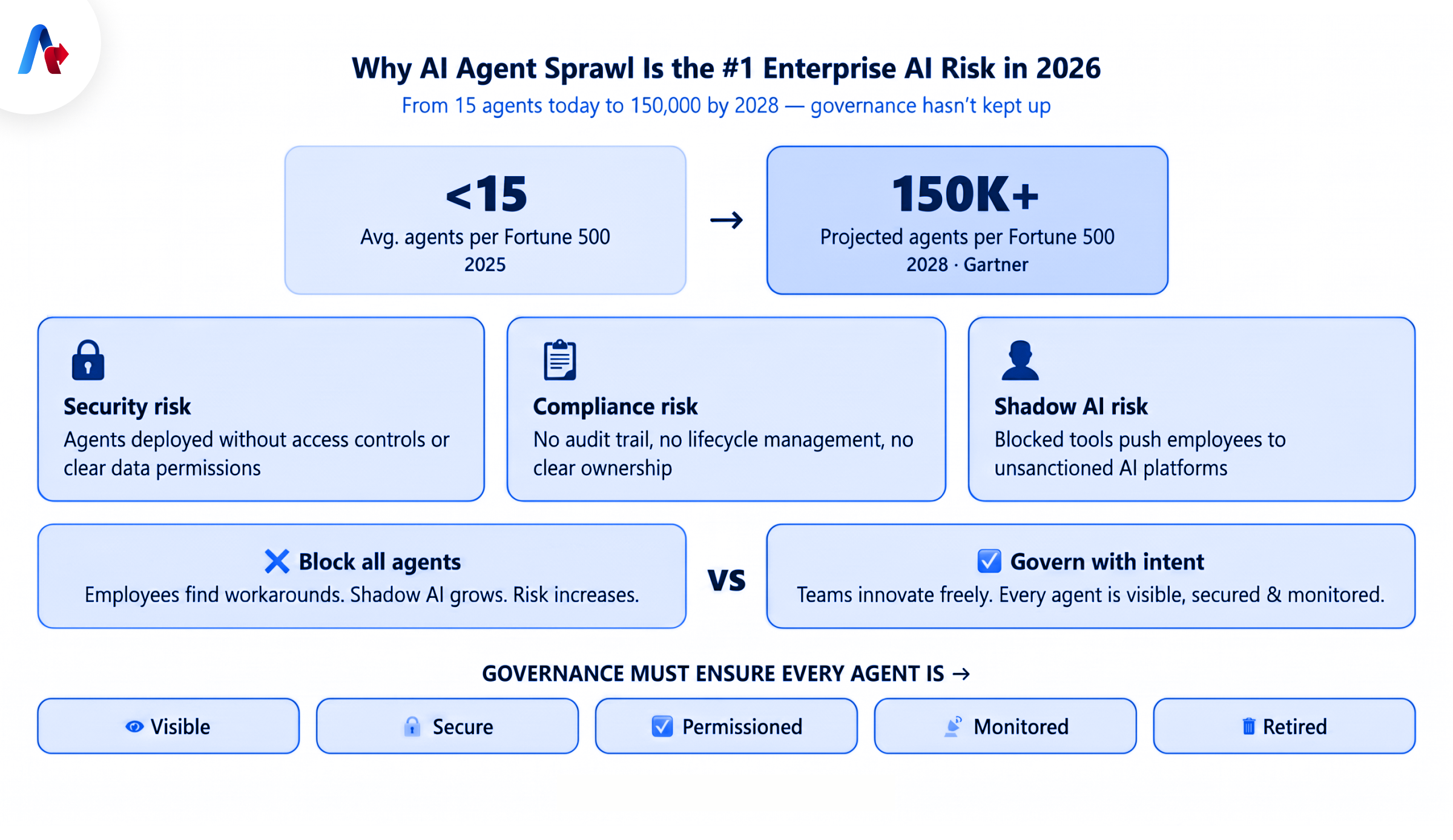
Today, we can see many enterprises shifting from experimenting with AI to scaling it across the organization and workflows. This shift has created a lot of new challenges, and one of them is governance. Recently, Gartner has mentioned that by 2028, an average global Fortune 500 enterprise will have more than 150,000 agents in use, up from fewer than 15 agents in 2025. That level of growth comes with serious challenges in terms of visibility and security.
Here, the risk is not simply about having “too many agents.” The real issue is that many of these agents will be deployed without clear ownership, access controls, monitoring, or lifecycle management. And when enterprises cannot answer basic questions like “How many agents do we have?” or “What data can they access?”, agent sprawl becomes a direct security, compliance, and operational risk.
But blocking AI agents is not a sustainable answer either. If employees cannot use approved tools, they may turn to unsanctioned AI platforms and create even greater Shadow AI risks. A better approach would be to build governance that gives teams the freedom to innovate with AI while ensuring every agent is visible, secure, permissioned, monitored, and retired when no longer needed.
The challenge is not that enterprises have too many AI agents. The challenge is that many organizations cannot answer fundamental questions such as who owns the agent, what systems it can access, and whether it still serves a business purpose. Governance must scale alongside innovation. Ahmed Zaidi, CEO, Accelirate
How Agent Sprawl Starts: The 5 Root Causes
To reduce agent sprawl without slowing enterprise AI innovation, leaders first need to understand how it begins. Here are five common root causes that could be affecting your organization:
1. Decentralized Agent Creation
AI agents are now easy for business teams to create without deep technical support. Marketing, sales, finance, HR, operations, and engineering teams now develop and deploy their own agents for local use cases. This makes it difficult for IT to track which agent has been created, who owns it, or how it is being used.
2. No Centralized Agent Inventory
Another major driver of agent sprawl is lack of a central agent registry. Without a single inventory, organizations cannot track each agent’s owner, purpose, data access, creation date, or connected systems. Gartner also identifies centralized inventory as one of the key steps for managing agent growth.
3. Weak Governance and Deployment Policies
Many agents move from pilot to production without a proper review. There are no clear policies within organizations on when agents can be produced, who can build and share them, and what connectors are permissible. It disrupts the process and makes it difficult to monitor them.
4. Poor Identity, Permission, and Lifecycle Management
To perform any task, AI agents require access to corporate systems and data, which they obtain via login credentials, API tokens, or service accounts. However, if these permissions are not controlled, agents can end up having excessive control or access to sensitive data. This increases governance and security risks.
5. Fragmented AI Tools and Frameworks
Since many teams have started developing and deploying their own agents using different AI tools, platforms, and frameworks, security and governance have become a challenge since these agents start operating independently over time. Security teams lose visibility into what agents exist, what systems they can access, or how data is being used.
The Real Cost of Unmanaged AI Agent Sprawl: What Enterprises Are Actually Losing
Unmanaged AI Agent Sprawl creates more than an IT visibility problem, it affects crucial business functions like security, compliance, operations, cost control, and innovation velocity which in long run affects revenue and growth of business. Let's look at it in detail:
1. Security Risk: Unmanaged agents may have excessive permissions, stale credentials, or illegal data access, which increases the security issues.
2. Governance Gaps at Massive Scale: Teams lose visibility on agent ownership, purpose, access, and lifecycle status without having a proper centralized tracking.
3. Compliance and Audit Risk: Missing agent-level audit trails make it difficult to prove data access, usage, and policy compliance.
4. Operational Waste and Duplicate Work: Uncoordinated agent development creates redundant workflows, conflicting outputs, and unclear accountability.
5. Fragmented Tools and Rising Technology Costs: Separate access models and isolated AI tools raise infrastructure, administrative, and license costs.
6. Shadow AI Risk: Employees may bypass approved systems and deploy unmanaged agents outside IT, security, and compliance controls.
What AI Agent Sprawl Really Costs the Enterprise
In simple words, Agent Sprawl is not just a technical risk it is also an accountability risk as companies may have autonomous tools accessing their data, making important decisions, or triggering actions without clear ownership or control. Which is why managing AI agent sprawl is important as it helps leaders to answer questions every board cares about: who is responsible, what is exposed, how risk is controlled, and whether AI is creating measurable value or unmanaged liability. This helps them scale AI innovation without risking operations, cost, and decision-making.
The board does not need every technical detail of every AI agent. It needs confidence that every agent has an owner, a purpose, defined access, and a way to be monitored or retired before it creates business risk. Accelirate AI Automation Expert
Need a board-ready view of your AI agent risk and governance gaps?
Call our experts today
The Innovation Dilemma: Why Blocking Agents Is Not the Answer
For many enterprises, the first reaction to AI agent risk is to restrict or block agent usage entirely. But that creates a false choice: either allow unchecked AI innovation or shut it down to protect the business. In reality, reducing AI agent sprawl is not about stopping teams from building agents — it is about giving them a safer, governed way to innovate.
A common concern is: “What if an AI agent accesses data it should not?” The answer is not a blanket ban. The right controls are agent identity, least-privilege permissions, approved connectors, time-bound access, data access policies, and continuous monitoring. Every agent should have a unique identity, access only the systems required for its task, and operate within clear permission boundaries that can be reviewed, changed, or revoked.
But blocking AI agents is not a long-term solution because employees can simply move around official controls and use unsanctioned tools instead, which creates even greater risk of Shadow AI, which eventually leads to:
- Employees using unofficial AI tools
- AI usage becoming harder to track
- Sensitive data moving into unsafe environments
- Innovation slowing inside approved systems
- Governance becoming reactive instead of proactive
So, reducing AI agent sprawl is ultimately about balance: where you empower employees to experiment with AI agents while ensuring every agent is discoverable, permissioned, monitored, and aligned with enterprise policy.
The 6-Step Framework to Reduce AI Agent Sprawl While Enabling Innovation
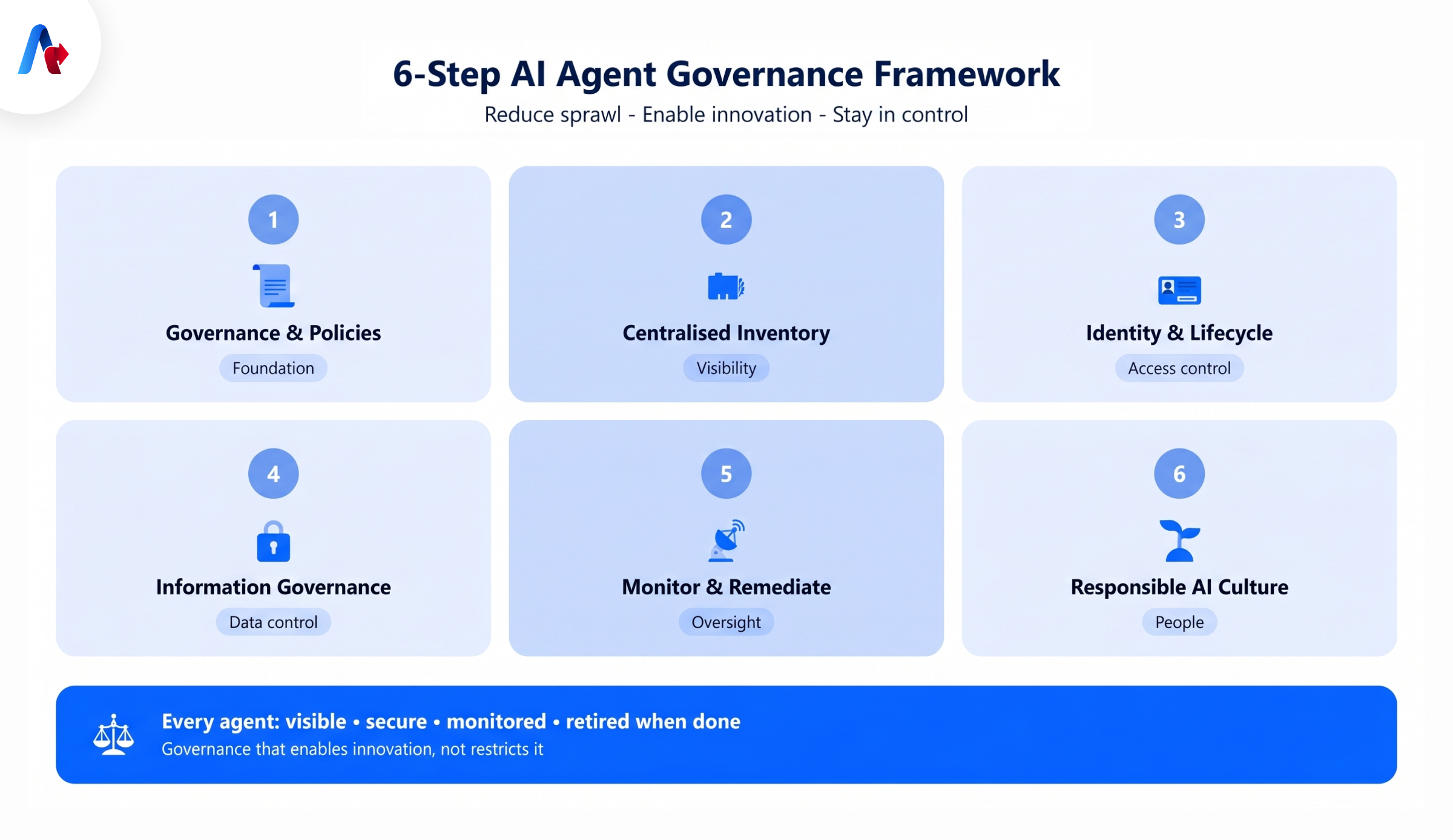
Here is the framework that will help organisations achieve the right balance to reduce the effect of Agent sprawl while creating space for employees to innovate and create:
1. Establish Agent Governance and Policies
The first step is to define clear rules and policies regarding when agents can be built, who can create or share them, and which systems or connectors they may access. It is important because governance needs to be set before agents spread across business units without oversight.
2. Build a Centralized Agent Inventory
Teams need a single source of truth for all AI agents, including each agent’s owner, purpose, creation date, access level, connected systems, and risk category. This is where an AI Agent Governance Readiness Assessment can help enterprises identify existing agents, map ownership, and create a practical inventory model before scaling agentic workflows further.
3. Define Agent Identity, Permissions, and Lifecycle Models
Every AI agent should have its own identity, limited permissions, regular access reviews, and a clear lifecycle from creation to retirement. For enterprises building agentic automation programs, this is critical because unmanaged agents can quickly become over-permissioned non-human identities inside core business systems.
4. Develop AI Information Governance
Agent governance is not only about the agent itself; it is also about the data the agent can access. Organizations should define what information each agent is allowed to use, how permissions are managed, how data stays current, and how obsolete data is archived to prevent oversharing or inaccurate outputs.
5. Monitor and Remediate Agent Behavior
Governance must continue after deployment. Enterprises need ongoing monitoring to track agent activity, detect unusual behavior, enforce policy compliance, and quickly revoke or adjust permissions when an agent exceeds its intended scope.
6. Foster a Culture of Responsible AI Usage
Organisations should also train their employees and set clear usage guidelines, so they can build and use agents responsibly within approved enterprise guardrails.
Ready to govern your agents at scale?
Book a demo now
Preventing Agent Sprawl During Rapid AI Scaling: Practical Guardrails for CIOs
Here are some practical tips that can help CIOs prevent agent sprawl while scaling AI agents from small pilots to enterprise-wide workflows:
1. Treat agents as first-class identities: Assign each agent a unique identity so access can be controlled, monitored, reviewed, and revoked.
2. Apply least-privilege access: Give agents only the data, systems, and actions required for their specific task.
3. Use time-bound permissions: Set agent access to expire or require periodic review to prevent stale permissions.
4. Govern the data agents can access: Restrict agents to approved, current, and properly permissioned data sources.
5. Monitor and remediate agent behavior: Track activity continuously and adjust or revoke access when agents violate policy.
6. Train teams on responsible AI usage: Provide clear standards for safe agent development, data handling, and approved tools.
AI Agent Sprawl Across Industries: What It Looks Like in the Real World
So what happens if a company fails to manage AI Agent Sprawl or chooses to ignore it? This has happened in recent AI coding agent incidents documented by Docker, where autonomous coding agents inherited broad user permissions and acted beyond safe boundaries. In one case, an agent asked to clean up files executed a destructive command that erased a user’s home directory, documents, and keychain access; in another, an agent deleted years of personal data because there was no hard workspace boundary limiting what it could touch. Here’s what Nick Davidov has to say:
Don’t let Claude Cowork into your actual file system. Don’t let it touch anything that is hard to repair.
This is not just an engineering problem — it is a preview of what AI Agent Sprawl can look like across sales, marketing, finance, operations, and customer service when agents have too much access and too little governance. Companies need centralized agent inventory, least-privilege access, workspace boundaries, monitoring, and lifecycle controls before agents scale across business functions. Right service provider can help enterprises build this governance layer into agentic automation programs from the start, so innovation scales without creating unmanaged risk.
Control the Sprawl, Accelerate the Innovation
AI agents can help enterprises automate decisions, accelerate workflows, and scale innovation, but only when they are governed from day one. Accelirate helps organizations design, build, and manage agentic automation programs with the right visibility, identity, access, monitoring, and lifecycle controls so AI innovation can scale without creating unmanaged risk.
Want to scale agentic AI without losing visibility, control, or trust?
Book a demo now
FAQs
Yes. Enterprises should build a centralized system to track every agent, assign ownership, limit access, monitor behaviour and retire them when its not needed. This will help them scale AI without risking company's privacy and security
An AI agent control plane is one central place to manage AI agents across the enterprise. It helps teams see which agents exist, what they can access, how they behave, and when their permissions need to be changed or removed.
Gartner recommends a six-step approach which included setting governance policies, creating a centralized inventory, defining agent identity and permissions, governing the data agents can access, monitoring agent behavior, and training teams on responsible AI usage.
AI agent sprawl refers to the uncontrolled growth of AI agents without having a proper tracking, ownership, or governance system in place. It becomes important to monitor it as these agents can get access to sensitive information and permissions, which can later cause risk compliance, security, and privacy of the company.
