



Quick Summary
The market is growing quickly. Automation vendors, cloud providers, CRM platforms, and AI-native companies are all introducing agentic capabilities. Many sound similar on the surface, but they are designed for very different enterprise needs.
Therefore, the right choice comes down to how your enterprise operates today: the systems you rely on, the processes you want to improve, the level of governance you need, the skills available in-house, and where you want your automation strategy to go next. And today we are comparing nine of the top agentic AI platforms in 2026.
When we talk about the state of enterprise AI in 2026, there has been a major shift beyond chatbots and pilots. AI agents are no longer just being built by enterprises. They are successfully taking the lead by running and approving business processes and systems, with human involvement where necessary.
That is why an agentic AI platform becomes important. These platforms help enterprises build, deploy, connect, monitor, and govern AI agents. They give AI agents the foundation to move between systems, make informed decisions, respond when something unexpected happens, and carry out multi-step work while staying within the company’s rules.
Today we are comparing nine of the top agentic AI platforms in 2026:
- Accelirate
- UiPath Agentic Automation Platform
- Salesforce Agentforce Platform
- Microsoft Power Platform
- Automation Anywhere
- Google Cloud Vertex AI Agents
- Moveworks
- Relevance AI
- Aisera
What Is an Agentic AI Platform?
An agentic AI platform is a software environment used to build, deploy, coordinate, and govern AI agents. An AI agent can understand a goal, retrieve information, decide what to do next, use tools, act, and adjust based on the result. The platform provides the structure around that agent.
The enterprise agentic AI platform structure usually includes agent-building tools, AI model access, enterprise data connections, workflow orchestration, memory and context management, business rules and guardrails, human approval steps, testing and monitoring, security and access controls, audit trails, APIs and connectors and Agent lifecycle management.
For example, an individual agent may review an invoice and identify missing information. An enterprise agentic AI platform can help that agent retrieve the purchase order, compare records, apply approval rules, update the ERP, contact the right employee, and escalate the case when required. That difference matters.
Build Enterprise AI Agents with Confidence
Talk to an AI ExpertHow Agentic AI Platforms Work
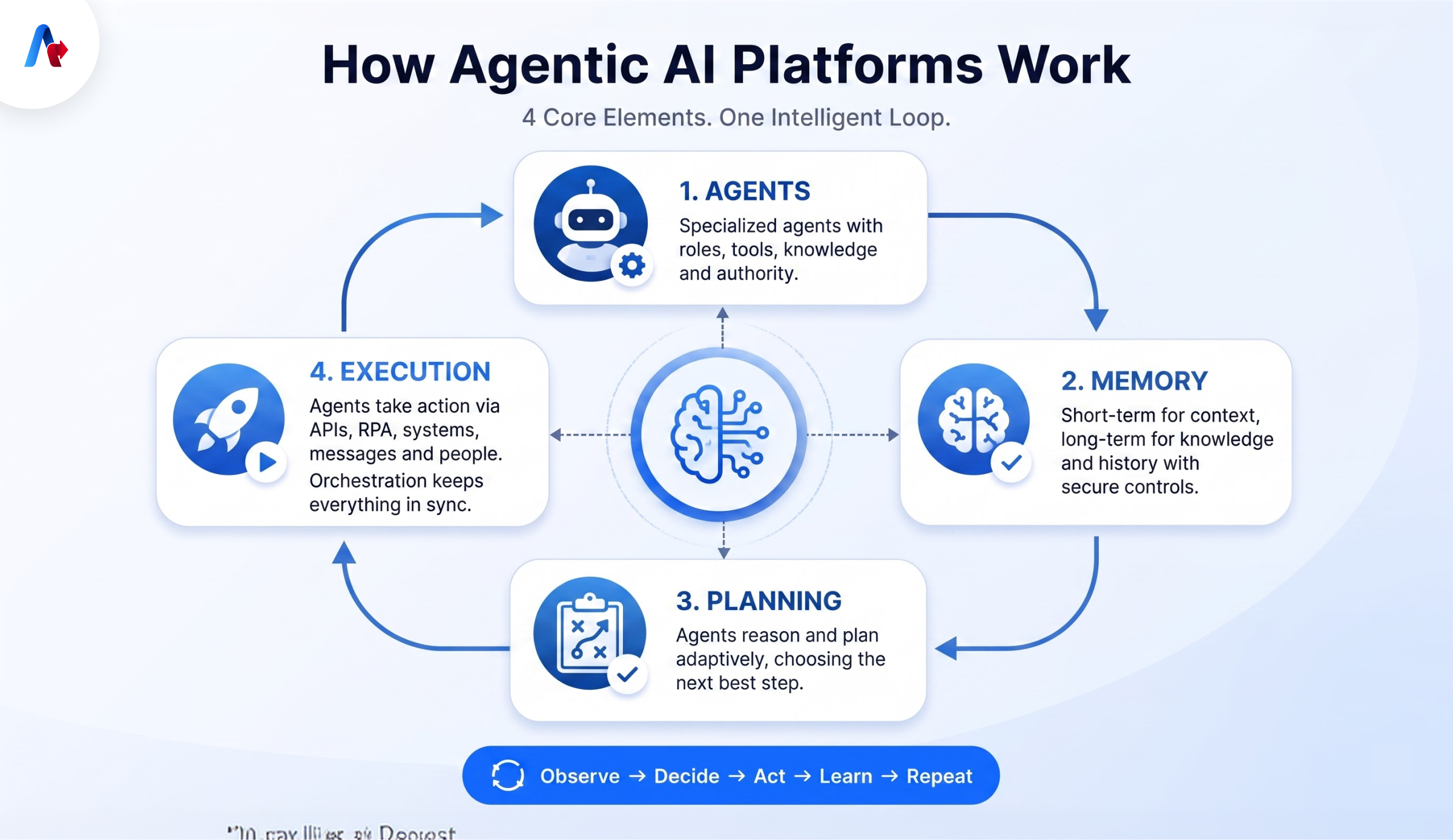
Most agentic platforms combine four core elements: agents, memory, planning, and execution.
Agents
Agents are assigned a role, objective, set of tools, knowledge sources, and level of authority. For an example, finance agent picking apart an invoice exception, a customer service agent untangling an account issue, a healthcare agent checking eligibility or pushing a prior authorization through, each one specialized, each one handling the kind of work that used to eat up someone's whole afternoon.
In more mature setups, several specialized agents can work together, each handling a different part of the process.
Memory and Context
Context is everything for an agent trying to make the right call. Short-term memory is what keeps it on track mid-task or mid-conversation, the working memory that stops it from wandering off course. Long-term memory is the deeper layer: past interactions, earlier resolutions, process history, business knowledge the agent can reach back for when it's relevant.
But memory without boundaries is a liability. Platforms need real controls over what an agent can remember, where that data sits, and who has access to it. Context, used well, sharpens decision-making. Context that's unmanaged just opens the door to privacy issues and bad calls.
Planning and Reasoning
Good planning is what bridges the gap between "here's the goal" and "here's how to actually get there."
An invoice agent, for instance, might work through something like:
- Flagging what's missing
- Retrieving the related records
- Comparing documents against each other
- Running the relevant business rules
- Requesting any outstanding details
- Routing the case for approval
- Updating the finance system
What sets this apart from a fixed workflow is flexibility, the agent adapts its next move based on what it uncovers, rather than marching through a predetermined script no matter what.
Execution and Orchestration
This is where thinking becomes doing. Depending on the setup, an agent might call APIs, kick off RPA bots, update systems, send messages, create records, or pull in a human when something needs a real decision.
Orchestration is what keeps it all working as one system, the agents, people, software, automation tools, all moving in sync instead of pulling in different directions. It also remembers where a process left off, so a delay, error, or escalation doesn't mean starting from zero.
Key Features to Look for in the Best Agentic AI Platforms
Comparing agentic AI platforms on model access and demo polish alone tells you almost nothing. What changes the ROI is how the platform behaves once it's live and under real pressure.
Multi-Agent Orchestration
Look for agents that can genuinely work together like handing off tasks, sharing context, pushing toward a shared outcome. This becomes critical the moment a workflow spans finance, operations, IT, customer service, compliance, or any combination of departments.Enterprise Integrations
The enterprise agents need to enter in the work environments. This include agent connections to CRM, ERP, ITSM, HR platforms, databases, document repositories, APIs, and legacy or automation tools.Governance and Observability
Teams need to be able to answer basic questions: what did the agent do, why, what data did it touch, which tools or models were involved, did a human approve it, and what came of it. The must haves include Audit trails, role-based access, monitoring, policy enforcement, decision tracing.Human-in-the-Loop Controls
Full autonomy to the tech cannot be the right call. The best platforms let enterprises set clear boundaries around when an agent can act alone. When it needs a human to weigh in, it should come with full context.Exception Handling
Actual enterprise processes rarely go according to plan sometimes the data goes missing, records duplicate, systems go down, policies hit edge cases nobody accounted for. A platform built for production should be able to hold its place, retry, reroute, ask for what it's missing, or escalate, without losing everything it's already done.Model Flexibility
Different jobs call for different tools. Heavy reasoning might need a more capable model; simpler extraction or classification tasks can run on something leaner and cheaper. Being able to mix and match models gives you better cost control and more room to adapt over time.Security and Compliance
Agents frequently deal with customer records, employee data, financial information, and regulated documents. That calls for serious attention to identity controls, encryption, data residency, retention rules, auditability, environment isolation, and the compliance certifications your industry requires.Testing and Lifecycle Management
Testing, evaluation, versioning, controlled deployment, rollback, ongoing monitoring, a good platform supports all of it. Building something that works once is the easy part. Keeping it working as policies, systems, and business needs shift is the actual test.
Why Enterprises Are Investing in Agentic AI Platforms in 2026
Traditional RPA is still the right tool for predictable, rules-based work. Embedded AI sharpens individual applications. Copilots speed up how people search, summarize, write, and analyze. But many high-value business processes still cross several systems and require judgment, coordination, and exception handling. This is where agentic AI orchestration platforms create value.
Enterprises are investing in them to:
- Automate more complex workflows
- Reduce manual coordination
- Improve response and processing times
- Extend existing RPA and application investments
- Handle more work without matching headcount growth
- Improve consistency and visibility
- Move AI from pilots into governed production
- Connect agents, systems, automation, and people
The buying conversation is changing as well. Enterprise leaders are asking fewer questions about whether an agent can generate a good response and more questions about whether it can operate securely, reliably, and economically at scale.
Top 9 Agentic AI Platforms in 2026
1. Accelirate
Accelirate differs from the traditional software vendors on this agentic AI platforms list. Rather than offering only a self-service agent-building product, Accelirate combines strategy, development, orchestration, integration, testing, governance, and implementation around real enterprise processes.
Accelirate works across major enterprise ecosystems, including UiPath, Salesforce, MuleSoft, Microsoft, and other automation and integration technologies. Its broader portfolio includes industry and function-specific solutions for areas such as healthcare, testing, integration, finance, and enterprise operations.
Key Strengths
- Enterprise-focused strategy and implementation
- Experience combining agents with automation and enterprise applications
- Support across major technology ecosystems
- Industry and function-specific solutions
- Guided deployment and managed support
- Strong focus on governance, integration, testing, and measurable outcomes
Potential Limitations
- Accelirate is not a replacement for a broad, open-source developer framework.
- Organizations that only want a standalone visual agent builder or a do-it-yourself experimentation environment may prefer a software-first platform.
- Its strongest fit is with enterprises that need support across architecture, implementation, orchestration, deployment, and scale.
Overall Assessment
Accelirate is a strong choice for organizations looking for more than agent-building tools. It is best suited to enterprises that want a structured path from use-case discovery to governed production deployment.
2. UiPath Agentic Automation Platform
Enterprises expanding from RPA into end-to-end agentic automation
Already running on automation? UiPath let's you bring AI agents into the fold without ripping out everything you've built. This platform brings AI agents, software robots, enterprise apps, and your actual employees together under one roof. Agent Builder is where you create and deploy the agents themselves. Maestro is the piece that ties it all together, coordinating robots, third-party agents, enterprise systems, and human tasks inside a single, governed workflow.
Most enterprises have hundreds of RPA workflows already grinding through structured tasks. UiPath doesn't ask you to throw that away. The robots keep doing what they're good at, and the agents pick up the slack on reasoning, planning, and the messier decisions robots were never built to handle.
Key Strengths
- Mature RPA and enterprise automation foundation
- Agent Builder for creating and managing AI agents
- Maestro to coordinate agents, robots, systems, and people
- Strong UI automation chops
- Built-in human approval and escalation
- A deep bench of existing automation components and connectors
- Cloud or self-hosted, depending on the environment
Worth flagging: UiPath's been investing in self-hosted agentic capabilities lately — good news if you're in public sector or another heavily regulated space with strict deployment rules.
Overall Assessment
UiPath is a natural fit for enterprises with an established automation program. Its strongest value lies in connecting new agentic capabilities with the robots, workflows, systems, and governance structures already in place.
3. Salesforce Agentforce Platform
Best for: Enterprises running customer, sales, service, and operational workflows within Salesforce
Agentforce lives inside Salesforce. You can build agents that draw straight from Salesforce data, business logic, automation, and actions to get real work done across sales, service, marketing, commerce, and everything in between.
For example, a customer files a request, and an agent pulls up the account, checks order history, updates the case, fires off a refund, or escalates it, all guided by your actual company policy. It's not improvising. It's working directly with the data and workflows already baked into Salesforce.
Key Strengths
- Deep, native ties into Salesforce apps and customer data
- Atlas Reasoning Engine for planning and action selection
- Strong fit for sales, service, marketing, and commerce
- Direct access to existing Salesforce workflows, APIs, and business logic
- Familiar ground for Salesforce admins and developers
- Security and permissions inherited straight from the platform
- Built-in testing, analytics, and agent management
Potential Limitations
Agentforce earns its keep when you're already deep in the Salesforce ecosystem. Once key processes start living outside it, spreads across several non-Salesforce systems, you're probably looking at MuleSoft, extra integration tools, or custom dev work to get true end-to-end orchestration.
Overall Assessment
Agentforce is one of the strongest options for Salesforce-centered enterprises. It offers direct access to the customer and business context agents need to take meaningful action.
For organizations outside the Salesforce ecosystem, the decision is less obvious. The platform can still be useful, but buyers should calculate how much integration effort is required before the agent can see the full process.
4. Microsoft Power Platform and Copilot Studio
Best for: Microsoft-centric enterprises and organizations supporting citizen development
Microsoft Copilot Studio is a graphical, low-code environment for building and managing agents. It works alongside Power Automate, Power Apps, Dataverse, Microsoft 365, Azure, Teams, and the broader Microsoft ecosystem.
Organizations can use Copilot Studio to give agents instructions, connect knowledge sources, call tools, trigger agent flows, and publish agents across internal or customer-facing channels. Microsoft also supports autonomous agents that can respond to events and complete work without waiting for a user to begin every interaction.
Key Strengths
- Deep integration with Microsoft 365, Teams, Azure, and Dynamics
- Low-code agent development through Copilot Studio
- Power Automate support for workflow execution
- Dataverse for structured enterprise data
- Strong identity and access management through Microsoft Entra
- Large connector ecosystem
- Human-in-the-loop workflows
- Large connector ecosystem
Potential Limitations
Licensing can become difficult to predict because costs may involve Microsoft 365, Copilot Studio capacity, Power Platform services, premium connectors, Azure consumption, and other components.
The platform is also easiest to adopt when the organization already follows Microsoft’s data, security, and application architecture. Processes spread across competing ecosystems may require more integration work.
Overall Assessment
Microsoft offers a practical path for organizations that want to bring agentic AI into tools employees already use.
Its value is strongest when Microsoft already sits at the center of the digital workplace. In that environment, Copilot Studio can reduce deployment friction and make agent development accessible to a wider group of users.
5. Automation Anywhere
Best for: Enterprises combining cognitive agents with process automation
Automation Anywhere rebuilt its automation platform around what it now stands as Agentic Process Automation, agents and bots working the same process.
AI Agent Studio is the low-code space where you build the agents. The Process Reasoning Engine is what keeps everything on track underneath, juggling goals, context, actions, exceptions, and handoffs as a process moves along.
Key Strengths
- Established enterprise automation foundation
- Low-code agent development through AI Agent Studio
- Process Reasoning Engine for context-aware orchestration
- A strong pairing of agents with deterministic bots
- Human approvals and handoffs baked into the process
- Governance and monitoring across agentic workflows
- Built for structured, exception-heavy processes
Potential Limitations
As with UiPath, delivering a complete agentic workflow here usually means stitching together several platform components, so it's worth sizing up the full architecture and commercial terms rather than evaluating Agent Studio on its own.
6. Google Cloud Vertex AI Agents
Best for: Cloud-first enterprises with advanced AI and engineering teams
Google’s offering has changed significantly in 2026. Vertex AI Agent Builder has evolved into the broader Gemini Enterprise Agent Platform, which Google describes as a unified environment for building, deploying, scaling, governing, and optimizing enterprise agents.
The platform gives technical teams several development options. Agent Studio provides a lower-code experience, while the open-source Agent Development Kit supports more customized and sophisticated multi-agent systems. Agent Runtime, Sessions, and Memory Bank support production deployment, state management, and persistent memory.
Key Strengths
- Strong AI and cloud infrastructure
- Low-code and developer-led building options
- Open-source Agent Development Kit
- Managed runtime for production deployment
- Support for multi-agent systems
- Persistent sessions and memory
- Access to Google and third-party models
- Enterprise security, agent identity, tool governance, and observability
- Strong integration with Google Cloud data and analytics services
Potential Limitations
Google’s platform is technically powerful, but it may require more AI engineering capability than packaged business-user platforms.
The product naming and architecture have also evolved quickly. Enterprises currently evaluating Vertex AI Agent Builder should make sure their roadmap reflects the newer Gemini Enterprise Agent Platform and any related service migrations.
Consumption-based cloud pricing can also become difficult to estimate when deployments involve models, storage, search, runtime, networking, observability, and multiple supporting services.
Overall Assessment
Google offers one of the strongest agentic AI development platforms for organizations that want deep technical flexibility and managed cloud infrastructure.
It is particularly attractive for enterprises already invested in Google Cloud. For business teams seeking a ready-to-use agent for one department, however, the platform may require more engineering than they want to own.
7. Moveworks
Best for: Enterprises modernizing employee support, enterprise search, and internal service workflows
Moveworks helps employees quickly access information and complete internal service requests across IT, HR, finance, and workplace systems. Its reasoning engine understands the request, finds the right information, and triggers the required workflow. Following ServiceNow’s acquisition in December 2025, enterprises should also watch how the two platforms, pricing, and roadmaps come together.
Key Strengths
- Genuinely strong employee-facing conversational experience
- Enterprise search built on permission-aware retrieval
- Enterprise search built on permission-aware retrieval
- Reasoning and orchestration across connected business apps
- Agent Studio for extending and customizing agents
- Deepening alignment with ServiceNow workflows post-acquisition
- Designed for governed, enterprise-scale deployments
Potential Limitations
Moveworks is best suited for employee support and internal service access. Enterprises looking for broader process automation, deeper customization, or customer-facing orchestration may need a different platform. Buyers should also review how the ServiceNow acquisition could affect future packaging and costs.
Overall Assessment
Moveworks is a strong choice for enterprises that want to provide employees with one intelligent entry point for internal support and workplace services.
Its appeal is easy to understand: employees should not need a map, three portals, and a support ticket just to find out which laptop they are allowed to order.
8. Relevance AI
Best for: Teams seeking accessible, flexible, and visual multi-agent development
Relevance AI is a low-code and no-code platform for building individual AI agents and multi-agent teams. Its visual environment allows users to define agent roles, assign tools, connect knowledge, design workflows, and monitor how agents collaborate. The platform calls this broader collection of agents an AI Workforce. This makes Relevance AI attractive to operations, sales, marketing, and customer-support teams that want to build tailored agents without developing the full technical infrastructure from scratch.
Key Strengths
- Visual builder for individual agents and multi-agent teams
- Low-code and no-code accessibility
- Flexible tool, API, data, and model connections
- Strong fit for customized knowledge-work workflows
- Collaborative environment for business and technical teams
- Options for single-tenant and private-cloud deployment
- Faster experimentation than a developer-only framework
Potential Limitations
Relevance AI offers strong flexibility, but enterprises still need to define ownership, maintain integrations, test agent behavior, and set clear governance controls.
Regulated or mission-critical use cases should be validated carefully for auditability, recovery, and support before deployment.
Overall Assessment
Relevance AI is a compelling option for organizations that want to develop customized multi-agent workflows without committing to a fully code-driven framework.
It is particularly useful for teams that value experimentation and flexibility but still want a managed environment for building, deploying, and coordinating agents.
9. Aisera
Best for: Enterprises automating IT, HR, and service-management operations
Aisera is an enterprise agentic AI platform focused on IT, HR, employee support, and service-management workflows. It combines AI agents, enterprise search, workflow automation, and prebuilt service capabilities to resolve common requests, reduce ticket volumes, and improve self-service in high-volume environments.
Key Strengths
- Strong focus on IT and HR service automation
- Domain-specific agents and workflows
- Support for autonomous service resolution
- Integration with enterprise service-management environments
- Employee self-service and knowledge capabilities
- Low-code, no-code, and configurable development options
- Security, governance, and enterprise deployment support
Potential Limitations
Aisera is strongest in IT and HR service management. Enterprises seeking broader automation should validate its orchestration capabilities across other functions.
Implementation may also require significant configuration, integration, and knowledge cleanup despite the availability of prebuilt workflows. documents agree with one another.
Overall Assessment
Aisera is a strong choice for organizations prioritizing IT, HR, and employee-service transformation.
Its domain focus can accelerate these use cases, particularly for enterprises that want to improve self-service and reduce repetitive service requests without developing everything internally.
Agentic AI Platform Comparison: Features, Pricing, and Use Cases
The following table provides a high-level agentic AI platform comparison based on each vendor’s strongest enterprise fit.
| Platform | Primary Strength | Best Fit | Development Approach | Pricing Approach | Main Consideration |
|---|---|---|---|---|---|
| Accelirate | Guided implementation and cross-platform execution | Enterprises seeking tailored, outcome-led deployment | Partner-led with platform flexibility | Custom, project or engagement based | Best for organizations needing execution support, not only software |
| UiPath | Agent, robot, system, and human orchestration | Existing RPA and UiPath environments | Low-code and pro-code | Enterprise licensing and usage based | Platform architecture and licensing can require planning |
| Salesforce Agentforce | Salesforce-native data and workflow access | Sales, service, marketing, and commerce | Low-code and Salesforce development tools | Usage and enterprise licensing based | Strongest value within the Salesforce ecosystem |
| Microsoft Power Platform | Microsoft ecosystem integration and citizen development | Microsoft 365, Dynamics, Azure, and Teams users | No-code, low-code, and pro-code | Capacity, licensing, and consumption based | Total cost may span several Microsoft products |
| Automation Anywhere | Combining reasoning agents with process automation | Automation-heavy enterprise operations | Low-code and enterprise development | Custom enterprise pricing | Evaluate the full platform, not Agent Studio alone |
| Google Cloud Vertex AI Agents | Technical flexibility and cloud-scale AI development | Google Cloud and engineering-led enterprises | Low-code and code-first | Cloud consumption based | Requires stronger technical and cost-management capabilities |
| Moveworks | Employee support and enterprise search | IT, HR, finance, and workplace services | Prebuilt plus extensible agents | Custom enterprise pricing | Roadmap and packaging should be reviewed after ServiceNow acquisition |
| Relevance AI | Visual multi-agent development | Business teams building customized knowledge workflows | Low-code and no-code | Tiered and enterprise pricing | Flexible building requires clear governance and ownership |
| Aisera | IT and HR service automation | Service desks and employee-service operations | Configurable, low-code, and prebuilt | Custom enterprise pricing | Broader cross-functional fit should be validated |
Pricing should be treated as more than the subscription shown in a vendor proposal.
The cost includes model usage, agent activity, automation runs, integrations, data preparation, cloud infrastructure, implementation, testing, monitoring, support, and internal governance.
A cheap pilot can become an expensive production program if the commercial model does not match transaction volumes. Enterprise buyers should model expected usage before signing, not after the first surprisingly energetic invoice arrives.
This comparison evaluates each platform based on enterprise deployment capabilities, orchestration features, governance, integrations, pricing models, security, scalability, developer experience, and publicly available documentation.
Need Help Choosing the Right Platform?
Schedule a Free ConsultationHow to Choose the Best Agentic AI Platform for Your Business
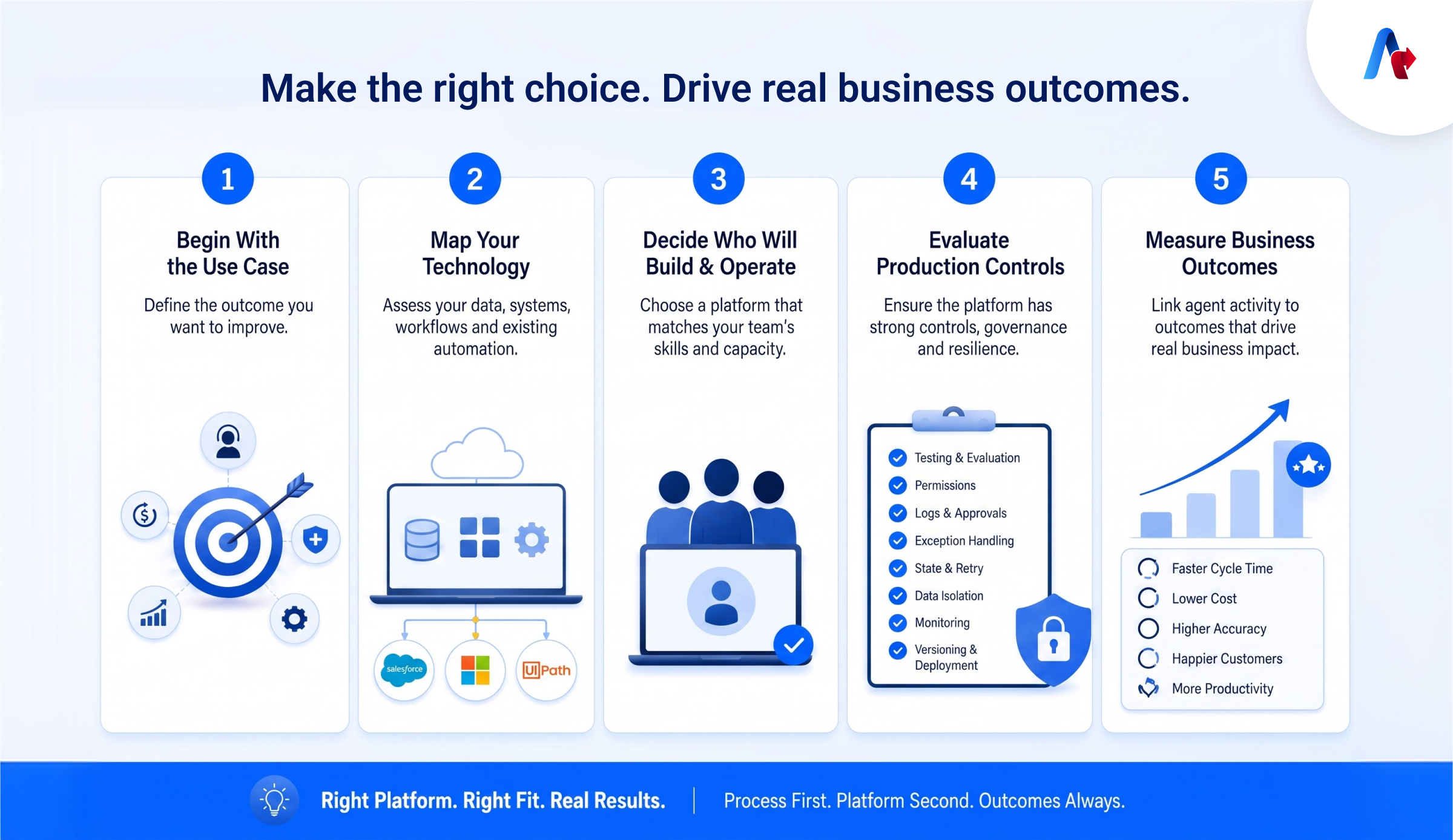
Choosing the best agentic AI platform starts with the business process, not the vendor demonstration.
1. Begin With the Use Case
Define the outcome you want to improve.
Is the priority employee support, customer service, claims processing, software testing, finance operations, sales productivity, or end-to-end enterprise automation?
Specialized tools win when the job is narrow, one function, done well. But stretch a process across multiple departments and systems, and that's exactly where a broader orchestration platform starts earning its keep.
2. Map Your Existing Technology
Before picking a platform, take stock of what you're already sitting on, where your data lives, which applications run the business, what workflows are already in motion, and what you've already sunk into automation.
That existing footprint usually points the way. Deep in Salesforce? Agentforce will likely get you to value faster than anything else. Built around Microsoft? Copilot Studio is going to feel like home. Already running a mature RPA operation? UiPath or Automation Anywhere is probably where the real upside is waiting.
A cloud engineering team may favour Google’s platform.
Ecosystem alignment can reduce deployment effort, but it can also increase vendor dependency. Both sides matter.
3. Decide Who Will Build and Operate the Agents
Some platforms are designed for business users. Others expect professional developers, AI engineers, automation teams, or implementation partners.
Be realistic about your internal capacity. Buying a technically flexible platform does not automatically create the team required to operate it.
4. Evaluate Production Controls
Ask vendors to demonstrate:
- Agent testing and evaluation
- Role-based permissions
- Decision and action logs
- Human approvals
- Exception handling
- State preservation
- Retry and rollback mechanisms
- Data isolation
- Cost and performance monitoring
- Versioning and deployment controls
Do not only test the perfect transaction. Test missing information, unavailable systems, conflicting instructions, and unusual cases.
5. Measure Business Outcomes
The platform should help connect agent activity to business results such as cycle time, cost per transaction, automation coverage, accuracy, customer satisfaction, employee productivity, revenue recovery, or reduced manual effort. The number of agents deployed is not just a business outcome but needs to be treated as inventory count.
Agentic AI Orchestration Platforms: Trends Shaping 2026 and Beyond
The market is moving from isolated agents toward managed networks of agents, systems, automation, and people.
Several trends will shape the next phase:
1. Multi-Agent Systems Will Become More Common
Enterprises will increasingly use specialist agents coordinated around a shared process rather than relying on one agent to perform every task.
2. Governance Will Move Into the Design Stage
The old playbook, build first, bolt on security and compliance later, is on its way out. Those controls will get defined at the same time as the agent itself, woven into the build rather than patched on afterward. Private evaluations, policy testing, traceability, continuous monitoring, none of this will be a nice-to-have anymore. It'll just be how things are done.
3. Open Interoperability Will Matter More
Right now, too many agents are stuck inside whatever ecosystem they were built in. That starts to change as standards like Model Context Protocol and emerging agent-to-agent communication approaches mature, giving agents a common language to reach tools and work with each other, regardless of which platform they came from.
4. AgentOps Will Become Essential
As agent portfolios grow, enterprises will need formal practices for monitoring performance, controlling versions, managing failures, tracking costs, and improving agents after deployment.
5. Platforms Will Become More Industry-Specific
General development tools will remain important, but vendors and implementation partners will increasingly offer agents designed around healthcare, financial services, insurance, manufacturing, retail, and other regulated or process-heavy industries.
6. ROI Will Replace Pilot Activity as the Main Measure
Enterprise leaders are becoming less interested in how many AI pilots are running and more interested in which ones are creating measurable value.
Build an AI Roadmap That Delivers Measurable ROI
Start Your AI Transformation JourneyConclusion
The market for top agentic AI platforms is broad because enterprise needs are broad. UiPath and Automation Anywhere are strong for organizations connecting agents with established automation. Agentforce is a natural option for Salesforce-centered processes.
For enterprises already living inside the Microsoft ecosystem, Power Platform is the obvious fit. Google's stack, on the other hand, hands technical teams the flexibility to build things their own way. Employee and service operations is where Moveworks and Aisera really earn their reputation, while Relevance AI takes something that used to require serious engineering muscle, custom multi-agent development and makes it accessible to teams without that depth.
Then there's Accelirate, which is an outcome-led implementation and orchestration partner, wiring together multiple technologies, use cases, building governance that holds up, and pushing agents into production instead of leaving them as a nice demo.
The best choice is the platform and operating model that fit your processes, systems, risk requirements, and internal capabilities. One agent is easy to demonstrate. Building a governed agentic operation that delivers reliable business value is the part that separates experimentation from enterprise transformation. Talk to experts!