



Quick Summary
Salesforce's Agentforce enables AI-driven task automation across use cases such as case resolution, lead qualification, IT ticket routing, and approvals. It functions as an agentic layer within Salesforce, orchestrating multi-step workflows across Salesforce and connected systems, while still operating within defined rules, human oversight, and system constraints.
This blog highlights the top 15 Agentforce use cases across departments and industries, helping businesses identify where AI agents create the biggest efficiency, productivity, and scalability gains.
As businesses navigate increasing demands for efficiency and agility, Salesforce’s Agentforce emerges as a transformative AI Agent platform. More than just a tool, Agentforce functions as an autonomous digital workforce enabler, Agents via Agentforce can help in executing multi-step tasks, optimizing workflows, and seamlessly integrating with enterprise systems. Unlike conventional automation limited to chatbots or case routing, these agents enable intelligent workflow execution across customer service, IT, finance, and beyond.
By automating repetitive processes and reducing manual inefficiencies, Agentforce helps businesses transition from manual, reactive operations to proactive, Agent-driven efficiency. Its deep integration with Salesforce Data 360 and enterprise applications allows organizations to scale effortlessly while improving productivity and operational quality.
What is Agentforce?
Salesforce’s Agentforce is an AI-powered digital labor platform for creating, deploying and managing autonomous AI agents that work alongside humans. Unlike traditional automation tools, Agents via Agentforce functions as an autonomous AI-driven workforce, capable of handling multi-step processes, integrating with Salesforce applications, and optimizing efficiency across departments such as customer service, IT, finance, and HR.
Agentforce does not replace human agents with chatbots or NLP-driven virtual assistants—instead, its agents execute business processes autonomously, reducing manual effort and improving decision-making.
Why Businesses Are Adopting Agentforce
Organizations today operate across fragmented systems, siloed data, and increasingly complex workflows. Traditional automation approaches—rule-based flows, RPA, and chatbots—struggle to handle dynamic, cross-functional processes. Agentforce addresses this gap by introducing autonomous, context-aware AI agents that can reason, decide, and act across enterprise systems.
- Context-Aware Task Execution: Agentforce agents execute multi-step tasks by combining real-time business context with LLM-driven reasoning. Instead of following static workflows, they dynamically determine the next best action across functions such as service, IT, and finance.
- Autonomous Workflow Orchestration: Agents move beyond predefined logic to handle approvals, data updates, and process coordination with minimal human intervention—while operating within defined policies, confidence thresholds, and escalation rules.
- Enterprise-Grade Integration Layer: Agentforce operates across Salesforce clouds and external systems, leveraging APIs and integration platforms like MuleSoft to orchestrate actions and access data in real time.
- Scalable Autonomy: Agents can operate at varying levels of autonomy—from assistive to fully autonomous—allowing organizations to scale automation safely without increasing operational overhead.
- Data-Grounded Decision Making: Execution is grounded in unified enterprise data (via Data Cloud and connected systems), ensuring agents act on accurate, contextual information rather than isolated rules or static datasets.
Build Smarter Automation with Agentforce Agent Builder!
Get Started TodayHow Agentforce Integrates with Salesforce CRM
Agentforce is deeply embedded within the Salesforce ecosystem, but its role is not just automation—it acts as an execution layer for autonomous agents operating across CRM data, enterprise systems, and external applications. Unlike traditional AI tools limited to interaction or insight generation, Agentforce agents reason over context and execute actions across systems.
- Orchestrated Business Operations: Agentforce agents coordinate multi-step processes across departments by evaluating context, determining next actions, and executing tasks such as case updates, approvals, and service workflows—reducing reliance on static process flows.
- Unified System Connectivity via APIs: Agents operate across Salesforce clouds and external platforms by leveraging APIs and integration layers like MuleSoft. This enables real-time data access and action execution across systems, rather than isolated automation within a single application.
- Context-Driven Task Execution: Instead of predefined sequences, agents dynamically retrieve, update, and act on data based on current business context—ensuring more adaptive and accurate workflow execution.
- Scalable, Controlled Autonomy: Agentforce supports varying levels of autonomy—from assistive actions to independent execution—while enforcing guardrails such as policies, permissions, and escalation rules to maintain operational control.
- Integration with Einstein AI for Decision Intelligence: Agentforce works alongside Salesforce Einstein AI, using predictive insights (e.g., lead scoring, risk signals, recommendations) to inform agent decisions and improve execution outcomes.
- Data Grounding via Salesforce Data Cloud: Agents rely on unified, real-time data from Salesforce Data Cloud and connected systems to ensure actions are contextually accurate, consistent, and aligned with business state.
How Agentforce is Different from Salesforce’s Einstein AI
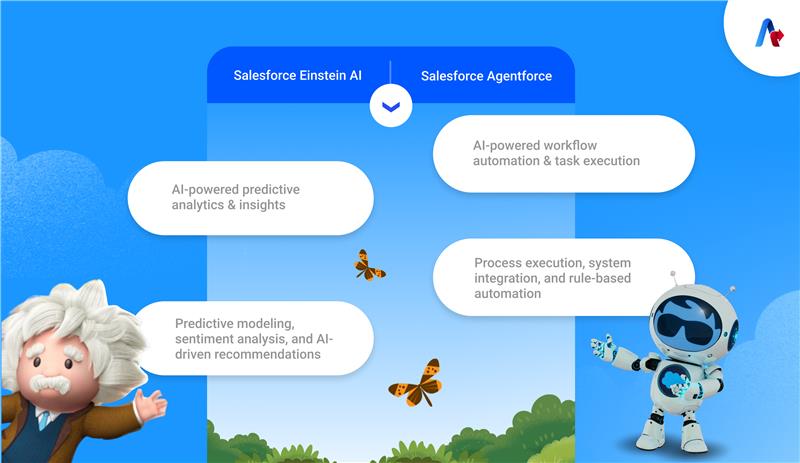
While Agentforce and Salesforce Einstein AI both leverage artificial intelligence, they serve complementary roles within the Salesforce ecosystem. Agentforce functions as an agentic execution layer, where autonomous agents reason over real-time business context and carry out actions across workflows, systems, and departments, rather than simply following predefined automation. In contrast, Einstein AI provides decision intelligence through predictive models, machine learning, and generative capabilities, delivering insights such as lead scoring, recommendations, and forecasts. In practice, Einstein informs decision-making, while Agentforce acts on those insights, enabling end-to-end processes where decisions are not only identified but also executed within defined guardrails.
Feature Comparison: Salesforce Agentforce vs. Einstein AI
| Feature | Salesforce Agentforce | Salesforce Einstein AI |
|---|---|---|
| Purpose | Agentic execution layer that enables autonomous task orchestration and action across systems | AI-powered predictive analytics & insights |
| Primary Use Case | Executing multi-step business processes, coordinating workflows, and taking actions across Salesforce and external systems | Data analysis, forecasting, and intelligence for sales, marketing, and business operations |
| AI Capabilities | Context-aware reasoning (via LLMs), dynamic task execution, API-driven actions, and workflow orchestration | Predictive modeling, sentiment analysis, and AI-driven recommendations |
| Decision-Making | ✅ Yes – Makes context-aware decisions within defined guardrails and confidence thresholds | ✅ Yes – Uses machine learning to provide AI-driven insights and predictions |
| Integration Focus | Cross-system execution across Salesforce clouds and external platforms via APIs and MuleSoft | Sales, marketing, and decision intelligence |
| Predictive Analysis | ⚠️ Indirect – Consumes predictive signals (e.g., from Einstein) to guide actions but is not primarily a prediction engine | ✅ Yes – Einstein AI provides forecasting, lead scoring, and trend analysis |
Key Difference between Agentforce and Einstein AI
- Agentforce is an execution layer that uses AI agents to reason and take actions across workflows and systems.
- Einstein AI provides advanced analytics, detecting patterns and offering AI-driven recommendations to support data-driven decision-making, but does not execute workflows like Agentforce.
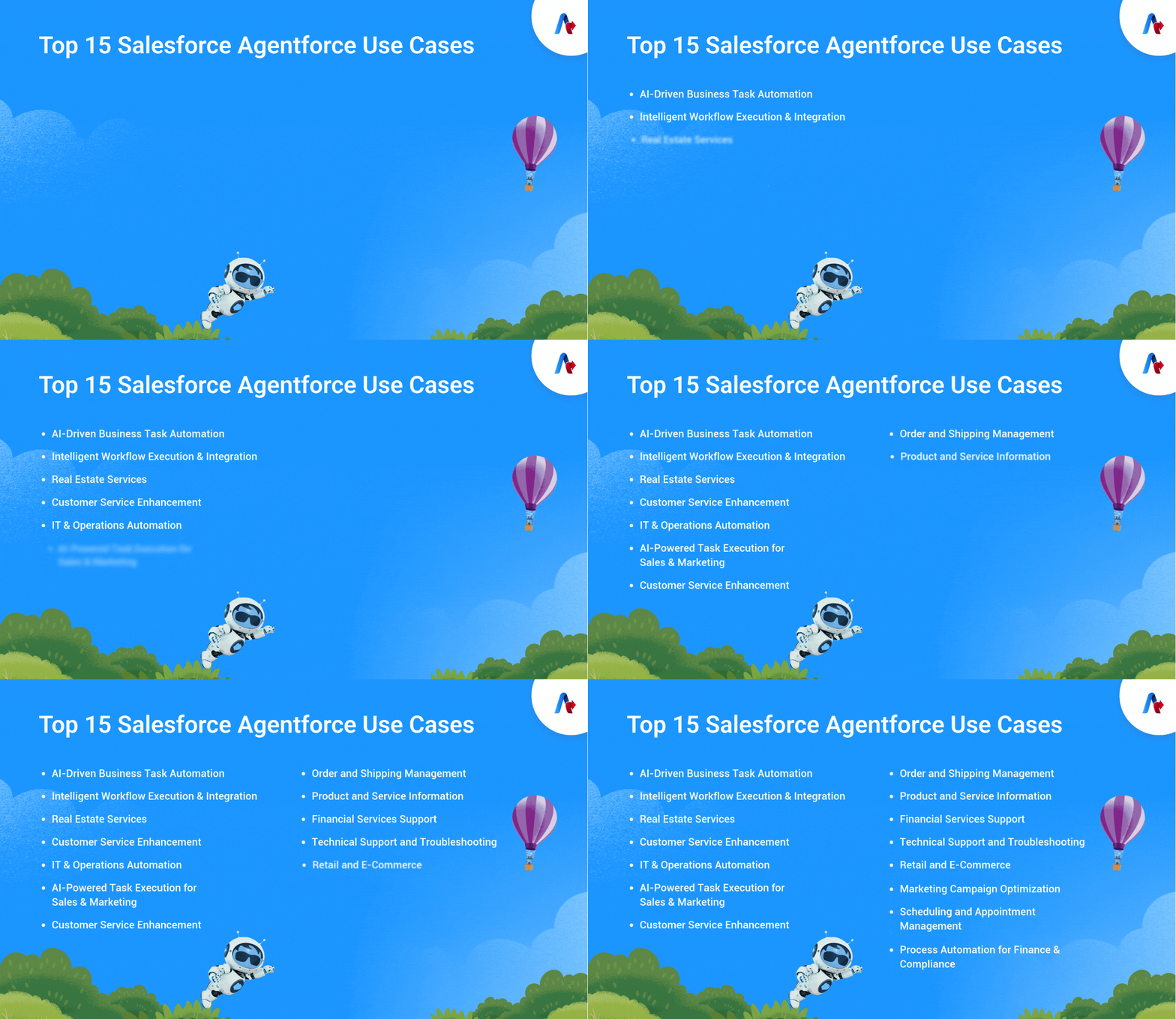
Top 15 Salesforce Agentforce Use Cases
1. AI-Driven Business Task Automation
Agentforce automates repetitive tasks across departments such as customer service, finance, HR, and IT operations, reducing manual workload and improving accuracy.
Examples:
- Automating data entry, document processing, and workflow approvals.
- Running background processes like record updates and form submissions.
2. Intelligent Workflow Execution & Integration
Agentforce seamlessly connects with Salesforce applications and third-party tools to execute processes without human intervention, using predefined logic and machine learning.
Examples:
- Automating lead qualification in Salesforce Sales Cloud.
- Managing ticket escalation workflows in Service Cloud.
3. AI-Powered Task Execution for Sales & Marketing
Agentforce acts as a digital assistant, automating routine tasks for sales and marketing teams, enhancing efficiency and reducing operational bottlenecks.
Examples:
- Automating follow-ups, lead enrichment, and CRM updates.
- Executing marketing campaigns such as email sequences and audience segmentation.
4. Process Automation for Finance & Compliance
Agentforce streamlines finance and compliance operations by automating processes like report generation and regulatory tracking.
Examples:
- Automating invoice approvals and expense reconciliation.
- Processing contract compliance checks and audit reports.
5. IT & Operations Automation
Agentforce integrates with IT service management tools and infrastructure systems to automate administrative tasks, enhancing operational efficiency.
Examples:
- Running automated troubleshooting scripts for IT support.
- Managing ticket assignment and resolution tracking for IT incidents.
6. Order and Shipping Management
Agentforce manages order status inquiries, provides tracking information, and handles returns or exchanges, ensuring timely customer updates.
Examples:
- Providing tracking information and updates on delivery statuses.
- Assisting with order modifications and addressing delivery issues.
7. Product and Service Information
Agents respond to customer queries about product features, pricing, and promotions, offering personalized recommendations and comparisons.
Examples:
- Answering questions about product specifications and features.
- Providing information on pricing, discounts, and promotional offers.
8. Financial Services Support
In the financial sector, Agentforce automates tasks such as loan processing, fraud detection, and compliance reporting, providing personalized financial advice.
Examples:
- Automating loan application processes and sending updates to applicants.
- Leveraging AI to detect patterns and provide alerts for potential fraud in real-time.
9. Technical Support and Troubleshooting
Agents offer technical assistance by resolving software issues, guiding product setup, and addressing connectivity problems.
Examples:
- Providing support for technical issues related to software and systems.
- Offering maintenance tips and addressing potential malfunction issues.
10. Healthcare Administration
In healthcare, Agentforce automates patient appointment scheduling, follow-ups, and compliance monitoring, managing patient data securely.
Examples:
- Automating the booking and rescheduling of patient appointments.
- Setting up automated follow-up messages to remind patients about check-ups or medication.
11. Real Estate Services
Agents in real estate qualify leads, match clients with properties, and automate communication, streamlining operations.
Examples:
- Automating the lead qualification process based on buyer or renter behaviors.
- Using AI to match clients with properties based on their preferences.
12. Retail and E-Commerce
Agentforce enhances retail by managing omni-channel customer engagement, stock alerts, and loyalty programs.
Examples:
- Engaging customers via email, chat, social media, and more, maintaining a consistent experience.
- Automating alerts for low stock levels and ensuring timely reordering.
13. Marketing Campaign Optimization
Marketers leverage Agentforce to create targeted campaigns, personalize customer interactions, and analyze performance.
Examples:
- Identifying specific customer groups for targeted marketing efforts.
- Automating tailored communication to enhance customer engagement.
14. Customer Service Enhancement
Agentforce automates customer service by handling inquiries, performing sentiment analysis, and resolving issues proactively.
Examples:
- Providing 24/7 support to address customer inquiries and issues.
- Analyzing customer sentiment to proactively address concerns.
15. Scheduling and Appointment Management
Agents facilitate scheduling for services like healthcare appointments, maintenance, and sales meetings, optimizing time management.
Examples:
- Assisting with scheduling and cancelling medical appointments, sending reminders and confirmations.
- Facilitating the booking, modification, or cancellation of reservations across various services.
Overcoming Challenges and Maximizing ROI with Agentforce
Implementing Agentforce requires careful planning to ensure seamless integration, data readiness, and employee adoption. Organizations must address key challenges such as legacy system compatibility, change management, and automation oversight while optimizing AI-driven workflows.
Key Challenges and Solutions
- Integration Complexity – Legacy systems may require additional configurations for smooth deployment.
- Employee Adoption – Clear training and communication help overcome AI resistance.
- Data Quality – Structured, standardized data is essential for effective automation.
- Automation Oversight – Establish human-AI collaboration protocols to manage exceptions.
- Scalability – Continuous refinement ensures automation adapts to evolving business needs.
Best Practices for Success
- Start Small & Scale – Begin with high-impact automation and expand strategically.
- Optimize Data Workflows – Maintain clean, structured data for better AI execution.
- Customize for Business Needs – Leverage Salesforce Flow to tailor automation.
- Encourage AI Adoption – Train employees to enhance AI collaboration.
- Monitor & Improve – Use feedback loops to refine automation models.
Leverage Agentforce and Transform Business Operations with AI Agents!
Connect for Agentforce Consulting!The Future of Enterprise Automation is with Agentforce
As businesses continue to embrace AI-driven automation, the ability to scale efficiently while maintaining operational agility is crucial. Agentforce empowers enterprise automation to eliminate manual inefficiencies, streamline workflows, and enhance productivity across departments.
By seamlessly integrating with Salesforce CRM, Service Cloud, and third-party applications, Agentforce future-proofs enterprise operations, ensuring businesses can adapt to evolving challenges and increasing workloads without additional staffing costs.
In a competitive market, Agentforce enables companies to work smarter, scale faster, and drive sustained business growth. Organizations that are leveraging AI-powered automation today are gaining an edge in efficiency, scalability, and long-term innovation.