



Quick Summary
For enterprises transitioning beyond AI pilots to governed, multi-step workflows, enterprise-ready AI models and AI agent builders are playing a very critical role in designing, managing, and deploying them. But to select the right platform, factors like integration, governance, and ease of use need to be considered. Compare leading AI agent platforms like Accelirate, Agentforce, UiPath, Microsoft Copilot Studio, and many more tools that allow for trusted, controlled, and production-ready AI agents.
In 2026, most enterprise leaders have already invested in AI and automation. They are familiar with dashboards, workflows, copilots, and AI pilots. On paper, the ROIs look very real, but are these businesses really reaping the right returns? Is the workforce still juggling between “systems” and approving things manually? Here’s where the conversation is shifting from AI tools being used just to summarize data and answer questions to taking enterprise-ready action.
This shift is pushing more enterprises to take greater consideration of the AI agent builder category. With AI agent builders, these enterprises get a way to design, test, deploy, and manage AI agents far more efficiently and make decisions within guardrails. So now the question is no longer whether to use AI agents or not, but to pick the right platform that gives a governed and smarter approach to building these agents. In this blog, we will look at the best AI agent builder platforms for enterprises in 2026, what makes them useful, and how to choose the right one for your enterprise.
What Is an AI Agent Builder?
To explain in simple terms, AI Agent Builders are platforms that help enterprises create AI Agents without investing resources into building everything from scratch. These platforms include low-code tools, integrations, orchestration logic, model access, testing, and governance, all in a single environment. These builders can retrieve data, call tools, trigger workflows, follow instructions, and complete multi-step tasks across systems. That lets enterprises create agents that do more than respond to prompts. They can retrieve data, call tools, trigger workflows, follow instructions, and complete multi-step tasks across systems.
An AI agent, when working independently, can reason, decide what to do next, and take action within the rules and limits you define. The platform, on the other hand, determines whether that agent stays useful in production or becomes another disconnected experiment.
Identify where AI agents can deliver the highest ROI across your workflows.
Speak with Our Automation ExpertsWhy Enterprises Need AI Agent Builders in 2026
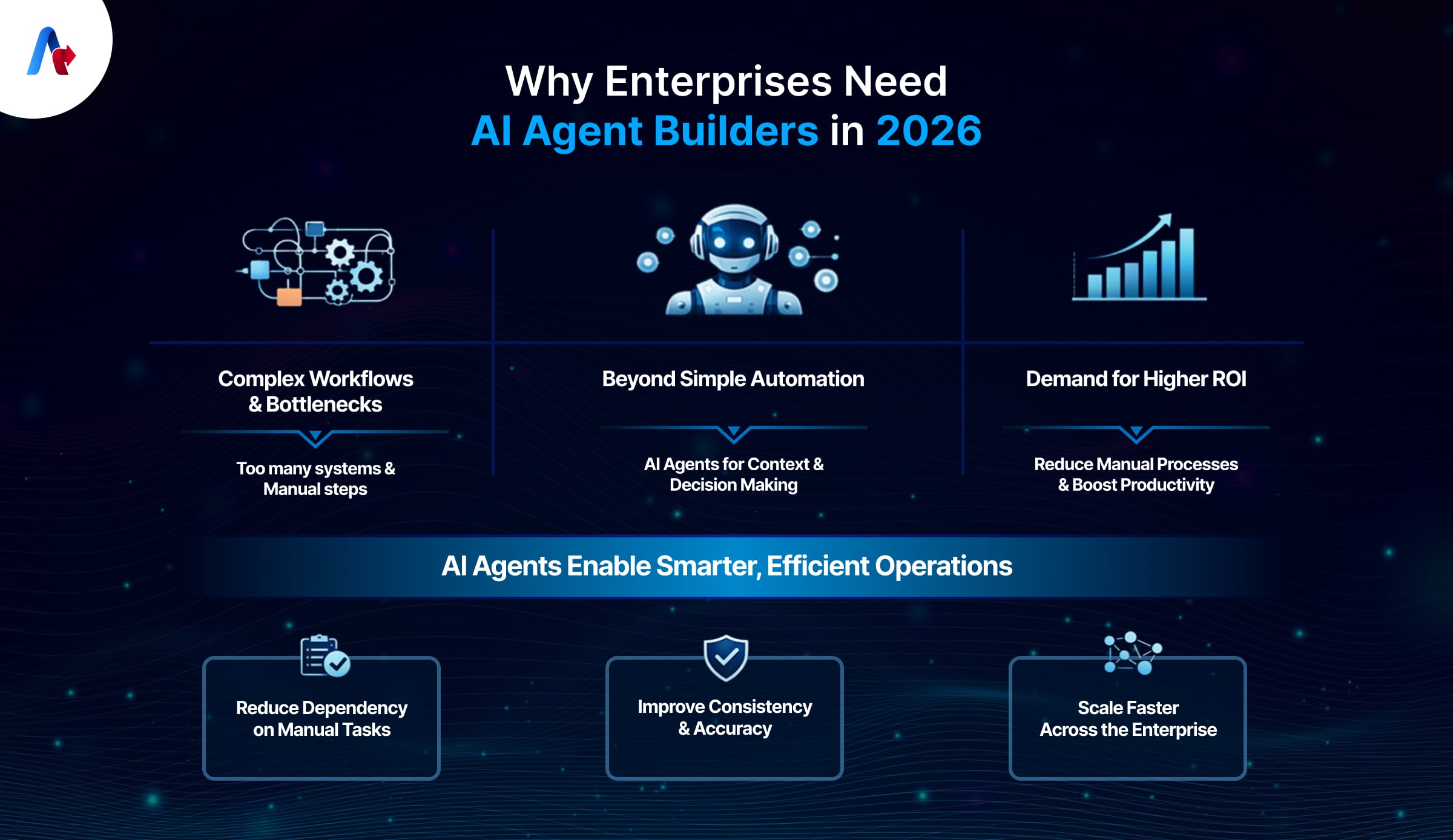
As enterprises enter 2026, they are already aware of where the friction is coming from. It is in service operations, claims handling, finance approvals, employee support, sales workflows, IT requests, and compliance-heavy tasks that move across too many systems and too many people.
The traditional way to automate contributed to expediting monotonous repetitive tasks, whereas agents are being used to perform more dynamic tasks that require context, judgment, and coordination. This is also one of the reasons why the automation industry has shifted from simple assistants to enterprise-grade builders.
The goal of enterprises for ROIs has moved beyond delivery speed to reducing manual dependency, improving consistency and quality, so their teams can handle more volume of tasks, making their existing systems more productive. When done correctly, AI agent development solutions can make data, applications, and workforce more effective without rebuilding everything from zero.
Related Reading: How Enterprises Are Achieving Measurable Agentic AI ROI
Must-Have Features in the Best AI Agent Builder Platforms
To find out more about which AI platform is the best for enterprise use, here are a few things one must consider.
- Ease of Use Biggest platforms can fail if they are not easy enough for enterprise teams to use and rely on. To maintain the ease of use, there needs to be a mix of low-code building, deep customization options, reliable integrations, security controls, testing tools, analytics, and flexible deployment models. The platform’s function should be to connect the dots in your system, support your scale, and build the governance guardrails to move with ease.
- Integration Integration is one of the high-priority decisions, as it handles major connectivity. AI agents can only be as useful as they provide accessibility to various business functions, records, and workflows. So, enterprises keep this factor in focus to find AI Agent builders that can connect to CRM, ERP, internal databases, APIs, and knowledge sources without creating fragile workarounds.
- Governance In enterprise, data sensitivity and data leakages are very common. So, enterprise leaders need full visibility into how agents behave, how they were configured, what data they touch, and how changes are promoted into production. Observability, role-based access, auditability, and testing are no longer nice-to-have features. Governance is what separate an interesting pilot from a platform that enterprise teams can scale.
7 Best AI Agent Builders for Enterprises in 2026
1. Accelirate
Accelirate stands out less as a generic software vendor and more as an enterprise-focused AI agent solutions partner built around real business outcomes. Its solutions are positioned on helping large scale enterprises build and deploy tailored AI agents with fastest delivery methodology. Some of the Accelirate solution highlight include AI Agent Activator Program, Accelirate QA solutions, Accelirate Healthcare solutions, Salesforce, Tableau and MuleSoft consulting. Its major USP is to build and deploy tailored AI agents quickly, with a strong emphasis on practical workflows, faster time to value, across major industry use cases.
That makes Accelirate especially relevant for enterprises that do not just want an AI builder interface, but also want hands-on support in designing, implementing, and scaling agents around their actual business processes. Its value is strongest when the enterprise need is not just tooling, but execution.
The strength here is speed plus enterprise context. The limitation is that this is not positioned like a broad horizontal developer framework such as LangChain.
Looking for a partner, not just a platform?
Talk to Accelirate to design and deploy AI agents tailored to your business2. Keragon
Keragon stands out less as a generic workflow automation tool and more as a healthcare-first automation platform purpose-built around HIPAA compliance and the operational realities of clinics, hospitals, and digital health companies. Its solutions are positioned on helping healthcare organizations automate patient-facing and back-office workflows without writing code and without taking on the compliance risk that comes from using horizontal tools like Zapier or Make. Some of the Keragon solution highlights include HIPAA-compliant workflow automation, AI agents for healthcare, patient intake and scheduling automation, EHR and EMR integrations, and insurance verification and revenue cycle workflows. Its major USP is delivering enterprise-grade automation inside a fully HIPAA-compliant environment, with a Business Associate Agreement (BAA) by default, native healthcare connectors, and pre-built templates mapped to real clinical and administrative use cases.
That makes Keragon especially relevant for healthcare providers, telehealth companies, digital health startups, and medical practices that do not just want a generic automation builder, but also need compliant handling of protected health information (PHI) across fragmented systems like EHRs, scheduling tools, communication platforms, and billing software. Its value is strongest when the workflow touches PHI or patient communication and a non-compliant tool simply isn't an option.
The strength here is healthcare-specific compliance plus a no-code builder with AI agent capabilities. The limitation is that for purely non-healthcare use cases, a broader horizontal automation platform may offer wider integration coverage at lower cost.
3. UiPath AI Center and Autopilot
UiPath remains a serious option for enterprises that want to connect AI agents with automation at scale. UiPath Agent Builder is positioned around creating, customizing, and deploying AI agents for complex enterprise workflows, while Autopilot extends AI-powered assistance across different user roles in the platform. AI Center adds another important layer by helping enterprises monitor models, manage versions, retrain workflows, and keep visibility into model performance.
This makes UiPath especially strong for enterprises that already have RPA investments and want to move from task automation toward more agentic, end-to-end orchestration.
The only limitation for using UiPath is that the enterprises may need more deeper planning and understanding to align with Agent Builder, Autopilot, AI Center, and orchestration components depending on their use cases.
4. Agentforce by Salesforce
If your enterprise already runs heavily on Salesforce, Agentforce Salesforce AI agent builder is one of the strongest options in the market. Salesforce positions Agentforce as a full-stack enterprise platform for building, testing, deploying, and optimizing AI agents across sales, service, marketing, and commerce. Agentforce 360 is mainly built on Atlas Reasoning Engine. This is designed to guide agents understand intent, decide what actions to take, and execute those actions using business data and workflows.
A major strength of Agentforce is that it is not limited to simple chat interactions. Salesforce emphasizes data grounding, multi-department use, built-in testing, analytics, and tight connections to the broader Salesforce ecosystem. That makes it a strong fit for enterprises that want a unified platform with governance and workflow already is built within the salesforce ecosystem. For the enterprises outside ecosystem the value can still be strong, but the fit is less automatic.
5. Microsoft Copilot Studio
Microsoft Copilot Studio is one of the most practical choices for enterprises deep in the Microsoft ecosystem. Microsoft describes it as a graphical, low-code platform for building agents and agent flows, with the ability to connect to business data, publish across multiple channels, and use prebuilt or custom connectors.
Its appeal is easy to understand. Many enterprises already work inside Microsoft 365, Teams, Azure, and Entra. Copilot Studio offers a steady environment for building Agents without the need to changing tools altogether. So, this lower friction builds internal productivity and quicker workflow modernization.
The only limitation here is that Copilot is only relevant to the users who already have Microsoft as their base. And if the workflows and integrations are outside the ecosystem, other builder may offer better flexibility.
6. Google Vertex AI Agent Builder
Google’s Vertex AI Agent Builder is a strong choice for cloud-first enterprises, especially those already invested in Google Cloud. Google describes it as a full-stack system that helps teams build, scale, govern, deploy, and manage agents in production. It also connects with Vertex AI Agent Engine, giving enterprises managed infrastructure for scaling agents in live environments.
One of Vertex’s biggest strengths is that it brings together enterprise AI development, deployment, and governance in a secure cloud environment. It also supports open frameworks and large-scale model access, which makes it attractive for enterprises that want both flexibility and managed infrastructure.
The limitation is that pricing and cloud alignment can become more complex at scale. For GCP-heavy organizations, that may be acceptable. For others, it may add friction.
7. LangChain plus LangGraph
LangChain and LangGraph are not packaged in the same polished, low-code way as some enterprise suites, but they remain highly relevant for developer-led enterprises that want maximum flexibility. The value here is control. Teams can design advanced orchestration, retrieval, tool use, and multi-agent flows with a lot more freedom than many packaged platforms allow.
That makes LangChain a good fit for enterprises with strong engineering teams, custom requirements, and a willingness to own more of the build and governance effort. It is a powerful option, but not always the fastest route for non-technical business teams that want quick deployment and built-in operational controls.
Which AI Agent Builder Platform Fits Which Enterprise Need?
There’s no direct answer for every dynamic enterprise. The further question is whether your enterprise is looking for a more guided, enterprise-outcome-led partner. Accelirate is a strong option. If your major workflows live in Salesforce, Agentforce is an obvious contender. If you are transitioning or expanding from RPA into agentic, UiPath is the right option. If Microsoft runs your digital workplace, Copilot Studio makes sense. If your AI strategy is tied to Google Cloud, Vertex AI Agent Builder is a natural fit. And if your developers are looking forward to building customized systems, LangChain plus LangGraph can be the right path.
Here is a quick comparison of the best AI agent builder platforms in 2026 based on core enterprise needs such as integration, scalability, security, pricing, and ease of use.
| Platform | Integration | Scalability | Security | Pricing | Ease of Use | Best Fit for Enterprise Need |
|---|---|---|---|---|---|---|
| Accelirate | Strong enterprise integration support based on use case and implementation approach | Strong for enterprises looking to scale AI agents with guided support | Enterprise-focused approach with governed implementation | Custom / consultation-based | Easy with guided support | Enterprises looking for a guided, enterprise-outcome-led partner |
| Agentforce by Salesforce | Strong integration with Salesforce ecosystem and connected business systems | High scalability across sales, service, marketing, and commerce | Strong enterprise-grade governance and security | Custom enterprise pricing | Easy for enterprises already using Salesforce | Enterprises whose major workflows live in Salesforce |
| UiPath AI Center & Autopilot | Strong integration with automation, RPA, and enterprise systems | High scalability for enterprises expanding from RPA into agentic automation | Strong governance, testing, and orchestration controls | Custom enterprise pricing | Moderate to easy for existing UiPath users | Enterprises transitioning or expanding from RPA into agentic |
| Microsoft Copilot Studio | Strong integration within Microsoft 365, Teams, Azure, and Entra | Good scalability inside Microsoft-based environments | Strong security and compliance within Microsoft ecosystem | Enterprise licensing / custom pricing | Easy for Microsoft-based teams | Enterprises deep in the Microsoft ecosystem |
| Google Vertex AI Agent Builder | Strong integration with Google Cloud services, APIs, and enterprise data sources | High scalability for cloud-first enterprise use | Strong cloud security and governance | Usage-based / enterprise pricing | Moderate | Enterprises whose AI strategy is tied to Google Cloud |
| LangChain + LangGraph | Flexible integration across APIs, models, tools, and custom systems | High scalability with the right developer support | Security depends on enterprise implementation | Open-source + implementation cost | Moderate to difficult | Enterprises looking to build highly customized systems |
Compare platforms based on your exact use case
Get a personalized AI agent builder comparison for your enterpriseHow to Choose the Best AI Agent Builder for Your Enterprise
The smartest way for leaders to choose is not to start with the platform right away, but rather to start by asking the right questions. Look at which workflows matter most, how sensitive the data is, how many systems need to be connected, who will build and manage the agents, and how much governance your enterprise requires. A platform that looks powerful in a demo can still be the wrong choice if it does not fit your operating model.
It helps to evaluate each builder against a few practical questions. Can business users contribute without waiting on engineering for every change? Can developers customize deeply when needed? Can the platform support testing, versioning, observability, and safe deployment? Can it scale across departments without losing control? Those are usually the questions that reveal the right answer fastest.
Future of AI Agent Builder Platforms in 2026 and Beyond
The future of enterprises in 2026 looking to expand is not just to come with hundred new agents. It is better and governed enterprise systems for building and scaling them.
We are moving toward platforms that combine orchestration, reasoning, integration, governance, observability, and deployment into a single operating layer. Theses market winners will help them run agents safely, improve them continuously, and tie them to measurable enterprise outcomes.
That is why the rise of the ai agent builder platforms category matters so much. It is becoming part of how enterprises redesign work itself. And for leaders planning the next phase of automation, choosing the right best ai agent builder can shape how quickly their business moves from pilot mode to actual ROI phase.
FAQs
Some of the best AI agent platform solutions for enterprises are Accelirate, UiPath, Agentforce by Salesforce, Microsoft Copilot Studio, Google Vertex AI Agent Builder, and LangChain plus LangGraph.
The cost depends on the platform, level of customization, integrations, and enterprise scale. Some platforms have custom enterprise pricing, while others may include open-source or usage-based costs.
You should look for ease of use, strong integrations, governance, security, testing, analytics, and scalability. These features help enterprises build and manage AI agents more effectively.
AI agents are better for dynamic tasks that need context, judgment, and coordination, while RPA is better for repetitive rule-based tasks. In many enterprises, both work better together.
There is no single best option for every enterprise. The best AI agent builder depends on your systems, workflows, governance needs, and whether you need guided support or deep customization.