



Quick Summary
Many CFOs in companies are thinking about adopting AI agents for financial operations. It is a good thought, but before you invest, it’s important to ask the right questions to learn whether it solves your problems or creates hurdles. These questions include integration compliance, ROI, security, and team impact. Agentic process automation in finance must focus on the real concerns a team faces today.
Handling financial risk is a big challenge for enterprises, but this difficulty is mitigated in the era of AI agents for financial operations. As a CFO, you have many promises, such as that AI agents automate invoices, speed up the month-end close, and reduce manual work. Yet the reality on the ground is different.
Buying automation without asking the right questions can create new risks instead of benefits. Research by Gartner in 2024 found that 58% of finance functions are already using AI to improve productivity and predicts 90% of finance functions will deploy at least one AI-supported technology by 2026.
The reality is that not every AI solution is ready for real-world finance operations. In demos, it works well, but it struggles with complex functions, compliance rules, and messy data. That’s why finance leaders must slow down and ask several valid questions before they adopt a smart solution.
The real goal of finance agents is not to automate everything on trend but to bring accuracy, control, and trust across critical workflows. Let’s discuss the top 10 questions CFOs must ask when they adopt AI in financial services.
Q1: What Exactly AI Agent in Finance Does in the Workflow?
When leaders invest in AI agents for financial operations, they must ask themselves a clear question: How do AI agents work in financial processes? This question is vital as not all AI automation in finance works the same way. Let’s see a few types for more understanding.
An assistive AI agent helps the team extract invoice data, suggest journal entries, and flag mismatches. An autonomous AI agent is more independent, and it completes tasks with minimal human intervention. It validates invoices, matches them with POs, posts entries into ERP systems, and triggers payments if necessary.
The second type is closer to autonomous finance automation. In simple terms, the assertive type still requires human review and approval, but the agentic automation is more independent and needs less guidance.
The difference between task automation and end-to-end workflow ownership is another area where the team should have an understanding. For example, task automation extracts the invoice data, but the workflow ownership reviews the invoices to update the reports.
Many claim to use the term “AI finance automation,” but they only automate one or two steps. Agentic workflow in finance is different as it can handle connected steps in your entire financial process.
Understand that there are exceptions where a human loop is unavoidable, such as high-value transaction approvals, overseeing compliance-sensitive entries and reviewing unusual patterns to avoid risks.
Other Real-World Questions to Ask
Clarity is the most important part here. So, while meeting a specific vendor, ask this question. Can your AI agent process invoices completely? From this question, you should get the following answers. If not, the risk is high.
- Total percentage of invoices that the agent can handle.
- How do you handle exceptions?
- When humans step in
Q2: Do the AI Agents in Finance Integrate with Our Existing Systems?
An AI agent can continue tasks autonomously, but if it cannot integrate smoothly with your ERP and other finance tools, it cannot deliver better results. A financial team must be running several applications, such as SAP, Oracle, NetSuite, Workday, or BlackLine. Bringing intelligent automation to your workflow is a smart choice, but it should work without disrupting daily operations.
It is utmost important that an AI agent in corporate finance work harmoniously with existing tools, or your team may end up doing duplicate work. Reliable AI agents for financial operations should:
- Post entries directly into your ERP
- Read financial data securely.
- Trigger workflows inside your existing system
- Respect for the approval of hierarchies and controls
Choose Between API and Native Integrations
While looking for integrating agents with your working tools, an enterprise has two options to choose from:
- API-Based Integration: AI connects to other tools through API services and support. It is flexible but may require experts or a trusted integration partner.
- Native Integration: In this method, you need to build one for certain ERP systems by yourself or with partners.
A typical artificial intelligence (AI) in finance may take at least 12–18 months to show value, but this is also based on:
- Data readiness
- Integration complexity
- Number of workflows automated
- Governance approvals
Some of the real-world questions CFOs must ask:
- Will agents work inside SAP?
- Do we need new middleware to make it?
The answer you get from vendors should include technical architecture, system changes, security controls and go-live timeline. A true financial process automation improves your current systems, not complicates them.
Q3: How Accurate and Reliable Are AI Agents for Financial Decisions?
CFOs are mostly worried about the accuracy of the automation. Committing a small mistake in this sector can have serious consequences. So, the AI tool they select must not affect reporting, compliance, and trust. That’s why accuracy is one of the top priorities when evaluating AI agents for financial operations.
AI agents work on financial data analytics to identify patterns, detect anomalies, and improve accuracy over time. A team must ensure that the data is clean and not outdated before running the software. A provider may claim 95% or 98% accuracy, but top leaders should clarify how it is measured and where it is going to bring value, such as:
- Invoice data extraction
- PO matching success rate
- Journal entry classification
- Exception detection precision
During demos, don’t just give a simple file to test. Instead, test AI agents in corporate finance with real historical finance data. We also must understand that no workflow is perfect, so there should be clarity on how to handle exceptions. If not, humans must spend more time fixing those errors. A good AI agent in finance should:
- Flag anomalies clearly
- Escalate complex cases
- Learn from corrected decisions.
- Maintain a confidence score for each action.
In an AI automation service, auditing and tracing its decisions is the most vital part that leaders should not forget. There must be an explanation, a reference, a timestamp, an approval log, etc.
Sub questions a team can think about here are:
- How did they correct their time?
- What if the AI misclassifies expenses?
- How AI detected the errors
AI in finance must improve compliance, accuracy and stability. Let our team evaluate how secure and audit-ready your AI strategy is.
Meet our experts todayQ4: How Will AI Agents for Financial Operations Impact Compliance, Audit, and Risk?
Integrating AI agents soon after the discussion improves your speed and accuracy. There are several other things to discuss, including control, compliance, and accountability. When adopting autonomous AI automation, financial officers must think about how it affects audit readiness and regulatory risk.
SOX Compliance and Regulatory Considerations
If you are coming into the public companies’ category, it is essential to comply with SOX and other financial regulations. Any system that posts entries, approves transactions, or modifies financial data must support:
- Segregation of duties
- Approval of hierarchies
- Access controls
- Clear documentation
Research from Gartner shows that AI adoption in finance is improving, but data quality issues and governance are the main barriers to scaling safety as they affect compliance and control outcomes.
Explainability and Traceability
Regulators and auditors expect clear logic from automated decisions. If a model is thinking from an angle, it won’t pass the test; instead, leaders should confirm:
- Logs every automated action
- Provides context for decisions
- Maintains explainable outputs for audit review
Audit and Governance
An automation is triggered, and the action moves forward with AI support. After that, there must be a record of everything, including who triggered the process, the data used, the decision and the time.
Here is a question leaders should answer:
Can auditors trace every AI decision, just like a human entry? The answer will clearly explain how it works. Strong governance, explainability, and auditability improve customer trust.
Q5: Is Our Financial Data Ready for AI Agents?
This is one of the most important questions you should ask before scaling AI agents for financial operations. The data is a soul, and if it is not ready, it can affect the result and the performance. Strong financial data analytics ensure your agent works with reliable, well-governed information. Understand that AI does not fix bad data, but it just follows what is there.
In finance, a small inconsistency can create large errors. For example, Duplicate vendors, inconsistent GL codes, missing PO references, or outdated master data can mitigate the accuracy of artificial intelligence in finance.
What leaders should evaluate?
- Vendor data accuracy
- Historical invoice consistency
- GL coding standards
- Exception frequency rates
What is the difference between structured and unstructured finance data?
- Structured data consists of ERP entries, ledgers, and reconciliations.
- Unstructured data includes PDF invoices, emails, contracts, and receipts.
When you choose financial AI solutions, they should be able to handle both types of data. This is where it shows its capabilities.
How does the AI handle OCR and Document Readiness?
This is another area where financial institutions face issues because invoices arrive in multiple formats, languages, and layouts. At this time, automation should be able to handle them correctly.
When you combine OCR (Optical Character Recognition) with machine learning, it can improve extraction, but the performance depends on document clarity and historical training data.
A simple final question to ask the vendor
Can the agent handle messy invoices? The answer you get should explain the accuracy level on complex documents, except for workflows and continuous learning capabilities.
Understand that automation should begin with data. If it is weak, it will create hurdles in scaling. Successful automation in finance begins with data readiness. If the foundation is weak, scaling will be slow and risky.
Q6: What Measurable ROI Can We Expect from AI Agents?
Finance and accounting agents are not for hype but for ROI. It is the final output that every financial leader expects. A team that thinks about AI agents for financial operations must have ROI plans and be tied to the business.
There are numerous problems with manual finance tasks, such as invoice processing, reconciliations, and data entry. It takes time and requires a lot of manpower. Using financial operating models can reduce repetitive effort and lower costs.
What do you get from automation agents?
- Reduce manual processing hours.
- Mitigate rework cycles
- Lower handling costs
- Better working capital visibility
AI reduces rework, so a team can save time and close everything early. Instead of handling everything manually, teams focus on where the problem is when it flags. AI automation in finance means a lot to the team because they handle repetitive tasks, allowing the team to focus on forecasting and analysis.
Real-World Question to Ask
Can AI reduce close time from 8 days to 4? After this question, you will get a clear answer on the percentage of time teams may save with clear metrics and values. A smart system not only reduces headcount but also improves accuracy and efficiency.
Before investing in AI, know what it can bring to your business with Accelirate. Let’s assess agent value in your financial environment.
Book a demo with our expertsQ7: How Secure Will Our Financial Data Be?
Security of finance is a top priority for CFOs and other leaders. And there should not be any compromise in this when selecting AI agents for financial operations. Now, there is a question: where does all this financial data go, and who controls it?
The answer to this question must be strong data encryption and access control. A strong automation software in finance will follow the security standards below.
- End-to-end data encryption
- Role-based access controls
- Multi-factor authentication
- Detailed access logs
This matter is a security concern because it contains sensitive information, including payroll, vendor payments, forecasts, and regulatory filings. Compromising those details will lead to issues with trust and compliance.
According to Gartner, cybersecurity is a strong concern at the enterprise level, and organizations are increasing their investment in secure AI deployment as automation is taking a greater role in core business functions.
There is another area where companies must be careful about things such as vendors’ details and security. While selecting, ensure they have SOC 2 or ISO 27001 certifications, data residency policies, incident response frameworks and third-party risk controls.
Another area is how you store your data. There are two options: Cloud and On-Premises. On-premises means you should spend money on infrastructure, people and other areas. Most AI agents in corporate finance solutions operate in the cloud. It is not bad, but it should clarify:
- Data storage location
- Backup procedures
- Encryption standards
- Cross-border data compliance
Real-World Question to Clarify
Will our data train external AI models? The answer you get will help you decide whether to continue or not. Enterprise-grade Financial AI solutions must isolate customer data and prevent unauthorized model training. Security is not optional here, but a necessity to avoid issues that affect your customers and goodwill.
Q8: Can AI Agents Scale Across the Finance Function?
We all know that there is a testing period for every automation. So, a company starts with small accounts payable and sees early wins. But the real value of AI agents for financial operations lies in their expansion across the finance function. Always ensure the software you choose can scale responsibly.
How can you plan your adoption?
Most organizations begin with:
- Accounts Payable (AP): Invoice processing, 3-way matching, payment approvals
- Accounts Receivable (AR): Cash application, dispute management
- FP&A: Forecast variance analysis, scenario modeling
- Treasury: Liquidity tracking, risk monitoring
Know that a standard tool connects the entire workflow and leaves nothing in isolation. More than that, a scaling strategy must include clear governance standards, centralized AI monitoring, performance measurement, and guidance on when humans should intervene.
A standard governance model is necessary when you scale your financial automation. For this, finance leaders should define:
- Who approves new AI use cases?
- How do they evaluate the model’s performance?
- What are the procedures for handling exceptions?
- How do we manage compliance?
Q9: How Will AI Agents Change Roles in Our Finance Team?
When AI takes on repetitive and other complex tasks, there are always doubts in the minds of people who work in the financial sector. Let’s think about this from a different perspective. Today, financial teams spend hours on tasks such as data entry, invoice matching, reconciliations, and manual report preparation.
With artificial intelligence in finance, teams can reduce repetitive work and avoid maximum frustration. In this situation, they get more time for higher-value activities like variance analysis, cash flow forecasting, risk assessment and business advisory support.
Upskilling and Managing Resistance to AI
These are other major problems companies face while moving to financial automation. Upskilling is important for data interpretation, automation oversight, exception management, and AI governance in finance. Planned upskilling can help avoid issues and support planned adoptions.
Another one is the change management. Before moving, leaders should clearly explain which tasks AI will handle, which will remain human, and how performance will be measured. Clarity will avoid resistance and improve the adoption of autonomous accounting.
Other Questions to Ask
Will AI automation replace accountants? The direct answer to this is going to be no, but the role will change. Convince that this innovation will reduce manual effort and help with smarter financial decision-making. AI will not eliminate humans, but it will elevate the team with its abilities.
Q10: What Is the Total Cost of Ownership (TCO) Of AI Finance Automation?
The cost is a real problem because the subscription price is only part of the story. The rest is hidden, so finance leaders must look beyond licensing and calculate the full total cost of ownership before committing to software automation.
Some tools show only the low cost, but the cost rises when it comes to integration, support, and governance.
Types of costs to clarify
There are many costs to clarify. For some, you need to pay more as you scale. Let’s see some of the common ones.
Software and Licensing Costs
- Platform subscription fees
- Usage-based pricing (per invoice, per transaction, per workflow)
- Add-on modules for advanced analytics or compliance
Hidden Integration and Maintenance Cost
- ERP configuration changes
- API setup
- Middleware requirements
- Ongoing model monitoring
Training, Governance, and Support
- Employee training
- Change management programs
- Compliance reviews
- Ongoing vendor support
Extra Question to Clarify
Is an agentic workflow in finance cheaper than hiring three analysts? A good provider will expose the following.
- 3-year total cost projection
- Productivity gains
- Risk reduction value
- Compliance impact
Understand that good AI agents for financial operations should lower operational costs, improve accuracy, and improve control.
What Happens If the AI Agent Fails? (Business Continuity)
A financial operating model in a business is a good idea, but what if they fail? As a CFO, you must ask yourself this question and plan accordingly if it slows or makes incorrect answers.
Let’s see some of the common failures to consider
- System downtime
- Incorrect data classification
- Integration breakdown with ERP
- Delayed exception handling
- Security incidents
Agents fail, and the escalation path is vital for artificial intelligence (AI) in finance. The plan from the provider wants to explain the manual override process, escalation workflows, role-based intervention triggers and alerts for anomalies.
Before scaling automation, the top managers in finance strategies failed procedures, such as fallback processing, backup approval mechanisms, disaster recovery protocols and SLA guarantees from vendors.
Finance AI Readiness Checklist Questions For CFOs
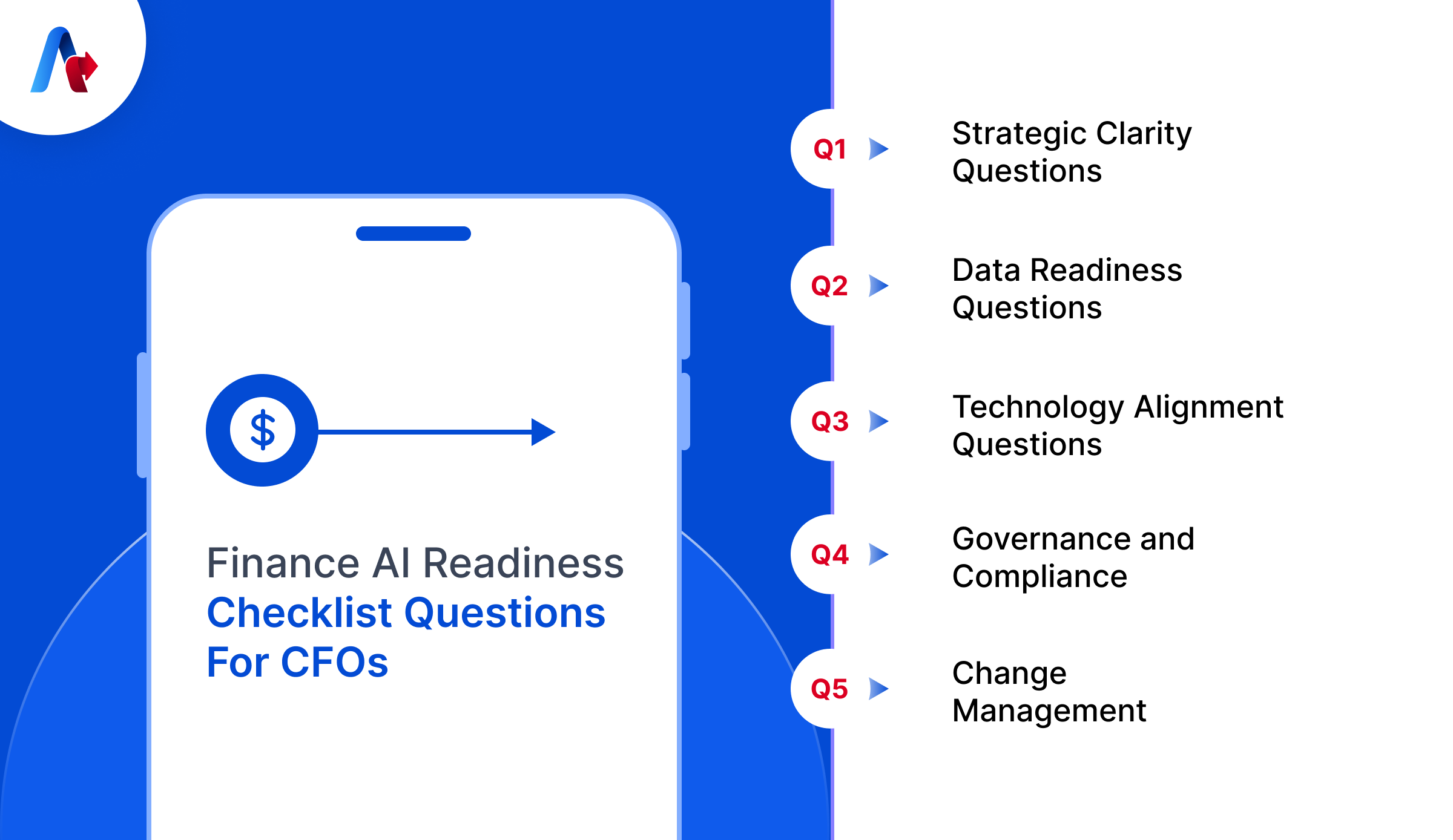
Before committing to a tool, a finance leader must assess the overall readiness of people to governance. Finance agents work effectively when the foundation is strong. If the answer is “Yes” to all five categories, you can move forward.
Use this checklist to evaluate your position:
1. Strategic Clarity Questions
- Do we have a clear idea of what we want to automate?
- Are we solving a real finance bottleneck or following hype?
- Are we ready with the KPIs to measure improvement?
2. Data Readiness Questions
- Is the data collected from the vendor clean and standardized?
- Are GL codes consistently used?
- Do we have structured and historical data for training?
3. Technology Alignment Questions
- Does the AI integrate with SAP, Oracle, NetSuite, and other tools?
- Are APIs and security controls documented?
- Is the implementation timeline realistic?
4. Governance and Compliance
- Is there any hierarchy for approval?
- Is there any method to audit an AI decision?
- Do we have internal oversight and ownership?
5. Change Management
- Are teams trained?
- Is leadership aligned?
- Is there a proper adoption plan?
Choosing the Right AI Agent for Financial Operations
AI agents in the finance industry are a reality, but their impact depends on how you execute them carefully. The value of artificial intelligence in banking and other financial sectors lies in measurable efficiency, control and better decision-making. It’s not about automating something, but the real value should be visible and clarified.
Forrester Total Economic Impact research found that modern finance automation initiatives can deliver ROI up to 111% in less than six months if implemented with care and proper strategy. After implementation, the return will not come on its own. It starts from the beginning, from tool selection and integration to how you scale and manage risk.
Chief financial officers (CFOs) need to evaluate tools based on questions and clear everything before adopting a tool. Also, they need to ensure that the application aligns with your business, follows governance and focuses on outcomes rather than speed.
The finance leaders who succeed will not adopt AI blindly. They will evaluate carefully, align it with governance, and focus on outcomes. AI Agents for financial operations will not complicate operations. Instead, they simplify everything and reduce the team's burden.
The right AI decision today prevents costly financial risks tomorrow. Talk to our team to build a secure, compliant and scalable financial AI.
Schedule a free call nowFAQs
It is true that financial process automation can improve speed, accuracy and support many decisions. However, they cannot replace human expertise in complex judgment, strategic decision-making, planning, and reasoning. A combination of artificial intelligence and humans can make better decisions and improve workflow.
The implementation time for finance agents depends on its complexity. A normal pilot can take 3–6 weeks, but the hardest ones can take 8–12 weeks if APIs and data are ready. An enterprise gets real value when it integrates property with the existing workflow with proper data.
The way you use it really decides whether your data is safe or not. Always use data with strong encryption, access controls, and data isolation. A financial team must ensure the following enterprise-grade safeguards, such as SOC 2 compliance, with clear non-training guarantees. This compliance will help to protect financial data from external models training and sharing.
Yes, it is possible. If you are a mid-sized firm, start with high-impact areas and rule-based workflows. With this strategy, clearer data and smaller scope requirements, your automation effort can deliver ROI quickly so you can scale automation responsibly.
You need to have a checklist before you commit to a tool. Make sure you have clean financial data, documented workflows, ERP system integration, and governance control to move with. Start with a clear use case, data quality checks, and, once you see that these foundations are strong, artificial intelligence in banking delivers faster value.