


Quick Summary
Finance operations have come a long way, from manual spreadsheets to RPA-based automation, but inefficiencies like siloed systems, rigid rules, and limited exception handling still slow month-end closings. Choosing the right Reconciliation Automation Tools is now critical. AcceliOps solves these gaps with UiPath-powered Agentic AI, that delivers adaptive learning, real-time visibility, and proactive error prevention. We get faster reconciliations, over 95% accuracy, and up to 70% less manual effort across enterprise-scale operations.
Every enterprise today relies on Monthly Reconciliation Automation to streamline finance operations, but many teams still spend hours chasing unmatched entries and resolving errors. Even with ERP extensions and RPA bots, automation often solves the manual part—not the underlying inefficiencies. Though RPA helps automate repetitive tasks, finance teams still struggle with disconnected systems, exceptions, and delayed insights.
Global finance teams report spending about 30–40% of their month-end closing time correcting mismatches and verifying records, highlighting the gap between claims and reality. This is where modern AI-powered Reconciliation Tools for enterprises come into place.
The right tools help to make the reconciliation process much faster and smarter by learning, adapting, and reducing repetitive errors. It reduces human efforts and ensures financial compliance and accurate reporting.

Tired of month-end reconciliation chaos?
Contact UsWhat Is Monthly Reconciliation Automation?
Monthly Reconciliation Automation uses advanced AI agents to track, align, and match financial records across systems. It helps with faster transaction matching, real-time exception detection, and smooth integration between different enterprise platforms, helping finance teams close books quicker.
While RPA used to work well with simple rule-based tasks but growing data volume and complex transactions are making it less effective due to the following inefficiencies:
- Static Rules: Rigid, rule-based logic breaks down when transaction patterns or data formats evolve, leading to recurring mismatches.
- Disconnected Systems: Many ERPs, bank portals, and ledgers work independently, making reconciliation difficult.
- Weak Exception Handling: While bots can find mismatches, they cannot resolve or learn from repeating errors.
- Batch-Based Processing: Detecting real-time errors gets delayed because data is reconciled in batches.
- Limited Context Awareness: Traditional tools cannot grasp transaction specifics or business rules, missing valid matches.
How AcceliOps Redefined Monthly Reconciliation Automation
AcceliOps has combined automation bots, AI-driven exception handling, and human-in-the-loop oversight to create a reliable and accountable reconciliation automation setup. The differentiator of our AI agents is adaptive learning, which helps to detect and prevent errors in advance, making the reconciliation process fully automated, accurate, and properly managed.
Core Capabilities Include:
- Adaptive Exception Prediction: It learns from past mismatches and flags future errors.
- Continuous Ledger Synchronization: Maintains real-time alignment across ERPs, sub-ledgers, and bank statements—eliminating batch delays.
- AI-Driven Root Cause Analysis: Detects recurring mismatch patterns and provides corrective actions to improve data accuracy.
- Human-in-the-Loop Governance: Offers contextual insights and approval protocols for exceptions to ensure compliance and supervision.
- Dynamic Integration Framework: It connects easily across ERPs, banks, and reporting tools via secure APIs for complete visibility.
- Self-Optimizing Performance: It trains automation models continuously to improve speed, accuracy, and scalability.
AcceliOps keeps evolving with every reconciliation cycle as it adapts and learns to deliver smarter and faster outcomes. This makes account reconciliation automation a proactive and self-optimizing process.
Manual Reconciliation vs. RPA vs. Agentic AI in Finance
| Aspect | Manual Process | Traditional Automation | AcceliOps |
|---|---|---|---|
| Speed & Efficiency | Time-intensive and error-prone | Automates repetitive tasks but limited by static rules | Real-time reconciliation with self-learning adaptability |
| Exception Handling | Fully dependent on human review | Flags issues but lacks reasoning | AI resolves or explains exceptions using contextual understanding |
| Scalability | Limited by team capacity | Requires new bots for scale | Expands autonomously across ledgers and entities |
| Data Context & Learning | Relies on human judgment | No contextual understanding | Continuously learns from mismatches and improves accuracy |
| Governance & Insight | Manual documentation and review | Basic logs, minimal analytics | Built-in auditability with explainable AI insights |
See how AcceliOps makes reconciliation effortless.
Contact UsHow to Choose the Right Reconciliation Automation Tools for Your Enterprise
Here’s what enterprises should look for when choosing Reconciliation Automation Tools:
- Cross-System Integration: Pick a tool that easily connects ERPs, bank systems, and data sources through secure APIs.
- AI-Driven Context Understanding: Opt for tools that interpret transaction intent and not just the patterns.
- Smart Exception Management: Go for tools that can spot, sort, and fix errors automatically to speed up month-end closings.
- Continuous Reconciliation and Monitoring: Implement systems that provide real-time anomaly alerts and proactive issue prevention.
- Enterprise-Grade Scalability: Ensure that the tool supports multi-entity, multi-currency, and high-volume data seamlessly.
- Governance and Self-Learning: Select platforms that combine audit transparency with adaptive learning for continuous improvement.
AcceliOps uses UiPath’s automation suite within its managed framework to build a smarter reconciliation solution for enterprises. It includes:
- Orchestrator centralizes automation and ensures governance.
- Document Understanding helps to extract and read financial data accurately
- Action Center enables quick human reviews and approvals.
- AI Center predict mismatches and detect future anomalies.
- Automation Cloud to keep automations secure and scalable.
- And Insights tracks performance with real-time dashboards.
Real Enterprise Impact: From Implementation to ROI
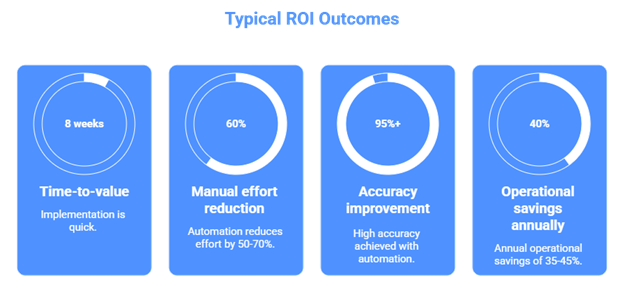
AcceliOps transforms reconciliation processes into fast, accurate, and scalable operations, reducing manual effort while improving compliance and visibility.
Enterprise-Wide Impact:
- Faster Financial Close: AI automatically matches transactions and predicts errors, cutting down manual work and improving accuracy to over 95%. It also keeps everything audit-ready and transparent.
- Enhanced Accuracy and Compliance: Live dashboards and continuous ledger tracking give instant updates on cash flow, variances, and reconciliation status across all entities.
- Real-Time Financial Visibility: AcceliOps easily manages large transaction volumes and multiple entities without extra setup, keeping performance consistent as you grow.
- Operational Scalability: Automation takes care of repetitive tasks, so finance teams can focus more on analysis and strategic work which saves up to 40% of their time.
- Optimized Workforce Efficiency: AcceliOps fits right into your existing ERP and UiPath setup with minimal disruption. It starts with high-impact areas and expands enterprise-wide within weeks.
AcceliOps integrates easily with existing ERP and UiPath environments with minimal disruption, using a phased rollout approach, starting with high-impact reconciliation processes and expanding enterprise-wide within weeks.
Typical ROI Outcomes:
Upgrade from bots to intelligent automation.
Book a DemoFuture of Agentic AI in Finance
Finance is entering a new phase where automation goes beyond doing tasks — it can think, learn, and help teams take better decisions. Agentic AI is changing reconciliation from a routine job into a smart, predictive, and self-correcting process. This helps finance leaders move from just reviewing reports to actually anticipating issues and making data-driven decisions in real time.
AcceliOps is leading this transformation. Its agentic automation framework brings together UiPath’s AI ecosystem and AcceliOps expertise to create reconciliation systems that evolve, not just execute. If your enterprise is ready to move from managing numbers to mastering financial intelligence, now’s the time to see it in action — book a demo and discover how AcceliOps turns every close cycle into a competitive advantage.
FAQs
Automation helps to improve reconciliation accuracy by using agentic AI that helps to detect patterns, validate data, and learn from past trends while reducing manual efforts
Automation helps to sync invoices, payments, and statements in real-time, making review cycles shorter. It eliminates manual checks, allowing the financial team to close vendor accounts 70% faster.
With a well-planned deployment, most businesses can set up reconciliation automation in 6 to 8 weeks. The timeline may vary depending on the company's size and complexity.
Yes. Modern automation tools have cross-system integration features that lets enterprises integrate different ERPs, financial systems, and data sources through secure APIs. This ensures transparency and reliability.