


Quick Summary
Enterprise generative AI use cases include customer support, managing and searching knowledge, summarizing documents, generating and reviewing code, personalizing marketing content, speeding up financial and HR workflows, and improving supply chain operations. The best use cases are more than generating text because they connect AI with trusted enterprise data, existing applications, and pass it to human review if necessary.
Three years ago, most company leaders were thinking about whether enterprise generative AI was a real shift. That question is almost settled. Now, they are moving to another question: which use cases are worth the budget? The reality is that generative AI has already moved beyond experimentation.
McKinsey's 2025 global research found that 88% of organizations were regularly using AI in at least one business function, which was 78% a year before. Yet nearly two-thirds are still not scaling AI across the enterprise. This means the majority is still experimenting or piloting. That gap matters a lot.
Enterprises know that generative AI can write an email, summarize a report, and generate code, but they now question whether it can improve a real business workflow to justify the investment.
What Is Enterprise Generative AI?
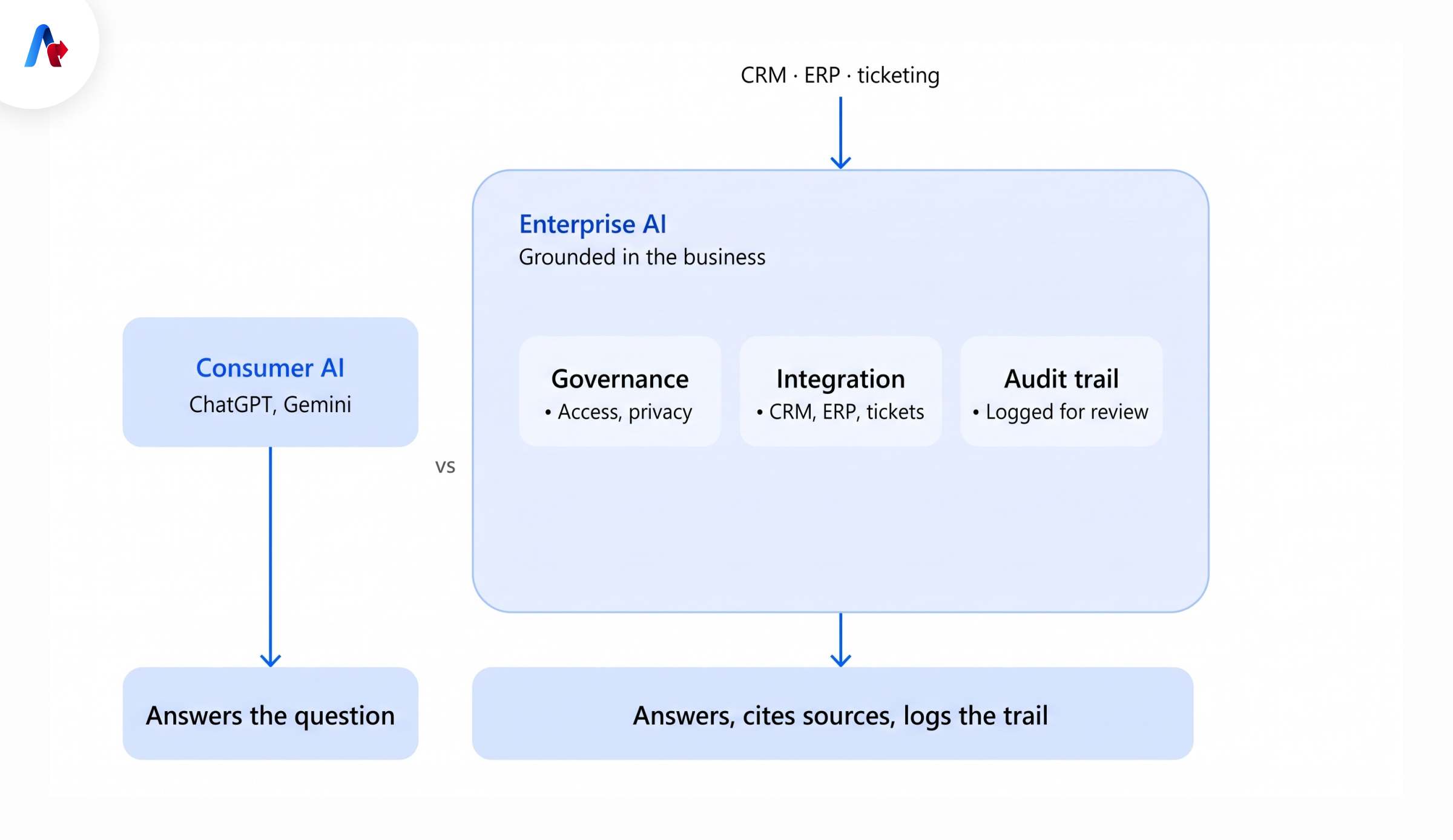
Generative AI is a large language model in a business environment that helps to create, summarize and analyze information by using its contextual capacity. This tool can plug into existing business systems, such as CRM, ERP, and ticketing platforms, to operate under rules that stick to data privacy, auditability, and access control.
The general purpose of this AI assistant is to draft an answer based on the available information. Other than that, this tool also helps companies retrieve approved policies, check access rights, generate responses and send unclear cases to human support.
Consumer generative AI tools like ChatGPT and Gemini are built mostly for general conversational and quick answers with minimal integration into a company's internal systems. Enterprise generative AI is different because it is built around three things: data governance, system integration, and auditability.
A simple way to tell this is that the consumer tools answer the questions, whereas the enterprise AI answers the questions, cites the sources, respects privacy and leaves a trail to review later.
What Is the Difference Between Generative AI, Predictive AI, and Agentic AI?
| Type | What it does | Typical enterprise use | Human involvement |
|---|---|---|---|
| Generative AI | Creates new content such as, text, code, images, and summaries | Document drafting, summarization, and content generation | Human reviews before use |
| Predictive AI | Analyzes historical data to forecast an outcome (risk, demand, fraud score) | Demand forecasting and credit risk scoring | Human reviews and acts on the prediction |
| Agentic AI | Plans and executes multi-step tasks toward a goal, often using generative AI as one component | Claims processing, invoice reconciliation, and multi-system workflows | Human sets guardrails; agent acts within them, escalates exceptions |
Why Is Enterprise Adoption of Generative AI Accelerating?
The adoption of enterprise generative AI is rising because the technology is becoming easier to access, more capable, and it can connect with the software that is already in use. The investment alone today does not create value in your business.
Gartner's May 2026 forecast shows worldwide AI spending can grow up to $2.59 trillion in 2026, which is a 47% increase compared to the last year. The report also further explains that companies are now focusing more on AI projects to improve productivity and get business value.
A shift like this is vital because the conversation is moving from what it can do to where it gives enough value.
Why Are Enterprises Moving from GenAI Pilots to Production?
There are three things that changed over the past 18 months:
- Model Costs Dropped: The cost of using enterprise generative AI has dropped as there is more competition and efficiency improvement. Due to this, companies can use this tool more instead of limiting it to small pilot projects.
- Integration Made Easy: Integration is much easier with tools like RAG, APIs, and orchestration platforms. Now, companies can connect GenAI with company data, applications, and other business systems. A method like this can help AI work with real enterprise information with more accuracy.
- Improved Governance: More companies today have clear policies about how AI should be used, what data it can access, and where human approval is necessary. These policies are also valuable for legal and compliance teams because they can approve AI projects without any issues.
Most adoption of generative AI investment still connects back to one of four drivers, such as productivity, efficiency, speed, and revenue. Your GenAI initiative becomes easy to evaluate when any one of these outcomes is defined before implementation.
Do you have a GenAI but no clear path from idea to production? Accelirate can help to evaluate the workflow, data, and integration requirements.
Talk to Our Expert to Explore Services10 Enterprise Generative AI Enterprise Use Cases Delivering Real Business Value
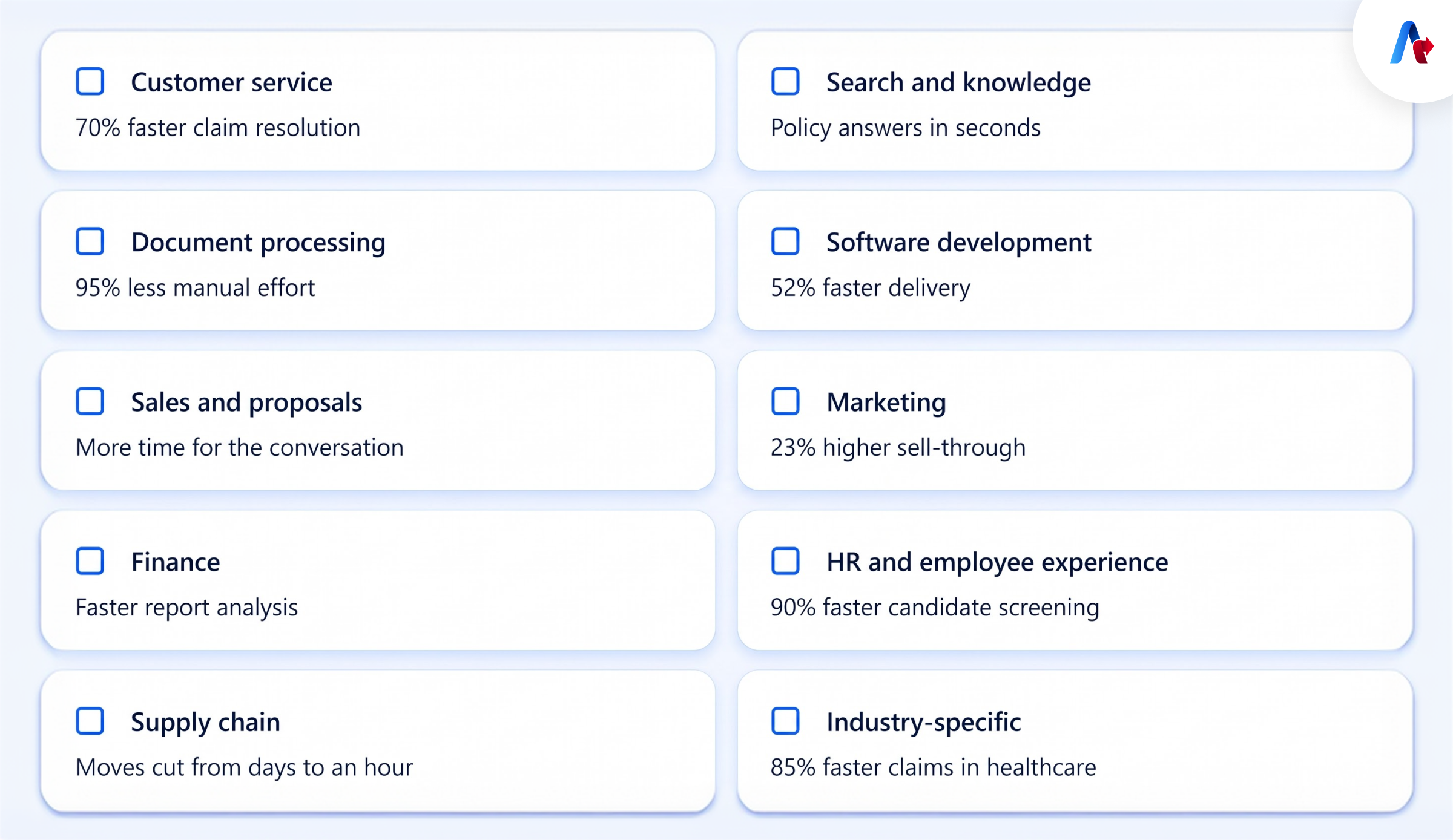
There are many enterprise use cases for generative AI, but the best one is not with the most advanced model. It is the one where GenAI removes the problems and produces results that are easy to evaluate. Let's see the 10 areas that are happening now.
1. How is Generative AI for Business Improving Customer Service and Support?
Generative AI is making customer support easier and faster by understanding the issues early, finding the right information and reducing response time compared to before. The use of AI agents mainly reduces the time spent searching documents or past interactions, so the executive can spend time where necessary. Some of the other areas are:
- Summarizing customer conversations
- Retrieving the right answers
- Generating responses
- Classify cases
- Creating personalized follow-up messages
A company gets more value when it is connected to the right workflow.
For example, Accelirate implemented enterprise generative AI for a global company that helped them extract information from the documents received and validated warranty details and policies. If something is not clear, the AI sends it to a human for review. Because of this implementation, the client achieved:
- 70% faster claim resolution
- 90% warranty-claim automation
- Saved $250,000 annually
- 220% ROI within 12 months
Read the Warranty Claims Case Study
2. How Does Enterprise Adoption of Generative AI Improve Search and Knowledge Management?
Generative AI is very useful for employees to find the right information faster at the right time without spending more time. With this tool, a person can pull information from company documents and knowledge bases. This is essential today to save time and make work faster.
The problem is that in most companies, the information is scattered across different systems. The document a person is searching for may be in SharePoint, documents and other databases. By using GenAI, it is easy to search for information.
For example, an employee may ask:
"What is our current approval process for a purchase above $100,000?"
In a normal scenario, you need to search many places and spend hours. Instead, using an AI assistant can get you the policy in seconds and summarize it without much effort. The RAG is something that is helpful here, but the quality of the answer depends on the quality of the data. If information is outdated and incomplete, the answer will be wrong.
3. How Does Generative AI Improve Document Processing and Summarization?
With the help of enterprise AI, a business can understand, read and summarize information much faster. This technology can pull information from many areas, such as invoices, contracts, emails and other documents and then prepare it in a format that is easy to understand. This not only reduces manual work but also avoids heavy documentation-related work.
What can you get by using enterprise generative AI services?
- Contracts summarization.
- Find important points.
- Understand requests from emails and other sources.
- Compare details with other documents.
- Create a short summary.
- Prepare information for the next workflow step.
Don't think that simply reading a document is what you can do with this tool. The real value comes from information extraction and summarizing in a short, useful way.
In one Accelirate implementation with a finance company, an agentic invoice reconciliation solution reduced manual effort by 95%, reduced reconciliation time by 70%, and saved 2,500+ hours annually.
Read this Invoice Reconciliation Case Study for More Information.
4. How Is Generative AI for Enterprise Changing Software Development and Code Generation?
The use of GenAI in software development can help your team write, understand and test code faster. Apart from that, the artificial intelligence handles many repetitive development tasks that will give engineers more time for problem-solving and other complex technical issues.
Today, developers use Generative AI for various purposes, such as generating code, explaining existing code, and creating unit tests. It is also useful for generating documents.
Accelirate has its own experience with a MuleSoft client that faced delays across RAML drafting, governance, Mule flow scaffolding, and other related issues. Our team used FlowAgent, which helped them with:
- 52% faster delivery in the project
- 69% less time spent on DataWeave writing
- 88% first-pass governance compliance
- 53% reduction in post-deployment defects
Read this case study for more information.
Using this technology does not mean humans are out of these services. The code generated by AI looks perfect but might fail in complex scenarios and regulated environments. Manual testing still has its place in the market, where human testers can check the usability and other edge cases.
5. How Can Generative AI Improve Sales and Proposal Writing?
The use of GenAI technology in sales speeds up work, helps teams prepare for meetings and creates personalized messages. Along with that, it can also bring information together from various places, including CRM and other relevant sources. With this tool in hand, the sales team can spend more time on personalized conversations with customers.
Before meeting with a client, a salesperson needs to understand various things such as past conversations, check opportunities, research the customer and industry and find relevant case studies. All these are easy nowadays with the assistance of enterprise generative AI.
It is also useful after a meeting, where GenAI assists in updating the CRM, summarizing meeting notes, drafting follow-up emails, and preparing a proposal. AI can reduce the time a sales team spends on these tasks. For example, a sales assistant can ask to retrieve the account history and identify customers' challenges by using a tool.
Humans are still valuable in many areas. They can send pricing and contractual information and do sensitive customer interactions that may be possible with an AI tool. The goal here is to reduce repetitive work, so the sales team can have more time on where judgment is necessary.
6. How Is Generative AI Supporting Marketing and Content Personalization at Scale?
After the integration of enterprise generative AI, marketing teams create, adapt and personalize content faster. AI also supports research, campaign planning, messaging and content creation for various channels. The purpose here is not to produce more content faster but to make things faster and more relevant.
Marketing was one of the first business functions to adopt GenAI because it involves research, language, ideas and creatives. Today, by using this tool, the teams are moving beyond content generation. GenAI can support other areas, such as:
- Audience research
- Campaign variations
- Content repurposing
- Product descriptions
- Personalized messaging
- Account-based marketing
- Research summaries
- Sales enablement material
- Localization
- Campaign analysis
Research by McKinsey in 2025 shows that marketing and sales were among the business functions with the highest reported use of generative AI.
AI can now create more content, but it does not mean that you get more value from it. So, a team should make sure that it reaches the right audience, improves speed, and reacts more quickly to customers in the market.
An Accelirate retail engagement case study mentioned earlier proved this value: what if AI goes beyond creating content? The customer also reported a 23% increase in their targeted sell-through and reduced their trigger promotion from one or two days to under 10 minutes. This is not only the power of GenAI but also the power of integration and AI agents.
7. How Is Generative AI Helping Finance Teams to Analyze Reports Faster?
A financial team in a company can use enterprise generative AI to review information and prepare reports. It is especially useful for situations where you have plenty of financial documents and business context. However, a company should use the calculations from trusted financial systems.
Finance teams work with two things: structured numbers and large amounts of unstructured information. GenAI is useful for helping with the second part. There are many use cases like summarizing financial reports, explaining variances, reviewing, and retrieving information.
It is vital to separate explaining a number from calculating the number. Systems such as ERP and financial applications should still handle calculations where accuracy is not a compromise.
For example, an ERP should calculate that expenses increased by 12%. GenAI can help explain here with the possible reasons behind that increase using the available financial and business information. A system like this matters because an AI-generated explanation can sound convincing even when it is incorrect.
The same things can apply to complex finance workflows. Here, AI understands and summarizes information, automation handles predictable steps, and people remain responsible for important decisions.
8. How is Generative AI Enhancing HR and Employee Experience?
HR is one of the areas where employees can reduce repetitive work and give faster access to information by using GenAI technology. It can also support other areas, such as onboarding, candidate document review, and internal communication. With this technology, HR teams will get more time to focus on where personal interaction is necessary.
Other use cases of enterprise GenAI in HR include:
- Onboarding support
- Job-description drafting
- Learning-content creation
- Candidate document review
- Employee assistants
- Internal communications
- Summarizing employee queries
Accelirate has the same type of experience with one of our healthcare clients, where they used GenAI agents for the candidate background verification process. The result was more than expected, where they dropped processing time from 10 minutes to one minute per candidate. This technology also saved 90% (364000 annually) of their time in the candidate verification.
Read the GenAI Candidate Screening Case Study
Still, there are many areas in HR where human review matters, so that should not be ignored.
As NVIDIA CEO Jensen Huang said:
"You're not going to lose your job to an AI, but you're going to lose your job to someone who uses AI."
9. How Is Generative AI Improving Supply Chain and Operations?
In supply chain and operations, using enterprise generative AI helps teams understand the large amount of information faster. The AI notifies teams of delays, inventory issues, supplier updates, and operational exceptions. When you connect them with predictive models and AI agents, you can use them for decisions and actions.
The problem in this supply chain is the constant change. Sometimes the demand changes, inventory gets older, suppliers send new updates, and there are issues with the orders. The use of GenAI is vital here to understand what is happening. More than that, it becomes more powerful when it works with other technologies that can take action.
In our previous case study, we implemented AI agents and MuleSoft solutions for a global retailer that was facing fragmented inventory data and slow response times. The fact is that before implementation, moving inventory between locations took 7–10 days, but after that, it took less than one hour. The client also reduced their losses from $5.4 million to $1.6 million quarterly with this technology.
Explore the Retail Inventory Case Study for More.
10. Which Industry-Specific Generative AI Use Cases Are Producing Value?
Generative AI in an enterprise creates value depending on the industry. For example, a healthcare team can support claims and documentation, whereas financial services can utilize it to review documents and compliance research. In the manufacturing sector, enterprises may use it for technical knowledge and operational support.
Healthcare
In healthcare, you can use GenAI to process and understand large amounts of clinical and administrative information. Here, you can use it for claim processing, denial, prior authorization, patient communication, and document processing.
In one of our client services, Accelirate helped with 85% faster claims, reduced 95% errors, and mitigated approximately 60% operational cost for a healthcare insurer. Today, speed matters in the healthcare sector, but it should not be compromised on compliance and traceability.
Financial Services
A financial organization benefits from GenAI by reviewing information and working with heavy documents quickly. It can also be used to summarize documents, retrieve policies, support KYC, and compliance research. AI is good to improve decision-making, but it doesn't mean that you must automatically make every decision, especially high-risk ones.
Manufacturing
The implementation of GenAI in the manufacturing sector will make operational access easier. Here, a team will be able to search technical documents, generate work instructions, check warranty and procurement documents, and use it for operational reporting.
If one of these use cases feels relevant to your business, the next step is to test it in a real workflow.
Start With Our 5-Week AI Agent Activator PlanHow Are Enterprises Deploying Generative AI in Production?
Enterprises today use different ways to bring generative AI into real business. Some may start with a GenAI tool, while others use a larger enterprise platform. The right approach is based on the use case, data, how many systems need to connect, and how much control you need.
Difference Between Generative AI Platform and a Point Solution
A point solution is something that is built for one specific use case, whereas an enterprise GenAI platform supports multiple teams and workflows.
| Factor | Point Solution | Enterprise GenAI Platform |
|---|---|---|
| Speed to start | Faster | Requires more setup |
| Governance | Specific to one tool | Easier to manage across teams |
| Integration | Limited to a specific workflow | Can connect across more systems |
| Initial cost | Lower | Higher |
| Scalability | Good for a focused use case | Better for multiple use cases |
| Best fit | One clear business problem | Broader enterprise AI strategy |
- RAG: It allows AI to retrieve information from approved sources. If someone asked about company policy, RAG could find the latest company document and give a response.
- Fine-Tuning: It is a method of training a model by using examples, so it behaves more consistently for a task. This situation is useful when a business needs a certain writing style, format and behavior.
- Agentic Orchestration: It allows AI agents to use tools, connect with systems, and complete several steps in a workflow. An issue can be detected with GenAI, but AI agents can check the invoice and purchase order and send it for approval.
Organizations have different choices while using a GenAI solution: build one, buy an existing solution, work with a service partner or use a hybrid approach.
When to build a generative AI platform
- You can build one if the use cases are highly specific and the company has the internal skills to develop and manage it.
When to build a generative AI for enterprise
- A company can buy one when a product already solves most of the business needs. /li>
When to Use GenAI services
- Use one if you seek custom workflows, integrations, governance, and specialized expertise for projects.
When to Use Hybrid GenAI Services
- A hybrid method is practical if you have an existing AI platform and use customer parts for their own data, processes, and systems.
What Should You Look for in an Enterprise Generative AI Platform?
An enterprise GenAI platform should have many things to work better, such as data integration, security, flexibility, RAG, governance and human support where necessary. Apart from that, a company also must look for monitoring capacity, cost management, scalability, and workflow integration.
- Look at where the AI can connect with CRM, ERP, documents, and databases presently used.
- Check whether the tool follows existing user roles and permissions.
- Can a team select different models based on cost and speed?
- Verify that the tool can use trusted information from the company to provide reliable answers.
- Check to see if the GenAI has any controls on what it can access.
- Is there a way to send sensitive information to people to review?
- Can you trace back errors, performance and AI behavior changes?
- Can the organization identify usage of AI and operational costs?
- If needed, does the platform support more users and workflows?
What Are the Biggest Risks of Using Generative AI?
Enterprise GenAI is useful in many ways, but it can create risk by giving incorrect answers, making data privacy and integration issues, building a governance gap and creating more cost for organizations.
- Incorrect Answers: This is called hallucination, where the AI produces answers that look right, but they are not.
- Data Privacy: Information such as customer data and financial details needs protection, but AI may leak it unless used properly.
- Data Quality: There is a risk of data quality as AI produces better output only based on the data it receives. If the data is not correct, it affects the quality.
- Integration Issues: Sometimes, the integration creates more complexity while connecting with old systems.
- Higher Costs: The cost for various areas like usage, monitoring, and maintenance can be higher while using a GenAI app.
- Governance Gaps: Governance is vital for using AI tools, especially for access and human support. If not, the tool may behave differently.
Planning to move GenAI from a pilot? Accelirate can help you plan the right controls, integrations, and human review before you scale.
Explore Our ServicesHow to Measure ROI from Enterprise Generative AI
Measuring the ROI of a GenAI tool can be done by checking the time saved, cost reduced, improvement in quality, productivity increase, impact on the customer and revenue. The following questions can help you more:
- How many hours are saved after using this tool?
- Have you reduced the cost of production with AI?
- Do you face only a few errors or less work by using GenAI?
- Are there fewer errors or less rework?
- Can your team handle more work than before?
- Have you improved response time and quality with the tool?
- Is AI helping improve conversion, sales, and speed to market?
A simple ROI formula is:
ROI = (Financial Benefit − Total AI Cost) ÷ Total AI Cost × 100
Total AI cost should include model usage, integration, infrastructure, monitoring, human review, and ongoing maintenance.
How Can You Get Started with Generative AI
A business can start with a clear problem by choosing clear use cases, checking readiness, and selecting the right approach. Once everything is ready, choose a pilot and scale as the business grows.
1. Begin With a Particular Use Case
This implementation can be measured with a clear use case to start with. Instead of saying use GenAI in finance, say reduce the time needed to prepare monthly financial reports.
2. Check Data Readiness
Data is the soul of AI function, so understand what data the AI needs. Also learn where it is stored and check if the AI will be able to access it securely.
3. Choose the Right AI Approach
Every situation does not demand the use of GenAI. Some may work better with traditional automation, but some do not. Better check this before you start.
4. Start with a Pilot
Always start small and check accuracy, cost, speed, human review and errors.
5. Scale What Works
Do not use AI for everything. Instead, check where it shows value. Start small, measure the results and scale later.
Start with the Right Generative AI Enterprise Use Cases and Scale What Works
Using AI at work can solve many business problems, but understand that using it is not a choice in every place. So, a company should find where it works, save time, reduce costs and improve quality.
First, start with important use cases by connecting with trusted data and existing systems. Not every case can be handled by GenAI, so there should be a clear rule when humans should step in.
Enterprise generative AI is only one part of the AI journey. In many cases, a company must combine GenAI with automation, RAG and agentic AI for better results. The goal is to use the right technology for the right problem and scale when there is a clear value.
Are you not sure which GenAI use case to start with? Accelirate team can identify the right opportunity and build a solution for your problem.
Talk to Our ExpertsFAQs
You can see several use cases in GenAI that include customer support, document processing, software development, sales, marketing, finance, HR and supply chain management. The best use cases are the ones where employees spend more time searching for details, reviewing, and creating content.
A consumer-type AI tool is limited and used for individual work, such as creating content, answering, and summarizing. Enterprise GenAI is completely different from the other one because it works with company data, business applications, security rules, permissions, and governance. Enterprises also need testing, monitoring, audit trails, and human review, as it may affect customers and business operations.
The ROI is based on the use cases. An organization should consider how AI helped, such as time saved, cost reduction, error reduction, productivity improvement and revenue increase. You can also compare it with full cost solutions, including models, integration, monitoring, maintenance and human review.
Using GenAI comes with many risks if not properly used. It includes incorrect answers, data privacy issues, poor data quality, security, cost and weak governance. The risk is higher when AI starts taking actions instead of only generating information. The solution to this is to use trusted data, better control, testing, monitoring, and human review for high-risk workflows.
An enterprise can choose generative artificial intelligence based on the business needs. Apart from that, look for data integration, security, access control, and RAG. Security, governance and scalability are the must-check criteria before moving to the final selection.
Generative AI is used to create information, such as text, summaries, code, and answers. Agentic AI goes further and connects with systems to complete multiple steps to reach a goal. In short, GenAI might explain an invoice issue, but an AI agent investigates further, updates the system, and sends it for approval.
Many metrics can be used, including the time saved, cost reduction, productivity, error rate reduction, and revenue impact. It should not be calculated by checking how many employees use it. The generative model you use should improve the workflow and give an advantage in daily tasks.