



Quick Summary
Agentic RAG is where AI starts thinking for itself. It brings together two big ideas, retrieval-augmented generation and agentic intelligence, to create systems that can fetch data and understand what to do with it. Apart from surface-level answers, agentic RAG checks multiple sources, validates facts, and learns how to do it better next time. For enterprises buried under data and documents, this means faster insights, fewer errors, and decisions made with real context and impact.
Agentic RAG short for agentic retrieval-augmented generation refers to an AI system that fetches facts and refines itself further before sending it to you. It combines two major technologies including RAG (Retrieval-Augmented Generation) and Agentic AI.
RAG helps in improving AI responses by retrieving right data from LLMs live and not just when they are trained to do so. Agentic AI in RAG acts as an active partner which works independently to plan, reason and act.
Together they create a smarter system that can figure out how to get the right answer rather than just giving answers to the questions. This mix makes modern enterprises rethink how they use AI for analytics, knowledge management, and automation. In this article we will get a clear understanding of how RAG works and some important applications across various industries.
What Is Retrieval-Augmented Generation (RAG)?
Let’s start with basics before diving into what makes an Agentic RAG framework different.
A plain RAG system connects a model to an external knowledge base documents, databases, or APIs so it can look things up when needed.
Here’s what happens:
- You ask a question.
- A retrieval model searches for relevant data.
- That data is added to your query.
- The model generates an answer using both.
This process grounds answers in facts and reduces hallucinations. But there’s a catch: it’s usually one-and-done. The RAG agent validates the results or pulls from multiple sources and grabs what looks closest and stops there.
See how enterprises are upgrading from traditional RAG to Agentic RAG
Learn MoreWhat Is Agentic AI?
The term "Agentic AI" describes AI systems that are capable of goal setting, decision-making, and autonomous action to accomplish desired results. Compared with traditional AI, it can adapt, learn, and take proactive action without continual human guidance.
As per a report by Gartner, by 2028, up to 33% of enterprise software apps will include Agentic AI. It will be up from less than 1% in 2024.
So, when you ask, “Why did our support response time spike last month?” an agentic system might pull ticket logs, compare staffing data, check CRM notes, and summarize patterns automatically. That’s what orchestration does.
What Is Agentic RAG and Why It Matters
In a typical agentic RAG implementation, intelligent agents oversee the retrieval process itself. They decide which sources to use, how many rounds of querying to run, and whether the results make sense. If not, they refine the question or change the data source.
It’s a major upgrade for real-world environments where data lives across CRMs, ERP systems, and unstructured repositories. A single-step RAG can’t handle that. An agentic approach can think it before it searches.
How an Agentic RAG Framework Works
Modern Agentic RAG functions by combining various AI agents working towards one particular goal. These multiple agents are specialised on their own, for example one agent would create structured databases, second agent might check through emails and third would go through web for any updates. To create a complete final solution these agents, collect the most reliable information, making Agentic RAG best suited for complex enterprise workflows.
Some of the popular agentic AI frameworks available on GitHub include LangChain, LlamaIndex, and LangGraph. These frameworks support developers in constructing test RAG setups, trying out designs giving teams control over how data is gathered, utilized and optimised for right use.
Types of AI Agents in Agentic RAG Systems
1. Routing Agents
Routing agents as the name suggest look for the prompts and figure out what needs to be sent to create good RAG pipeline. For performing these agents select different tools data sources or find ways to get the information to answer user’s question. In single-agent setups, a routing agent just picks which source to query. In multi-agent systems, on the other hand, it coordinates numerous specialized agents to get the best answers.
2. Agents for Planning Queries
These are the "task managers" for the RAG pipeline. They take complicated questions from users and split them down into smaller, easier-to-understand tasks or subqueries. The proper agent gets each subquery, and then all of the answers are put together into one answer. AI orchestration is the name for this form of collaboration amongst several agents.
3. ReAct Agents (Reasoning and Action)
ReAct agents can think, make decisions, and take action on the fly. They can create a workflow with several steps, choose the best tools to employ, carry out each phase, and make changes based on what they find along the way. This makes the system flexible and able to change its mind about how to accomplish things if the first try doesn't work out well.
4.Plan-and-Execute Agents
These are the smartest agents as they go step ahead with the autonomy criteria. Plan-and-Execute agents don’t depend on other agents to take decisions, instead these agents carry out multi step processes on their own. In this process the dependency of ongoing monitoring, processing costs gets reduced generating better and faster results.
Key Steps in Agentic RAG Workflow

Step 1: Planning and analyzing the query
Agentic RAG is different from standard RAG. It starts by looking at the user's question to see if it needs facts, logic, or both. Then Agentic RAG makes a strategy that breaks down hard activities into smaller, easier-to-manage ones.
Step 2: Strategic Retrieval and Tool Usage
Next, the system leverages frameworks like LangChain to carry out the strategy for retrieval. You can use more than one agent or retriever to get data from different places. The agent checks to see if the results are good enough and can change the questions or utilize different techniques on its own if necessary.
Step 3: Adaptive Response Generation and Refinement
Lastly, the agent puts all the information it got into a complete, high-quality answer. Before giving the answer, it checks its own work, fills in any gaps, and fixes any mistakes. This self-monitoring and improvement cycle is what makes agentic RAG systems more trustworthy and aware of their surroundings than regular RAG systems.
Agentic RAG vs Traditional RAG
Take for example Traditional RAG is a useful intern. You ask a question, and they sift through your documents, extract a few important lines, and neatly summarize them. Useful but limited. If the solution isn't put down, they simply stop.
Agentic RAG, on the other hand, behaves more like a research analyst. It receives information and further considers, plans, and acts to fill gaps. If anything is absent, it knows how to discover it or create it – whether by examining new data, comparing outcomes, or performing minor chores. So, rather than simply reporting what exists, it provides an intelligent, adaptive response.
In summary, standard RAG retrieves and repeats, but agentic RAG retrieves, reasons, and responds intelligently.
| Feature | Traditional RAG | Agentic RAG |
|---|---|---|
| Data Sources | One fixed dataset | Multiple, dynamically chosen |
| Query Flow | Retrieve once → generate | Plan → retrieve → validate → refine |
| Decision-Making | None | Agents plan and adjust |
| Adaptability | Static | Context-aware and self-correcting |
| Accuracy | Depends on first pass | Improves through reasoning loops |
| Cost | Lower | Higher, but smarter |
Top High Impact Use Cases of Agentic RAG in Enterprises

RAG’s role for enterprises has expanded beyond just content generation, now RAG is helping in timely delivery of right information from the most relevant data sources. Each of these cases has one thing in common: the agentic RAG framework adds logic between retrieval and response, cutting through noise that traditional RAG pipelines can’t handle. Let’s understand it’s five practical use cases and their impact:
- Customer Support Agents Instead of a chatbot searching one help-center database, a RAG Agent can look across tickets, product manuals, and company policies, decide which is most relevant, and stitch together a single answer. The user gets context that feels genuinely human.
- Internal Knowledge Search Big firms produce a thousand of paperwork across various channels. What agentic RAG does here is, it routes queries across channels and CRM systems before giving a summarised output to the right user.
- Finance and Compliance Reviews In regulated industries like finance and compliance AI accuracy is a must. Agentic RAG plays an important role is fetching exact policies validating them against updated laws so they can have a hassle-free internal audit data summary.
- Healthcare and Research Hospitals are using multi-agent RAG systems to help doctors and analysts pull clinical notes, research papers, and patient records, all while maintaining data boundaries. The agents’ reason through results rather than dumping raw information.
- Sales Enablement To understand this use case clearly imagine a rep asking, “What’s our renewal policy for mid-tier accounts in Europe?” The agent fetches pricing sheets, regional guidelines, and CRM entries to form one clear, factual answer.
Ready to implement your own Agentic RAG use case?
Partner with Accelirate to make it realBenefits of Agentic RAG for AI Agents
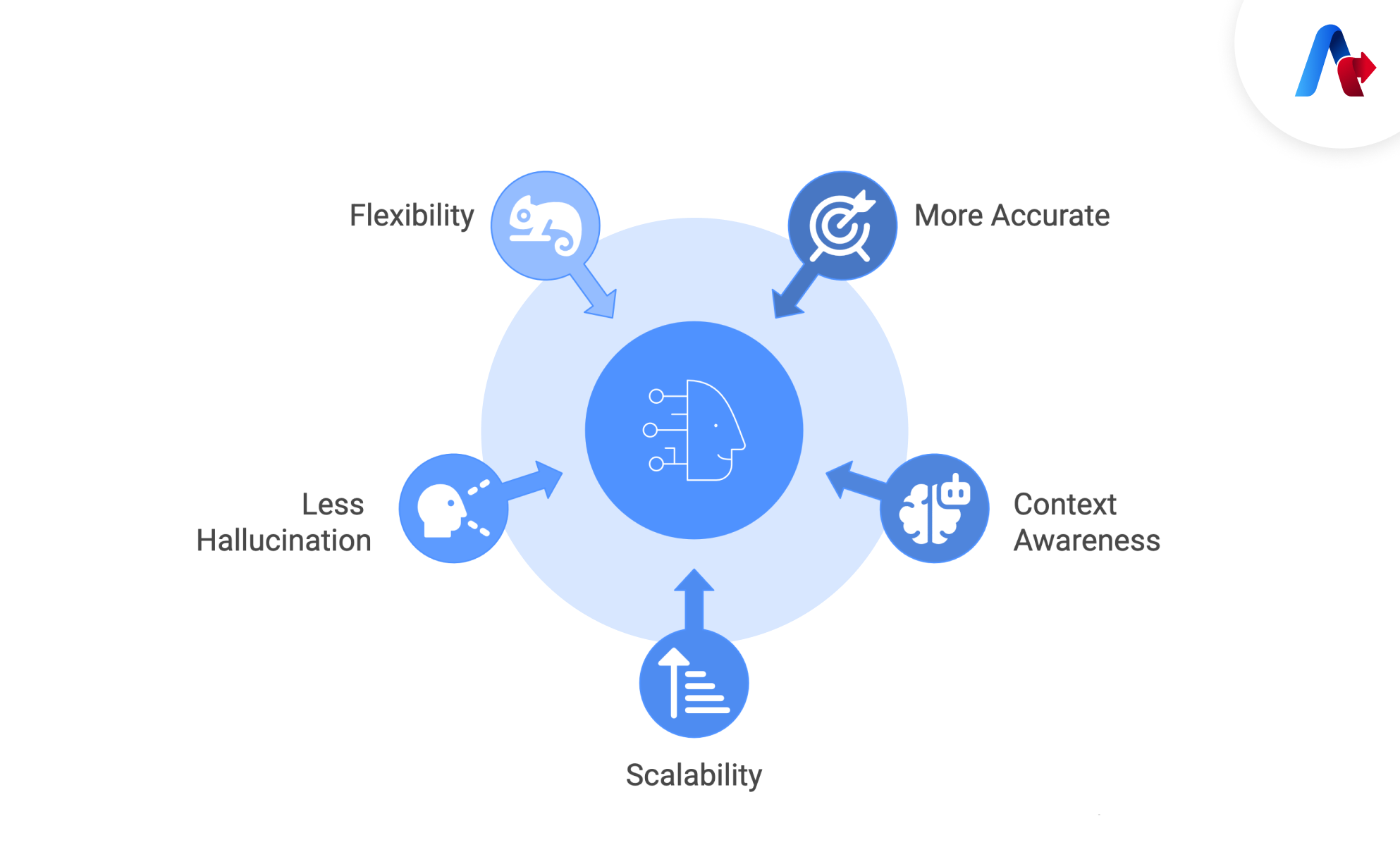
- More Accurate: Agents can check and re-query data instead of just trusting the first match they find.
- Context Awareness: They remember what you searched for before and use that context again, which makes extended conversations or workflows run easier.
- Scalability: Multi-agent coordination lets processes run at the same time, which saves time on big datasets.
- Less Hallucination: The model's answers are based on real, verified data from a variety of sources.
- Flexibility: Agents can add new data or tools without having to retrain the main model.
Understanding the Agentic RAG Architecture
The modern RAG architecture goes beyond the traditional RAG architecture with new capabilities of adding intelligent agents. These agents are capable of reasoning, planning and deciding the use of information. Agentic RAG architecture contains various levels of complexities. Let’s understand what different type of RAG architectures looks like and how they operate.
Single-agent RAG (Router)
In its most basic form, an agentic RAG functions as a router. Before responding to a user question, the single agent selects which external knowledge source or tool to employ and collects extra context. These external sources are not restricted to vector databases; they can also include web searches, APIs, and communication channels such as Slack and email. This architecture adds intelligence to the retrieval process, ensuring that each query is sent to the most relevant source for optimal results.
Multiple-Agent RAG Systems
Multi-agent architectures expand on this concept by grouping numerous specialized agents under a coordinating "master" agent. Each sub-agent specializes in a specific type of information; for example, one retrieves data from internal databases, another from personal communication tools, and another from public online sources. The master agent facilitates their collaboration by combining the recovered insights into a cohesive, high-quality response. This arrangement increases logic, scalability, and accuracy, particularly in complicated company or research contexts involving data from numerous systems and formats.
Related Reading: Understanding Agentic AI Architecture
A Quick Agentic RAG Example in Action
Picture a multinational retailer launching a new product line. The marketing team wants to analyze customer sentiment across Twitter, support tickets, and sales feedback in different languages.
A traditional RAG setup would pull from one dataset at a time and merge results later.
An Agentic RAG implementation, on the other hand, assigns:
- one RAG Agent to social media data,
- another to customer service logs,
- a third to regional sales reports.
The planner agent orchestrates them, compares patterns, filters duplicates, and sends a refined summary to the generator model. The result? A near-real-time insight into what’s working, what’s not, and why, all without a single manual query.
Why Enterprises Are Adopting Agentic RAG for Smarter AI
Businesses are trying to fix their biggest problem: too much content. The ordinary business has to deal with hundreds of tools and millions of documents. It saves time, money, and irritation to have a system that can think through all of that and provide you answers that make sense. Adoption is rising quickly because:
- It works with existing tech stacks. Most agentic RAG implementations are built on top of existing vector databases or cloud-based knowledge bases.
- It increases the return on investment (ROI) of existing models by adding intelligence without needing to retrain them.
- It helps with greater governance and data visibility because retrieval is logged, validated, and easy to understand.
Agentic RAG as the Next Leap in Enterprise AI
Modern artificial intelligence knowledge systems can trace their roots back to Standard RAG, which let robots to retrieve pertinent data whenever needed. Knowledge, however, is insufficient in the modern business world. Adaptable, reasoning, and context-aware intelligence is essential for businesses.
Agentic RAG holds multi-agent ecosystems together, allowing AI agents to work together and fix themselves. Transforming enterprise AI from a tool that discovers answers to a system that understands outcomes, it delivers accuracy, reasoning, and real-world context in one cycle. AI is seeing a shift from static to self-improving models, and Agentic RAG is leading the charge. Build your first Agentic RAG workflow with Accelirate and watch it learn smarter every time.
FAQs
An AI assistant that can find documents and plan further steps is a good example of Agentic RAG. For instance, an HR assistant can get interview scheduled from the ATS, get candidate profiles from another system, summarize them, and deliver the necessary information to each interviewer. In this process its performing multiple end-to-end steps autonomously.
Agentic RAGs provide people more freedom and power to make decisions, but this also raises the level of risk. You check them to make sure they get the right information, make safe decisions at every stage, obey the rules, and don't produce confident but inaccurate outputs. Teams can trust RAG system, grow it safely, and maintain performance predictable only if they follow the right analysis.
When the system prepares a series of steps instead of just retrieving and answering, you know it's an agentic RAG. It decides what to get next, uses tools or APIs, changes based on what it has learned before, and does things like upgrading systems, checking numerous sources, or coordinating actions. It is agentic if it "thinks, retrieves, acts, and then retrieves again."
ChatGPT is not a RAG on its own. It uses what it knows to answer questions. It only becomes RAG-based when it is connected to outside retrieval systems that give it new information. It only becomes agentic RAG if it also plans tasks, employs tools, and does more than just answer questions.
Agentic RAG systems are strong, but they are also more complicated, take longer to respond, have riskier decision routes, and are harder to debug. They depend a lot on good retrieval quality, can still make things up, might access the wrong data source, and need strict rules and monitoring to keep from making mistakes, becoming stuck, or doing anything dangerous.