



Quick Summary
The cost of manual testing is not just the salaries and tools, but also includes hidden costs, such as release delay, fixing production bugs, test maintenance, and QA teams' burnout. AI testing can avoid the hidden costs of manual testing by increasing regression cycles, reducing maintenance work, and covering the area. Accelirate experience says that a hybrid method works better where artificial intelligence can do repetitive work and human testers can be utilized for decision-related work and other areas where manual QA is still valuable.
Ask engineering leaders about software testing costs, and they will come up with a QA budget that may include team salaries, testing tools, and external partner payment tools. But this won't show you the full cost.
The hidden costs of manual testing mostly don’t appear in the initial stage. Because of this, your release may be delayed, and the team cannot keep up with the sprint. This problem prevents senior engineers from finding new features as they fight to fix bugs that were solved earlier.
All these costs can affect delivery, customer experience, productivity and the overall revenue. It doesn’t mean that a company should replace the entire team with the new AI tools. Still, human judgment is necessary for testing and complex business scenarios.
This article is going to explain what the hidden costs of manual testing are, including the hidden expenses that are easy to miss. It also explains where AI agent testing can reduce repetitive work and where human testing is still necessary.
What Do We Mean by "Hidden" Costs of Manual Testing? (Visible vs. Hidden Cost)
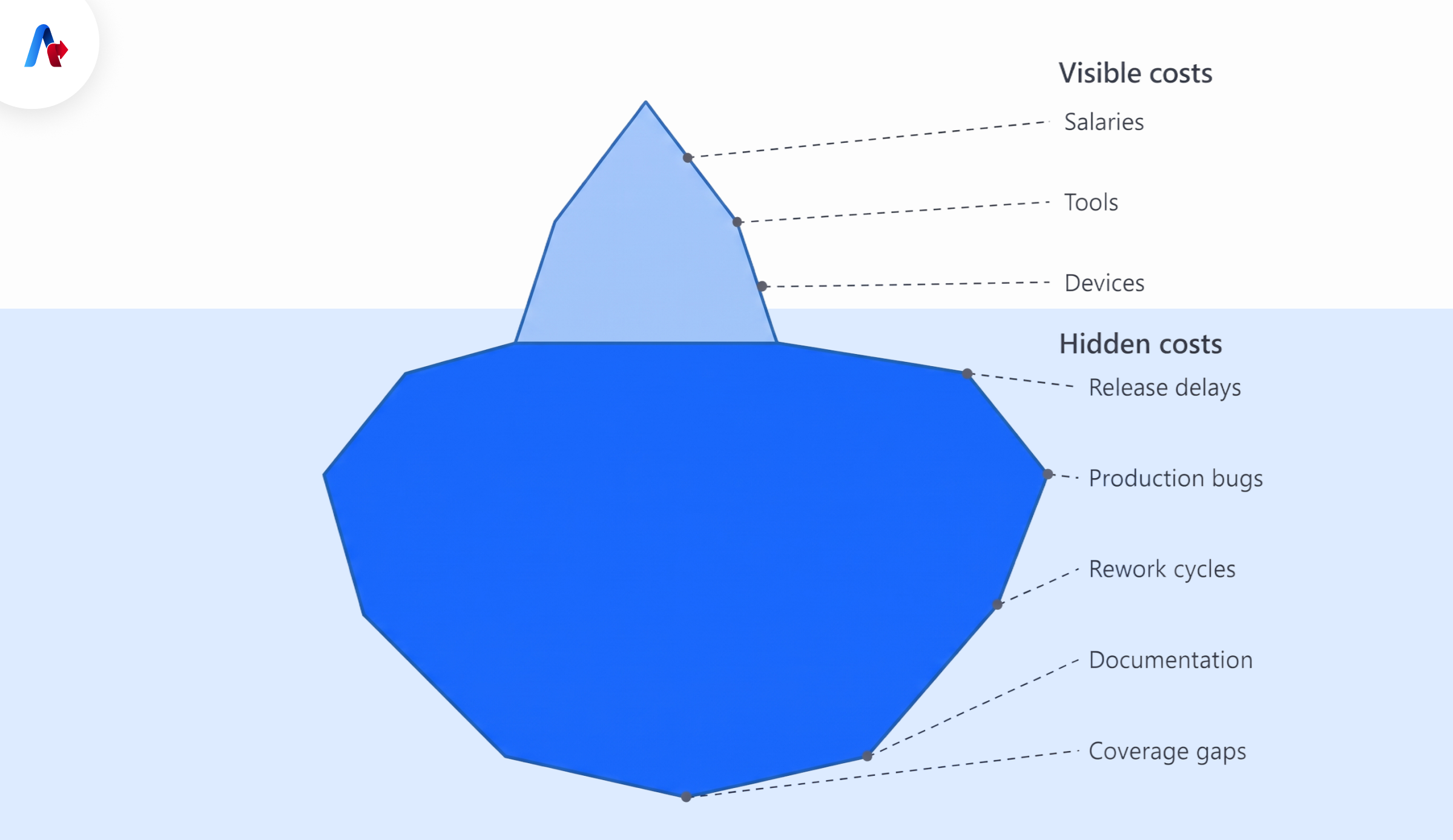
The hidden costs of manual QA testing are the type of expenses that are not clearly visible in the budget. The visible costs are what you can see on the invoice, such as license fee, salaries, but the hidden costs are not visible, such as delay in the release, maintenance cost and production bugs.
What counts as visible testing cost?
This visible area has many costs that include:
QA salaries and benefits
Tools subscription for management
Devices and testing environments
What counts as a hidden manual testing cost?
These are the costs that don’t appear visibly, including:
Release waiting time
A production bug
Repeated regression testing
Documentation and audit evidence
Unexecuted tests and coverage gaps
Why Hidden Costs Can Be Larger Than Visible Costs
The hidden cost of manual testing can affect the entire budget. Normally, a few things will be visible in testing, such as salaries, tools, and outside support. The fact is that in QA, there is a delay due to bugs, rework, and developers find time to fix problems.
Atlassian’s 2025 research found that 50% of developers lose more than 10 hours a week due to workplace inefficiencies. The report also says 90% lose at least six hours in testing that will not be included in the normal budget.
Accelirate’s experiences also prove this because the testing cost usually comes at least 15-25% in software development. By using AI in testing, a team can mitigate this kind of cost and save the precious time of the developers.
What Are the Seven Hidden Costs of Manual Testing?
The seven hidden costs of manual QA are rising labor needs, release delays, human errors and production bugs, test maintenance, team burnout, limited coverage, and slower innovation. All the time, these costs may fall outside of the QA budget, but they really affect in many ways.
Hidden Cost 1: Why Do QA Labor Costs Scale Out of Control?
The cost of manual QA testing increases when the product grows. Every time you add new features, integration and devices, there is a need to test. At this time, the workload of the team will increase, which will lead to more hires, reduced test coverage or delayed software release.
So, the QA budget will increase rapidly, and if the company cannot keep up with this pace, testing will slow and reduce coverage. When a team member leaves the organization, the existing testers may be taking on too much work, which will affect their productivity.
Now, the faster release cycle is putting more pressure on developers. In fact, one QA engineer may support up to five developers. When the pressure increases, there is only a small chance that the developers will pay attention to where it is necessary. This is where the automation can support, where it is not only essential but also not to replace the team.
Hidden Cost 2: How Much Revenue Does QA Cost for Time Delay?
The hidden costs of manual testing include delays that can push back the releases, slow growth and take developers away from actual work. When regression testing cannot keep up with the actual speed, QA teams must either delay the release or launch with less coverage, and two of these choices carry a cost.
QA bottlenecks can delay the sprint.
There are only two choices when traditional testing cannot keep up with the pace: delay the application release or continue with less test coverage. A delayed release can slow down the entire business, and releasing with limited QA can increase the chance of bugs reaching customers.
How to calculate manual testing costs, such as delays in testing
A two-week delay in a subscription model business can push back the revenue of an organization. You can find it by using delayed days (expected annual revenue ÷ 365). With this, a company gets a rough idea about the revenue they have missed, but the actual cost can vary on several factors, such as features, customer demand, and sales cycle.
Feature backlog vs. developer velocity gap
The scenario of today is different because developers produce more code and testers must check it faster. If it is not up to speed, it will affect the whole delivery process.
Accelirate experienced this kind of scenario with a global bank and helped to overcome it with AI support. After modernizing the bank’s testing process, regression cycles dropped from 10 days to three. More than that, the bank also saved more than 40,000 hours each year in testing and maintenance, which helped them to update faster without affecting the test coverage.
Are testing delays slowing your releases? Accelirate can closely work with your team to find problems and build a practical plan to reduce them.
Find Your Testing Bottlenecks.Hidden Cost 3: What's the Real Cost of Human Error in Manual QA?
Human error in manual QA is risky as it can lead to production bugs, urgent fixes, support tickets, and sometimes affect customer trust.
Even if a company has more experienced testers, it is sometimes impossible to catch all these errors. As a result, the team also leads to more repetitive work, tight deadlines and may miss important things that add another issue in the queue.
Instead, if testers can find a bug early, they can correct it before it reaches the customers. If it reaches the final user, the team may have to investigate it, respond to the tickets, fix it and explain to the customer what went wrong.
When problems repeatedly reach the final user, the company may face trust issues that will affect the business. The reason is very simple: enterprise customers expect applications to work reliably, and, finally, they think about product renewal and expansion plans.
Hidden Cost 4: How Do Test Maintenance and Documentation Affect Engineering Time?
In traditional testing, there is always a maintenance and documentation problem when you change the design, buttons, and adjust the workflow. These types of issues can increase maintenance work for the team, but with self-healing AI, a company can tackle many of these situations.
These types of costs may be ignored by the companies in the initial stage. When this type of repetition occurs, engineers' productivity is affected because they keep working on existing cases rather than new ones.
This keeps on coming with traditional automation, but when you use automated testing, it can automatically update the test cases and the small changes in all areas on its own. For example, if there is a change in the button or element that can affect many scripts, automation handles it easily by updating in all the places and avoiding failure.
A flaky test also sometimes fails even when the software is working correctly. During this time, the engineers must spend more time checking whether the problem is real or just a result of the test itself. When this type of problem arises, teams may start ignoring failed tests, and they may overlook the genuine problems that may create bigger risks.
In one Accelirate engagement with a US-based enterprise, this type of situation happened where a small UI change caused 30 existing automations to fail. Because of this, the entire team spent 16 hours fixing them.
We have introduced auto-healing capabilities for this customer as a solution for these UI changes to fix this issue. After using our solution, it mitigated their maintenance work and reduced disruptions due to frequent updates.
Although this case is not connected with software testing, it shows how changes to traditional test automation can affect the entire process.
See how Accelirate helps teams reduce test maintenance, save time, and keep testing working as applications continue to change.
Explore Test Automation ServicesHidden Cost 5: How Does Manual QA Burnout Drive Up Attrition Costs?
Manual regression testing is repetitive, so doing the same work repeatedly can lead testers to burn out. This situation creates additional pressure that may force someone with the main knowledge to leave and create more problems for other QA team members.
Repetitive testing can lead to burnout.
Running the same test cases manually will affect the release and leave only a little room for creative work for the testers. Most testers’ quality work is challenging, and they become frustrated when they do work that has already been completed many times.
Experienced testers take their knowledge with them.
Qualified and experienced QA team members know where the product may fail, and this knowledge is necessary for a quick resolution. Continuing work on something will force them to leave the organization, and if the processes are not documented, new hires may struggle to identify the problems.
Fewer members mean more pressure.
When a tester leaves the organization, we can expect a replacement, but this may take time. Not only that, but the new hires also need training and time to understand the process, which may put pressure on the existing team. While this may seem regular, it can lead to less coverage and slow release. There are other hidden costs of manual testing that companies ignore here, such as recruitment, onboarding and training.
Burnout leads to missing defects.
As the team is tired due to overloading, they may be more likely to miss the details that need more attention. Once they fail, it reaches production, which affects the final users.
Hidden Cost 6: What Test Coverage Gaps Cost You
Test coverage gaps can cost a lot because they will increase production bugs, lead to emergency fixes, and sometimes customer dissatisfaction. If it is manual QA, the chance of fixing a number of scenarios is less, which may avoid any essential case being unchecked.
Manual testing has a limit.
Each tester can complete only a certain number of test cases within a sprint. So, if you ask them to move forward, it will reduce the time they spend on each, and this will increase the chance of missing something. In 2026, the complexity increases more and going with only a manual method is not a good choice.
Browser and device coverage increases the gaps.
Testing across different browsers, devices, operating systems, and screen sizes involves hundreds of combinations that will frustrate the testers. A team going with traditional methods may focus on the most common ones, but this may leave some customer experience (CX) unnoticed.
Untested areas create business risk.
More untested areas mean more risks. A team can be optimistic that most may never cause problems, but it becomes dangerous if one problem reaches the final users. There are many hidden costs of manual testing like this here, such as resolving tickets, urgent fixes and loss of trust.
Hidden Cost 7: What's the Opportunity Cost of Slower Innovation?
Opportunity testing cost is a significant loss for your organization because it takes away precious time from your engineers, who should be working on new products. Such a loss is not a small one, as it can leave the company behind the competitors that improve faster.
Most of the time, senior engineers attend the production incidents as they are more experienced in diagnosing. Their time is more valuable on architecture and new feature work, but instead of that, they spend more time fixing issues.
This also affects competitive advantages, where other companies spend more time improving new features, but you don’t. Competitors who introduce software faster get more advantages, and they win the market while your team still fights with regression testing.
How Do You Calculate Your Real Manual Testing Spend?
Estimating human testing cost is easy if you try this: (Number of testers) × (Hours per testing cycle) × (Cycles per quarter) × (Fully loaded hourly rate). Know that this formula can help you find the visible cost, not the hidden costs of manual testing.
For that, a company can try a different formula: Manual QA Cost (Visible) = Testers × Hours/Cycle × Cycles/Quarter × Hourly Rate.
Example for a mid-size team
Think about a team with 6 manual testers, where they spend 30 hours per regression cycle. They also run 6 cycles per quarter at the cost of $45/hour. The calculation comes like this here: 6 × 30 × 6 × $45 = $48,600 per quarter.
AI Testing vs Manual Testing: Side-by-Side Cost Comparison
This manual testing vs automated testing cost comparison table gives a clear explanation that traditional QA may cost less at first, but in the future, it will go up as you scale.
| Criterion | AI Testing | Manual Testing | Accelirate's Recommendation |
|---|---|---|---|
| Year 1 cost | Higher upfront setup but reduce in the future. | Lower upfront cost but higher ongoing labor cost. | Start AI with one measurable and high-volume testing process. |
| 3-year TCO | Cost grows more slowly and most of the repeated tasks handled by self-healing tests | Labor cost compounds as product complexity grows | Compare licenses, labor, maintenance, integration, and oversight over three years. |
| Error/defect leakage rate | Lower as it depends on test quality rather than team size. | Higher because the team test more and frustration lead to missed issues. | Better combine automated checks with human review for high-risk areas. |
| Test coverage | Can cover more test paths, including less common edge cases. | Focuses on the most important test paths. | Automate common paths and utilize testers for unusual scenarios. |
| Regression cycle speed | Reduce from hours to minutes | Hours to days per cycle | Begin AI with stable regression suites that delay releases today. |
| Best fit | Regression, cross-browser/device, and high-frequency release cycles | Exploratory, usability, and early-stage product testing | Use AI for repeated testing and human for judgement. |
How Does AI Testing Actually Eliminate the Hidden Costs of Manual Testing?
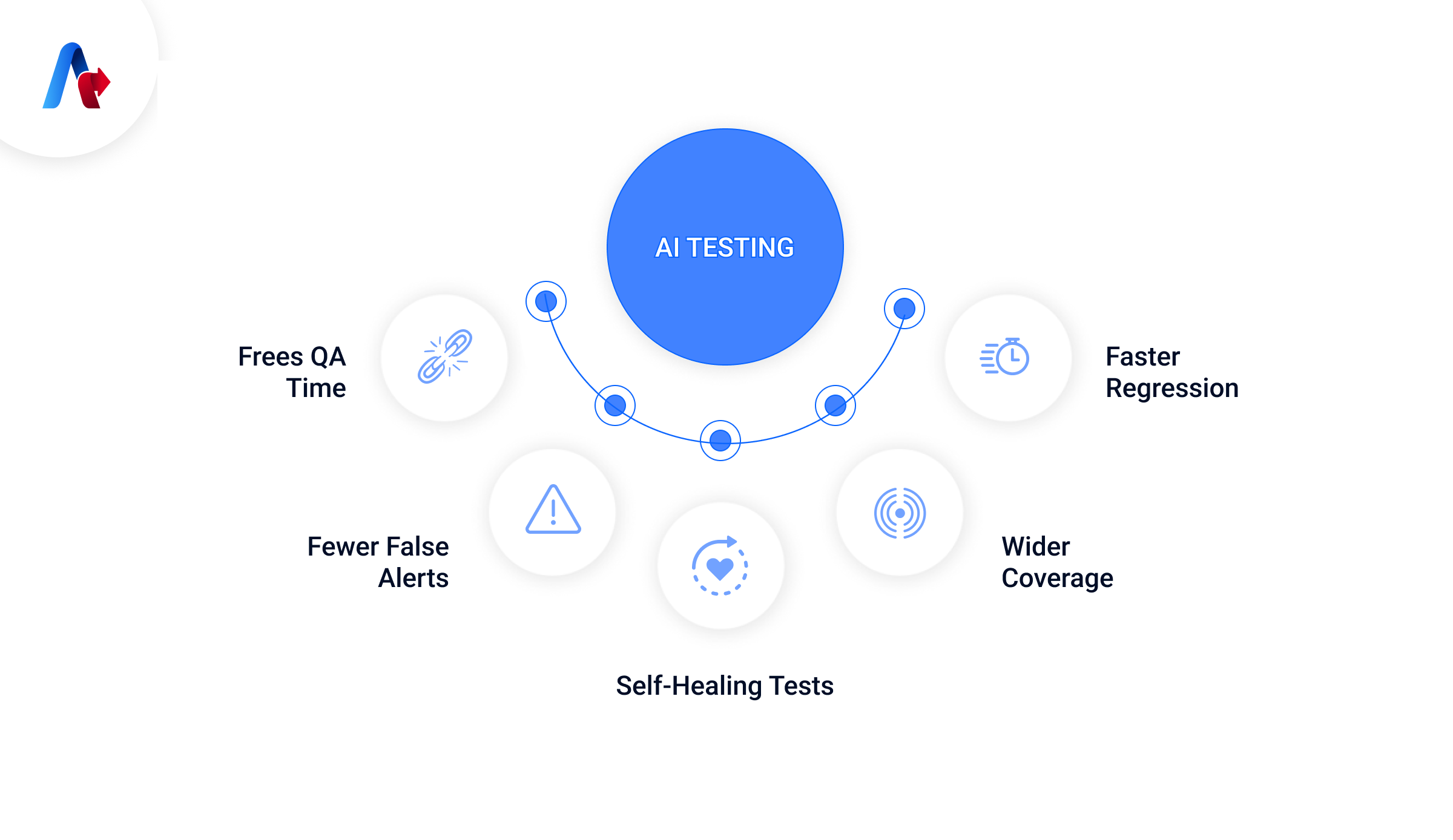
AI testing can reduce the hidden cost in many ways, such as cutting test maintenance, shortening the regression cycle, and improving maximum coverage that is difficult with human-led testing. It doesn’t remove the QA team from the process but augments their capacity and saves time for what is important.
Reduce maintenance
There is always a question of how AI agent testing can reduce maintenance. The answer to this question is self-evident. Instead of breaking every time a selector or UI element changes, these AI-driven tests can detect the change on their own and adjust automatically. This really helps the companies to avoid the hidden costs of manual testing.
Regression cycles from hours to minutes
AI testing vs manual testing comparison here can help an organization to save time. Initially, what took hours to recover now takes minutes with this AI-powered testing. Now, testers can use this precious time to do something that is vital for the company’s growth.
Improve test coverage.
Human testers have their limitation with covering areas as they need rest, but this is not the case with automated testing. It can work across different workflows, devices and browsers without considering the working hours. Technologies in software testing are vital as they can cover most of the things that might be missed by manual testing.
Reduced errors and false alerts.
The breaking of the application gives more pressure to the QA team, and this will be more when fixing repeated work. A better AI testing tool will help because it can avoid exhaustion and pressure by avoiding failure. However, in some situations, there is still a human touch needed to achieve perfection.
Freeing QA teams for high-value work
A few may believe that AI testing is to replace the tester, but actually not. The intention is very clear: reduce the repetitive work, so the team can spend more time on important work. Automation in testing helps more with repeated, boring work, but there are other areas where human touch is unavoidable, such as exploratory testing, usability testing, and complex business scenarios.
McKinsey’s 2025 report says 79% of organizations regularly use generative AI, but only 39% reported a financial return. This is also proven clearly in one of our reports, “The State of Agentic AI and Automation in Enterprises”. This agentic report also goes beyond cost optimization and talks about failures, remedies and the questions the CFOs ask themselves before taking a tool inside.
So, the answer is simple here: buying a tool for testing is only the beginning. As a tester, you need clear use cases, reliable processes, and measurable goals in advance.
What ROI Have Teams Actually Seen After Switching to AI Testing?
The ROI of AI testing may come from shorter regression cycles, fewer defects reaching production, and less time spent maintaining tests. It is calculated based on how many tests are still manual, how often you release apps and the time your testers spend on each maintenance.
A case study on how a global bank modernized its testing process
This is a story of a bank that spent more than 80,000 hours each year only on regression tests alone. The fact is that this international institution took 10 days for each testing cycle, and other things, such as test maintenance, documentation, and compliance, added more pressure to their work.
The condition before
- 80,000+ hours in regression testing each year
- 10-day regression cycles
- Heavy manual work
- High test maintenance effort
- Slow return
What Accelirate changed
We introduced automated regression testing, auto-compliance, end-to-end cycle coverage and human review for important testing decisions. And this changed everything and led to better ROI.
After introducing AI-testing
- 65% lower testing costs
- Regression cycle time reduced from ten days to three.
- Saved 40,000+ hours each year
- 50% less compliance-reporting work
- Investment recovered within six months
This is a good practical example of how automated testing can reduce repetitive testing, reduce the release cycle and lower maintenance effort with a human-in-the-loop system.
Want similar testing results for your team? Explore Accelirate’s testing approach and find a starting point that fits your team.
See How We ApproachIs AI Testing Right for Your Team?
AI testing will help teams that go through frequent regression cycles with a stable product. It may not be very useful for the team that is in an early stage and still needs many modifications frequently. So, it is vital to know in which category you are before going with a particular tool.
What are the signs of your hidden manual testing expenses?
- Regular delay in release due to regression testing.
- Finding the same types of bugs in production.
- Test maintenance is taking more time for the QA team.
- Testers are spending more time repeating the same checks.
If these problems are there, it is worth considering an AI testing tool.
Where does manual testing still make sense?
Manual QA is still useful in many areas, especially if your product is new. In this scenario, a company must change it often based on the feedback from users and experts. It works with situations like exploratory testing, usability checks, and unusual situations.
When Does a Hybrid QA Model Work Best?
Most of the team gets better results using a combination. Accelirate’s view is that testing tools should take routine checks, while QA professionals should take responsibility where there is risk and need judgment. In this way, your testers get more time for where their creativity is unavoidable.
Start Reducing the Hidden Costs of Testing
There is no doubt that traditional testing is important today, but relying on people alone is not a good choice, as it can increase speed and slow down the release. The cost of QA is not what you see, such as salaries, but includes maintenance and loss of experienced team members due to frustration. These hidden costs of manual testing are hard to see at this initial level.
The positive side of AI-connected testing is that it reduces the pressure for the team by handling boring, repetitive work, but human professionals are still good for where there is a need for critical thinking and decision-making. Many teams today choose a mix of AI and humans and use them when it is necessary.
Ready to see where your own hidden costs of manual testing are? Accelirate has the expertise to help you find them with a short call.
Talk to our testing experts.FAQs
The exact number is hard to predict as it is based on the size of the QA team, releases and the time spent on each maintenance. From Accelirate’s perspective, you can estimate last year’s savings with your current testing hours and costs.
It is good to measure in months when a team starts with a large, repetitive regression process. Accelirate experience with an international bank client shows that it takes at least six months compared to the old testing method that takes eighteen months. To get a better result, choose the right use cases, connect AI with the development process and keep humans in the loop when required.
Yes, it can help well if there is repeated work testing workload because that is one of the reasons for human errors, and it can free up your human force in testing for some other essential work.
There are many hidden costs for manual QA, including delays in release, production bugs, test maintenance problems, and team burnout, as they may leave, and the company has to find new hires. More than that, there is an extra cost as the team fights with them while competitors spend time bringing new features and modernization.
No. Automated testing is best for recurring tasks that include regression, cross-browser, and high-frequency release-cycle testing. For other work such as exploratory testing and judgment-based cases, human testers are necessary. Many companies are opting for a hybrid method rather than eliminating manual QA entirely.