



Quick Summary
Self-healing test automation differs from the traditional testing approach, as it can adapt and correct itself when a UI or code change occurs. It is a modern approach in QA that autonomously identifies changes through primary or secondary identifiers and fixes them before they cause issues. This is going to be a great deal for organizations because it offers numerous advantages, including cost savings, error alleviation, reduced manual effort for your team, and comprehensive coverage from testing software to browsers.
Can you imagine a test automation that can manage errors instead of breaking? That’s what self-healing test automation does, and it has become necessary since traditional automation couldn’t handle the changes that occur between tests.
Software that breaks requires a significant amount of time and money, and it is prone to errors if you rely on manual testing. However, this is not the case when you have AI agents for testing because it can save your time and effort. This means that it can automatically detect issues like UI changes and move forward to fix them without human intervention.
The advancement of technology, including machine learning (ML) and artificial intelligence (AI), has made this possible. With self-healing on your side, you can analyze patterns, monitor behaviors, and look for recovery options to address the errors. Gartner says that software testing tools and test creation are one of the most promising areas for AI augmentation.
Things you are going to learn.
- What is self-healing and how it works.
- Examples and benefits.
- The tools available and how we can help you with automation.
What Is Self-Healing Test Automation?
Self-healing is a software solution that comes with the ability to find out issues and resolve them automatically during the test. When there is any change in the UI or the code, the system identifies and manages them according to the situation. This is not the case with the traditional system; instead, it breaks down and wastes your money and time.
Let’s see an e-commerce website fail due to the change of the “Add to Cart” button’s locator to “Cart “. This will not happen with self-healing because it detects the update, finds the new element, and fixes the locator instantly with no human intervention. Without self-healing, your developers need to do it manually, as the original script has only the previous button (Add to Cart).
Why is Self-Healing Automation Important?
Self-healing test agents offer numerous advantages in your software testing. This includes improved efficiency, reduced maintenance, cost savings, increased coverage, and more. Gartner observes that the AI-augmented software-testing market is growing rapidly, particularly in test creation and maintenance. It is a clear indication that this industry is growing.
- Efficiency Improvement: The conventional method of testing is very difficult since it involves a lot of manual effort, such as finding errors and fixing them. When you leverage the power of self-healing, it can find out what the problem is and resolve it on its own without any external intervention. This is very important for your software development.
- Reduce Maintenance: When an organization uses the traditional method of testing, there are many problems associated with it. Every time you change a manual script, it requires labor that erodes the time of your team. If you are using auto-heal testing, you can avoid these troubles, such as updates and corrections, as it can handle the changes automatically.
- Cost Efficiency: The upfront investment for self-healing test automation tools is indeed high, but you get long-term financial benefits compared to the manual process. With a small group of people, you can achieve comprehensive coverage that may take weeks or months with self-healing. This will help you reduce costs in the future.
- Mitigate Downtime: Every test failure leads to downtime, and this can be mitigated when you have a self-healing tool. If your developers want to discover where the actual problem lies, they need time and lots of effort, but this is easy with this software.
- AI and ML Support: Auto-heal testing comes with the support of AI and ML. It is a game-changer because healing can learn from interaction and improve capabilities with the help of data. Since healing interacts with many changes in the software, AL can predict future issues and provide you with the best software or application.
- Faster Feedback: Using auto-healing in development can give rapid feedback. It means that your development team can work on the issues faster than before, avoid problems, and develop software at full speed. The result of this feedback leads you to save time, resources, and money, and fulfill the needs of your customers.
For a deeper understanding, read: How Self-Healing AI Agents Fix Automation Issues in Real Time Without Intervention.
How Self-Healing Automation Works
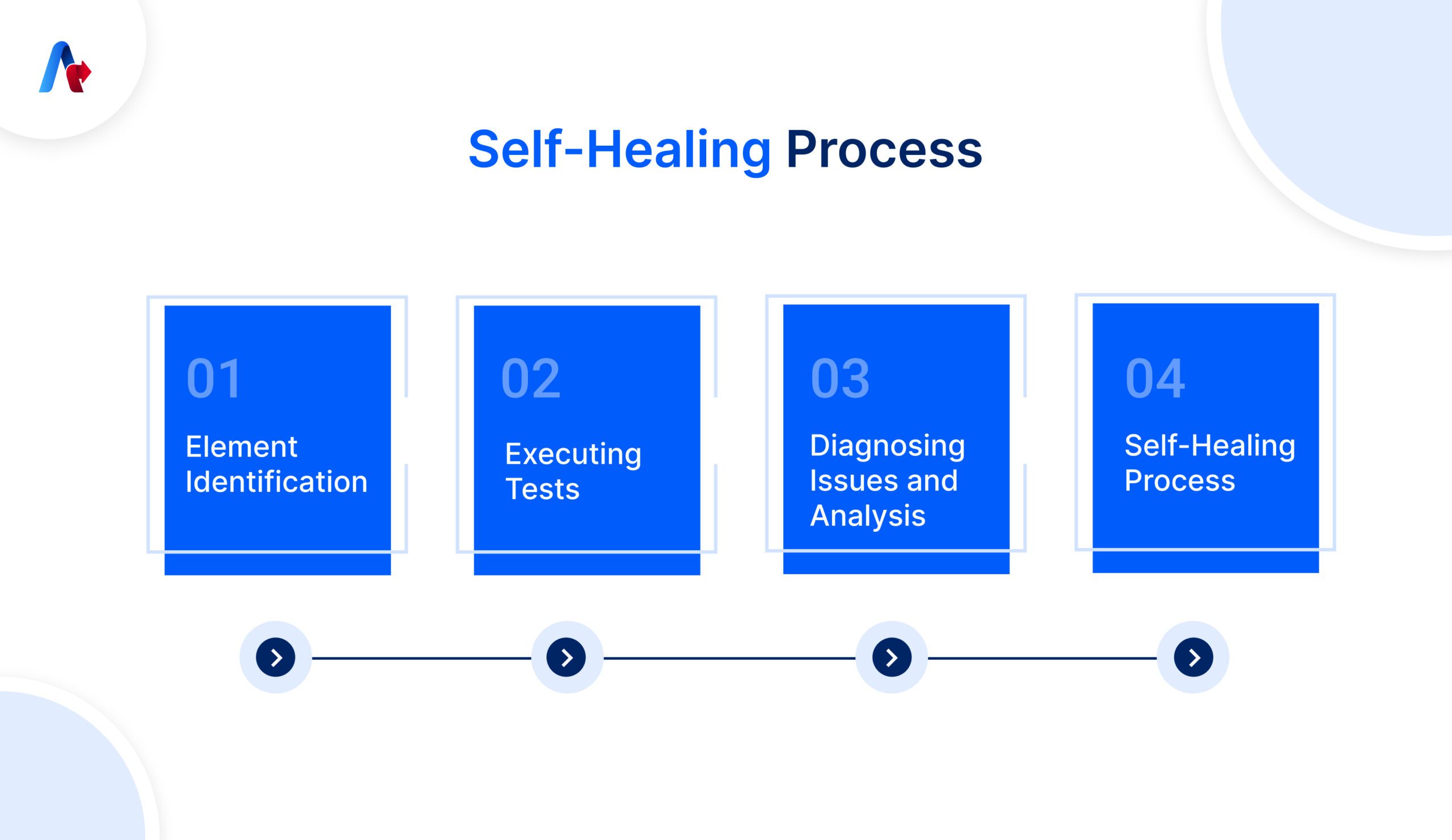
The self-healing mechanism in the test automation follows a systematic step-by-step process to perform its tasks. Let’s see how this works in detail.
Element Identification
You can consider this first step as the backbone of the self-healing automation framework. This is not like the traditional method, which checks only single attributes. Instead, it can capture multiple attributes such as name, ID, CSS selector, XPath and test with their relative positioning.
This will help with self-healing test automation to recognize elements even if the attributes change. Such an ability can strengthen the test adaptability of self-healing processes.
Executing Tests
At the time of the test, the framework tries to identify the elements by using primary identifiers. If not found, it looks for the secondary attributes or any other alternative method to find the elements.
If a process involves clicking buttons, healing looks for that by using its primary identifier. If it fails, it checks for other attributes such as login or CSS selectors. Through this, the healer can find out the correct elements, allowing you to continue the test without failure.
Diagnosing Issues and Analysis
The automation process will not mark the test as failed when it is unable to find the primary element by using its primary identifier. Instead, it initiates a problem-solving analysis process. The healer moves to the backup method (secondary identifier) during this process.
It does not stop after this process. More than that, the tool sometimes uses elements' positions that allow it to adapt to any software changes and ensure it continues its job without breaking.
Self-Healing Process
The final job of self-healing is to identify the problem and fix it instantly. After that, it modifies the scripts with the new changes. It can also learn and adapt to the situations once it understands the changes in the application.
An ability like this will help your testing move further without any disruption. The tool itself learns from the changes, ensures continuous testing and avoids similar kinds of problems in the future.
Don’t allow broken tests to slow you down. See how our AI agents can automatically fix issues before they affect your workflow.
Explore and reclaim your team’s effort and timeSelf-Healing Test Automation Example
The power of self-healing lies in its machine learning (ML) and Artificial Intelligence (AI) capabilities, which can automatically identify and correct software issues during testing. You heard about its function, benefits and more. Now, it's time for us to see an example that can give you a better understanding of how it works and what it can do.
Industry: Supply Chain
What Went Wrong
A global retailer implemented a simple ERP update to make reporting better as part of its plan. What happened instantly astonished everyone in the organization. The warehouse robots stopped working completely. This led to the failure of their purchase orders, as shipment tracking didn't work, and staff had to complete every task by hand.
A simple update led to a mess that cost the company thousands of dollars, delayed everything, and irritated clients. This was the problem with their automation because it couldn’t handle a small change. They finally concluded that there is a vulnerability in their automation system.
The Fix: They switched to self-healing automation that can adapt to scenarios like this.
How It Works
- AI agents notice the "Submit Order" button that has moved to a new spot
- It automatically finds the button in its new location
- Later updates itself to use the new path
- This will help the process run without stopping supply chain operations
- Finally, self-healing AI logs what happened so IT can fix it whenever necessary
What are the Real Results?
- No failures after that, and it dropped their costs by 47%.
- 95% of their issues are solved by self-healing test automation.
- Adapted instantly when there was a change in the website.
- The implementation led to 65% better speed.
Benefits of Self-Healing Test Automation
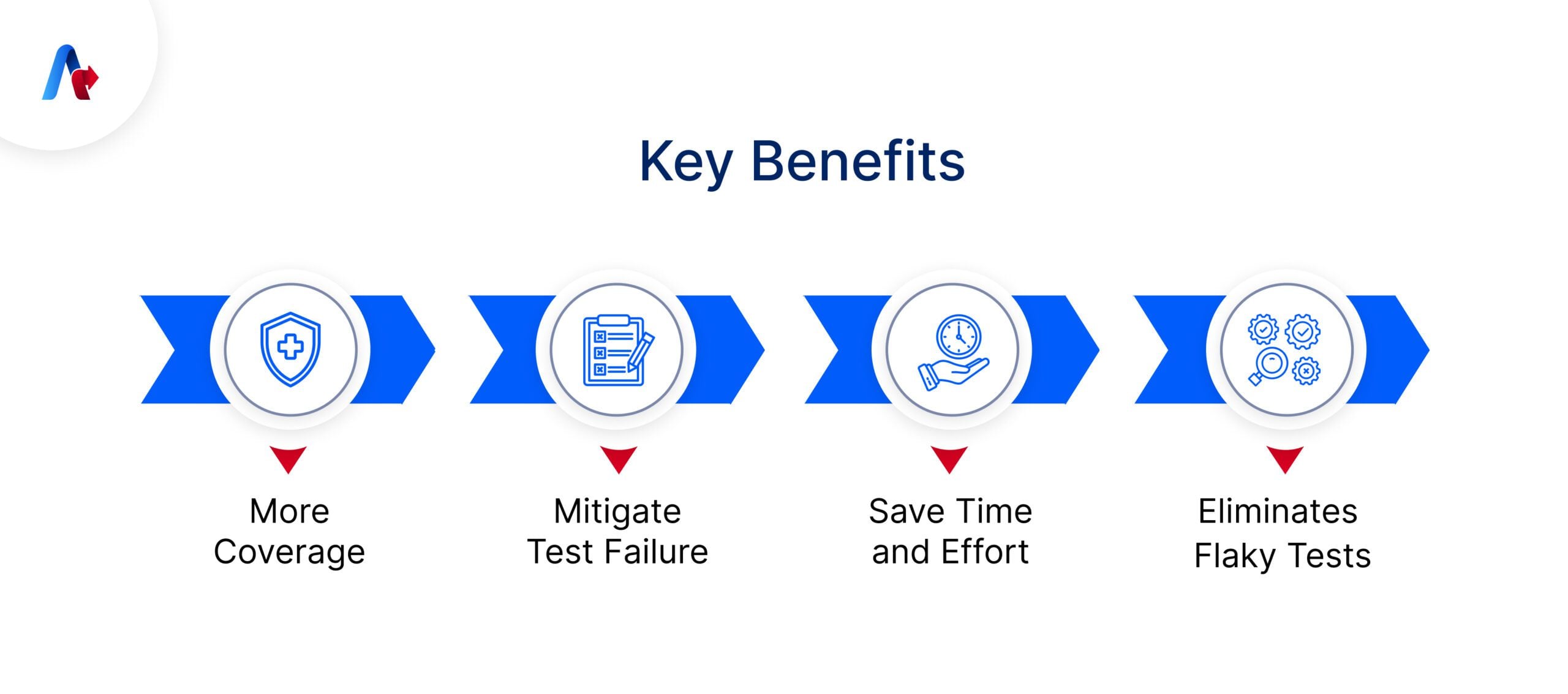
The final result of the self-healing automation framework is what the top leaders look at. They are vital for organization and influence decision-makers.
- More Coverage: What happens when people take tests? It takes more hours, and there is a chance of errors. The result is less coverage, leading to pressure from the clients and the management. This is different from self-healing AI, as it can simultaneously cover more areas. Comprehensive coverage is one of the benefits that attracts more people to AI.
- Mitigate Test Failure: By automating the fixes, the healing process can reduce test failures compared to the traditional method of testing. When testing is processed manually, there are higher chances of committing errors, leading to a higher failure rate.
- Save Time and Effort: The testing time of a software is the most vital part in today’s competitive world. And this is well connected to the delivery time of software. What if you do not use an advanced method in testing? The answer is simple: your competitors will take it as an advantage. To avoid such situations, you can use self-healing that saves time and effort.
- Eliminates Flaky Tests: The arrival of automated testing reduces the headache of your test managers. While changing something in the application, the self-healing can detect it and update the locator in real-time. This makes everything stable, reliable and consistent when the application evolves.
Self-Healing Test Automation Tools
The test automation is in great demand now, and many companies are already in this sector. The list of what you are going to explore is a mix of enterprise-grade and DevOps. Let’s explore them.
1. UiPath – Healing Agent
It’s a famous one in the market that comes with an AI-powered feature. It can bring intelligence to your testing along with self-healing UI automation. The healing agent continuously monitors the failures that arise from missing selectors, pop-ups, and overlays and applies recovery strategies.
Features and benefits
- Offer a recommendation when the Ui automation fails and suggest new selectors. It can also update codes to handle unexpected pop-ups.
- The UiPath agent executes multiple recovery steps and applies a small delay to load the pages.
- It can check across web, desktop, and cloud UIs via Unified Targeting. Your team doesn’t need separate setups for different platforms.
2. Tricentis Tosca
Tosca is another tool that has the self-healing mode feature. It can make automated tests more robust if there are any changes to the elements or code. If it fails to find the primary element, it can identify the secondary matching element and prevent software crashes.
What are its Features and benefits?
- Tosca is more stable because locator changes don’t automatically cause failures.
- Instead of manual editing, it picks an alternative control and avoids problems in the application. In this way, developers can avoid checking everything.
- The user can control the self-healing and decide whether to keep the change permanently.
3. Healenium
GitHub Healenium is an open-source tool that utilizes the power of machine learning for self-healing, enhancing the reliability and resilience of your tests. Once the changes occur in the UI, it automatically detects and resolves test failures, preventing failures in your application.
Features and benefits
- Healenium catches errors that come during the changes and replaces failed locators with best-match alternatives at runtime.
- Detailed reporting is a unique feature of this tool, where you get generated reports with healed locator values, screenshots, and control status.
- Customers can use advanced support that works with iFrames, parallel runs, remote execution, Selenide, and integrates with several test frameworks.
4. Katalon
Katalon’s self-healing feature is built into Katalon Studio, which improves your tests by automatically detecting and handling broken locators. When a default locator fails, it searches for an alternative locator to continue execution and correct any issues. The human is in the loop, allowing you to review and approve suggestions after the update in the test cases.
What is Special About it?
- It follows multiple locator strategies that support alternative locators like XPath, CSS, Attributes, and Image. Katalon prioritizes tasks and allows you to set their search according to importance.
- During runtime, if the default locator fails, self-healing attempts alternative locators, allowing you to continue testing without disruption.
- After execution, testers can approve changes to make them permanent. Katalon reduces your effort and lowers the number of failures during UI changes.
Interesting Read: Top 10 Qualities of the Best Testing Agent in Healthcare
How Does AcceliQA Enhance Self-Healing Test Automation?
The old way of testing can fail when the moment UI elements change, such as when buttons move, and IDs update, leaving your teams struggling to fix broken scripts. AcceliQA's agentic AI testing rescues your organization from such nightmares, helping you with the right solution and getting smarter over time.
The traditional method just concludes that the testing has failed, but our tool finds the problems and fixes them in real-time.
This is how AcceliQA self-healing test automation sets itself apart from others
- Our tool fixes issues when there is a change in the UI or code.
- It can learn from the past and make your application smarter.
- Predict changes that happen in the future.
- Adapt to the situation and understand how business logic changes.
What is the final result? You can deliver software faster than before, shrink your budget by at least 40%, achieve faster results and reduce your manual effort. Working with AcceliQA brings innovation, results and takes your business to the next level.
Best Ways to Use AI-Powered Auto Heal Testing
If you have to make the best out of intelligent agent testing, you need to follow these best practices.
- Make sure that you choose the right tool with AI capabilities to fix your problems, such as broken elements and UI changes. If you come across complex UI changes frequently, it is best to choose one that has the capability of visual AI.
- You need to implement smart strategies to write test scripts with flexible locators. It can combine several properties instead of relying on static ones, and allows your agent to find alternative ways to locate changed elements.
- Opt for one that integrates with your current workflow to ensure seamless and continuous testing. Prioritize healing to the applications that are frequently changing or anything that is critical to the function of the software.
- This is just the beginning of your testing, so you need to monitor the system continuously and find the reasons behind the failure and prevent future issues. Always review the test scripts and ensure the system provides the proper output as expected.
- The final process is to test return on investment. Check the implementation is giving the output, such as time savings, reducing maintenance and avoiding flaky tests. The main purpose of using this tech is to get ROI in the form of time, cost and other areas.
Reduce Costs and Manual Efforts with Self-Healing Test Automation
Including self-healing in your process will make a big difference in your testing, and a move like this is essential for today’s ever-changing world. Through self-healing test automation, a business can improve its productivity and accuracy, reduce the dependency on manual work, and cut costs in the testing area.
Once you implement this, the ability of your test coverage will not stand in one place but spread to other areas simultaneously. The high test coverage will improve your delivery, quality and solve customer issues faster than before. With these advantages, you can undoubtedly say that this self-healing is an integral part of software testing and development.
Start your journey from manual to self-healing automation to deliver faster and safer software.
Explore our automation services todayFAQs
Self-healing is a capability of adapting and curing when there is any change in the code, application UI or web elements. For example, if there is any change in clicking a button, the self-healing tool will try to locate the button through its main identifier or secondary identifiers and fix it automatically without breaking the software.
You get lots of advantages with the AI software testing. The first one is that it identifies the issues in real-time and fixes them instantly. As part of this, a business can save time, improve productivity, cover many areas and fasten their software delivery.
Healing improves the test by automatically identifying and fixing broken locators or any other test script that causes disruption. The real-time adaptation to the changes is an essential ability a test software should have, because it can reduce the failure, ensure the result is accurate and help you in better software development.
Not entirely. Auto-healing can exist without human help, and humans can test it manually without AI automation. But what you need to understand is that there are limitations for both sides. Healing might cause errors, and this time, humans can pick them. On the other hand, this also happens to humans, and at that time, AI can correct the errors.
Yes, it can save thousands of dollars on your QA assurance cost. The initial investment cost may seem high, but it will decrease in the future. AI in testing means you don't need to hire extra personnel for your development, as it can handle many tasks automatically. Most businesses tend to see this change within six months after implementation.
It can easily integrate with existing testing frameworks or the software. Developers understand these kinds of needs and build agents that connect to CI/CD pipelines, facilitating the easy adoption of this software for businesses. It means that you don’t need to abandon your existing tools; instead, it works alongside them.