



Quick Summary
Software testing has moved far beyond manual cycles and brittle scripted automation. Though traditional test automation still plays an important role in delivering consistency and speed to enterprises, it struggles to adapt to fast-changing applications and continuous delivery pipelines. Agentic AI testing introduces intelligent, autonomous testing agents that can self-heal, adapt, and make contextual decisions in real time.
If you’ve been in QA long enough, you’ve seen the journey from manual testing, scripted automation, to the rise of agentic AI software testing. The industry is at a point where businesses need to ask: Should we continue with the stability of traditional test automation? Or is it time to try agentic test automation with AI testing agents that adapt in real-time?
The truth is, both have their place. As someone who works with enterprises across industries, I’ve seen organizations struggle when they lean entirely on one side. The future is about using both wisely. In this article, we compare traditional test automation with agentic test automation powered by autonomous QA agents. Let’s break down what that means and where each works best using advanced tools like UiPath Test Suite and Test Cloud under our automation experts.
What is Traditional Test Automation?
Test Automation focuses on predefined, scripted instructions that a tool executes to validate software functionality. These scripts are typically built using testing frameworks or automation tools and require ongoing human intervention for:
- Test case design and maintenance
- Data provisioning and environment setup
- Defect analysis and reporting
Common Characteristics:

- Deterministic behavior: Runs exactly as scripted, no room for flexibility
- Tool-driven: UI/API testing with tools like Selenium, Tosca, or UiPath Test Suite
- Limited adaptability: Cannot dynamically change based on context
- Dependent on human logic: Test coverage is only as good as what’s defined
How Accelirate Leverages UiPath for Test Automation?
Using UiPath Test Suite, testers can automate regression test cases, API tests, mobile device testing (via Test Cloud), and reuse RPA components for validations across enterprise apps. However, the logic remains human-defined.
Related Read: AI in Test Automation: Everything You Need to Know
What is Agentic Testing?
Agentic Testing introduces an AI-powered, autonomous layer into the QA process. Instead of executing pre-written scripts, agents operate with goal-oriented behavior, dynamically determining what to test, how to test, and how to adapt based on live context or historical trends.
These agents are powered by LLMs (Large Language Models) and integrated reasoning engines, allowing them to simulate human decision-making in test planning, execution, and analysis.
Key Characteristics:
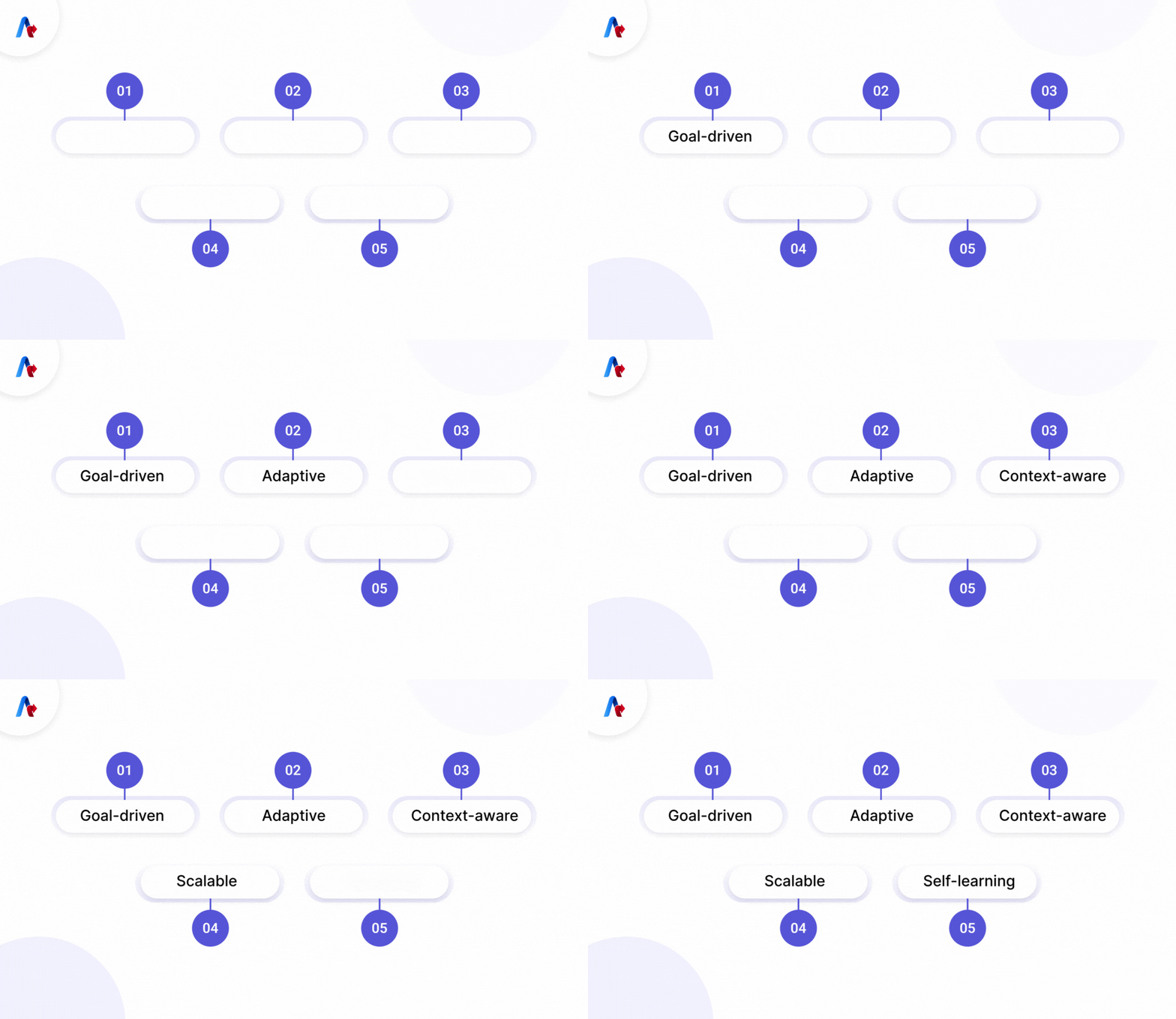
- Goal-driven: Agents understand outcomes rather than steps
- Adaptive: Tests can change in real-time based on UI/API state
- Context-aware: Agents can use historical results, logs, and behaviors to guide testing
- Scalable: Adds intelligence to large and complex test suites.
- Self-learning: Capable of improving future runs based on past outcomes
How Accelirate Enables Agentic Testing with UiPath?
With UiPath Autopilot and Agentic Testing Labs, testers can delegate tasks like:
- Autonomous test case generation from user stories
- Natural language defect reporting
- Intelligent test data creation
- Test prioritization based on business risk
This transforms testers from script writers to strategic supervisors of autonomous systems.
Looking to modernize your QA testing?
Let AcceliQA help you blend stability with intelligence.How Is Accelirate Bringing the Best of Both Worlds?
At Accelirate, we offer a comprehensive testing services portfolio tailored for both traditional automation and agentic evolution:
Traditional Test Automation Services:
- End-to-end test suite development using UiPath Test Suite
- API, web, desktop, and mobile testing with CI/CD integrations
- Migration from legacy tools to scriptless frameworks
Agentic Testing Enablement:
- Design and implementation of Agentic Testing Labs
- Integration of UiPath Autopilot into QA workflows
- Custom AI agents for intelligent data generation, triage, and optimization
- Advisory on transforming test teams from executors to AI supervisors
Agentic AI Testing vs Test Automation: When to Use What?
Not every scenario needs AI-driven adaptability. Sometimes, structured automation is more cost-effective. Use traditional test automation when workflows are stable, repeatable, and compliance heavy. Else, use agentic AI software testing when applications change often, exploratory testing is needed, or speed is critical.
Here’s a detailed comparison:
| Scenario | Use Traditional Automation | Use Agentic Testing |
|---|---|---|
| Well-defined workflows | ✅ | ✅ |
| Agile/rapid releases | ✅ | ✅ |
| High volume regression testing | ✅ | ✅ |
| Exploratory testing & edge case discovery | ❌ | ✅ |
| Self-healing and adaptive automation | ❌ | ✅ |
| AI-in-the-loop environments | ❌ | ✅ |
| Natural language test inputs | ❌ | ✅ |
Blending Automation and Autonomy in QA and Testing
The debate isn’t about which one wins—it’s about knowing when to use traditional automation and when to adopt agentic AI testing. Traditional automation ensures stability, while QA testing agents bring adaptability and intelligence.
At Accelirate, we help enterprises with both; from classic automation QA testing to agentic AI software testing with UiPath agentic testing. At Accelirate, we empower our clients to adopt both—helping them automate faster, test smarter, and build future-ready QA practices. Whether you're looking to modernize legacy frameworks or explore AI-driven testing models, we’re here to lead the way by making testing more scalable, cost-efficient, and future-ready.
FAQs
Agentic AI testing uses AI testing agents that adapt, self-heal, and generate tests dynamically. Unlike scripted automation, they make contextual decisions and reduce manual effort.
Traditional automation runs pre-written scripts, while agentic test automation relies on autonomous testing agents that can adjust to changes, prioritize risks, and explore scenarios without scripts.
Not yet. For stable workflows, traditional automation is still reliable. Agentic testing is best for dynamic, fast-changing applications. The right approach is often a hybrid model.
Platforms like UiPath agentic testing (Autopilot, Agent Builder, Test Suite) and other AI-driven solutions allow teams to adopt autonomous testing services effectively.
They reduce script maintenance, speed up cycles, and scale coverage. Most enterprises see 30–40% cost savings and 50% faster execution cycles with our agent-led autonomous QA model.