



 Industries
Accelirate QA Solutions
Industries
Accelirate QA Solutions
One thing always stands out when we talk about AI agents testing is their ability to think, plan and act autonomously. Agentic AI software testing does not just finish what is in the scripts, but it ensures delivering safe, correct, and efficient outcomes, even when conditions change. If we can establish such power in our workflow, leaders like us can scale these systems with confidence.
It means that the intelligent agents can adapt, learn, and grow stronger in the future. Take healthcare as an example, where AI is critical to maintain regulations. If you are managing sensitive patient data, complying with compliance like GDPR, or predicting risks, these agents help you mitigate them and make your processes safer, faster, and reliable.
What to Look for in an Agentic QA Testing
Now, you may ask yourself where to begin. For me, this process starts with these three things. Let's dive in.
- Outcome: Did the testing achieve what I intended with acceptable accuracy? (Clear acceptance criteria define success.)
- Process: While in test or working, did it follow policies, privacy rules, and brand guidelines? I also check the data leaks, wrong actions, and tone mismatches.
- Efficiency: Did it complete the task fast, cost-effectively and consistently? The time spent and reliability really matter here.
After understanding these three things, leaders can move to test approaches to build trust in the system, not to find the bugs.
Simple Test Framework to Follow
So, how do I apply these frameworks? This is what I pursue.
- Define the Mission: This is the first thing you do in this stage. State the goal, constraints, context, and “never do” rules. It sets a clear boundary for your testing agent.
- Scenario library: It’s not just the typical cases you see here; instead, it includes situations like tool failures and ambiguous instructions.
- Separate what vs. how: I make a clear distinction between what and how. The AI agents are accountable for outcomes and policies, not step lists. Freedom is essential for innovation.
- Instrument Everything: Finally, make sure everything is auditable, such as log inputs, decisions, tool calls, and final outputs based on data.
Simple framework is not enough when you want to adopt it on a large scale, so as an expert, I layer the testing process.
Build a test that works for your enterprise
Let’s build it togetherFive Layers of Agentic AI Software Testing

My experience proves that an AI agent in testing needs to look at multiple layers, not one alone.
- Tool/skill checks: Prove each capability (e.g., search, file read, API call) works alone and handles errors.
- Planning & reasoning: Remember to plan for quality and recovery when the initial approach fails. There should not be any endless loops or dead ends.
- Mission scenarios: The next one is running end-to-end tasks, and I look for the whole outcome, not just pieces.
- Production health: Once everything is working, it’s time to keep an eye on pilot mode, track drift and cost.
- Feedback: I believe there should be a space for people. Since they are in the ground, you get better feedback.
The above procedure is just a half-battle, but how can I show the leaders that it is really paying off? This is where the role of KPI comes in.
KPIs Leaders Must Understand
When I talk about the results, the KPI is significant because it can deliver what executives want.
1. Task Success Rate
Out of 100 tasks, how many are finished by your AI agents correctly? To check this, I give a short ‘done’ checklist and count them at the end of the day or week. A favorable target for pilots is 90+ out of 100. For launch, expect 92–95+ out of 100, and this should be higher for critical works. This will help you know how test automation truly works.
2. Intervention Rate
How often is a human hand necessary to fix or approve? I maintain a checklist with a tick box and review it weekly. It can be around 7–10% or less in the pilot, but after launch, this must go to 5% or less (2% or less for high‑risk work). The lower rate is better for scale, but if it needs more intervention, it tells that your agent isn’t ready.
3. Policy Violation Rate
Checking whether the automation breaks privacy, security, compliance, or brand rules is important here. What I do is to set an automation alert for blocked action and review it daily. A good target is zero serious issues before any pilot and no major problems for launch. It matters in several ways because it can improve the trust of customers and the brand.
4. Time to Outcome
How long does the agent take to finish a task? We can check this with a clock like when the request starts and stops once the result is approved. What I feel is that agentic AI software testing takes 30–70% faster than manual checking. It means most tasks finish within 3 minutes.
5. Cost Per Outcome
Calculate the money and people time for completing a task. We can do this by using tool fees, computer costs, and tracking minutes of human help. I check whether it is at least 25–50% cheaper than the manual way. ROI is essential, and this way, you can calculate that.
6. Consistency (Reproducibility)
Checking the consistency of the intelligent agent is a big part, and rerunning the same task and analyzing the result. Try the same input 20 times in a test and see how many results you would accept as the same. It should be 85–95%, depending on the task type. It is vital to build confidence and ease of support.
7. User Satisfaction
I think the end users are the people who use this software for testing. Ask for their quick thumbs up/down or a 1–5-star rating. The average score is 4.3/5 or better, or thumbs‑down under 10%.
These KPI metrics are not just for checking, but to build confidence in your work. After them, an expert should focus on the safety net that keeps agents in check.
Want to learn how these KPIs apply to your testing setups?
Schedule a free consultation with our expertsGuardrails to Build and Test
It is important to give agents the least access they need to do their job. For this, we make a clear list to show what’s okay and what’s not. It is also crucial to limit the usage with budgets and limits so agentic QA can keep it under control. Ensuring escalation to a human and recording session is also part of its job. The most essential one is that if something goes wrong, I stop it and undo changes in minutes.
Guardrails are necessary to mitigate risks, but a good plan and discipline make things better. Wondering how? Let me explain.
The 45-Day Rollout Plan for Your Agentic QA
This is a plan I follow when deploying an AI agent in testing.
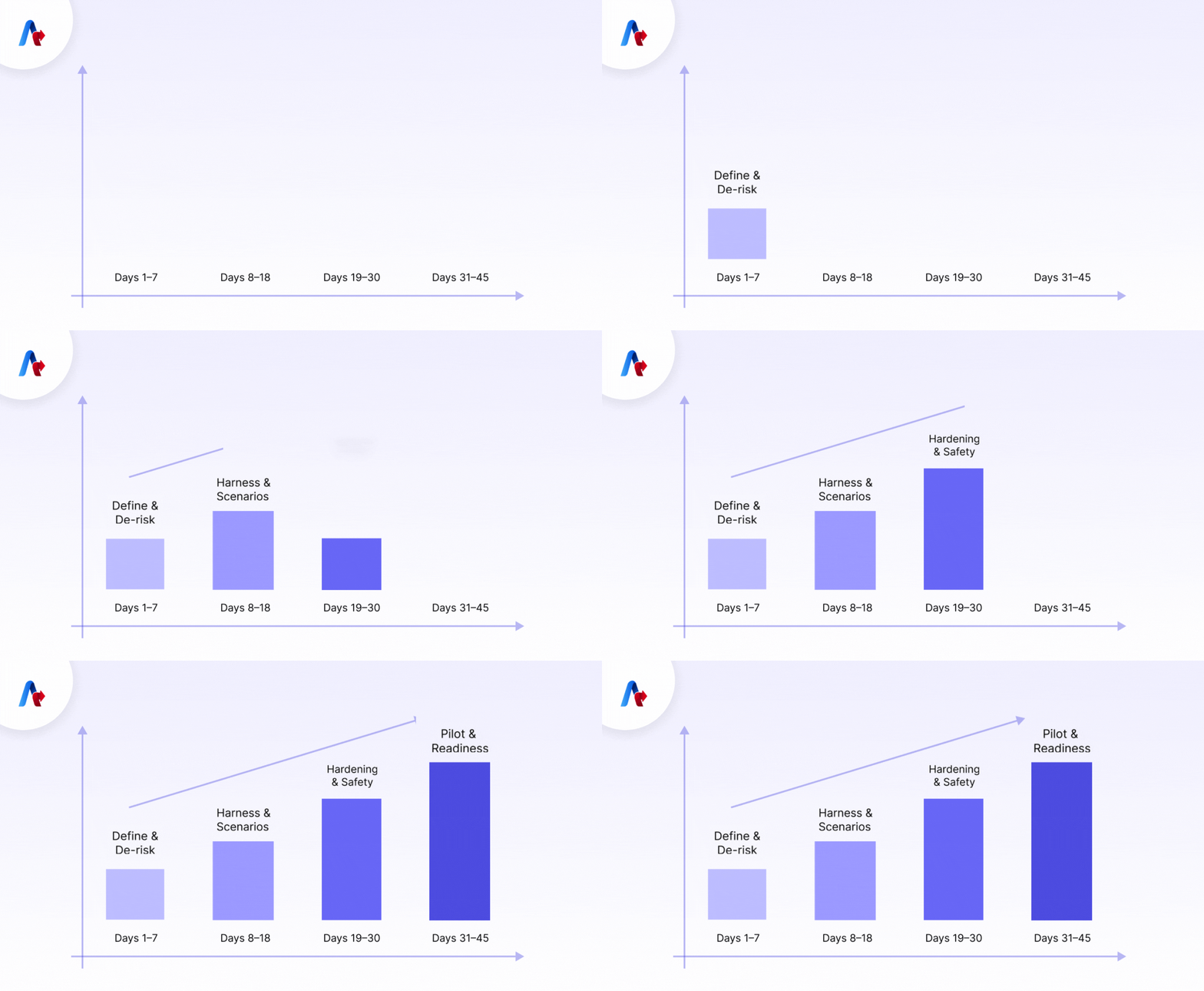
- Define & De-risk (Days 1–7): I pick 2–3 missions first, write goals, constraints, and exit criteria. Don't forget to set “never do” rules and to set KPI targets.
- Harness & Scenarios (Days 8–18): In these days, we can build the scenario library and logs, validators (“judges”), policy checks, and batch runs.
- Hardening & Safety (Days 19–30): Here, we can test privacy/compliance, reduce interventions, wire tests into CI and prove zero violations.
- Pilot & Readiness (Days 31–45): At the last stage, run a limited pilot (shadow/A-B, prove KPI gains in speed, cost, and quality, validate rollback and finally publish playbooks.
No matter how good a plan is, it will have issues. You can make sure that testing goes well and stay in control if you know what they are. My experience also taught me how to avoid certain common mistakes during testing.
Common Pitfalls You Need to Avoid in Agentic Software Testing
Agentic testing is not about perfection, but is about learning and adjusting things. The common pitfalls are.
- Over-specifying steps → Focus on your outcomes + policy, not micromanaged flows.
- Policy gaps → Write clear “never do” rules and test them clearly.
- Ignoring cost → Track cost per successful mission and cap retries.
- One-off demos → Turn wins into reusable scenarios with evidence and metrics.
- No human-in-loop → Add fast approvals for medium/high area.
Turning Testing into Trust
As an experienced person in this field, I think agents are just like another teammate. Provide a clear goal, strong guardrails and fair measurement. If we test this in this mindset, we can make agentic AI software testing safer, accurate, and ROI-positive operations. It is an imperative part in scaling with confidence.
Are you ready to scale your agentic testing with us?
Talk to our team now
More Articles

Agentic AI in 2026: What Enterprise Leaders Must Prepare for
By 2026, agentic AI will move from pilots to production. Discover what enterprise leaders must prepare for as AI agents reshape business operations.
January 22, 2026

UiPath vs. Open Source: A Test Manager’s Perspective on Choosing the Right Testing Tool
Compare UiPath Test Suite vs open-source tools like Selenium, Rest Assured, and JMeter from a Test Manager’s perspective to choose the right QA and automation stack.
November 18, 2025

Tosca vs. Open Source: A Test Manager’s Perspective on Choosing the Right Testing Tool
Compare Tricentis Tosca with open-source tools like Selenium, Rest Assured, and JMeter. Learn how to choose the right testing tool for scalability, cost, and long-term ROI.
October 21, 2025