



Quick Summary
AI agents are now moving with their autonomous actions. They now have the ability to act, decide, and adapt without human intervention. This is really a good thing, but there are some challenges, such as unpredictability, that are difficult to handle by traditional governance. That’s why strong AI agent governance is necessary to keep everything safe, transparent, and accountable. When there are right guardrails, monitoring, and auditability, you can use their speed, accuracy, and autonomous power with more confidence.
A modern AI agent is not what you have seen before because it can do many things. This is not the case with previous automation, like Generative AI, that makes predictions and gives you insights based on your prompt.
This has become a different situation with agents, as it can run autonomously. It means that they act, make decisions and adapt to a situation. It is helpful in one way, but it causes a serious issue with AI agent governance.
This is a serious topic for enterprises that are exploring agentic AI. It doesn’t mean we are controlling a model; it is about managing an autonomous actor capable of learning, adapting, and influencing your workflow.
Understanding the Governance Challenges of Autonomous AI Agents
Since the agents are not like the traditional ones, they pose different types of challenges. Autonomy is powerful, and if you are managing it with conventional methods, it poses serious risks.
Independence in decision-making gives AI the opportunity to make real-time decisions without human review. This capability raises serious questions about AI agent governance and its use. Without proper control, agents might perform high-risk tasks (finance) that may bring some serious issues for your business.
Autonomous AI can pose security risks to a business. This will happen if it communicates through poor APIs, and hackers may utilize this situation to take control. Prompt injections and manipulation can also lead to unauthorized access.
The decisions that come from these AIs are very complicated, so it is tough to understand why they did it, and it is difficult for humans to audit. An explanatory gap like this will create some challenges, especially if you are in a highly regulated sector.
Why Autonomous Decision-Making Complicates Oversight
Although AI offers numerous capabilities to your workflow, it is now raising a new question about how we manage it. This will make control difficult in many areas, such as:
- Blur Human Role: The decisional capacity of an intelligent system is confusing, as to who is responsible for oversight. According to NIST’s AI RMF, companies must clearly define and distinguish human roles in decision-making. It includes who intervenes, who monitors, and who reviews.
- Reduced Transparency: The working conditions of a smart system are complex, so its decisions become invisible or hard to detect. Experts believe that this opacity complicates auditing or understanding agent decisions. If something goes wrong, you find it difficult to understand why AI made such a choice.
- Turn from Proactive to Reactive: The activity of agents in real time. It adapts and makes the human role from proactive to reactive. It means that humans can intervene only after something goes wrong, not before.
- Unexpected Behavior: When it works or performs a task, it may behave unexpectedly, which is not part of its action. A behavior is likely to occur when it works in a new environment. An unpredictable action like this can raise serious concerns about governance.
- Ethical Problems: Artificial intelligence makes decisions based on the data that it has. When it comes to moral issues, it cannot make better decisions. It also creates regulatory risks if the decision is unfair or causes harm.
Key Components of AI Agent Governance Platform
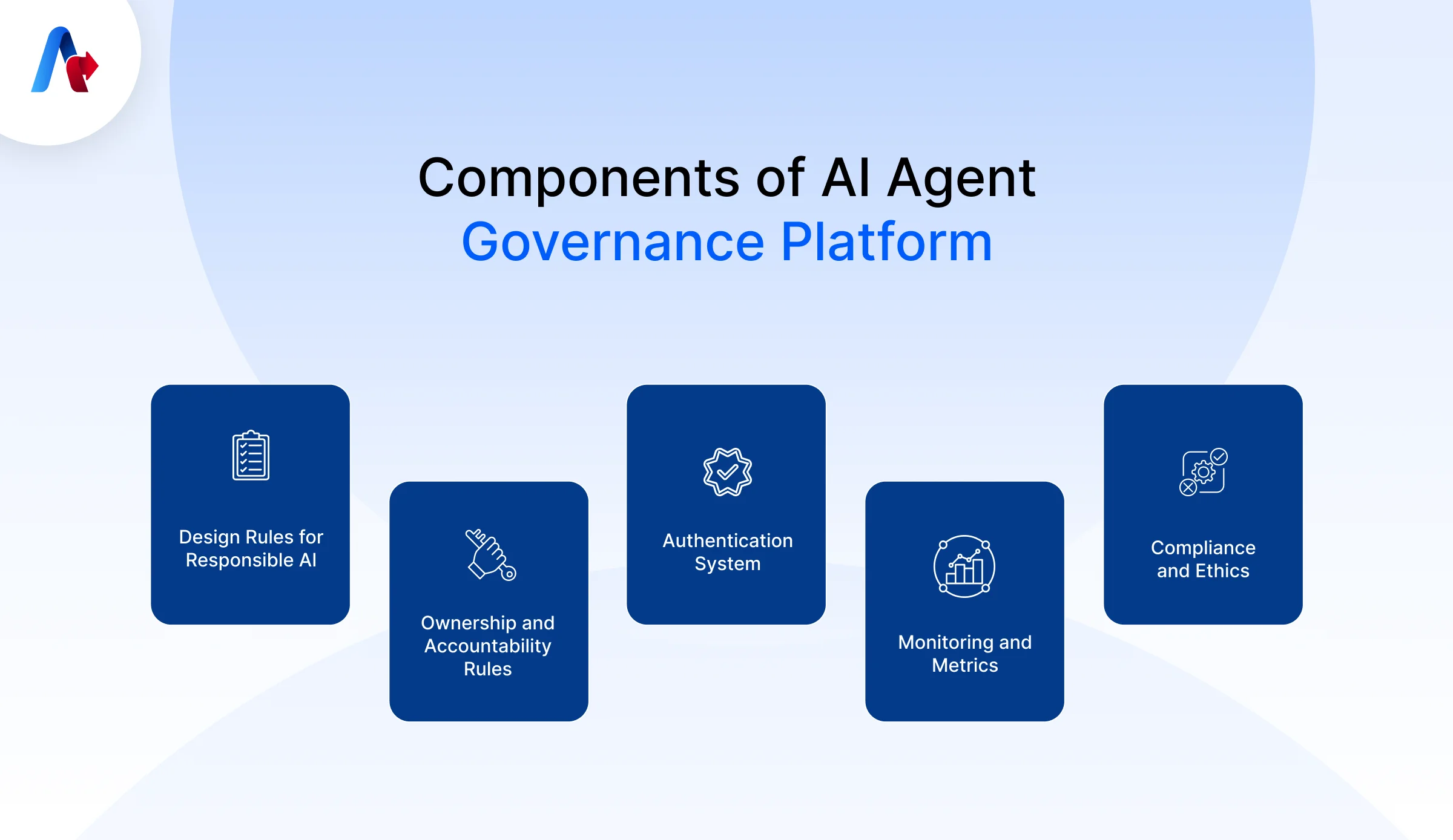
Building a strong governance platform must include policies, technical controls, risk checks, and continuous monitoring. Since artificial intelligence acts without human approval, you need to monitor its movements with a strong tool.
- Design Rules for Responsible AI: It is vital to build agents that are fair, safe, transparent, and align with the rules from the start. Creating something like this in the beginning will guide how agents learn, decide, and interact across systems.
- Ownership and Accountability Rules: You need to clearly mention who approves the agent’s actions, monitors them, and handles escalations in case of an emergency. It is also vital to set role-based access control (RBAC) to avoid consequences.
- Authentication System: Set a default method where AI asks users for authentication before it makes any critical movement. If the user allows it, the agent will take the next action that will not harm your business.
- Monitoring and Metrics: Static control alone is not enough with autonomous AI. Instead, you need to track agent actions in real time. Using a dashboard can help you to check the quality of the decision, safety, and performance.
- Compliance and Ethics: There are several laws in the world, like GDPR and NIST AI risk management, to follow. Adhering to such rules is essential to avoid consequences and legal action. Also, ensure there is no bias and fairness in the decisions.
The Explainability Gap: Auditing Decisions in Agentic Systems
Explainability and transparency are essential for the AI agent governance framework. If not, it affects clients' trust and faces some other economic and social consequences. Since they are on their own, it is like a black box that is difficult to retain and encode why they behave like this.
This is really a big gap, and as an organization, you need to fill it and need to know each and every piece of information about AI’s decision-making. Some of the logs you can practice are:
- Capturing prompts
- Tool calls, Inputs and outputs
- Approval steps
- Data lineage
- Model and agent cards outlining purpose and limits
- Context window and memory for action
- Short reasoning summaries
- Counterfactual views for comparison
- Performance and safety KPIs
IAPP, a global organization service in AI agent governance and the digital side, recommends multi-tier guardrails and guardian agents produce “explanations of record” to support transparency.
Bias, Fairness, and Ethical Risks in AI Agent Behavior
There is absolutely no doubt that AI brings advantages to your workflow, but there are some issues with bias, fairness, and ethics as it takes actions, decisions, and learn from the new output. If the data has problems, the agents repeat the mistakes. Organizations must ensure that the agents consider moral, social and legal frameworks.
Where do you face ethical risks?
- Unfair decision-making
- Harmful recommendations
- Unacceptable behavior
- Inconsistencies in the outcome
Real-World Consequences of Bias and Poor Governance
1. Air Canada chatbot case
A case was reported against Air Canada after its website chatbot gave incorrect information about the fare. At the tribunal, the company argued it was a mistake, but the final judgment is that the company is responsible for the information its AI provides.
2. Dutch childcare benefits scandal
Another case happened in Denmark where an algorithm for fraud detection wrongly labeled thousands of families as suspicious. Because of this, many lost their benefits, financial issues, and went through years of damage. This case shows how a biased system can affect if there is no proper oversight.
These incidents are an example that an AI agent governance platform is an imperative part of the organization to mitigate the consequences.
Now, let’s explore the security and compliance risks of agent AI systems.
Security & Compliance Risks in Agentic Ecosystems
By working autonomously and automating tasks, agentic AI introduces new security and compliance risks for you and your organization. Let’s look into some of the dangers that you may face.
Connected Vulnerabilities
One agent may take the wrong decision due to data problems, and a connecting agent continues.
- Example: Due to some issues in the logic, AI converted debts into income. Since it is a multi-agent system, the other agent gave a good score for the person, which increased the score of the applicants. This incorrect information then moved to the credit scoring and loan approval agent and finally led to a risky loan approval.
Cross-agent Escalation Issues
An agent, due to its malicious character, exploits another one to gain unauthorized access.
- Example: An intelligent system in the healthcare system requests patient records from a clinical-data agent by falsely telling that the request comes from a licensed physician. Upon request, the agent releases sensitive health data. What happened is unauthorized access and data leakage without triggering security alerts.
Synthetic identity
Hackers forge agent identities to get the details.
- Example: An attacker takes the digital identity of a claims processing agent and requests access to insurance claim histories. The next agent believes it and grants access. Here, there is a chance of leaking sensitive information.
Dynamic Regulatory Environment
Rules may change frequently, so agents must be able to update them to stay compliant.
- Example: A company deploys an autonomous agent for regulation. After a few months, a rule changed, and because of an issue with the agent, the update failed. Leaving the update may expose the organization to regulatory risks.
Data Privacy & Security
Agents process sensitive data by using external APIs. If not trusted, this may increase the risks for enterprises.
- Example: A customer support agent wants to pull user records from an internal database. Due to a misconfigured API permission, it accessed stored medical information without the user’s consent. Such a violation is against the laws under GDPR and HIPAA leads to consequences.
Remember that a simple GDPR violation will result in a penalty equal to 4% of your annual revenue. Having an AI agent governance framework at your organization can avoid financial loss and reputational issues.
Why Traditional Governance Is Not Enough for Agentic AI
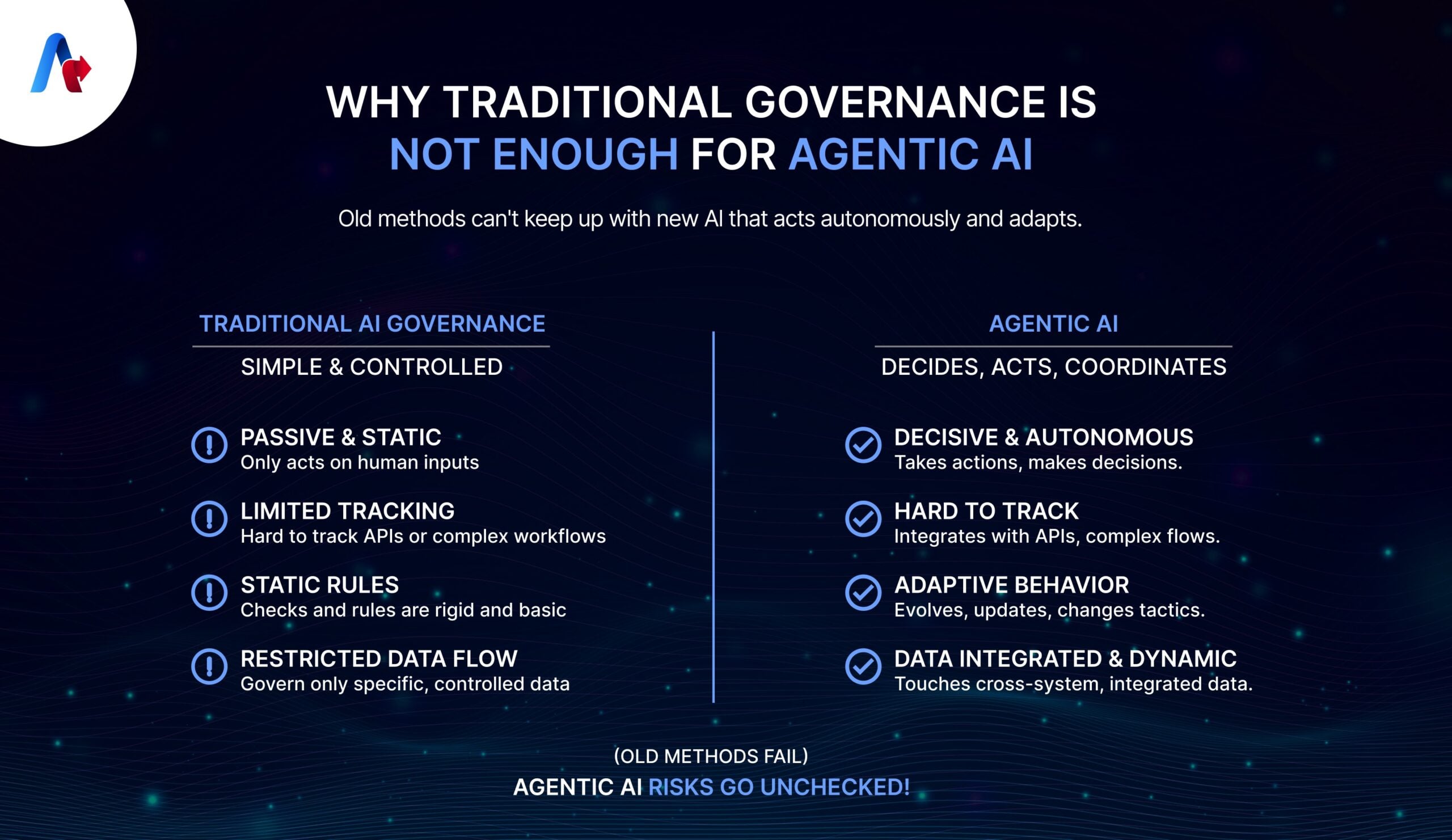
Traditional AI agent governance is only fit for the first stage of artificial intelligence. Now, the situation with agentic AI is different due to its ability to decide, act, and coordinate its own actions.
Why old methods fail today
- AI is no Longer Passive: The traditional one was passive and acted only on prompts. The situation has now changed because it can take action, trigger workflows, and make decisions.
- Old Governance Can’t Track: Modern agents not only work without human help but are also very complex when combined with APIs and other tools. It is almost impossible for the old method to track AI agents.
- Traditional Checks Don’t Work for Evolving Systems: Modern AI evolves every day. The ability of an agent that you see today will be different after one week. It learns, changes prompts, updates memory, and adapts, so the risks will increase.
- Data Governance is Outdated: The new technology with AI touches data across systems, partners, and APIs. Old governance is mostly lean towards human-controlled data flow, as it acts only based on your prompt. This no longer exists.
Are you governing autonomous AI with yesterday’s rules?
Upgrade to Modern AI Agent GovernanceAI Sandboxing and Simulation for Safe Experimentation
AI sandboxing is a method of testing your AI in a real-life and isolated playground before it goes live. Without testing, AI agents bring several risks, but here, this will help you test everything before your full deployment.
Why is sandboxing vital
- Agents are now unpredictable due to their autonomous behavior. If you release without isolation, it may corrupt the entire system and expose your sensitive information.
- If you need to check how the intelligent system works, run it on a separate system. This will help AI from escaping or accessing forbidden areas or resources.
- This method provides maximum security in a different area, ensures software quality, prevents the spread of malware, and saves your organization costs.
Agent-to-Agent Monitoring and Conflict Resolution Rules
In an organization, you may have to use multiple agents to perform a task. In this situation, they must interact with each other, but if one commits an error, the other one continues.
It is important to monitor these interactions and establish conflict resolution rules to make them work together without any issues. Monitoring with an AI agent governance tool ensures:
- Agents follow the correct policies during collaboration
- No unauthorized cross-agent data sharing
- Detect deviations, anomalies, or risky patterns in real time
How do you monitor it?
- Recording conversations, tool use, decisions, and data exchanged between agents
- Ensuring every agent’s decision follows rules such as safety and compliance.
- Periodically reviews agents to identify bias or inconsistent behavior
- Create a restriction on what each agent can request or access
Setting Conflict Resolution Rules
There is a change in conflict even in a well-designed agent’s environment. To prevent this, there must be conflict resolution rules, such as:
- Decide based on the priority when there is a decision clash
- Pause or block the action
- The best method is to interfere with human review to find solutions.
Governance Agents: Monitoring and Moderating Other Agents
Relying on just policies and reviews sometimes will not work due to AI agents' complex systems. This is why a governance agent, or guardian agent, helps you monitor, validate, and control behavior in real time. Gartner predicts that Guardian Agent will acquire 10-15% market by 2030. It can:
- Continuous Monitoring: This is one of the critical capabilities of this smart system. It can track the actions, decisions, prompts, tool calls, data requests, and interactions of the agents in your enterprise.
- Live Enforcement: With it, you can check all the decisions of the AIs against other rules, including safety, fairness, privacy, business alignment, and permissions.
- Detecting Issues: If something goes against the normal rules or behavior, it will find them and report them for further action. After that, a human can check and validate the problems.
- Prevent High-Risk Actions: Some actions are risky and irreversible. The AI agent governance in your workflow prevents it and secures your organization from high risks.
Emergency Shutdown, Containment & Fail-Safe Controls
There must be a system that stops agents from continuing their work in case of any emergency. Kill switches can prevent worst-case scenarios and save your company from data loss. This control is outside of the agents themselves, so agents can ignore or bypass it.
Containment is another thing that limits an agent’s impact, even when something goes wrong. It includes sandboxing actions, restricting permissions, and limiting the speed of action. If there is any risky pattern, the system automatically shifts the agent into isolation to avoid production issues.
The final stage is fail-safe controls and human intervention to help the recovery. In an uncertain situation, the system can turn into a no-action method. With proper guidelines and rules, you can avoid unnecessary actions and move forward without much trouble.
Stress-Testing AI Agents for Edge Cases and Adversarial Attacks
For safe delivery and work, an artificial intelligence system needs more than just regular testing. This means that it must go under stress-testing for edge cases and adversarial threats in a realistic condition. Because knowing the behavior of agents in normal testing is difficult. You get a better result when these things come together:
- Simulation testing
- Adversarial testing
- Continuous evaluation
- Human-in-the-loop testing
To test for malicious inputs, organizations can launch LLM-based adversarial agents for context poisoning and filter-evasion queries to stimulate real-world settings. In this method, you can include template-based fuzzing, historical exploit patterns, and dynamically generated queries to learn the hidden vulnerabilities.
More than simulation and adversarial testing, developers can also evaluate agent behavior in production so they can track success trends and anomalous actions. You can also go for other tactics like adversarial training, input sanitization, and live monitoring to detect real-time threats.
The Role of Governance Platforms & Specialized Metrics
The modern AI agent governance is moving toward platform-based oversight. There are many companies like Accelirate that provide security with orchestration tools (UiPath) and audit layers.
Their continuous evaluation systems can track agent behavior and prevent it from harmful situations. Many governance bodies, like IAPP, recommend structured documentation and a multiple-control system to ensure accountability for modern agent ecosystems.
1. Specialized Logging & Traceability Tools
Governance platforms are now using granular technical logs to reconstruct an agent’s reasoning chain, such as:
- Decision logs
- Provenance & data lineage tracing
- Model cards
2. Metrics for Non-Deterministic Agents
Agentic systems need more than accuracy or latency, so they should focus on:
- Behavioral stability
- Operational integrity
- Risk signals
3. Security & Adversarial Risk Metrics
Evaluating resilience against attacks is now central to governance. Some of the metrics can be:
- Adversarial robustness scores
- Exposure to poisoning
- Detection rates for harmful or unsafe behaviors
4. Governance Rule Automation & Policy Enforcement
Most of the governance platforms are moving to automation, including override rules, escalation workflows, and agent-to-agent monitoring. A multi-layer guardrail is necessary to support compliance and review.
The Four Pillars of AI Agent Governance
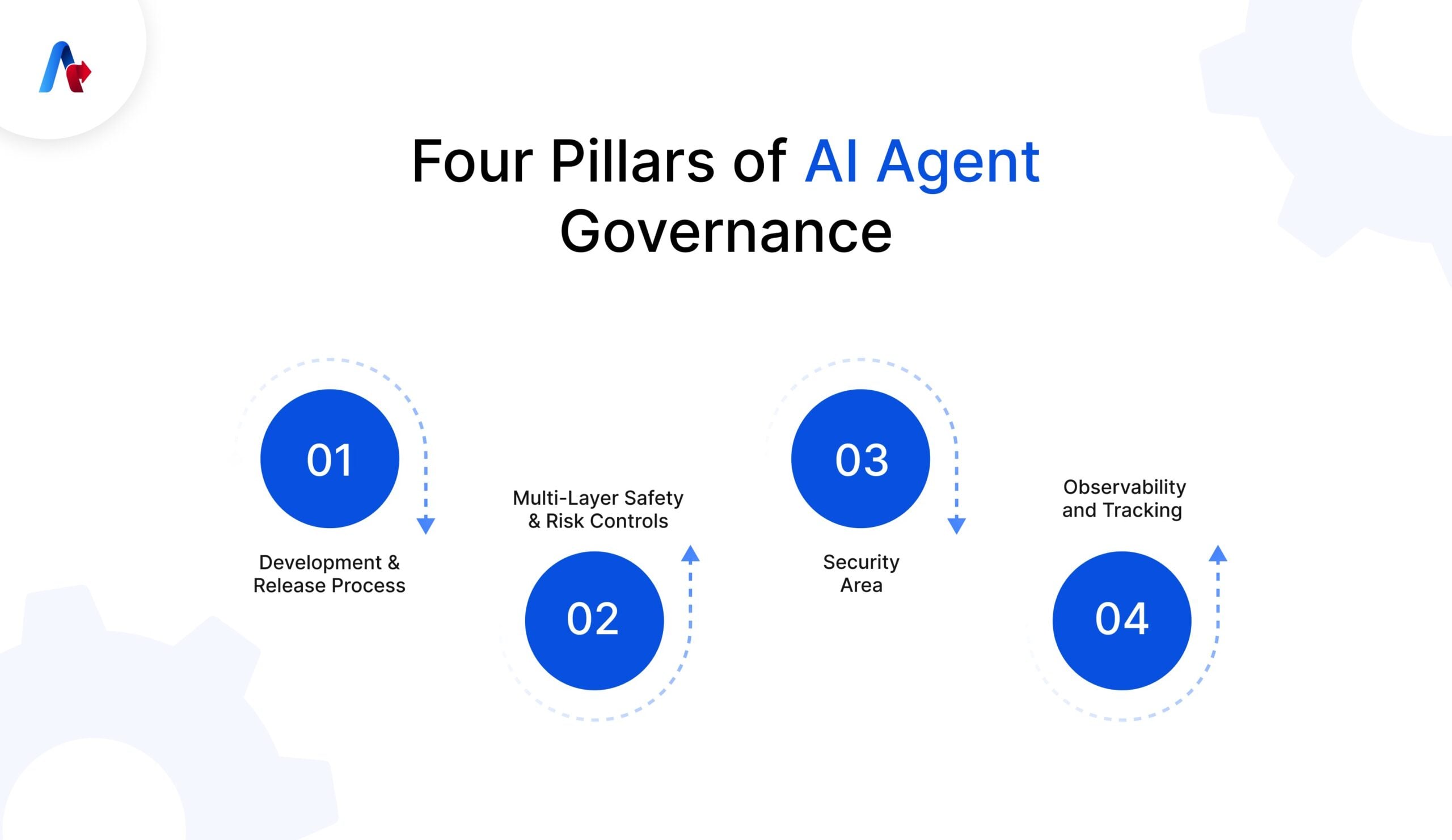
If you have a plan to build a strong agent governance, you should know about the four pillars. Each one is vital and gives you practical steps to keep your AI systems safe, predictable, and accountable.
1. Development & Release Process
This will clearly explain how an agent is built, updated, and maintained.
- Guiding Principle: Here, you get the separation of duties
- Tools Used: CI/CD pipelines, Git, and environment management platforms.
- Goal: It will restrict the team from deploying agents without a critical review and test from other members.
2. Multi-Layer Safety & Risk Controls
This pillar talks about protecting agents from failure.
- Guiding Principle: A diverse method of defense to protect the AI from small failures. This will ensure one failure doesn't affect all.
- Essential Tools: Data-quality monitors, behavioral guardrails, PII detection, model-testing suites and compliance validators.
- Goal: Identify risks early and prevent harmful behavior.
3. Security Area
This pillar is to control and verify the access of the agents.
- Guiding Principle: Give only minimum permissions for humans and agents to control misuse and reduce attacks.
- Important Tools: You can use MFA, API, SSO, secret vaults, and fine-grained access policies.
- Primary Goal: The purpose of this is to ensure only authorized access to the agent.
4. Observability and Tracking
This is where we can observe and track AI's behavior.
- Guiding Principle: Audit everything to understand an agent’s behavior and actions.
- Essential Tools: Audit logs, monitoring dashboards, access logs, inference logs, and data lineage systems.
- Main Goal: Provide complete visibility for debugging, behavior issues, and compliance.
A Practical Governance Checklist for Deploying AI Agents
Before you launch any AI, you need to clear the checklist to avoid a bad experience. Let’s go through some of the AI agent governance best practices to avoid consequences.
Lifecycle management questions
- Is it possible to promote change from development to production?
- Are reviews mandatory for each stage?
- Can you instantly manage a bad change if something goes wrong?
Risk management-related questions
- Do you have multiple layers of protection?
- Do you have active filters and safeguards to verify every piece of data the agent processes?
Security Questions:
- Is every system protected with encryption, identity checks, and monitoring?
- Is access limited to the agent’s specific identity and authorized persons?
Observability Questions
- Is it possible for you to reconstruct the timeline of any agent’s activity?
- Can you see every tool used, the time of use, the data AI accessed, and the result?
If all your answers are yes to these questions, your agent is ready for production.
Scaling Agentic AI Safely Across the Enterprise
Do not think that scaling means just about deploying more agents in your workflow. This is about expanding them in a way where they stay safe, compliant, transparent, and controllable. So, what do you need to look at? Let’s uncover them.
1. Standardize Governance Before Scaling
A unifying governance is a must before you widely accept it across your organization. It should talk about fairness, transparency, accountability, and monitoring when it is built by different teams.
2. Build a Common Infrastructure and Guardrails
You may have to deploy many other agents when your business grows. Build a centralized platform where teams can:
- Manage identities, permissions, and role-based access
- Track all agent actions and data flows
- Enforce consistent logging and audit requirements
- Review high-risk actions using human oversight.
3. Monitor Multi-Agent Interactions
The complexity increases when you have more agents communicating with each other. To manage this, you must keep:
- Continuous behavioral monitoring
- Conflict detection rules
- Intervention mechanisms
- Real-time alerts.
4. Expand Securely with Regulatory Awareness
There are many regulations, like the EU AI Act and ISO 42001, for ongoing compliance checks. It is important to follow those rules, especially for sensitive data and high-risk use cases, or you may face the consequences.
5. Start with Low-Risk Use Cases
Always begin with the small and scale later
- Begin with low-risk
- Validate performance and failure modes
- Expand to high-impact workflows.
6. Train Teams and Build a Better Culture
Scaling is a cultural change, so you must train your team for:
- Governance,
- Clear escalation channels,
- Cross-functional collaboration
The Evolving Future of Agentic AI Governance
Agentic AI is moving quickly, and controlling it with traditional methods is not very effective now. Many organizations are adopting autonomous agents that can collaborate and make decisions with minimal human supervision.
It is essential to have AI agent governance best practices to set a foundation that helps with responsible innovation. Insights from governance platforms such as IAPP highlight the importance of safety, trust, and long-term scalability. A set of rules gives enterprises confidence that these systems behave reliably, remain compliant, and operate within ethical boundaries.
The regulations in this sector are evolving, and companies that have a disciplined AI governance framework today can build trust and stay ahead tomorrow. AI is continuing with its evolution, so clear rules and oversight are imperative to keep agents safe, reliable, and connected with your business.
Related Blogs