


Quick Summary
An AI quality architect works differently because that person decides how an organization tests, evaluates, monitors, and governs AI systems. This is not a job like a traditional quality assurance architect that concentrates on building test scripts and checks whether the testing passes or fails. The architect goes deeper by creating acceptance criteria, evaluating outputs, checking agent decisions and tool use, and connecting feedback to future testing. This is vital for enterprises to identify AI risks, maintain human oversight and decide if their AI system is reliable and safe to use.
For many years, software testing followed a simple idea and path. You knew what the system was supposed to do, completed testing, and the testers checked whether the result was right or wrong. That time is mostly gone due to the arrival of AI.
This is where an AI quality architect comes in. This person now helps you decide what is good for an AI system and how to prove that the system is reliable, safe, and ready to use.
This matters in this automation era because AI applications may not give the same answer to the same question. Not only that, but AI agents can also make decisions, use tools, access data, and take actions on their own.
So, QA teams now face a bigger question: How do you test a system when there is not always one correct answer?
That is the job a quality architect does now.
What is an AI Quality Architect?
AI testing architect is the one who decides how an organization checks the quality of its artificial intelligence systems. Most QA used to write test scripts and maintain automation, but this person helps to find out what good AI behavior looks like and how it should be tested.
This person or group may work on test data, quality measures, automated checks, monitoring, guardrails, human review, and feedback from real-world use. The goal here is simple: make sure all these parts work together. This is important today because AI systems may give different answers for the same situation. With these AI quality engineering architects, a company can understand whether the AI is accurate, safe, and ready to use.
What has Changed in Software Testing Because of AI?
The change is not that QA teams now use different AI tools. Instead, it is harder to find the defect. In traditional software, the result was clear. A user clicks a button, then an API call happens, a response should come back, and finally the test may pass or fail. After the arrival of AI systems, testing does not always work this way.
Think about a situation where a person is asking an AI tool to summarize a long customer document. It may write three different summaries, and all three could be correct.
But if it writes the fourth one, you may feel it is completely natural, but it may include information that was never in the original document. Finding this information with the old system is very difficult.
So, a QA team now needs to look at some of the essential questions to ensure they are right, such as:
- Is the answer correct?
- Is it based on the right information?
- Did AI follow the business rules?
- Did it access only the data it was allowed to use?
- Does it know when to ask a human for help?
Because of these questions, the role of quality engineering will change a lot. Today, the job is not just finding defects but defining what acceptable AI behavior is in testing.
What is the Difference Between Testing with AI and Testing AI?
These may look similar, but they are different in many ways.
| Area | Testing with AI | Testing AI |
|---|---|---|
| Main purpose | Make testing faster and easier | Check whether an AI system behaves properly |
| Example | AI generates test cases | QA checks whether an agent used the right tool |
| Focus | Testing productivity | AI reliability and risk |
| Common methods | Test generation, self-healing, and automation | Evaluation, tracing, guardrails, and monitoring |
| Main question | Can AI help us test better? | Can we trust this AI system? |
Why is “Architect” the Right Word?
AI quality architect in today’s world is not just responsible for writing and managing test scripts. The role is also extendable to designing the complete system, where this group must evaluate AI quality, test data, monitoring, guardrails, and human review.
The role is More Than Traditional Test Automation.
Giving someone the title Test Architect does not make a difference. If the person is using an LLM to generate scripts, the work is still the same. The role will change if the person or group is responsible for deciding the AI quality.
An AI Testing Architect Owns the Evaluation System.
An AI evaluation system can include many things, such as test and evaluation datasets, rule-based checks, AI-based evaluations and production monitoring. The person also traces agents, creates guardrails, reviews reports and gives feedback from production failures. They need to work together as a single system.
What Accelirate Learned from Building an AI Evaluation Framework
Accelirate experienced this while building our own agentic evaluation framework. First, it looked like a simple task of running AI evaluations, but later it became a larger engineering problem. To solve this, our team had to build gated evaluation stages, parallel execution, AI-based judging, reporting, and JUnit XML output, so the results could be used in a CI pipeline.
Some of the hardest issues did not come from AI models themselves but from parallel processing, API configuration, and data handling. This is why we think the role is different from traditional test authoring.
An AI quality architect needs to understand every quality system and how every part of it connects.
What are the Five Main Responsibilities of a Quality Assurance Architect?
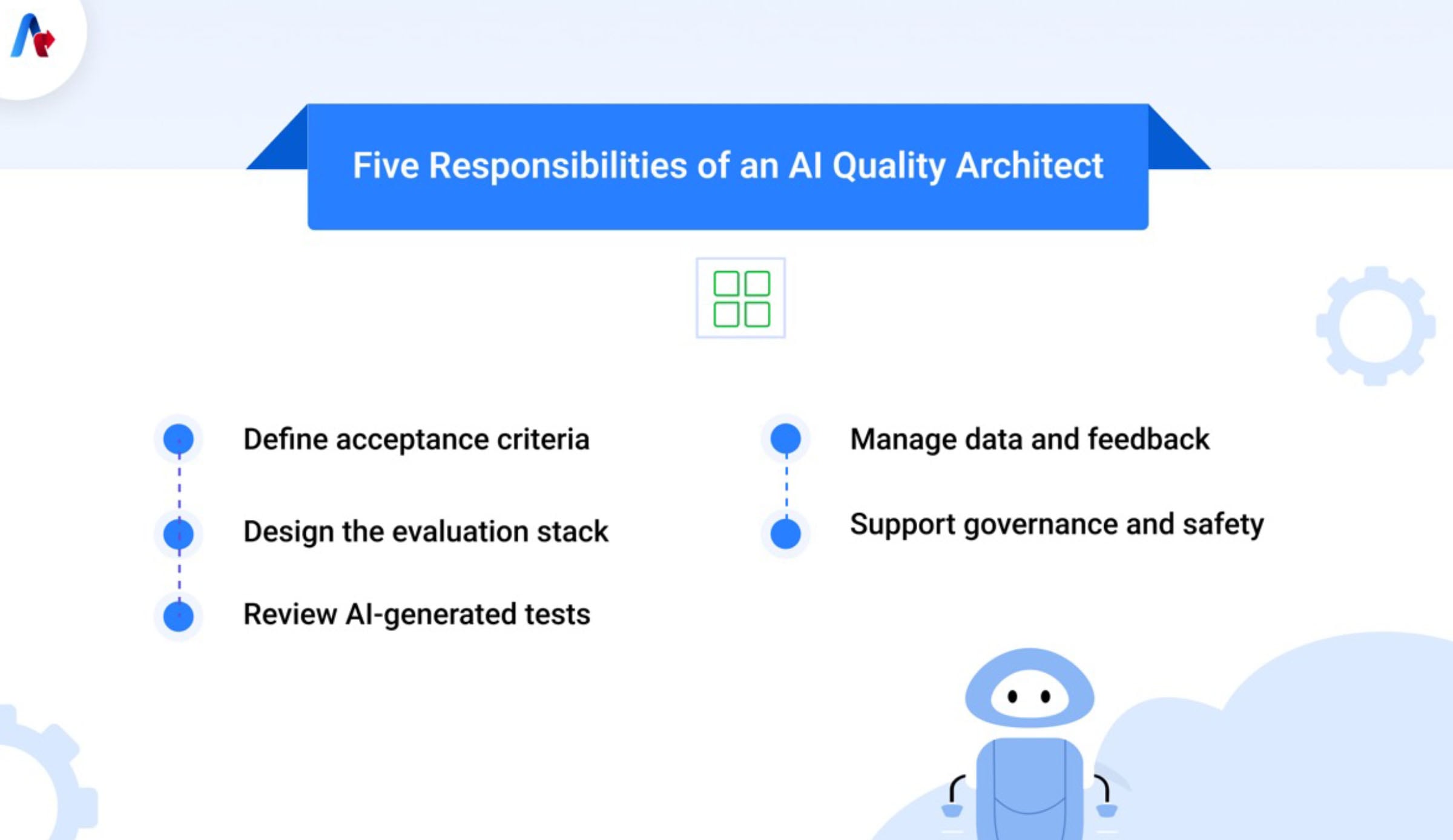
The main responsibility of an AI testing architect includes finding out what good AI behavior looks like and building a system to measure it. Other roles include setting clear acceptance criteria, designing the AI evaluation rules, and reviewing and making sure quality, safety, governance, and human oversight are tested with evidence.
1. Identify Acceptance Criteria
This is one of the hardest parts of the job because the architect needs to define what "correct” means for an AI claim, and what is good for an AI tool that summarizes areas like finance and medicine. The acceptance criteria also need to explain how much variability is acceptable, and when AI needs human support.
The answer will be different for every use case. For an internal writing assistant, a small mistake is something a person can easily correct. If AI is involved in high-risk areas, such as healthcare, insurance, and financial services, this will be different.
So, before testing AI, an architect should mention what success means. It may include:
- Factual accuracy
- Task success
- Correct tool use
- Policy compliance
- Safety
- Human escalation
- Latency
- Cost
2. Design the AI Evaluation Stack
The quality of AI should not depend on one test suite alone. It can be based on several layers, such as:
- Offline evaluations are helpful to test the AI before a new version is released.
- Online evaluations can help measure how the system performs with real-time traffic.
- Tracing is helpful to walk through the steps that agents have gone through.
- Guardrails are necessary to prevent actions that may affect other processes.
- Human evaluation is useful when automated checks cannot make a reliable judgment.
All these things are more important when you use AI agents. Looking for the final answer may not tell you enough. Agents might produce the correct answer finally but may use the wrong tools, make unnecessary calls, and use the wrong data. This is why a team needs to evaluate the trajectory along with the result.
3. Manage AI-Generated Testing Without Losing Sight of Real Risk
The use of AI can help you create test cases faster than a human. This is beneficial, but it creates other problems.
Think about a situation where AI generates 10,000 tests. In that case, how many can cover important business risks, how many are testing almost the same thing, and how many have weak assertions? You should not ask how many tests did we create? Instead, are we testing the things that matter most to the business and the user?
This is where the AI quality architect role comes into play. Here, they can review the test coverage, remove unnecessary tests, identify missing risks, and decide where humans should step in for an emergency.
The same applies to self-healing tests, because they can fix a broken selector and help move forward. But that does not mean the test is still checking the right thing. Artificial intelligence creates and maintains tests, but QA teams must ensure those tests are testing the right risks.
Read Accelirate's Agentic AI Software Testing guide for more details.
4. Take Care of the Data and Feedback Loop
The quality of AI is not complete soon after QA evaluation because something that happens in production can also improve future testing.
Consider a scenario where AI agents misunderstand a customer request. At this time, the QA team can review what happened and add it to the evaluation dataset to improve the quality. After this, a team can update the prompt, workflow, model, data source, and business logic and test the system again.
The process looks like this:
Production failure → Review → Labeled example → Evaluation → Improvement → Re-evaluation
Real problems found in production can become useful test cases for future releases.
5. Ensure AI Quality Governance and Safety
AI quality can be checked for safety and governance. This means that you need to check the exposure of the AI system to sensitive information, send information to the right person, and keep audit trails. Understand that these should be embedded from development onwards, not after that.
The role of an AI quality architect is to work with security, risk, compliance, engineering, and business teams to make sure these are tested and supported with evidence. It does not mean that the architect needs to make every governance decision. Their role is to ensure the quality requirements are clear, testable, and backed by evidence.
Need help building the right evaluation, governance, and human-review process?
Talk to Our AI Quality ExpertsWhy is the AI Quality Architect Becoming Important Today?
An architect is becoming important because AI is moving into real business processes, and QA teams are using it for testing software. Apart from that, AI agents may also introduce new risks, such as incorrect actions and data exposure. This role is also unavoidable, as there is a need for quality checks, ensuring safety, evaluation, and a balance between automation and human checks.
AI is Used for the QA Process.
AI is today part of QA processes, including writing tests, creating scripts, maintaining automation, and analyzing failures. It is changing how QA people spend their time. Because of AI, the team now spends only a little time on repetitive test creation and more time on risk checking, evaluation and governance.
Teams are Experimenting with AI Agents.
Today, AI agents are in action for many areas, including testing. Because of their autonomous nature, they may introduce a different type of quality problem in QA.
McKinsey reported in 2025 that eight in ten surveyed companies were already using generative AI in one way or another, but many still struggle to turn those deployments into meaningful impact.
This gap between use and deployment tells us that a proper AI evaluation is important. Organizations today need to know whether their AI systems are giving reliable results and making the right decisions. That is possible with this architect position.
AI Evaluation Tools are Improving.
Many companies use tools today for activities like tracking, evaluation, monitoring performance, guardrails and comparing models. The challenge today is not about finding the tools but about finding the right tool, knowing how they work together and what they should measure.
AI Evaluation has a Cost.
AI-based evaluation has a cost because it uses computing resources. Asking for thousands of outputs is expensive, so a team should decide which ones need AI judgment, which ones should use normal code, which can run on a sample and where humans need to review. So, having an architect is vital in today’s AI world.
Security is Part of Quality.
With an AI agent, failure may be more serious than before. The reasons are many: agents may call the wrong tools, expose sensitive data, and take action that was not allowed. So, it is vital to test security, safety, and business behavior together.
What Skills Does an AI Quality Architect Need?
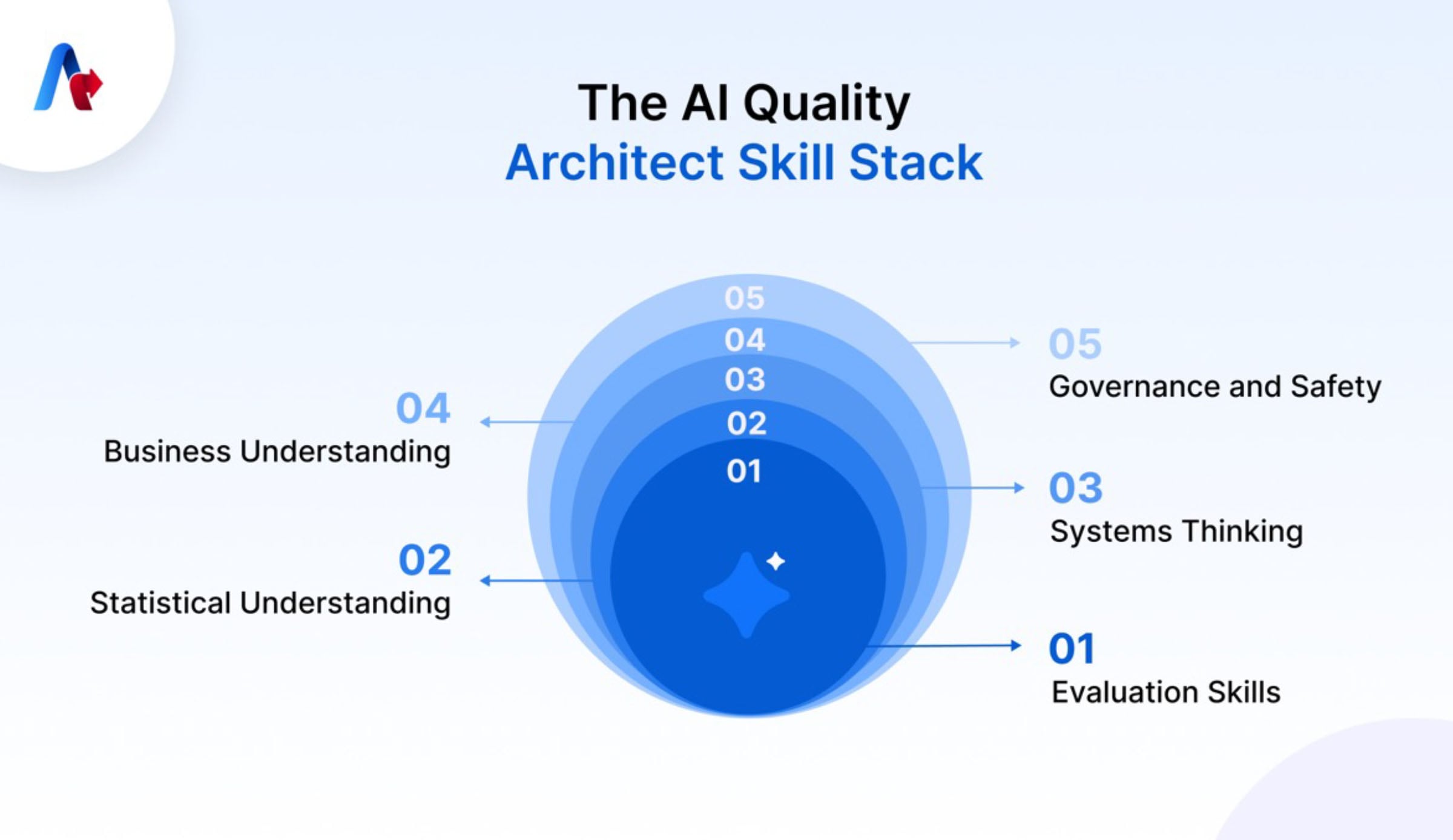
An AI quality architect needs a mix of skills, including testing, data, system, business, and governance. More than that, the architect also needs automation knowledge, but the role mostly involves judging AI quality, understanding risks, and seeing how different parts of an AI system affect each other.
- Evaluation Skills: This is the ability that assists them in knowing how to measure accuracy, relevance, task success, safety, and correct tool use.
- Statistical Understanding: AI quality is not about passing or failing. Instead, the architect should understand patterns, variation, false positives, and negatives in the test results.
- Systems Thinking: This is a crucial skill an architect needs because it will help to understand how these AI applications connect models, data, APIs, tools, agents, monitoring, and people.
- Business Understanding: Quality is also based on the use cases, so the person who handles this must understand the difference between an internal writing assistant and an insurance claims agent.
- Governance and Safety: The architect should also understand privacy, security, data access, human approval, audit needs, and escalation rules. It does not mean that this person should know everything, but they should be able to connect these areas to build AI quality.
How Can Organizations Build an AI Quality Function?
Organizations today can build an AI quality function in a smaller way. Choose one AI feature, create an evaluation dataset, define clear quality criteria, and after that add automated checks, monitoring, and guardrails. Once you get the production feedback, improve testing. It is important to assign ownership to a senior QA professional and focus on judgment and quality instead of just letting the tools do all the work.
1. Start With One AI Feature
An enterprise does not want to start big. Instead, choose one AI feature that is already in production. Later, build an evaluation process around it using test data, production data, monitoring, guardrails, and reporting. By doing this, the team gets to know what works and what needs to improve.
2. Give Someone Ownership
Ownership is a vital part where a senior QA or quality engineering professional should take responsibility for defining what good quality means for the AI feature. More than that, they must decide what to measure, how to evaluate the result and where attention is necessary.
3. Build a Feedback Loop
This is a method where you use problems found in production to improve future testing. When any failure is labeled, it can be added to the evaluation dataset and used in the future. This creates a simple cycle:
Production issue → Review → Evaluation → Improvement → Re-test
4. Decide the Right Team Structure
When the AI quality function grows, organizations need to decide how it should work. Most of the team may prefer a Center of Excellence (CoE) model, where a team sets the standards and helps other teams. Others might choose a federated model, in which AI quality experts are embedded in the individual businesses. The choice you make will depend on your needs, risk and size.
5. Judgment is Vital, Not Just Tools
AI testing tools may change in the future, but skills like what to test, how to measure quality and what evidence is essential to make a release decision should rely on people. The use of the tools is to simplify the work, not to replace the testers.
Read this case study: How Accelirate’s Agentic AI-Led COE Saves Over 40K Hrs and 65% Costs in Testing for a Global Bank.
Move From AI Testing to AI Quality
The arrival of AI in testing is changing quality engineering. Today, the QA team is not just checking whether software produces the expected result. Instead, they also need to evaluate accuracy, safety, business risk, and how the system behaves in diverse situations.
This is why the role of an AI quality architect is becoming essential. In this role, the architect checks AI output quality, builds the right evaluation process, and uses evidence to decide the final release.
There are tools already available, but we need to bring in the professionals who know how to bring these tools, data, testing, and governance together to build a reliable AI quality process.
Ready to move from traditional testing to a complete AI quality approach?
Connect With the Accelirate TeamFAQs
QA Architect is a person who designs the overall approach to software quality. The person will decide on testing strategies, standards, and other practices to ensure applications meet quality requirements. The role here also may involve developing a quality framework that works across the SDLC.
A quality architect is responsible for the QA approach, teams, systems, and projects, whereas the QA engineer focuses on creating, executing, and maintaining tests for a specific application. In short, the architect is responsible for many things, such as structure, standards, and tools, but engineers just execute the testing and maintain it.
AI architect is the one who creates quality criteria, designs evaluation processes, monitors AI behavior, and addresses risks that affect the quality of the tools. Also, this person connects testing, AI evaluation, security, and business and tells whether AI is ready to use or not.