



Quick Summary
Almost 60% of customer-care chats are fully managed by chatbots today; still many enterprises get confused while choosing the right fit for their business needs. The choice between an AI chatbot and conversational AI becomes tricky as one helps to handle predictable workflows and predefined questions, whereas the other understands context, supports multiple intents, triggers relevant actions and works across channels. The right choice depends on your use case, complexity, budget, and required level of automation. This will help leaders improve response time and deliver a better customer experience while reducing cost and manual workload.
Many enterprises get confused when choosing between AI chatbots and conversational AI because both are often positioned as similar solutions. The real difference becomes clear only when a customer moves beyond a simple question. One system might only provide scripted answers, whereas the other will follow the conversation, understand user intent, and guide them toward a useful outcome.
That difference can directly affect customer satisfaction, support workload, and the value businesses receive from their investment. Which is why enterprises should choose a solution that matches the complexity of the customer journey and fits business needs while reducing cost and human escalation.
What Is an AI Chatbot?
An AI chatbot is a software application that lets users ask questions in their own words and provides very natural, human-like responses. Unlike rule-based chatbots, they use NLP, ML and intent recognition system to understand user intent, recognise language patterns and interpret context to provide a suitable answer.
AI chatbots are commonly used as customer-support assistants, banking virtual assistants, insurance support tools, and internal IT or HR helpdesk assistants. Their role can range from answering a simple question to retrieving customer information and helping complete a specific task.
What Is Conversational AI?
Conversational AI helps users to interact with systems through speech or text. It combines natural language understanding (NLU), natural language processing (NLP) and dialogue management to analyse sentiments, understand context and engage in human-like conversations.
Voice assistants are the most popular examples of conversational AI delivered through speech, like Siri, Alexa, and Google Assistant. It is also implemented as chatbots or messaging tool in banking, e-commerce, healthcare, travel, and customer service.
See how the right conversational AI approach can improve customer support.
Book a demo todayAI Chatbots vs. Conversational AI: Key Differences
Though both AI chatbots and conversational AI offer similar solutions, they differ a lot in practice. Which is why enterprises need to understand the key difference between the two before making a choice
| Comparison Area | AI Chatbots | Conversational AI |
|---|---|---|
| Intelligence and context handling | Understands intent but may stay within limited topics or workflows. | Handles context, multiple intents, and more complex conversations. |
| Channel and language support | Commonly works through websites, apps, and messaging platforms. | Supports text and voice across multiple channels and languages. |
| Learning and improvement over time | Improves through training, conversation data, and manual updates. | Continuously improves using interactions, historical data, and machine learning. |
| Integration with business systems | Connects with tools such as CRMs, ticketing systems, and knowledge bases. | Integrates across multiple systems to support complete customer journeys. |
| Cost and implementation complexity | Faster and more affordable for simple, focused use cases. | Requires more planning and investment for complex, scalable use cases. |
How Chatbots and Conversational AI Relate to Each Other
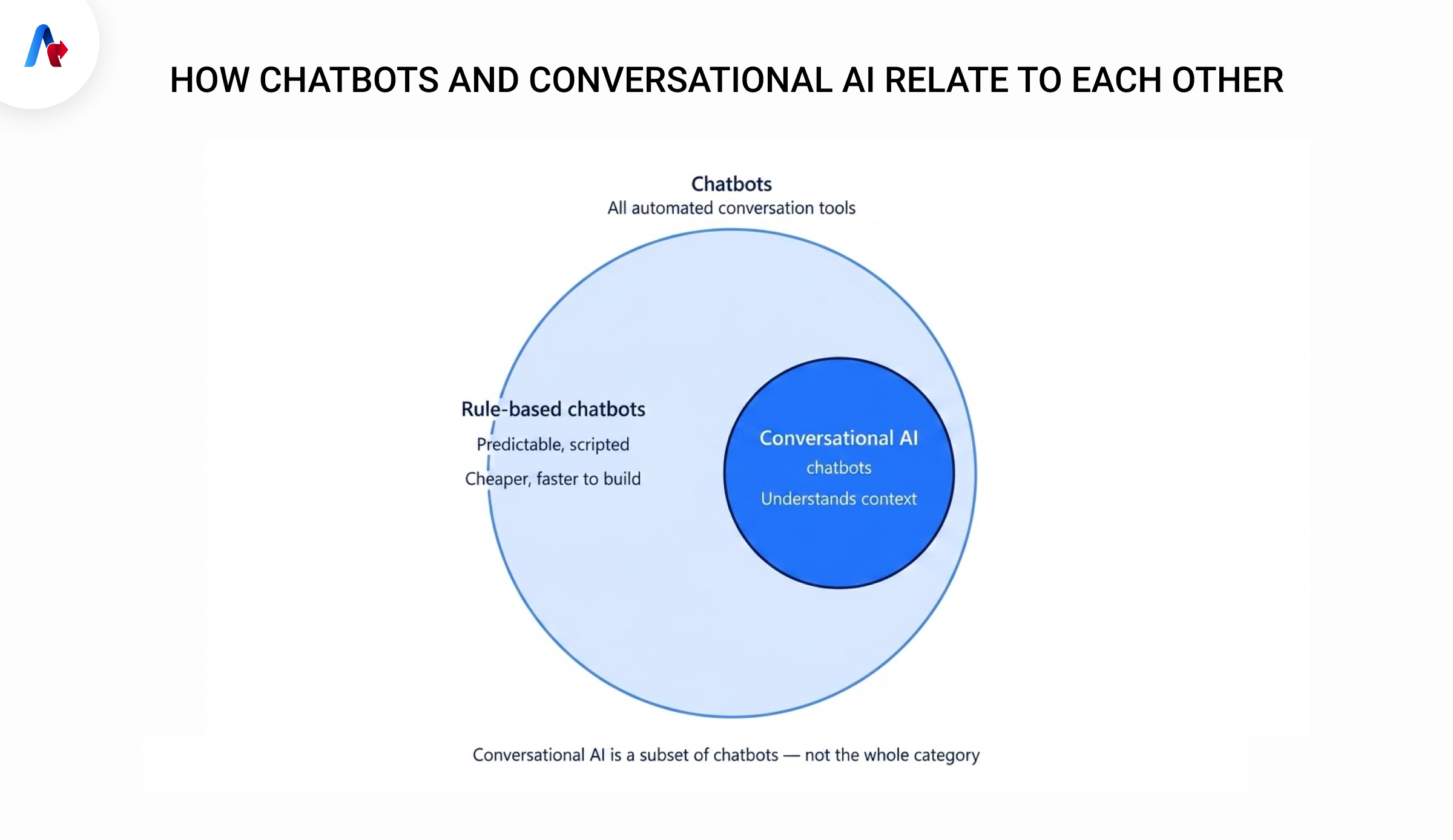
Is every chatbot conversational AI? This is a common misconception among enterprise leaders. The answer is no.
Conversational AI helps chatbots to understand the user’s intent, sentiments and context to converse more naturally. Enterprises use it to deal with complex questions, follow-up requests, multiple languages or conversations across text and voice channels. But not every chatbot needs conversational AI.
In case of predictable rule-based tasks, enterprises generally prefer simple chatbots as they are comparatively cheaper and easier to implement. Though both solutions help to automate customer interaction, the final decision is taken by carefully analyzing the customer journey and business requirements.
AI Chatbots vs. Conversational AI vs. AI Agents vs. LLM Agents
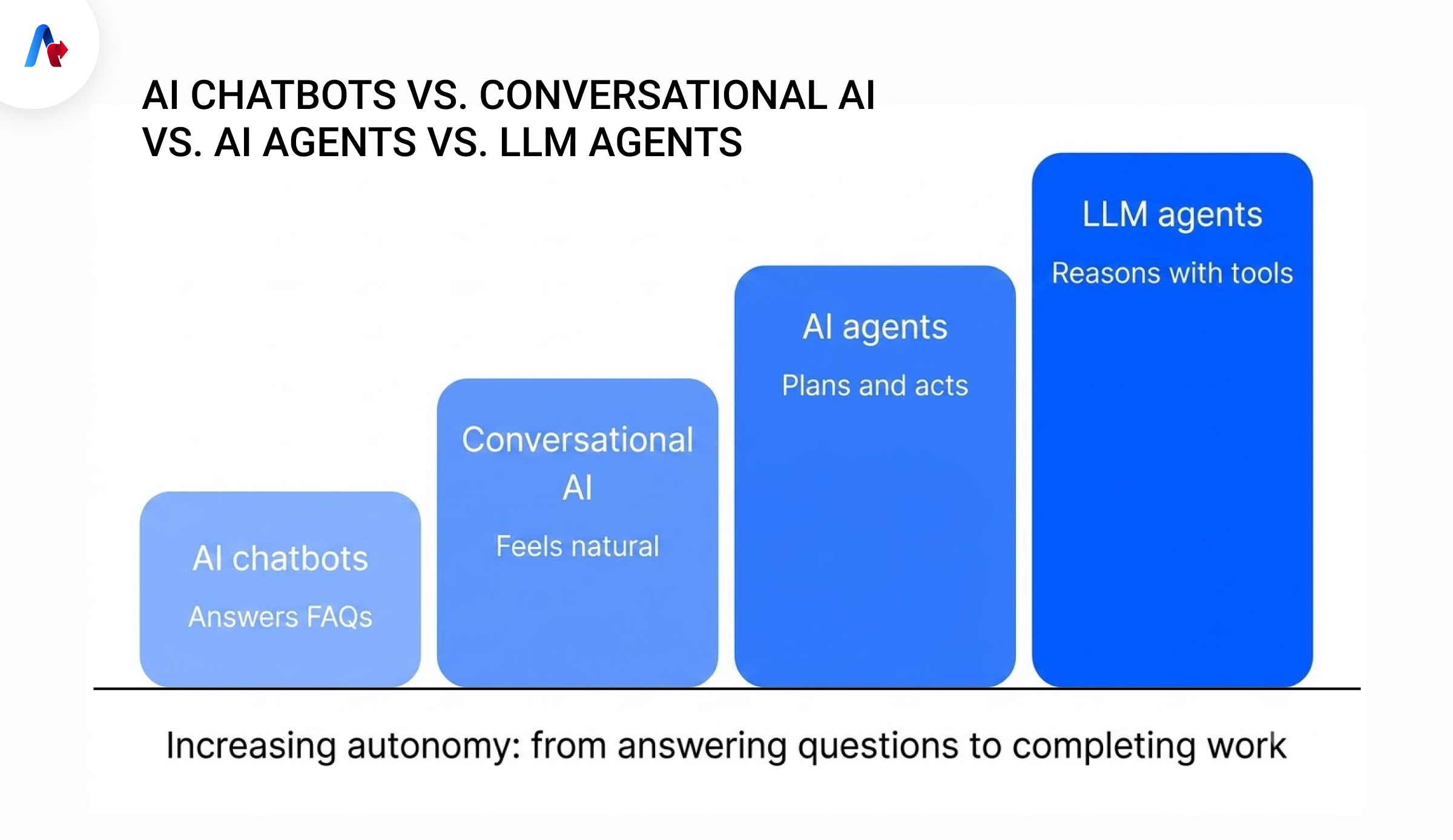
Once you understand how chatbots and conversational AI fit together, it’s easier to understand where AI agents and LLM agents fit in. AI chatbots and conversational AI both help system interact with users through text or voice. AI chatbots mainly answer questions and support specific tasks, while conversational AI improves these interactions by making it more natural.
AI agents and LLM agents goes one step further. AI agents help to complete a specific goal by planning steps and triggering actions. LLM agents use large language models as their reasoning and language layer, often combined with business data, APIs, memory, and tools. The key change is that the system no longer only explains what should happen; it can help complete the work while following defined permissions and human oversight.
As these technologies become more capable, businesses can move from simple automated responses to measurable improvements across service, productivity, cost, and customer experience.
Benefits of AI Chatbots and Conversational AI for Businesses
Let's understand more about AI and Chat Technology by looking at the benefits
24/7 Support and Reduced Wait Times
Chatbots help to reduce wait time and speed up issue resolution by providing around-the-clock support for basic tasks and simple questions.
Lower Support and Operational Costs
AI chat solutions can reduce repetitive tasks, handle multiple conversations and manage routine requests, helping team reduce workload and operational costs.
Scalability During Demand Spikes
Chatbots help teams stay organised and manage demand spikes during busy period without lowering response rate or needing additional support staff
Personalization and Lead Qualification
Teams use conversational AI to analyze customer data and current needs to identify strong leads, route them to the sales team and recommend relevant products.
Measurable ROI
It tracks key metrics like response times, resolved queries, customer satisfaction, and support costs, that helps team measure ROI and improve overall experience.
Use Cases by Industry
Here's how teams can implement AI Chatbot and AI Model Platforms across different industries to achieve these results in real life
Customer Service and Support
AI chatbots help to automate routine conversations like answering common questions, tracking orders or guiding customers through basic troubleshooting, reducing human dependence and waiting period.
Banking and Financial Services
Conversational AI is used in banks and financial institutions to help customers with different tasks like checking balances, reviewing transactions or making payments. It helps service providers to fast-track the process while having human oversight in place.
E-commerce and Retail
AI Chatbot and AI Model Platforms help to make shopping experience more personal by analyzing users' browsing history, preferences, or previous purchases. It also recommends relevant products, compares options and guides them through the buying journey.
Healthcare
Teams use AI chat solutions to help patients schedule appointments, receive reminders, answer billing questions or direct patients to the right department. It routes sensitive or complex cases to the right team to avoid any errors or incorrect handling.
Insurance
AI chatbots help to handle common questions regarding policies, coverage and renewals. It also helps insurers with automating the entire claim process from gathering initial data to sharing real-time updates.
Travel and Hospitality
The main advantages of AI chatbots in the travel and hospitality business are speed and availability, which matter most. AI chatbots primarily help with booking reservations, cancellations, or rescheduling. It also handles queries related to baggage, check-in or hotel facilities.
IT and HR
Internal chatbots help employee automate their routine tasks. They are especially used by IT and HR teams to report technical issues, check leave balances, find company policies, update personal details, and submit service requests. It helps to make the process efficient while reducing human workload.
Real-World Examples
To understand how AI Chatbot and AI Model Platforms work in practice lets consider Accelirate’s recent deployment of an NLP-powered customer-support chatbot for a major e-learning provider. At a basic level, the chatbot answered common questions using information from the company’s FAQ pages. At a more advanced level, it recognized user intent, retrieved personalized information from Salesforce, updated account details, supported enrollment-related requests, and transferred unresolved conversations to live agents with the correct context.
Key results included:
- $870,000 saved in call-centre costs
- 23,198 leads created
- 406 accounts reactivated
- 60% of chats handled by the chatbot
This example shows how a chatbot can begin with answering simple questions to evolving into a connected conversational system that supports users, completes tasks, and reduces manual workload.
Build an AI chat experience your customers can rely on.
Book a demo nowLimitations and Challenges
Limitations and benefits are both part of adopting any technology and enterprises should consider both while choosing a solution. For example, rule-based chatbots remain a common choice for simple and predictable tasks, but it still struggle with complex intent, unexpected questions, repetitive flows, frequent updates, and heavy dependence on human escalation.
Whereas conversational AI is more advanced, but it can still produce inaccurate responses, lose context, mishandle sensitive queries, or trigger poor handoffs. Strong data, monitoring, safeguards, and human oversight remain essential.
The challenge is not simply getting a chatbot to respond. It is making sure the system knows when to answer, when to ask for more context, and when to involve a human.— Accelirate Automation Expert
How to Choose: Chatbot vs. Conversational AI vs. AI Agent
Having difficulty making a choice? A simple decision checklist can help teams compare their use case, budget, required integrations and other important factors including:
- Type and volume of user requests
- Need for context or personalization
- Text, voice, and channel requirements
- Number of systems to integrate
- Need to complete business actions
- Accuracy and compliance requirements
- Available implementation budget
- Human review and escalation needs
As a quick rule of thumb, teams should choose a simple chatbot when users need fixed answers, basic navigation, or support for predictable tasks such as FAQs and order tracking. Conversational AI is better for contextual, personalized, and multichannel conversations, while an AI agent is required when the system must use tools, update records, trigger workflows, or complete tasks beyond responding.
How to Implement Conversational AI or an AI Chatbot
Here’s how teams can plan and implement these AI solutions successfully into their workflows
- Define the use case: Identify the exact questions, tasks, or customer journeys the system should handle.
- Map conversation flows: Document user intents, expected responses, fallback paths, and situations requiring human support.
- Prepare business data: Organize FAQs, policies, knowledge bases, customer records, and historical conversations for accurate responses.
- Connect required systems: Integrate the chatbot with CRM, helpdesk, order management, payment, or other business platforms.
- Test and improve: Monitor accuracy, completion rates, handoffs, and user feedback before expanding to more complex use cases.
Getting the implementation right is only part of the process. The platform and the vendor you choose also play an important role. The team should look out for options that can understand question patterns, connect easily with CRM systems, work on different platforms and keep human oversight in place for sensitive or complex interactions. Teams should also review analytics, security controls, scalability and pricing while making a decision.
Need help turning your AI chat strategy into a working solution?
Call our experts todayFuture of AI Chatbots and Conversational AI
What’s next for enterprise customer service? AI and chat technology will increasingly shift from systems that wait for questions to agentic and autonomous solutions that detect events, understand goals, and initiate approved actions. Future customer-service agents may identify a delayed order, investigate the cause across connected systems, notify the customer, offer an appropriate resolution, and update the service record without requiring separate prompts for every step. Voice and text experiences will also become more connected, allowing conversations to move freely across channels without losing context.
Choose the Right Technology for the Right Task
The best place for enterprises to start is not with the most advanced solution, but with a clear goal. The goal is to build a solution that works for both customers and the teams supporting them. Accelirate helps teams choose the right AI chat approach, connect it with existing systems, and maintain human oversight
Ready to identify the right conversational solution for your business?
FAQs
ChatGPT is a conversational AI assistant delivered through a chatbot-style interface, with natural-language understanding, contextual responses, and broader task capabilities.
No, many traditional chatbots works use predefined rules, keywords, scripts, and decision trees rather than artificial intelligence.
Yes, Siri and Alexa are voice-based conversational AI assistants that understand speech requests and respond through natural voice interactions.
Yes, a chatbot can be upgraded by adding NLP, intent recognition, contextual memory, machine learning, voice support, and business-system integrations.
The price depends on the number of conversations, voice usage, integrations, customization and support. Many of the platforms charge per request, message or minute of audio.
Related Blogs