



Quick Summary
Voice remains one of the most trusted and widely used channels in customer service, yet traditional IVR systems often frustrate customers with rigid menus and slow responses. Salesforce Agentforce Voice changes that equation by bringing conversational, AI-driven automation directly into the voice channel. Built natively on the Salesforce platform, Agentforce Voice allows organizations to deploy intelligent voice agents that understand natural language, access customer data in real-time, and take action, not just provide responses.
Despite the surge in chatbots, mobile apps, and self-service portals, voice remains a critical channel for customer interaction. According to a PwC study, 82% of consumers still prefer phone calls when complex or urgent issues arise. Yet, most enterprises continue to rely on outdated Interactive Voice Response (IVR) systems that route calls through rigid menus and robotic tones.
The result? A poor experience that drives frustration and longer resolution times.
This is where Agentforce Voice, Salesforce’s latest AI-powered voice technology, makes a big difference. It brings conversational intelligence, automation, and context-awareness to customer service calls, making voice not just another channel, but a smarter, action-oriented experience. This blog explores all about Agentforce Voice, how it works, what to consider when bringing AI-powered voice interactions into your service strategy, and more.
What is Agentforce Voice?

At its core, Agentforce Voice is an AI-powered voice agent layer built natively on the Salesforce platform. It allows organizations to create voice agents powered by AI, speech recognition, and natural language understanding (NLU) that can interact conversationally with customers across phone and digital voice channels.
Key Characteristics of Agentforce Voice
- Conversational Understanding: It uses natural-language understanding (NLU) and speech recognition (and synthesis) so that customers can talk rather than navigate rigid menus.
- Salesforce Native: It’s deeply integrated with Salesforce’s CRM, Service Cloud and data stack. It means the voice AI agents are context-aware, knows the customer, their history, and can take action (create/update records) rather than just respond to voice queries.
- Multi-Channel Ready: It supports deployment across channels: phone calls, web click-to-talk, mobile app voice, and invites reuse of the same agent logic across channels (so you build once, deploy many).
- Low Latency and Enterprise-Grade: It emphasizes low-latency, enterprise-grade performance and integrations into telephony systems (PSTN, Contact Centre as a Service platforms) so that the experience feels natural and professional.
Why Is Agentforce Voice Important for Customer Service?
Customer service teams face rising expectations like faster resolution, personalised experience, 24/7 availability, and seamless hand-off between digital and human agents. Voice is still a major channel and so upgrading from old IVRs to AI-powered conversations is a competitive advantage.
The Key Benefits of Agentforce Voice
- Better Customer Experience When the voice agent has context (customer history, CRM data) and can directly act (update a case, change an order), the interaction feels more human and efficient.
- Operational Efficiency Routine voice calls (status checks, simple tasks) can be handled by the voice AI agents, freeing human agents for more complex issues.
- Scalability & Integration Because it’s built on the Salesforce platform, organisations already using Salesforce-based service stacks can extend into voice AI without entirely separate systems.
- Consistent Omnichannel Voice If voice logic is shared with text/chat agents (through the same Agentforce builder), the customer sees consistent experience across channels.
How Agentforce Voice Works: Key Architectural Highlights

Behind every seamless voice experience lies an end-to-end orchestration of AI, telephony, and CRM logic.
Here’s a simplified view of how Agentforce Voice becomes part of a customer service voice-interaction stack:
- Call initiation/Channel: A customer dials a number (PSTN) or uses click-to-talk on web/app.
- Telephony Routing/Platform: Behind the scenes, the call is routed via a telephony system (for example partner CCaaS like Vonage, Five9, or Amazon Connect) integrated into Salesforce.
- Agentforce Voice Engagement: The Agentforce Voice engine takes over:
- Converts speech-to-text in real time, interprets intent via NLU.
- Retrieves context: customer record, past cases, preferences via Salesforce Data Cloud or CRM.
- Determines action: respond, update record, ask for clarification, or hand the call to a human agent.
- Action & Data Update: The voice agent may trigger workflows, API calls, record updates in Salesforce (or external systems) as part of resolving the customer’s request.
- Escalation/Handoff: If the issue is complex, the voice agent hands over to a human agent, passing full context (transcript, conversation history, voice sentiment, metadata) so the human can pick up seamlessly.
- Analytics & Monitoring: Every voice interaction is captured: transcripts, actions taken, resolution times, sentiment etc. That data feeds insights for service improvement.
Did you know Agentforce Voice makes your IVR sound more like a knowledgeable assistant and less like a machine?
Try todayReal-World Use Cases and Capabilities of Agentforce Voice
Voice AI adoption is accelerating across industries, particularly where call volume is high and process repeatability is strong. Here are some scenarios where Agentforce Voice works the best:
- Call-Centre Inbound Volume Handling: For high-volume simple queries (account status, order updates, appointment scheduling) the voice agent handles them end-to-end (or ups to a hand-off).
- Web/App Voice Assistants: A user taps “speak with us” on a mobile app, and the voice agent engages, understands their query, pulls in CRM context, resolves or escalates.
- Omnichannel Consistency: The same Agentforce logic backs both chat/text and voice; so whether the customer types on web chat or speaks on phone, the experience and back-end action is aligned.
- Branded Voice Experience: Customisable voice (tone, accent), branded feel, so the agent feels like “your company’s voice” not generic.
According to Salesforce’s State of Service report (2024), 78% of service leaders plan to integrate AI voice agents into their operations within two years.
What to Consider When Implementing Agentforce Voice?
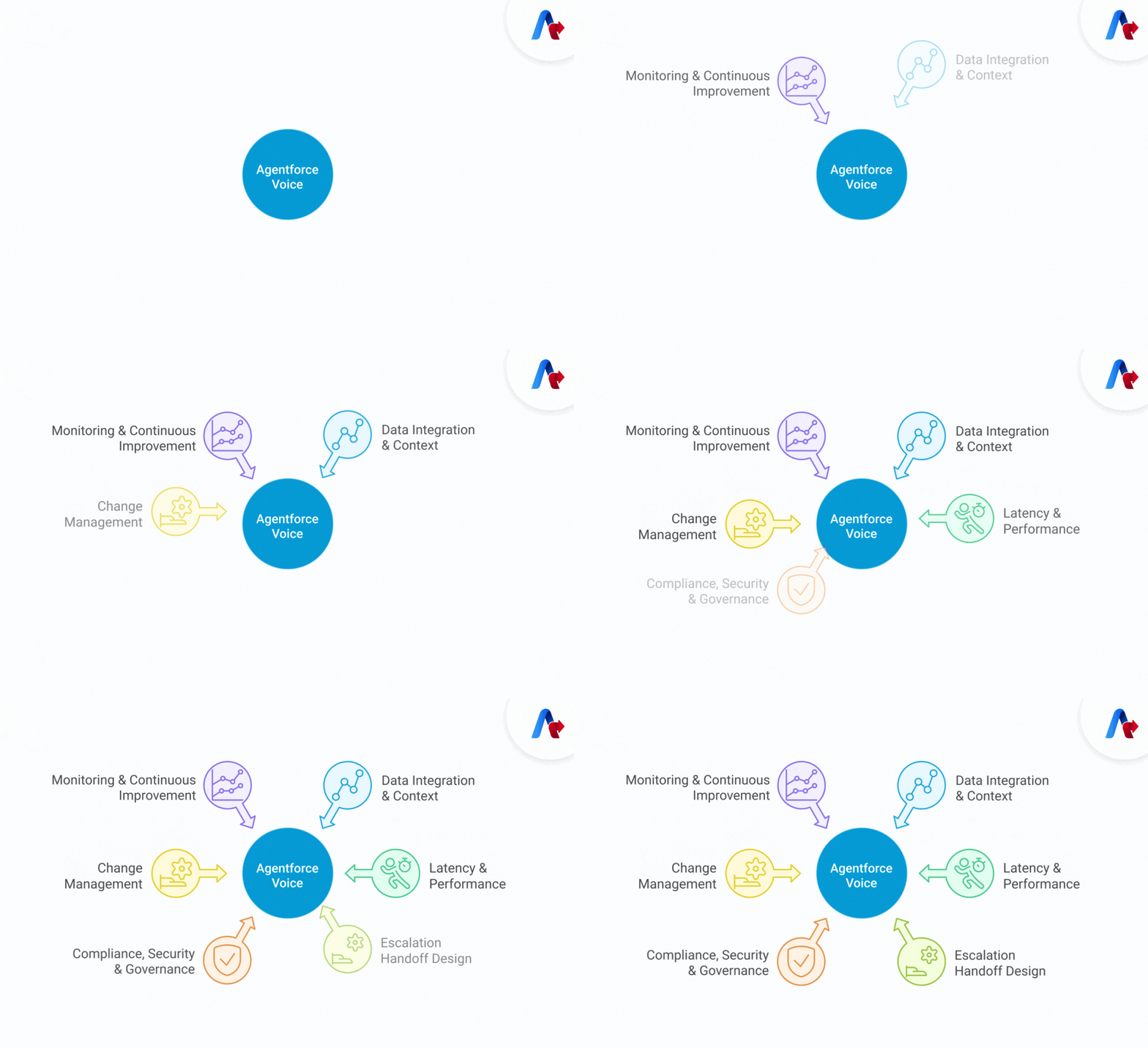
Deploying Agentforce Voice successfully requires both technical and organizational readiness. While the capabilities are impressive, success depends on thoughtful planning.
Here are some key factors to consider:
- Data Integration & Context: The voice agent needs timely, accurate customer context, if customer data is siloed or incomplete, the experience may suffer.
- Latency & Performance: Voice conversations judge delays harshly. Salesforce notes that typical overheads (500–600 ms) may frustrate users.
- Escalation Handoff Design: When the voice agent hands over to human agents, ensuring context flows smoothly is crucial to customer satisfaction.
- Compliance, Security & Governance: Voice conversations, telephony systems, data updates all need robust security, auditability, privacy controls.
- Change Management: Human agents need to embrace voice-AI hybrid workflows; processes may shift (what the AI handles vs humans).
- Monitoring & Continuous Improvement: Set up analytics on voice agent effectiveness, error rates, user sentiment, and iterate.
Why Agentforce Voice Is Needed for Your Organization (and You)?
For service organisations looking to scale and improve customer experience, Agentforce Voice offers a strategic path from legacy IVR to intelligent conversational voice AI. If you’re already using Salesforce Service Cloud and want to bring voice into your AI-agent roadmap, this becomes a compelling opportunity. It allows you to:
- Migrate from static IVRs to context-aware voice agents.
- It sits on the same platform and hence minimises integration overhead.
- Extend your customer service digital-agent strategy from text to voice.
- Meet rising customer expectations for seamless, personalised, immediate service.
- Free up human agents for strategic, complex tasks rather than repeatable voice queries.
The Future Speaks in AI
Voice will always remain one of the most human and personal ways for customers to connect with businesses. With Agentforce Voice, Salesforce is not replacing that connection, it’s making it smarter, faster, and more personal. As organizations look to scale customer service while maintaining empathy and accuracy, the question isn’t “Should we adopt Voice AI?” but rather “How can we implement it responsibly and effectively?” If you’re exploring voice automation, start by asking these simple questions:
- How many voice interactions are currently handled in your contact centre?
- What proportion are routine enough for automation?
- Do you have the CRM/data-foundation to support context-rich voice agents?
- How will voice agent + human agent workflows look (handoff, escalation, monitoring)?
Ready to modernize your customer service voice channel? Let’s discuss how Agentforce Voice can fit into your Salesforce ecosystem.
Got more questions?
Let’s talkFAQs
Unlike IVRs that rely on pre-set menus, Agentforce Voice understands natural language and can take real-time actions in Salesforce.
Yes, it supports major Contact Center as a Service (CCaaS) platforms like Vonage, Amazon Connect, and Five9.
No. Being native to Salesforce, it works within the Service Cloud and Agentforce ecosystem, leveraging existing CRM and Data Cloud components.
Industries with high call volumes, such as finance, healthcare, retail, and utilities, benefit greatly from intelligent voice automation.
Yes, voice tone, accent, and phrasing can be customized to match your brand’s voice identity.