



Quick Summary
API governance in the age of AI agents means enforcing security, data privacy, rate control, and observability across autonomous systems that consume APIs unpredictably and at high volume. Traditional gateway policies are not sufficient. Enterprises need agent-specific access controls, separate SLA tiers, field-level data masking via DataWeave, and Experience API facades that keep System APIs completely off-limits to agents. MuleSoft's Anypoint Platform addresses this across design time, runtime, operations, and security layers.
For years, enterprise API governance ran on autopilot. Teams defined design standards, security enforced authentication at the gateway, and lifecycle management kept things reasonably clean. It was not perfect, but it held.
That changed when AI agents entered the picture.
Unlike traditional integrations, AI agents do not follow fixed call patterns or wait for human input. They reason in real time, invoke multiple APIs simultaneously within a single session, and generate traffic volumes that most enterprise architectures were never designed to absorb. The same governance framework that handled thousands of scheduled API calls a day now struggles against an autonomous agent that produces that volume in minutes.
Security teams are finding over-privileged service accounts. Finance teams are getting hit with unexpected consumption costs. Compliance teams are asking which data an agent accessed during a session and finding no clear answer.
This guide breaks down where traditional API governance falls short with AI agents, what specific controls are needed, and how MuleSoft's Anypoint Platform helps enterprises build a governance framework that holds up at AI scale.
What Is API Governance and Why Does It Matter Now?
API governance is the structured set of standards, policies, and practices that define how an organization designs, deploys, secures, monitors, and retires its APIs throughout their lifecycle.
For a long time, this definition was practical enough. APIs connected systems, teams followed design standards, and security teams enforced authentication at the gateway. Governance was an IT discipline with well-understood rules.
That landscape has shifted significantly.
AI agents, including large language models, autonomous workflows, and agentic orchestration systems, are now consuming enterprise APIs in ways that no traditional governance model anticipated. These systems do not behave like developers making structured API calls. They reason autonomously that chain multiple APIs together in real time, and generate unpredictable, high-frequency traffic patterns without human intervention.
APIs are no longer just integration channels, in AI driven environments APIs are controlled decision gateways and governance is no longer a compliance exercise but a core operational requirement.
Ready to govern your APIs for AI scale?
Talk to an Accelirate MuleSoft expert today.
How AI Agents are Disrupting the API Consumption Model
In order to understand the governance gap, we need to understand the differences between how AI agents and traditional API consumers behave.
Traditional API consumption is predictable. Human action triggers requests. Integration logic is fixed and designed beforehand. Traffic volumes stay within expected limits. System behavior is deterministic and testable.
AI agent consumption works very differently. An agent handling a procurement workflow might simultaneously invoke inventory APIs, supplier pricing APIs, logistics APIs, and ERP systems as part of a single reasoning session. The exact call sequence changes based on what the model decides at runtime. The same task can produce different API call patterns on different executions.
This creates four characteristics that governance frameworks need to account for: autonomous decision-making with no fixed integration pattern, dynamic and context-driven API invocation, high-frequency burst traffic during multi-step reasoning or retry logic, and non-deterministic behavior from intelligent consumers.
None of these were part of the original design assumptions behind most enterprise API governance frameworks. Closing that gap is what modern API governance is about.
Key API Governance Challenges in the Age of AI
The rise of AI‑driven API usage introduces several new governance challenges that go beyond classic API‑management concerns.
Access Management and Security
AI agents frequently operate with delegated credentials or long-lived service account tokens. A single agent session can call dozens of downstream APIs with the same token which greatly increases the risk surface around token misuse, privilege escalation and unauthorized data access.
Traditional role-based access controls were designed for human users and deterministic integrations. They do not provide the per-agent, per-scenario granularity that agentic systems require. Governance needs to define exactly which agents can call which APIs, under which conditions, and with which scopes.
Rate Limiting and Cost Management
AI agents generate high-volume, burst-pattern API traffic, particularly during multi-step reasoning chains, error recovery, or iterative refinement loops. For consumption-billed APIs, whether internal infrastructure or external SaaS services, this kind of uncontrolled traffic translates directly into budget overruns.
Static rate limiting thresholds, which were designed for predictable human-driven traffic, are often insufficient against agent-generated spikes. What’s needed is intelligent, adaptive throttling that takes into consideration AI-specific consumption patterns.
API Data Governance and Privacy
AI agents do not simply pass data from one system to another. They read it, reason over it, and retain it within their context window for the duration of a session. If an API response includes personally identifiable information (PII), financial data, or regulated health records, that data becomes part of the agent's active context, regardless of whether it was needed for the task at hand.
API data governance must enforce field-level masking and data minimization before a response reaches an agent. Relying on downstream processing to handle sensitive data correctly is not a governance strategy.
Observability and Traceability
When a traditional integration calls an unexpected API endpoint, tracing the cause is a straightforward process. When an AI agent does the same thing, the reasoning chain that produced that behavior is internal to the model. The API call is visible in the logs. The decision that triggered it often is not.
Without observability tooling that connects agent behavior to API invocations and downstream outcomes, debugging, compliance auditing, and performance optimization all become significantly harder than they need to be.
API Sprawl
AI use cases to move fast, and teams building agent capabilities often create new endpoints rather than searching for existing governed alternatives. Left unchecked, this produces a proliferation of similar but unstandardized APIs across the organization, each with its own documentation status, security posture, and maintenance owner.
API sprawl is not just a technical inconvenience. It results in inconsistent security enforcement, duplicated maintenance costs, and endpoints that quietly become vulnerabilities when they are no longer in active use.
MuleSoft Governance Framework
MuleSoft provides governance capabilities for four main layers and helps manage API governance from design time until runtime operations and security enforcement.
Design-Time Governance
Design-time governance prevents issues from escalating to production. Anypoint API Designer allows API definitions in RAML and OpenAPI Specification formats so teams can define interface contracts, enforce naming conventions, and validate API structure before any implementation work begins.
Anypoint API Governance applies governance profiles directly to API specifications, automatically identifying non-conformant designs against organizational standards. Reusable API fragments stored in Anypoint Exchange give teams a governed library to build from, which reduces duplication and cuts off the conditions that produce sprawl.
Runtime Governance
Anypoint API Manager handles lifecycle management and policy enforcement for live APIs. This is where OAuth 2.0 and JWT validation policies are applied, client ID enforcement is configured, and rate limiting and spike arrest controls are enabled.
In runtime governance for AI-enabled environments, there are separate SLA tiers for human users and AI agents. This way, an agent-driven workflow that generates burst traffic does not impact the performance of customer-facing applications that use the same underlying APIs.
Operational Governance
Anypoint Monitoring provides continuous visibility into API usage patterns, error rates, latency distributions, and traffic anomalies. Centralized logging and alerting allow operations teams to identify unusual behavior as it happens.
For AI agent traffic, operational governance is particularly important. Behavioral anomalies, such as sudden changes in call frequency or an agent querying endpoints outside its expected scope, often indicate a model behaving unexpectedly, a prompt injection attempt, or a retry loop that has gone out of control.
Security Governance
Flex Gateway provides Zero Trust security enforcement at the API gateway layer. Every API call is verified continuously regardless of origin. Internal agents receive the same level of scrutiny as external callers. No implicit trust is extended based on network location or prior authentication.
MuleSoft Solutions for AI-Driven API Governance
MuleSoft has specific technical capabilities that directly address AI agent behavior beyond the governance framework.
Policy-Based Access Control
Anypoint API Manager’s OAuth 2.0 and JWT policies not only validate that a valid token exists but also validate agent-specific scopes and claims at the gateway. This enables organizations to define granular access rules at the per-agent and per-API level, to implement least-privilege access without having to rebuild their authentication infrastructure.
Intelligent Rate Limiting
SLA-based usage tiers with dynamic throttling give organizations the ability to define different consumption envelopes for AI agents versus human users. Spike arrest policies absorb burst traffic gracefully, returning a controlled response to the agent rather than triggering aggressive retry behavior that compounds the volume problem.
API Experience Layer for AI
Creating AI-specific Experience APIs as a governed facade between agents and backend systems is the most structurally important governance decision an organization can make. AI agents interact exclusively with Experience APIs. Those Experience APIs control what data and operations the agent can access, apply DataWeave transformations and masking, and invoke Process and System APIs on the agent's behalf.
System APIs, those that connect directly to core backend systems like ERP platforms, databases, and financial systems, should never be accessible directly by autonomous agents. This is a non-negotiable boundary.
API Data Governance with DataWeave
MuleSoft's DataWeave transformation engine runs inside API flows and can mask PII, filter regulated fields, and reshape response payloads before they leave the governed environment. API data governance at this layer is not a policy document. It is code that executes on every response, consistently, without relying on downstream consumers to handle sensitive data correctly.
End-to-End Observability and Traceability
Correlation IDs propagated across every layer of the API stack (from agent request through Experience API, Process API, System API, and backend systems) provide a complete, queryable audit trail for every agent-driven transaction. Custom logging at each layer captures the context needed to understand what happened, in what sequence, and why.
Recommended Architecture for Governing AI Agent API Access
A layered architecture helps you govern AI‑driven API consumption while preserving abstraction and decoupling.
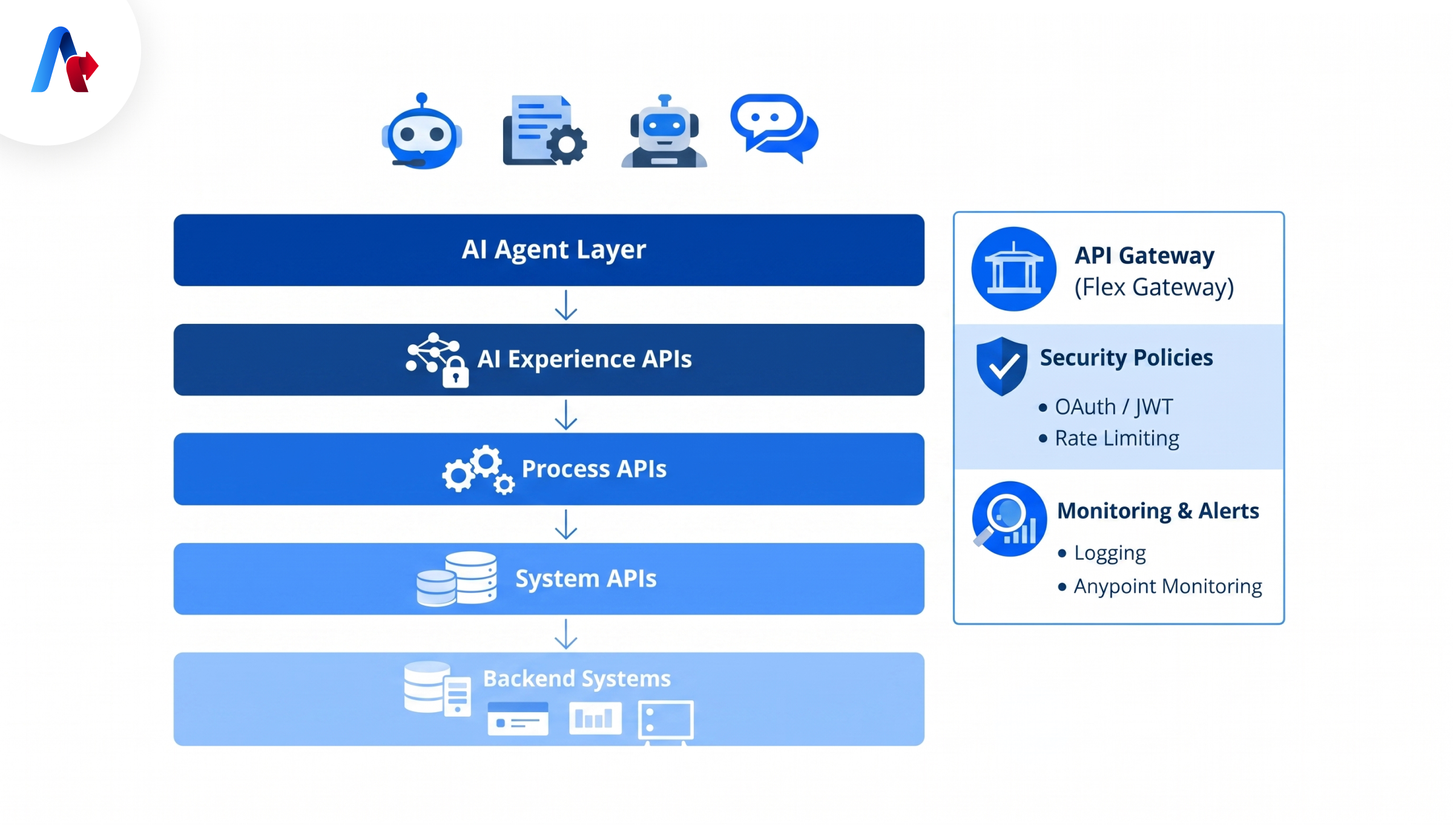
- Use a layered architecture: Agent → Experience API → Process API → System API → Backend systems.
- Flex Gateway enforces security at the perimeter. Anypoint Monitoring observes every layer. Anypoint Exchange maintains the catalog that keeps this architecture discoverable and reusable.
- The discipline that makes this work is maintaining clean separation between layers. Experience APIs serve specific consumer use cases. Process APIs own business logic. System APIs own backend connectivity. When those boundaries blur, the governance model degrades with them.
Want this architecture implemented in your environment?
Connect with Accelirate today.
Best Practices for Enterprise API Governance with AI Agents
These best practices combine design, security, performance, governance, and AI‑specific control patterns.
Design
- Follow API‑led connectivity principles.
- Build reusable Experience, Process, and System APIs.
Security
- Always enforce OAuth / JWT validation for agents.
- Apply a Zero Trust security model with continuous verification.
Performance
- Implement caching where possible to reduce backend load.
- Use asynchronous patterns for high‑latency or batch‑oriented workflows.
Governance
- Maintain a centralized API catalog in Exchange.
- Enforce a consistent versioning strategy.
- Monitor API health, usage, and deprecation lifecycles.
AI Control
- Restrict AI access through Experience APIs only.
- Avoid direct exposure of System APIs and legacy endpoints.
Business Benefits of MuleSoft API Governance
Strong API governance around AI agents delivers concrete business value, not just technical control.
Faster innovation
- Reusable APIs accelerate AI adoption.
- Standard patterns reduce duplication and speed up delivery.
Improved security
- Policy‑driven governance reduces the risk of uncontrolled access.
- Centralized controls improve auditability and compliance.
Cost optimization
- Controlled API usage prevents overconsumption.
- Intelligent rate limiting helps manage infrastructure costs.
Better visibility
- Enhanced observability tracks AI‑driven interactions.
- Teams can debug, tune, and optimize agent behavior more effectively.
The Future of API Governance
AI Agents will be the primary consumers of enterprise APIs. This shift will require governance frameworks to move from static rules to dynamic, behavior-based controls that react to agent behavior in real time.
That means AI-aware gateways that understand agent-specific traffic patterns. It means behavioral baselines that can flag semantic anomalies, not just volume spikes. And it means governance policies that update dynamically as agent capabilities evolve and the threat landscape shifts around them.
Organizations that build governed API foundations now, using structured platforms like MuleSoft's Anypoint Platform, are the ones that will scale AI adoption without the incidents that follow ungoverned growth.
API Governance Checklist for AI Agents
- API specs defined in API Designer using RAML or OAS before implementation
- Governance profiles applied to validate specs against organizational standards
- All APIs and reusable fragments published to Anypoint Exchange
- OAuth 2.0 or JWT validation policies applied to every agent-facing API
- Separate SLA tiers configured for AI agents and human users
- Spike arrest enabled to absorb burst agent traffic
- AI-specific Experience APIs built as the controlled entry point for all agent access
- DataWeave masking applied to PII and regulated fields at the Experience API layer
- System APIs blocked from direct agent invocation
- Correlation IDs propagated across all API layers
- Anypoint Monitoring behavioral alerts configured for pattern-level anomalies
- Caching enabled at the Experience API layer for reference data
Need help implementing this checklist?
Accelirate's MuleSoft team can take you from assessment to deployment.
Building API Governance That Scales With AI
AI agents are already inside enterprise API layers. The governance gaps they expose, around access control, data privacy, cost, and observability, do not fix themselves over time. They compound.
MuleSoft's Anypoint Platform covers the full governance lifecycle, from design-time spec validation to live behavioral monitoring. Every layer matter because a gap in any one of them undermines the rest.
The enterprises building governed API foundations now are the ones that will scale AI adoption without incidents. The ones that wait will fund remediation instead.
For organizations looking to accelerate that foundation, Accelirate's MuleSoft consulting services help enterprises design, implement, and govern API architectures built for AI-scale operations, from initial platform setup to production-ready governance frameworks.