


Quick Summary
Agentic AI has transformed healthcare by providing faster decision-making, reducing administrative burden, and smarter care coordination through practical use cases. Companies implementing Accelirate’s Agentic AI solutions have realised 30% reduction in paperwork and an estimated $50B annual savings opportunity across the healthcare industry, with use cases spanning chronic disease management, virtual health assistants, hospital workflow automation, and remote patient monitoring.
Does your team know exactly where the delay is happening, but still need someone to manually push the work forward?
A claim is waiting on validation. A prior authorization needs one missing document. A patient follow-up is stuck between systems. All these processes have to be manually checked and moved to the next steps.
Many healthcare teams already say, “We have automation in place.”
And they do. RPA bots and traditional automation have helped reduce repetitive work, especially in rule-based processes like data entry, task routing, and basic system updates.
But today’s healthcare workflows are more complex than that.
Today’s healthcare workflows involve payer rules, missing documents, compliance checks, and system handoffs, all of which can directly affect revenue, patient experience, and care coordination. Healthcare leaders need more than fixed-rule automation. They need systems that can understand context, act within compliance boundaries, and move work forward intelligently.
That’s exactly where Agentic AI has started to make a real difference.
What is agentic AI in healthcare and how does it differ from traditional AI?
In the healthcare industry, “agentic AI” refers to AI systems autonomously, making decisions, and acting according to objectives without continuous human supervision. These systems are made to be proactive agents by evaluating patient data, forecasting results, and starting care procedures like follow-up appointments or treatment plan modifications.
This is exactly what other rule-based systems lags. Traditional AI helps to identify patterns, generate predictions or send alerts, but teams have to manually review these information and take next steps. It results in delay, disconnected workflows, and poor decision-making.
Agentic AI fixes this gap by combining analysis with action that can understand real-time context, triggers next step, and move healthcare workflows forward. It helps teams to become more efficient by reducing manual follow-ups and delays, while improving decision-making and response rate.
What types of AI are used in healthcare, and where does agentic AI fit?
The healthcare sector uses a variety of AI models, like computer vision, natural language processing (NLP), deep learning, machine learning, and robotic process automation (RPA). These technologies support activities like virtual assistance, administrative automation, predictive diagnoses, document processing, and medical image analysis.
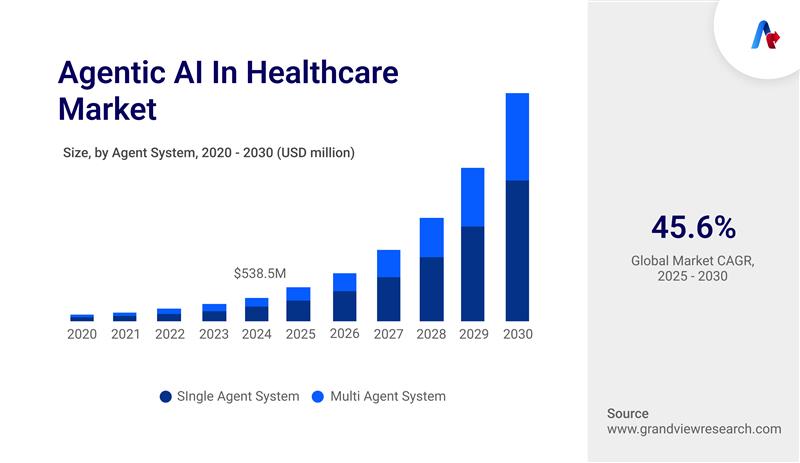
Implementing AI agents in healthcare industry helps to connect these different technologies by acting as an orchestration layer and decide when and how each one will be used in a workflow. For example, ML can predict a patient risk, NLP can read clinical notes, computer vision can review scan results, and RPA can update records or schedule a follow-up. Agentic AI brings all these actions together, so the workflow does not stop at one task.
It doesn’t just stop there. Agentic AI also understands the goal of a workflow, determines the next best action based on real-time context, and triggers actions with the right level of human-oversight. It also prioritizes urgent cases and resource allocation automatically and support teams to time-sensitive decisions.
Want to implement Agentic AI in your organization?
Talk to our healthcare automation experts
What measurable benefits does agentic AI deliver for healthcare providers
Let’s look at some key capabilities that make Agentic AI more advanced than traditional automation in healthcare:
Autonomous Decision-Making
The most revolutionary feature of an AI agent is its ability to make decisions without any constant human supervision. These agents can make even complex judgments on the basis of existing patient data and protocols and can trigger next steps such as preparing a follow-up, flagging a missing test, or routing a case for review.
As a result, healthcare professionals are less burdened and get more time to connect with patients to make important decisions
Personalized Patient Care
To create personalized care plans, agentic systems continuously examine a patient's genetic information, lifestyle choices, medical history, and treatment results. This approach helps to provide more relevant and customized treatment, resulting in better clinical outcomes and patient satisfaction.
Proactive Health Management
AI agents identify early warning signs by tracking vital signs, behavior patterns, medication activity, and patient updates. updates. It automatically sends reminders, flags issues, and escalates urgent cases before the situation gets worse. This makes care more proactive and efficient.
This is also seen in recent Accelirate deployments where UiPath-powered health monitoring and medication management AI agents have helped teams to reduce delays and provide more proactive patient care by automating reminders, caregiver notification, and symptom tracking, which improved medical adherence by 60-75%.
Streamlined Administrative Processes
Agentic AI greatly enhances administrative tasks in addition to providing therapeutic help. In order to reduce paperwork and free up people for higher-value duties, AI agents can handle appointment scheduling, insurance verification, patient onboarding, billing, and even documentation.
Recently, Accelirate’s AI healthcare assistant automated appointment scheduling and reminder coordination with 90% scheduling coverage and 95% reminder accuracy, helping healthcare teams reduce manual coordination work.
Improved Accuracy
As agentic AI systems use a vast amount of historical and real-time data, they are able to make extremely accurate suggestions for diagnosis and therapy. They keep learning from every new piece of information, which lowers the possibility of human error and promotes evidence-based medical judgment.
What are the top agentic AI use cases in healthcare delivering ROI in 2026?
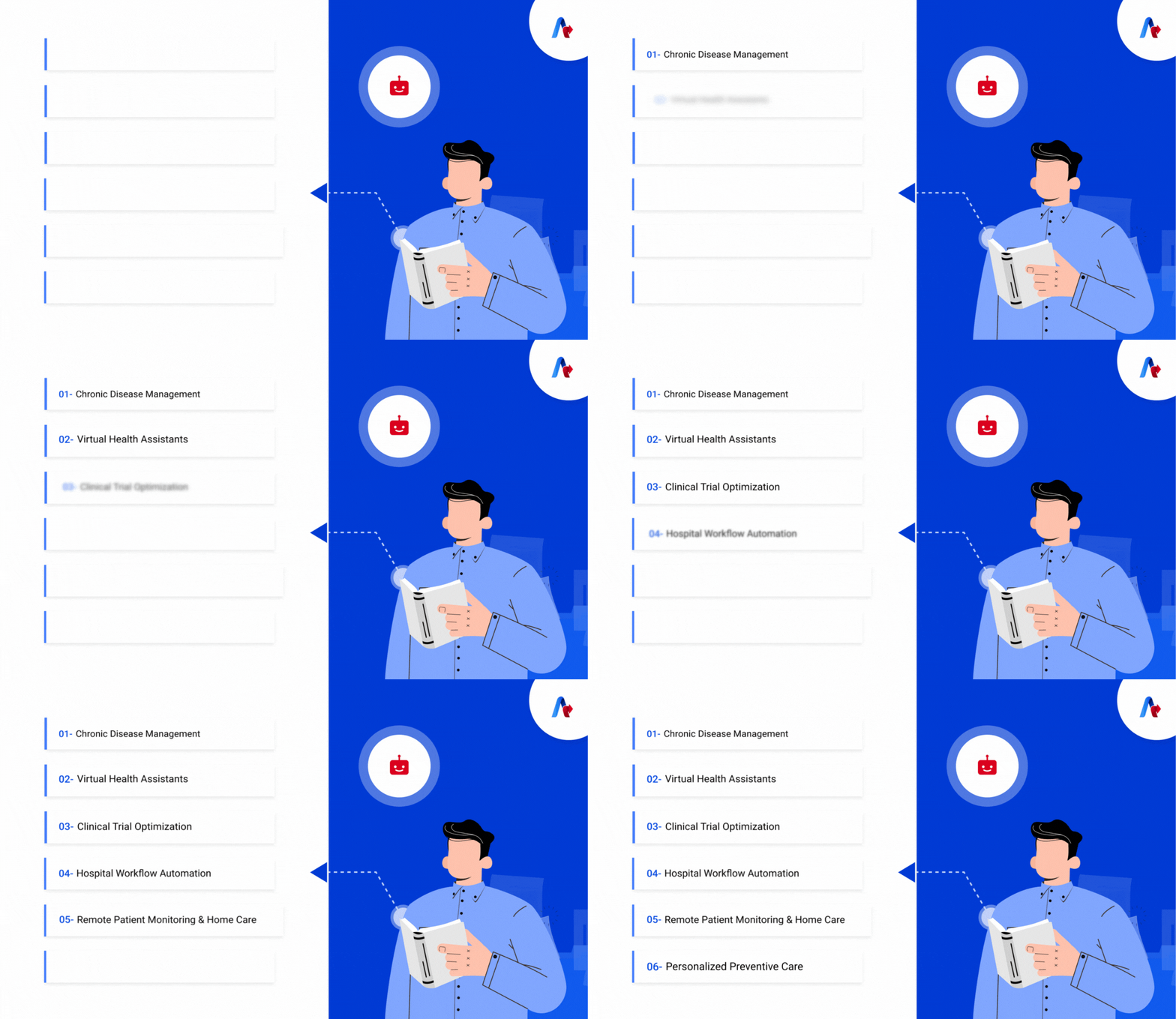
What are some real-world applications of agentic AI in healthcare? As agentic AI continues to gain adoption in healthcare, many leaders now want to understand where it creates real operational and clinical impact. We have listed down some of the top agentic AI use cases in healthcare and practical agentic AI applications in healthcare:
Prior Authorisation Automation
Prior authorisation is one of the most practical applications of agentic AI in healthcare. AI agents can review patient information, check payer requirements, identify missing documentation, submit requests, and track approval status with minimal manual effort.
Healthcare teams that have implemented Accelirate’s AI agents for prior authorization automation have seen 70% faster processing by reducing manual documentation checks, streamlining payer requirement reviews, and accelerating approval workflows.
Chronic Disease Management
Chronic conditions including diabetes, heart disease, and asthma have to be managed with ongoing observation and prompt action. Agentic AI systems regularly examine patient data from wearables, daily health diaries, and medical records in order to identify early indicators of decline.
When proactive action is required, these AI agents can notify patients or care teams, recommend treatment adjustments for review, and suggest lifestyle modifications, improving results and lowering hospitalization rates.
From Accelirate’s deployment experience, chronic care workflows work best when AI agents are connected to reminders, escalation alerts, care-team task queues, and patient follow-up actions.
Clinical Documentation and EHR Management
Clinical documentation and EHR management are high-value use cases for agentic AI because they solve a common workflow problem: patient information often sits across notes, forms, transcripts, lab results, and EHR fields. AI agents can extract the right details, summarize encounters, flag missing information, and prepare structured EHR updates for clinician review.
Healthcare teams are able to reduce after-visit documentation work, improve record completeness, avoid manual data entry errors, and keep patient records more accurate and up to date.
Remote Patient Monitoring and Home Care
As telemedicine and home-based care continue to gain popularity, agentic AI is indispensable in remotely monitoring patients' health. These systems fetch information from a mobile application, wearable tech, and home sensors, and then autonomously act on that information.
They can, for example, set up a virtual consultation, notify patients when it's time to take their medications, or call for help when vital signs rise above acceptable levels. It guarantees continuous care delivery, particularly for older or high-risk patients.
With Accelirate’s agentic AI approach, remote patient monitoring becomes more actionable. It helps to identify and highlight the patients who need care first instead of leaving care teams to manually sort through every update, which makes home-based care easier to manage at scale.
Hospital Workflow and Resource Optimisation
Through the management of complex medical logistics, agentic AI increases operational efficiency. In scheduling surgeries around the availability of personnel, agents manage room assignments in real-time according to patient priorities while guaranteeing that all resources, including equipment and drug stocks, are used optimally.
A report by Accenture claims that agentic AI can save up to $50 billion annually for the healthcare industry.
By pre-emptively resolving bottlenecks and reallocating resources, agentic AI ensures that the hospital ecosystem runs smoothly.
Virtual Health Assistants
Agentic AI-powered virtual health assistants are far more sophisticated than simple chatbots and interact with patients in individualized, natural ways. In addition to answering health-related inquiries and providing medical information, these agents also schedule appointments, remind patients to take their medications, start follow-up procedures, and report issues to doctors.
They improve patient participation and adherence to care plans by acting as digital caretakers who are always on.
Clinical Trial Optimisation
Managing patient recruiting, compliance, and data keeping is frequently necessary to run successful clinical research. It is made easier by agentic AI, which manages informed consent, tracks trial progress, and automatically finds qualified volunteers through EHR analysis.
Additionally, it has the ability to help teams respond faster to participant data and protocol requirements, which lowers dropout rates and speeds up the adoption of novel treatments.
What Accelirate Sees in Healthcare Deployments?
Accelirate sees the strongest agentic AI results in healthcare when agents are applied to workflow-heavy areas like prior authorisation, documentation, chronic care, remote monitoring, and resource coordination. These use cases combine high manual effort, repeatable decisions, and clear operational outcomes.
How is Agentic AI Being Applied in Healthcare Operations Today?
Today, agentic AI is not being used only for simple task automation but it’s being applied to operational workflows to process high volumes of information, work across multiple systems, and make time-sensitive decisions.
It helps automate intake, extract and validate data, identify exceptions, route cases to the right queue, track status, and trigger the next step without constant manual follow-up.
Accelirate’s healthcare automation work shows this clearly in claims processing, where AI agents help connect fragmented steps into a more structured, faster workflow.
Accelirate Client Example: AI-Powered Claims Processing
Industry: Healthcare payor operations
Challenge:
A large U.S.-based healthcare payor was handling a surge of claims during open enrollment and other peak periods. Manual claim validation, prioritization, and routing slowed processing times, increased backlogs, and made it difficult for operations teams to maintain SLA compliance and timely member response.
Approach:
Accelirate implemented AI agents integrated with MuleSoft APIs to automate claim intake, validation, and triage workflows. The solution used NLP to extract claim details such as member IDs, diagnosis codes, and procedure codes, whereas rules-based logic helped to identify duplicates, mismatches, and inconsistencies. At last, the agents then prioritized and routed claims to the appropriate adjudication queues in real time.
Result:
The client gained 60% faster claim triage and 40% reduction in claim backlogs during peak processing periods and boosted SLA compliance.
What are the biggest challenges when implementing agentic AI in healthcare and how do you solve them?
Agentic AI offers great potential for healthcare. However, implementing agentic AI in healthcare brings with it a unique set of disruptions. Autonomously deciding systems need to be introduced with plenty of consideration, regulation, and continuous evaluation in sensitive, high-stakes contexts like healthcare.
The following would be among the key issues and concerns confronting healthcare institutions:
Data Privacy and Security
Agentic AI systems need to have access at all times to huge reservoirs of sensitive patient data including outcomes of tests, data from wearable devices, genetic information, electronic health records, and much more. With regard to privacy, this stipulates serious concern. All healthcare suppliers must implement data protection regulations comprehensively, such as in the case of GDPR in the EU and HIPAA in the U.S.
How we solve it:
Accelirate’s AI Governance Framework helps organizations establish secure data boundaries, access controls, and HIPAA-aligned governance for AI agent workflows.
Regulatory Hurdles
Since AI agents are capable of making workflow-level decisions, it needs to pass stricter regulatory and compliance checks. Healthcare organizations may need to show how the system was validated, how decisions are explained, how risks are controlled, and how it aligns with requirements from bodies like the FDA.
How we solve it:
Accelirate supports human-in-the-loop workflows and controlled automation approaches to help organizations align with enterprise governance requirements.
Bias and Fairness
AI systems perform better when trained on representative data. Conversely, if the datasets used for training are biased, this will result in AI systems producing biased outputs that can result in health inequities along lines of age, gender, or ethnicity.
How we solve it:
Accelirate helps organizations implement monitoring and review workflows to improve transparency and reduce operational bias risks.
Human Oversight and Accountability
While agentic AI may increasingly become very competent, human oversight should still come into play. The control exercise must remain with health professionals.
we solve it:
Accelirate designs AI agent workflows with approval checkpoints, escalation controls, and human oversight mechanisms.
Interoperability with Existing Systems
EMRs, diagnostic software, appointment platforms, and billing tools are just a few of the IT systems that healthcare providers frequently employ. It can be technically challenging to integrate agentic AI for healthcare with these outdated systems.
How we solve it
Accelirate helps connect AI agents across healthcare systems, APIs, and automation platforms to support end-to-end workflows.
Let our team show you how Agentic AI can transform your healthcare operations.
Contact us today for a free consultation
How is agentic AI transforming the healthcare industry in 2026 and what comes next?
Healthcare operations are entering a major transformation in 2026. Organisations will move from simple task-based automation to more connected, proactive, and intelligent operations. Gartner also predicts that by 2028, 33% of enterprise software products would use agentic AI, compared to fewer than 1% in 2024.
This shift is already happening as healthcare leaders are now focusing on AI solutions that can work across existing systems, reduce operational pressure and help team improve their efficiency. Accelirate helps providers to achieve these goals by implementing workflow ready Agentic AI solution that can:
- Enable real-time and personalized patient care
- Support faster and smarter clinical decisions
- Automate routine administrative tasks for healthcare organizations
- Enhance chronic disease monitoring and management
The role of technology will only grow as it develops, bringing us one step closer to a healthcare system that is more patient-centered and responsive.
The Future of Healthcare Operations with Agentic AI
Agentic AI in healthcare is the future for growth, and with agentic automation companies like Accelirate, healthcare organizations can accelerate adoption with the right governance, integration strategy, and workflow automation approach.
Our experts help providers move from isolated AI pilots to practical, enterprise-ready healthcare operations powered by AI agents.
Ready to modernize healthcare operations with Agentic AI?
Book a Demo
FAQs
AI agents are used by healthcare organizations to automate tasks related to claims processing, prior authorization, documentation, and care coordination.
In 2026, healthcare providers are moving beyond standalone AI tools and investing in connected AI systems that can support clinical, operational, and administrative workflows together.
Many healthcare providers integrate AI agents with existing EHRs, payer platforms, scheduling tools, APIs, and other automation platforms.
Agentic AI is capable of understanding context, trigger action and analyse information in real time whereas traditional automation could only follow fixed rules and predictable steps.
Agentic AI is being used to reduce administrative and operational burden by automating tasks like identifying missing data, automating manual follow ups and improve response time.