



Quick Summary
Agentforce 360 is Salesforce's unified AI-agent platform, launched October 13, 2025 at Dreamforce. It layers intelligent orchestration across Einstein LLM, MuleSoft APIs, and Salesforce Clouds to automate complex, multi-step workflows. In Healthcare & Life Sciences, it connects fragmented systems like EHRs, payer portals, labs, and IoT devices into a unified patient view, automating prior authorization, remote monitoring, and clinical trial matching. Built-in HIPAA, GDPR, and FHIR compliance makes it enterprise-ready for regulated healthcare environments without bolt-on security.
Healthcare and Life Sciences has always been one of the most data-intensive industries on the planet, and yet, paradoxically, one of the most fragmented. A patient receiving care across multiple providers leaves data footprints in a dozen different systems an Epic EHR here, a Cerner record there, insurance claims in a payer portal, lab results in a separate system, and wearable device readings streaming in real-time from home. None of these systems were originally designed to talk to each other fluently.
The cost of this fragmentation is not just operational; it directly affects patient outcomes. When a care team has to manually pull together records from disparate sources before making a clinical decision, every minute of delay carries real risk. When a prior authorization gets stuck in a manual queue for days, a patient's care journey stalls.
This is the exact problem that Agentforce 360, Salesforce's agentic AI platform, is designed to solve in the HLS context. Announced at Dreamforce 2025 and built on over two decades of Salesforce's CRM and data infrastructure, Agentforce 360 layers intelligent orchestration on top of the existing Salesforce ecosystem; connecting the fragmented HLS data landscape, automating high-volume workflows, and empowering care teams with AI-driven insights while maintaining the strict compliance standards healthcare demands.
This guide is written for architects, technical leads, and healthcare IT decision-makers who want to understand how Agentforce 360 works at a deep technical level, from its layered reference architecture to its advanced HLS use cases, performance patterns, and the realistic challenges that teams face during implementation.
What is Agentforce 360 (Technical View)
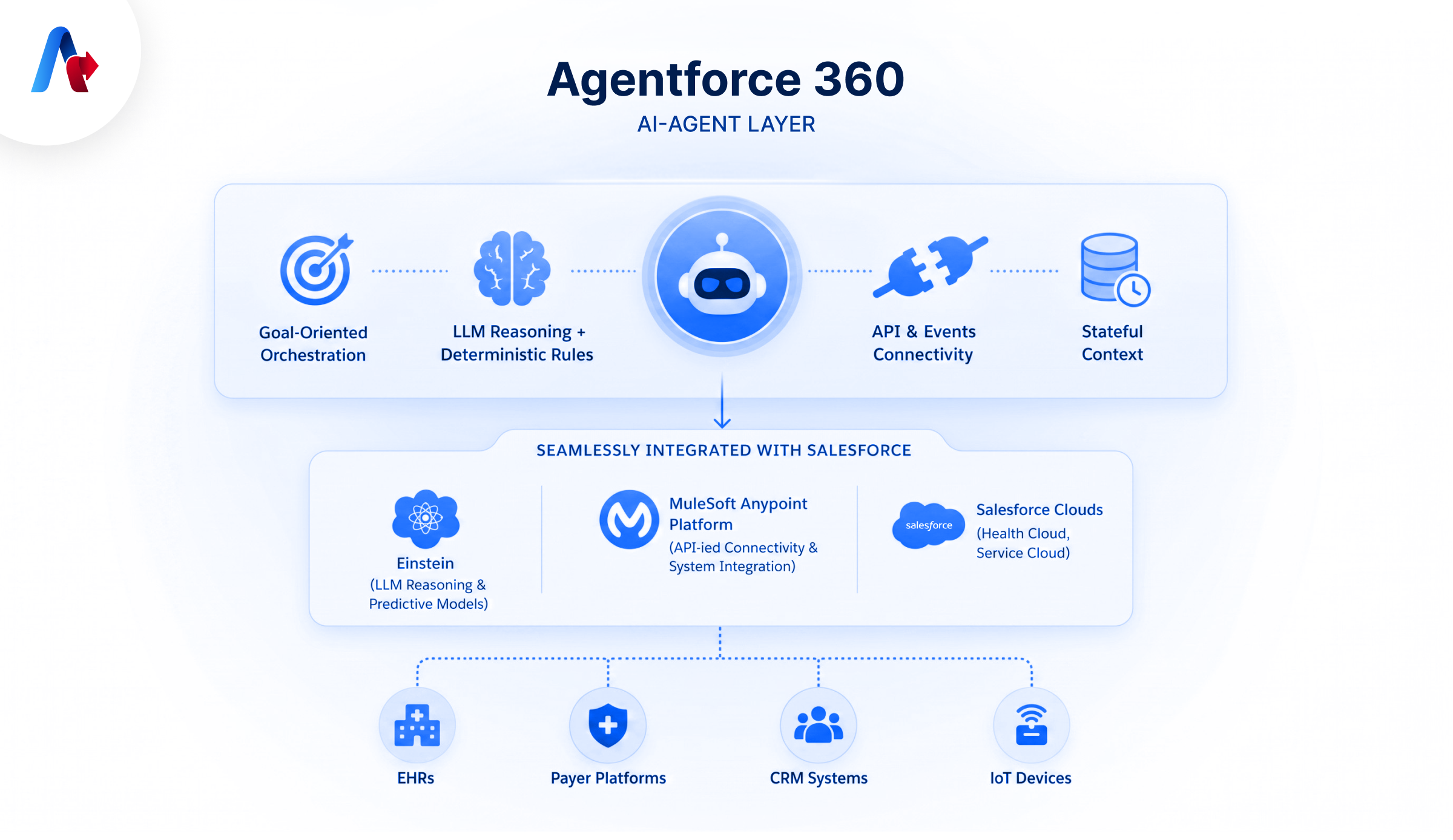
Agentforce 360 is an AI‑agent layer that sits on top of the Salesforce ecosystem. It adds intelligence and automation to otherwise static workflows, enabling organizations to move from manual coordination to goal‑driven, AI‑orchestrated operations.
At a technical level, Agentforce 360:
- Executes workflows that are goal-oriented, instead of operating as individual transactions, by using agentic orchestration
- Uses LLM reasoning to comprehend intent and suggest next best actions, plus deterministic rules for safety critical decisions.
- Connects with API and events to integrate EHRs, payer platforms, CRM systems, and IoT devices.
- Preserves a stateful context across interactions to ensure that the context of a conversation or workflow is coherent over time.
Agentforce 360 is seamlessly integrated with core Salesforce capabilities including:
- Salesforce Einstein (for LLM‑based reasoning and predictive models)
- MuleSoft Anypoint Platform (for API‑led connectivity and system integration)
- Salesforce Clouds such as Health Cloud and Service Cloud (for patient and service management)
Still Managing Healthcare Workflows Across Disconnected Systems?
Explore Agentforce 360 SolutionsContext & Problem Statement
The Healthcare and Life Sciences (HLS) ecosystem is highly fragmented. Critical patient and operational data live across multiple systems that were not designed to work together out of the box. For example:
- Electronic Health Record (EHR)/ Electronic Medical Record (EMR) systems such as Epic, Cerner
- CRM platforms managing patient engagement and provider relationships
- Payer systems handling claims and prior authorizations
- Labs, devices, and real-time monitoring feeds for clinical data
This results in:
- Fragmented data models that are hard to build a single view of the patient/ provider
- The delay in the decision to enter care, due to the need for information to be manually collected from different sources by clinicians and care teams, and
- A lot of working with systems that require coordination and have a high overhead for operation.
- Complex compliance requirements specifically privacy, consent, and auditability
Goal: With Agentforce 360, build a 360-degree patient/provider view with AI-powered orchestration and HIPAA-compliant security and auditing.
Core Architecture of Agentforce 360 for Healthcare
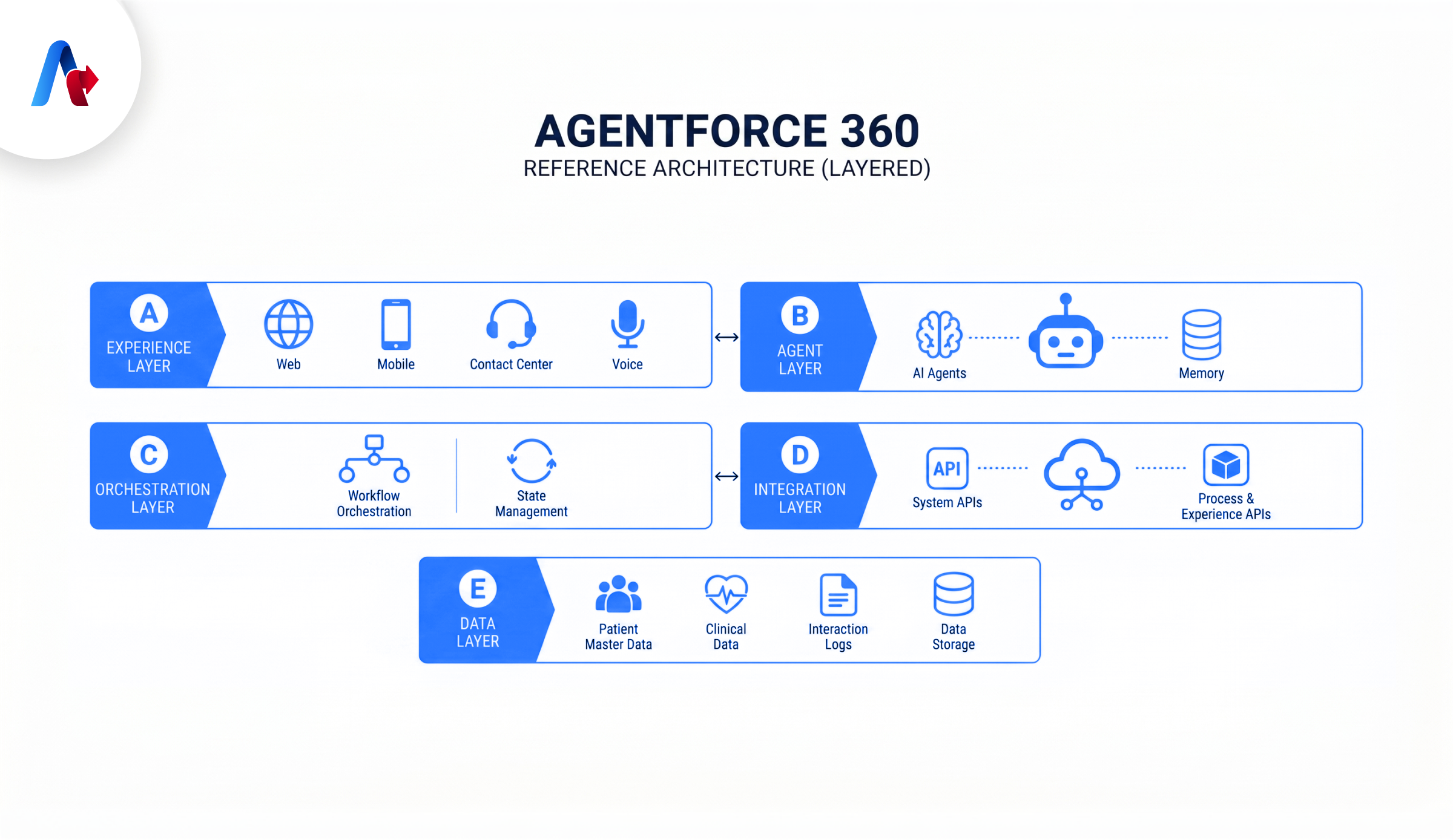
Agentforce 360 can be understood in terms of layers in an HLS environment. These layers serve specific functions each in giving smart, secure and scalable healthcare experiences.
A. Experience Layer
The Experience Layer is the part with which patients, providers, and care teams interface with the system.
- Channels: Web, Mobile, Contact Center, Voice
- Interfaces: Patient portal, provider console, care dashboards
- Protocols: HTTPS/REST, WebSockets (real-time updates)
B. Agent Layer (Core of Agentforce)
This is the layer where the AI agents understand intent, consider context and choose which workflow or API to trigger in response.
- AI Agents (task-specific or domain-specific)
- Use prompt templates and grounding (patient data, clinical context)
- Memory:
- Short-term: session context during a single interaction
- Long-term: complete patient timeline, historical interactions
Responsibilities of the Agent Layer include:
- Intent detection of the unstructured inputs (chat, voice or email).
- Decisioning using a hybrid of LLM reasoning and deterministic rules.
- Right-time workflow triggering- The agent layer has to invoke the appropriate workflows and integrations at the right time.
C. Orchestration Layer
To coordinate complex processes with multiple steps across systems and services, the orchestration layer plays a key role.
- Flow orchestration is implemented using tools such as Salesforce Flow or external orchestration engines.
- State management ensures that long‑running workflows can be paused, resumed, and retried without losing context.
- Retry, compensation, and fallback logic help the system handle failures gracefully.
Common patterns used in this layer include:
- Saga Pattern (for multi-step healthcare workflows)
- Event-driven orchestration (async processing)
D. Integration Layer
The Integration Layer will be based on MuleSoft Anypoint Platform, which enables API-led connectivity throughout the HLS ecosystem.
API-Led Connectivity:
1. System APIs that wrap legacy interfaces and normalize interactions with:
- EHR systems (using FHIR/HL7)
- Claims systems
- Lab systems
2. Process APIs that can be used to create higher-level business capabilities from system APIs, including:
- Patient 360 aggregation
- Care plan orchestration
- Prior authorization workflows
3. Experience APIs
- Optimizes responses for specific channels (mobile/web/agent UI)
Protocols & Standards supported:
- REST / SOAP
- HL7 v2
- FHIR (R4/R5)
- gRPC (optional for internal high-perf calls)
E. Data Layer
The Data Layer contains the master data of patients, clinical information and interactions with the system.
Key components include:
- A single source of truth for identity and demographics: patient master data (MDM).
- Data obtained from clinical resources including observations and encounters
- Interactions logs that can be used for agent decisions and audit trail.
Storage considerations:
- Structured (RDBMS)
- Semi-structured (FHIR JSON)
- Streaming (Kafka/Event Bus)
Build a Scalable Agentforce 360 Architecture
Schedule a Technical ConsultationKey AI Capabilities in Salesforce Agentforce 360
AI-Driven Decisioning (Hybrid Model)
Agentforce cannot solely rely on LLM. It uses:
- LLM reasoning (via Einstein)
- Deterministic rules (compliance, eligibility)
- Contextual grounding (patient data)
Example Flow:
1. Patient asks: “May I reschedule my appointment?”
2. Agent:
- Extracts intent
- Retrieves appointments from the API
- Applies rules (policy, eligibility)
- Suggests slots
- Executes booking
This flow illustrates how Agentforce 360 can handle high volume, routine interactions while still following business rules and compliance requirements.
API Orchestration (MuleSoft)
MuleSoft is one of the main components for orchestrating interactions between backend systems.
Example: Patient 360 Aggregation
                    <flow name="patient-360-process">
                        <http:listener path="/patient/{id}" />
                        <flow-ref name="ehr-system-api" />
                        <flow-ref name="claims-system-api" />
                        <flow-ref name="lab-system-api" />
                        <ee:transform>
                            <!-- Merge into unified patient model -->
                        </ee:transform>
                    </flow>
Agentforce uses this consolidated API as data for decision-making.
Event-Driven Architecture
A steady stream of events is generated in healthcare environments, which can trigger intelligent workflows. Typical healthcare events include:
- Admission/Discharge (ADT)
- Lab results available
- Device alerts (IoT)
Flow:
- An event is published to an event bus such as Kafka or Amazon EventBridge.
- MuleSoft consumes the event, validates it, and enriches it with context.
- Agentforce 360 is triggered to evaluate the event and decide the appropriate action.
- The agent may notify care teams, escalate critical issues, or update care plans.
State Management
Healthcare workflows are often long‑running and distributed across multiple systems. State management is therefore critical to ensure that care journeys remain coherent and trackable.
Approaches:
- External state store (Redis / DB)
- Salesforce objects (cases, tasks)
- Correlation IDs for tracking
These techniques help teams debug complex workflows and reassure compliance and audit teams that no step in the patient journey is lost.
Error Handling & Resilience
Healthcare systems must be resilient. Even when downstream systems fail or respond slowly, the overall experience should remain as reliable as possible.
Common patterns used in Agentforce 360 include:
- Retry with exponential backoff
- Circuit breaker (for unstable downstream systems)
- Dead-letter queues
Example:
- If EHR API fails → fallback to cached data
- If critical → escalate to human agent
This kind of resilience is essential in safety‑critical environments such as hospitals and clinics.
Security & Compliance (Deep Dive)
Security and compliance are non‑negotiable in healthcare and life sciences. Agentforce 360 is designed with these principles built into the architecture.
A. Data Protection
- Encryption at rest (AES-256)
- Encryption in transit (TLS 1.2+)
B. Access Control
- OAuth 2.0 / JWT
- Role-Based Access Control (RBAC)
- Attribute-Based Access (ABAC for fine-grained policies)
C. Audit & Traceability
- Every AI decision logged
- Trace IDs across systems
- Immutable audit logs
D. Healthcare Standards
- HIPAA (US)
- GDPR (EU)
- HL7/FHIR compliance
Real-World Healthcare Use Cases of Agentforce 360
Prior Authorization Automation
Prior authorization is a classic example of a complex, rule‑driven, multi‑system workflow.
- Agent collects required clinical and patient data
- Calls payer APIs to retrieve eligibility and rules
- Applies business rules to determine required documentation
- Submits the authorization request
- Tracks status asynchronously and notifies care team
The prior authorization automation significantly shortens cycle times, cuts out manual effort, and improves the experience for both providers and patients.
Clinical Trial Matching
- Analyze patient data against eligibility criteria
- Match against active trial criteria in the database
- Notify relevant providers and patients of matches
- This capability can accelerate recruitment and improve patient access to cutting-edge therapies.
Remote Patient Monitoring
- In remote patient monitoring, IoT devices stream continuous data from patients in their homes or care settings.
- IoT device streams biometric data continuously
- Event triggers agent evaluation on threshold breach
- AI detects anomalies using baseline and trend analysis
- Alerts care team with context and recommended action
Ready to Automate Prior Authorization and Care Workflows?
Explore Healthcare Automation SolutionsPerformance & Scalability
Key Considerations:
- Horizontal scaling (CloudHub workers / Kubernetes)
- Async processing (queues, streaming)
- Caching (patient data, reference data)
- Rate limiting & back pressure handling
Under Performance and Scalability, Agentforce 360 with these patterns can definitely handle peak volumes. For example, mass vaccination campaigns or large-scale clinical trials without degrading the quality of the service.
Implementation Best Practices
For real implementation impact of Agentforce 360 in healthcare and life sciences, teams should follow certain best practices:
Use API-Led Architecture
Decouple systems for flexibility and reuse. System, Process, and Experience API layers in MuleSoft are not just a pattern — they are the mechanism by which HLS organizations can swap out EHR vendors, add payer connections, or onboard new devices without rebuilding the entire integration surface.
Combine AI + Rules
Purely relying on LLMs is not the right direction in healthcare. Deterministic rule engines provide the guardrails that LLMs need in clinical workflows where accuracy and auditability are non-negotiable. The hybrid model is the safety net.
Design for Observability
Centralized logging across all agent decisions and API calls
Metrics tracking: latency, error rate, retry counts, and LLM token usage
Distributed tracing with correlation IDs that span MuleSoft, Salesforce, and external systems
Build for Failure
Healthcare systems need to be robust and resilient to failure. Any downstream dependency — an EHR API, a payer portal, a lab system — can and will fail. Design fallback paths, not just happy paths.
Start with High-Impact, Low-Risk Workflows
Organizations new to Agentforce 360 in HLS should begin with workflows that are high in volume, low in clinical risk, and well-defined in their rules — appointment scheduling, benefits verification, and intake questionnaire automation are good starting points before moving to prior authorization or clinical trial matching.
Validate Consent and Data Lineage Early
HIPAA compliance is not just about encryption. Organizations need to think carefully about consent management — which data can be used by which agents for which purposes — and build data lineage tracking into the architecture from day one, not as an afterthought.
How Does the Agentforce 360 Platform Work? (Step-by-Step)
Understanding how Agentforce 360 works in practice requires looking at the lifecycle of a single request from a patient or clinician:
Step 1: Input Received
A clinician uses the provider console to ask a question, or a patient uses the patient portal to send a message. Natural language text, speech, or even a structured form entry are examples of unstructured input.
Step 2: Intent Detection
The input is processed by the Agent Layer. The natural language is parsed using Einstein LLM models, which then extract the intent (such as "reschedule appointment," "check prior auth status," or "view recent labs") and locate the pertinent items (patient ID, appointment date, drug name).
Step 3: Context Enrichment
The agent retrieves pertinent information from the Data Layer, including recent encounters, eligibility status, current care plan, and patient history. The agent can refer to earlier portions of the chat thanks to short-term session memory. The patient's whole medical history is retrieved from long-term memory.
Step 4: Decisioning
The agent uses a hybrid decision model, which combines deterministic rules for compliance checks with LLM reasoning for nuanced judgment. For instance, a prior authorization agent would employ LLM reasoning to create the narrative rationale and rules to identify which clinical criteria must be fulfilled.
Step 5: Orchestration
The multi-step workflow is coordinated by the Orchestration Layer. MuleSoft API calls are sent to the appropriate backend systems, such as the lab system for results, the payer system for eligibility, and the EHR for clinical data. The saga design makes sure that compensatory measures are initiated in the event that any phase fails.
Step 6: Action & Response
After completing the action scheduling the appointment, submitting the PA request, notifying the care team, and revising the care plan—the agent responds to the original channel. Each action is recorded in the unchangeable audit trail.
Step 7: Continuous Learning
Over time, interaction records improve the accuracy of intent detection, next-best-action suggestions, and anomaly detection thresholds for remote monitoring scenarios by feeding back into Einstein's predictive models.
Common Challenges in Agentforce 360 Implementation
In spite of strong architecture and tooling, there are certain challenges which remain:
- Due to variations in FHIR implementations and legacy HL7 formats, there are data interoperability issues arising.
- There are a few legacy system constraints that limit the speed and scope of the integration.
- Automated AI decisions require explainability regarding the clear reasoning on which those decisions are being made.
- Regulatory approvals that may require additional documentation, validation, or review cycles.
These challenges are inherent in modern healthcare digital transformation. However, a well-designed architecture can certainly reduce the impact of these challenges in the workflows.
What Are the Benefits of the Agentforce 360 Platform in HLS?
The benefits of deploying Agentforce 360 in a healthcare or life sciences context span operational, clinical, and strategic dimensions:
| Benefit Area | Specific Impact |
|---|---|
| Unified Patient View | Aggregates EHR, claims, lab, and device data into a single coherent record accessible to agents and care teams |
| Reduced Care Delays | AI agents proactively gather information, reducing the manual data collection burden on clinicians before care decisions |
| Prior Authorization Speed | Automated submission and tracking cuts days-long PA cycles down to hours in many cases |
| Compliance by Design | HIPAA, GDPR, FHIR compliance is architecturally embedded, not bolted on after deployment |
| Scalability | Horizontal scaling and async processing allow the platform to handle peak volumes without degradation |
| Auditability | Every AI decision is logged with trace IDs, satisfying both compliance and clinical governance requirements |
| Staff Productivity | By automating routine interactions, care coordinators and admin teams are freed for higher-value work |
| Remote Monitoring | IoT integration and event-driven alerting enable proactive intervention before adverse events escalate |
Future of Agentforce 360 in Healthcare AI
In the future, there is a huge possibility that the combination of AI, APIs, and event-driven architecture can unlock unimaginable advanced capabilities in healthcare:
- Autonomous care orchestration, where multi‑step care journeys are managed end‑to‑end with minimal manual intervention.
- AI‑assisted diagnostics, where agents surface insights and recommendations to support clinicians.
- Real‑time digital twins of patients, enabling continuous modeling of health status and risk.
- Fully event‑driven ecosystems, where every change in a patient’s journey immediately triggers the appropriate downstream actions.
These capabilities are not speculative; they are an evolution of the patterns already emerging in Agentforce 360–based architectures.
Final Thoughts on Agentforce 360 for Healthcare
Agentforce 360 for Healthcare & Life Sciences is a combination of AI, APIs, and event‑driven architecture designed to deliver intelligent, scalable, and HIPAA‑compliant integrations across fragmented healthcare ecosystems. By orchestrating workflows, enriching decisions with contextual data, and embedding security and compliance into the core architecture, Agentforce 360 enables organizations to build a true 360‑degree view of patients and providers while maintaining the rigor expected in healthcare environments.
With Accelirate’s Agentforce Consulting Services, healthcare and life sciences organizations can accelerate adoption through expert-led architecture design, MuleSoft integration, AI orchestration, and enterprise automation strategies tailored for secure and scalable digital healthcare transformation.
Transform Healthcare Operations with Agentforce 360
Talk to an Agentforce ExpertFAQs
The Agentforce 360 Platform is the renamed and significantly upgraded version of the Salesforce Platform. The key difference is the addition of a native AI agent layer that can reason, orchestrate multi-step workflows, and take autonomous actions — rather than simply storing and displaying data. It also includes a unified metadata and governance framework (Data 360) and deeper integration with MuleSoft for API-led connectivity.
Agentforce 360 reached general availability on October 13, 2025, announced at Dreamforce 2025 in San Francisco. Salesforce described it as the culmination of a year of development across four major releases and thousands of enterprise customer deployments.
Agentforce 360 supports HIPAA compliance through AES-256 encryption at rest, TLS 1.2+ in transit, OAuth 2.0 and JWT access controls, role-based and attribute-based access policies, immutable audit logs with trace IDs across every AI decision and system interaction, and FHIR-compliant data models. Salesforce's Hyperforce infrastructure also supports region-specific data residency requirements.
Agentforce was the name for Salesforce's agentic AI capability introduced earlier. Agentforce 360 is the full platform — the complete enterprise system that includes Data 360, Customer 360, Slack, and the Agentforce agent infrastructure all unified under one governance and trust framework. Think of Agentforce as the agent capability, and Agentforce 360 as the entire platform it runs on.