



Quick Summary
With almost 79% companies reporting the use of AI agents in their core statistics, the Agentic AI statistics reveal a much bigger story than just adoption; it tells how fast enterprise AI is moving today. As the role of AI expands, almost 40% of organizations' applications are expected to include AI agents by 2026, which shows that many business decisions are expected to become autonomous very soon. Agentic AI has become a key driver of growth, efficiency, and operational change in organizations because of the increasing investments, productivity gains, and competitive advantage.
Artificial intelligence has been helping businesses work smarter for years by automating basic tasks and supporting decision-making. But in 2026, things are taking a step further with the rise of Agentic AI. Instead of just giving insights, these AI systems now plan, take action, and complete tasks on their own across the systems. And if you look at the latest agentic AI usage statistics, it’s clear this shift is happening fast.
Many companies are using Agentic AI like a digital co-worker to help teams look at data, manage workflows, answer customer questions, and even make decisions. These agents have become a core part of business operations as leaders today aim to move faster and grow efficiently
This isn’t just some trend; the shift can be seen already across industries. And to really understand the impact of this shift, it's important to look at the most important agentic AI statistics that will affect business use in 2026.
Key Agentic AI Statistics for 2026 (Quick Snapshot)
If you look at the latest agentic AI adoption statistics or AI agent market growth statistics, one thing becomes clear, this isn’t early-stage experimentation anymore. Enterprises are already scaling AI agents across real workflows, and the numbers show just how fast this shift is happening.
- 40% of enterprise applications are expected to include AI agents by 2026. In simple terms, AI agents are quickly becoming a built-in feature in business software
- 79% of companies report that AI agents are already being adopted within their organizations, indicating how companies are actively using them in real operations.
- 88% of executives plan to increase AI budgets because of agentic AI initiatives. Companies increase AI investments to scale automation and stay competitive.
- 66% of companies using AI agents have seen measurable productivity gains. The results have shown that the agents can make teams faster and more efficient.
- 15% of day-to-day business decisions could soon be made autonomously by AI agents. Businesses are starting to trust AI not just to assist, but to actually make routine decisions.
Understand what these AI trends mean for your business.
Call our expertsWhat Is Agentic AI? Understanding Autonomous AI Agents in Enterprises
Agentic AI refers to systems that can plan, act, and execute tasks on their own to achieve specific business goals. These agents are more goal-oriented than traditional AI systems. This shift is already visible in recent agentic AI adoption statistics, which show how quickly enterprises are starting to rely on AI agents for real operational tasks.
The AI agents act like digital workers. These agents can analyze data, update records, coordinate workflows, and respond to customer requests across systems like CRMs and ERPs. Companies are now increasingly using these agents to automate multi-step processes which required manual efforts
The key feature is agentic orchestration that lets multiple AI agents work together to handle entire workflows across teams that help organizations move closer to more autonomous operations.
Global Agentic AI Market Growth Statistics (2024–2030)
As agentic AI starts to take shape inside enterprise systems, growth becomes the key question. The latest AI agent market growth statistics reveal how quickly organizations are embedding AI agents into their core operations.
- Software Integration Surge: Almost 33% of software applications are expected to include agentic AI by 2028 which indicates how these agents have become a common feature in enterprise software.
- Enterprise App Expansion: 40% of enterprise applications will contain task-specific AI agents by 2026. In other words, AI agents are becoming a built-in layer across the tools businesses already use.
- Autonomous Decisions Rising: Around 15% of the decisions are expected to be made automatically by AI agents. This indicates that these agents not just support the decision-making process but now also one
- Massive AI Spending: Global spending on AI is estimated to be approximately $1.3 trillion by 2029, that means companies are investing heavily in AI-driven automation to stay competitive.
- Enterprise AI Adoption Base: 88% of enterprises already report regular use of AI. This widespread adoption helps companies to move faster into more advanced AI agent use cases.
Agentic AI Adoption Statistics 2026: Enterprise Implementation Trends
Here’s what the latest agentic AI adoption statistics show about how enterprises are actually implementing AI agents today:
- Production Deployments: 79% of companies report that AI agents are already being adopted within their organizations and are using them in real business scenarios.
- Budget Expansion: Currently, 88 percent of executives say that they are planning to increase budgets for AI due to agentic AI so that they can increase their use of AI agents.
- Productivity Gains: Around 66% of organizations using AI agents have been able to improve productivity by automating repetitive tasks.
- Cost Efficiency: Almost 57 percent of companies are able to save a significant amount due to the use of AI agents, which is helping them to cut down on costs.
- Faster Decisions: 55% of organizations achieved faster decision-making after adopting AI agents, as AI handles data analysis
- Customer Improvements: 54% of companies say AI agents are improving customer experience cause of faster responses and automated workflows
AI Agent Adoption Statistics by Industry

Let's look at agentic AI usage statistics and trends for different industries:
Healthcare
Healthcare is quickly becoming one of the leading adopters of AI. Around 71% of non-federal acute care hospitals already use predictive AI in their systems. Practically speaking this means AI agents are helping with clinical documentation, diagnostics, and patient monitoring, while also reducing administrative workload.
Financial Services
Banks and financial institutions are moving fast when it comes to AI adoption. About 70% of financial services executives expect AI to drive revenue growth. The agents are being used to detect fraud, improve customer service, and automate risk analysis across operations.
Retail and E-commerce
Retailers are using AI agents to improve both customer experience and operations. Some real implementations have shown measurable impact, including a 9.7% increase in sales calls. From handling customer queries to recommending products and forecasting demand, the agents are increasingly being integrated into everyday retail operations.
Manufacturing
Today, manufacturing companies are also improving efficiency in their operations, and automation is one way to achieve this. In fact, around 89% of executives plan to integrate AI in manufacturing, and 69% have already begun to do so. It will help to improve overall organizational performance by optimizing production and predicting equipment failures
Supply Chain and Logistics
Supply chain teams are also benefiting from AI agents. About 62% of leaders have seen AI agents help speed up decision-making and operations. These agents are being used to optimize inventory, improve forecasting, and manage complex supply networks more efficiently.
See how leading companies achieve ROI with AI agents
Book a demoROI and Productivity Statistics from Agentic AI Deployments
As organizations begin integrating AI agents across real workflows, it becomes clear that agentic AI statistics are now tied to real business outcomes:
1. Productivity Boost
Organizations have seen 34% increase in productivity for low-skilled workers using AI tools, helping them get more done in less time.
2. Budget Expansion
Around 8% of executives plan to increase AI budgets and aim to scale it across the organization due to agentic AI initiatives.
3. Competitive Pressure
Many executives worry about falling behind competitors in adopting AI agents, which pushes them to make faster and bigger AI investments.
4. Agent Scaling Plans
50% of enterprises using generative AI are expected to deploy autonomous AI agents across the organization workflows by 2027
5. Strategic Priority
CIOs consider agent-based AI a strategic priority and are seen as a core part of enterprise technology strategy.
6. Autonomous Agent Roadmaps
93% of IT leaders plan to introduce autonomous AI agents within the next two years showing how many organizations have clear plans to invest in AI agents soon.
7. Enterprise Transformation Focus
More than 80% of organizations believe AI agents will redefine enterprise applications making companies rethink how they invest in software with AI at the center.
AI Agent Market Growth Statistics: Funding, Valuation, and Vendor Expansion
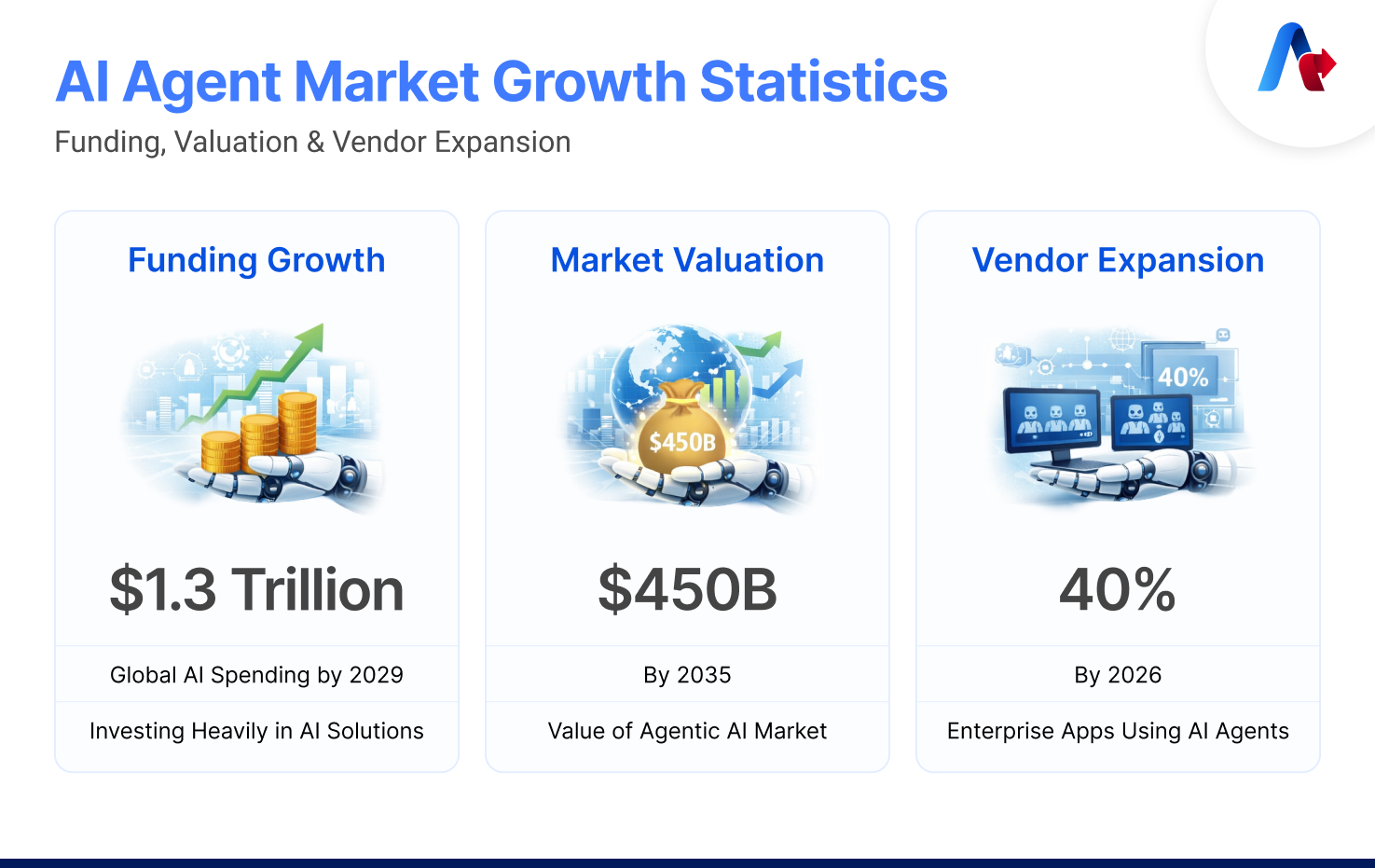
Funding Growth
Investment in AI is growing very fast as companies build systems powered by AI agents. The AI agent market growth statistics reveals that global AI spending could reach $1.3 trillion by 2029, which means businesses are putting serious money into AI to automate work and improve decision-making.
Market Valuation
The total value of agentic AI is expected to grow significantly in the coming years. The Agentic AI usage statistics indicates it could generate over $450 billion by 2035, showing how important AI agents are becoming in enterprise software.
Vendor Expansion
The AI agent adoption statistics show that around 40% of enterprise applications could include these agents by 2026, as many companies are now adding AI agents directly into their products. It makes them a core part of modern business tools.
Top Drivers Behind the Rapid Adoption of Agentic AI
Based on agentic AI adoption statistics 2026 here are some key factors that are increasing the implementation of AI agents across workflows and operations.
- Rising Automation Demand - Businesses now want to automate repetitive and data-heavy tasks to avoid manual errors
- Productivity Pressures - Teams are automating repetitive tasks, which lets them focus on high-value cases
- Operational Cost Reduction - AI helps to lower costs by reducing additional headcount and manual errors
- Real-Time Decision Support - AI agents help organizations make faster and more informed decisions.
- Competitive Advantage Pressure - Businesses are using AI agents and following automation trends to stay ahead of competitors
Turn these AI drivers into real business impact.
Book a demoThe Future of Autonomous AI Agents in Enterprise Operations
Agentic AI statistics indicate how AI agents are impacting businesses by improving productivity, reducing costs, and speeding up decisions. These numbers help organizations understand automation trends and make investment decision. As these statistics continue to evolve, they will help companies make smarter decisions and stay competitive in an AI-driven world
Want to turn these agentic AI statistics into real workflow automation and measurable results?
Start building with AccelirateFAQs
About 79% of businesses are already using AI agents in their daily operations in different areas of the business.
Healthcare, finance, retail, and manufacturing are leading the way in using AI agents across key business processes.
Organizations mostly use Agentic AI to automate tasks, assist customers, and analyze data, which reduces human efforts
It is predicted that by 2035, AI could generate over $450 billion in enterprise software revenue