



Quick Summary
Enterprise orchestration is the strategic, cross-system coordination layer that connects people, processes, data and applications, so end-to-end business outcomes happen reliably and at a scale. In today’s AI era, orchestration must evolve from fixed, rules-based flows into agentic enterprise orchestration — platforms that coordinate goal-driven AI agents, humans and traditional automation. Modern enterprise orchestration platforms and tools deliver connectivity, governance, observability and intelligence organizations need to move generative AI and autonomous agents from isolated pilots to measurable business value.
Companies run on flows: invoices that must be matched and paid, customers who must be onboarded, incidents that must be resolved, payroll that must close on time.
Over the last decade those flows have been automated piecemeal — a bot here, an API there, a spreadsheet glued to a human task. That approach produces brittle point solutions, manual handoffs, and poor visibility.
Enterprise orchestration is the conductor above those instruments: it models end-to-end processes, routes work, synchronises data, enforces governance and measures outcomes. As organizations invest in generative AI and autonomous agents, orchestration shifts from “execute tasks” to “achieve goals.” Agentic enterprise orchestration makes that shift possible by providing the platform where AI agents, human roles, legacy systems and cloud services coordinate, learn and act together.
What is Enterprise Orchestration?
Enterprise orchestration is the coordinated management of people, systems, data, and workflows across an organisation to ensure end-to-end execution of business processes with visibility, governance and responsiveness.
At its heart, enterprise orchestration connects disparate systems (e.g., ERP, CRM, legacy apps, cloud services), human tasks (approvals, exceptions, decision-points), data flows (handoffs, transformation, monitoring), event-triggers (changes in state, new data, external input), and rules-/policy-engines (governance, compliance). Where automation previously focused on discrete tasks (e.g., extract invoice, send email), enterprise orchestration is about processes — sequences of tasks and system-interactions that fulfil a business goal (e.g., “supplier invoice processed end-to-end”, “new hire onboarded fully”, “IT incident resolved within SLA”).
Enterprise process orchestration (often used interchangeably) emphasises the process-centric viewpoint: workflows that cross silos, integrate systems, and span human-machine interactions. The term “enterprise orchestration platform” denotes the software infrastructure that provides connectors, workflow engines, monitoring dashboards, event-handling, and often low-code/no‐code interfaces. “Enterprise orchestration tools” refer to the modules, connectors, templates and agents used to build and execute orchestration flows.
Thus:
- Automation = individual tasks
- Orchestration = full process coordination
- Agentic enterprise orchestration = orchestration augmented with autonomous agents that can reason, decide and act.
This distinction matters because many organisations invest in automation but struggle to bridge the gap to scaled outcomes. Orchestration is the missing layer that connects capability to value.
Why Enterprise Orchestration is Crucial Today
Complexity and silos
Enterprises now have hybrid cloud infrastructures, SaaS applications, legacy on-prem systems, external data sources, APIs, business units operating globally and AI experimentation running in parallel. Without orchestration, these become disconnected islands, leading to delays, manual hand-offs, duplication, and risk. A recent study found that 83 % of organisations consider tasks to orchestrate across diverse endpoints.
Business speed & change
Business conditions change rapidly — new regulations, shifts in supply chains, evolving customer expectations. Traditional static automations cannot adapt quickly. A Gartner report states that by 2026, 30 % of enterprises will automate more than half of their network activities (vs under 10 % in mid-2023), highlighting urgency in operational agility.
AI & autonomous agents
Generative AI and autonomous agent technologies are moving from pilot to enterprise-focus. But without orchestration, they remain isolated pockets of innovation. A survey found 95 % of IT leaders cite data-integration issues as primary barrier to AI adoption.
Research shows that while many organisations have adopted automation/AI, few have scaled it. A global automation report found 88 % of enterprises plan to grow their investment in automation and orchestration. Meanwhile, the process orchestration market study observed that only ~15 % of Fortune-500 firms had deployed AI-enabled process orchestration modules in 2023.
In sum: enterprise orchestration matters because it addresses complexity, enables agility, supports agentic automation, and provides the governance and scale layer that automation alone cannot.
The Role of AI and Autonomous Agents in Enterprise Orchestration
From static workflows to autonomous coordination
In the traditional automation model, workflows are rigid, rule-based and built to handle known paths. But many modern business processes involve exceptions, variable data, human decisions and non-deterministic outcomes. Autonomous agents — software entities capable of planning, decision-making or learning — change the paradigm. They can reason, summon services, collaborate and escalate when needed.
When these agents are introduced into enterprise processes, you need orchestration to:
- Coordinate multiple agents operating across systems (agents don’t run in isolation).
- Manage context and data flow between agents and systems to ensure consistent state.
- Govern agent behaviour (audit, security, traceability, exception handling) so agents are reliable and trusted.
- Integrate human-agent-machine workflows, routing tasks between humans and agents dynamically.
Hence, the concept of agentic enterprise orchestration: orchestration that explicitly supports intelligent agents as first-class components in process flows.
Why agents elevate orchestration
- Agents can handle ambiguity, exceptions and tasks beyond deterministic automation — enabling orchestration of more complex workflows.
- With orchestration, you avoid “agent islands” (agents doing one thing in a silo) and instead embed agents into enterprise-wide flows, driving measurable business outcomes.
- Orchestration platforms provide the monitoring, dashboards, governance, versioning and scalability that agents require to move from lab to production.
What this looks like
Imagine a customer-onboarding process: An AI agent handles document verification, another handles fraud check, yet another updates CRM and triggers provisioning. The orchestration layer sequences these activities, monitors each agent, triggers human review if anomalies, integrates with approval systems, logs the process and measures key metrics (time to onboard, costs, exceptions). Without orchestration, those agents may run, but you won’t achieve orchestration of the process, visibility, scaling, or governance.
Key stats around agentic automation & orchestration
- One study reports organisations implementing agentic orchestration achieving cost reductions up to 60 % while maintaining superior business performance.
- The process orchestration market report shows that AI-powered orchestration modules were installed in approx. 15 % of firms in 2023.
Because of this, enterprise orchestration is no longer just “nice to have” – it’s the bridge between AI/agent pilots and business-wide impact.
Ready to scale your automation efforts and realize true business value?
Let's connect and define your next stepsTop Benefits of Modern Enterprise Orchestration
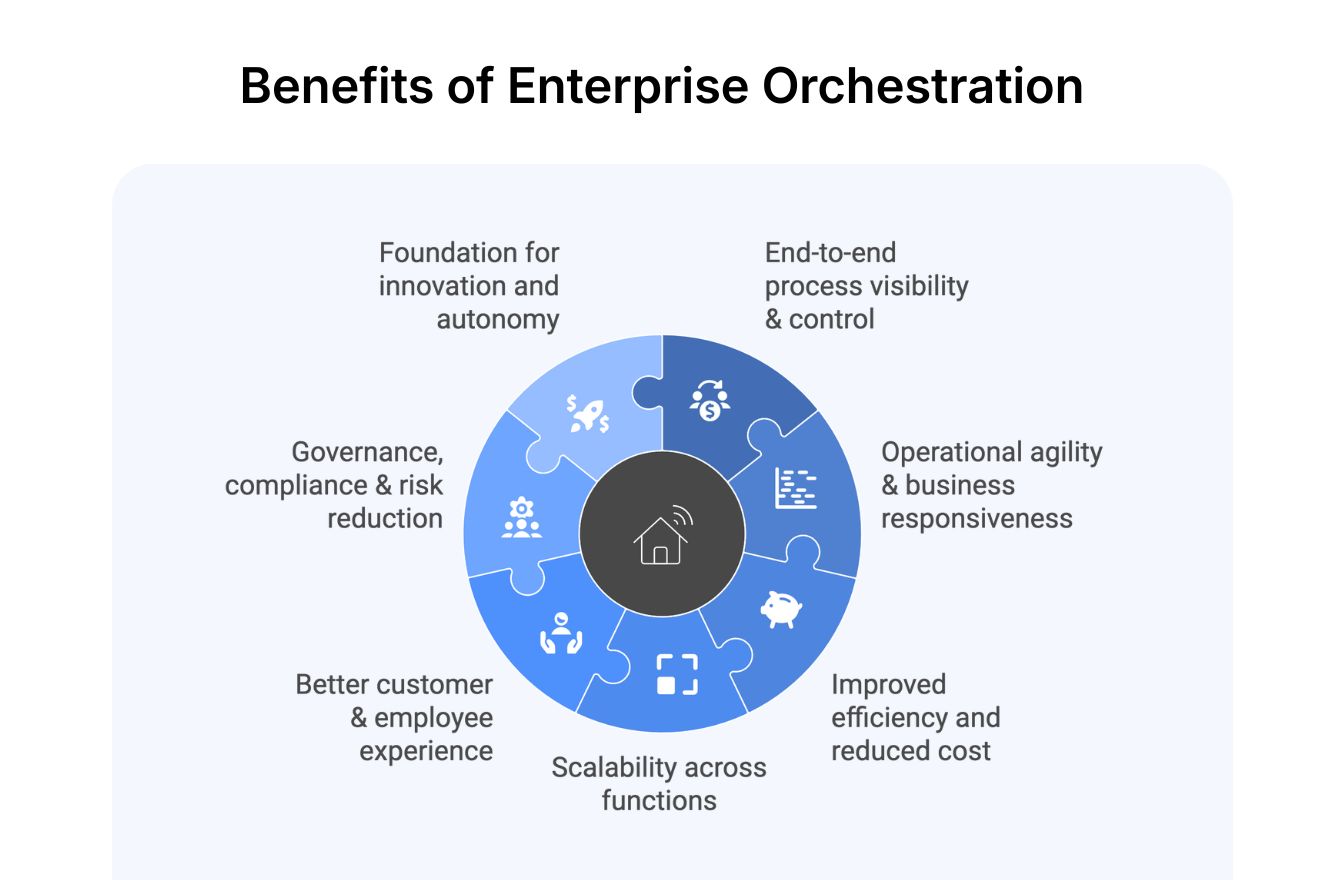
Here are major benefits organisations realise when deploying modern enterprise orchestration (especially in combination with agentic capabilities):
- End-to-end process visibility & control Orchestration platforms give a single pane of glass over workflows, tasks, exceptions, SLA breaches, metrics. This helps governance, process improvement, root-cause analysis.
- Operational agility & business responsiveness With orchestrated workflows and agentic components, enterprises can modify processes quicker, respond to disruptions, scale operations faster. Some organisations report 75 % faster adaptation to market changes.
- Improved efficiency and reduced cost By automating handoffs, reducing manual interventions, managing exceptions via agents and workflows, organisations cut costs. E.g., cost reduction up to 30 % reported in agent-enabled orchestration.
- Scalability across functions Once an orchestration layer and platform is established, it can be extended across HR, finance, IT, supply chain, customer operations — driving reuse, standardisation, economies of scale.
- Better customer & employee experience Orchestrated flows lead to fewer delays, fewer errors, more consistent outcomes. Employees spend less time on repetitive tasks and more on value-add work; customers receive faster, smoother service.
- Governance, compliance & risk reduction With orchestration you embed audit trails, role-based access, policy enforcement, exception routing and monitoring — all vital when workflows involve sensitive data or regulatory compliance.
- Foundation for innovation and autonomy A proper orchestration fabric allows organisations to move beyond incremental automation to autonomous operations. It creates the environment where agentic enterprise orchestration can flourish.
In short: orchestration turns workflow improvement into business transformation.
How Agentic Orchestration Works in Real Enterprise Environments
Architecture overview
A typical implementation of agentic enterprise orchestration comprises several layers:
- Integration / Connectivity layer: Connectors, APIs, adapters to SaaS apps, on-prem systems, data warehouses, event streams.
- Process / Workflow Engine: Models the business process (steps, dependencies, SLAs, human/agent tasks).
- Orchestration Layer: The coordination fabric — sequences tasks, orchestrates agents and systems, handles events and exceptions, provides monitoring, analytics and governance.
- Agent Layer: Autonomous or semi-autonomous agents (AI-powered) performing complex tasks — e.g., document verification, decision engines, predictive routing.
- Governance & Observability Layer: Audit logs, dashboards, exceptions, metric tracking, compliance enforcement.
- Data / Analytics Layer: Provides feedback loops, process mining, performance insights, optimisation.
Typical flow example
Consider an organisation’s “supplier invoice to payment” process:
- Invoice arrives, is digitised, extracted via an agent.
- Orchestration layer triggers validation against PO, receipt – if mismatch; an exception task is created for human review.
- Agent analyses historical supplier performance, flags risk, routes to risk-agent for additional checks.
- Once approved, orchestration triggers payment via ERP, updates vendor record, sends notification, logs everything.
- Data from this process is fed back into analytics engine; orchestration triggers improvement workflows (e.g., supplier negotiation initiative) coordinated by another agent.
Real-world pointers
- Many organisations begin with standalone bots/agents but run into scaling issues because they lack an orchestration fabric.
- The orchestration layer often becomes the hub for reuse of automations, agents, connectors and policies.
- Monitoring must cover not only tasks but agent performance, decision logs, SLA adherence and business KPIs.
- The shift from deterministic to adaptive workflows requires organisations to rethink exception handling, human-in-the-loop design and governance.
Business value gained
Organisations that combine agentic capabilities with orchestration report significant gains. For example, one source notes organisations implementing agentic orchestration achieved up to 60 % reduction in operational cost while maintaining high performance.
Another example: process orchestration market data shows that software solutions formed ~70 % of deployments by 2024, indicating strong momentum for enterprise orchestration platforms.
Enterprise Orchestration Examples & Use Cases
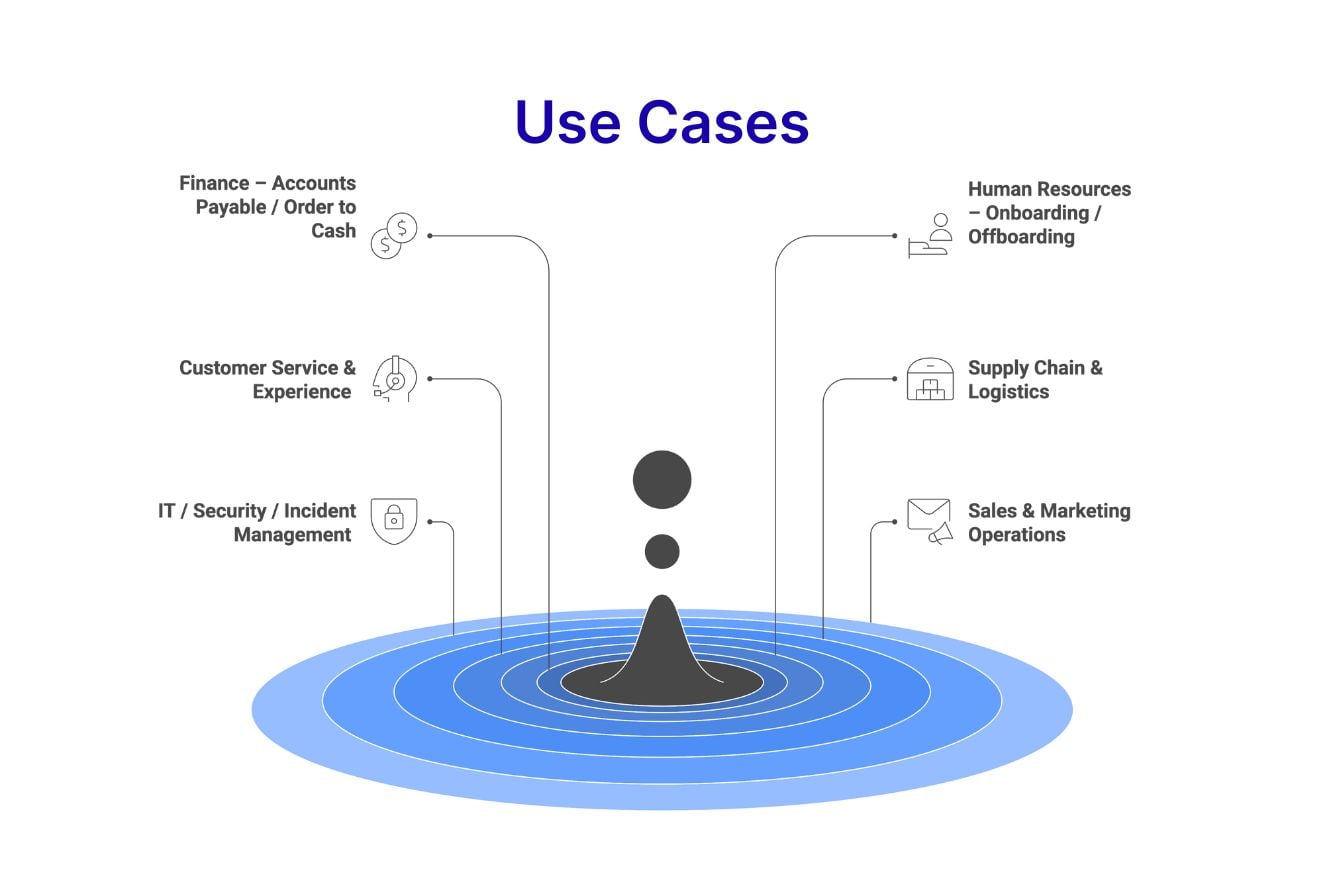
Below are practical use-cases where enterprise orchestration (and increasingly, agentic orchestration) drives value.
- Finance – Accounts Payable / Order to Cash Orchestrate invoicing, PO matching, exception handling, payment execution, supplier onboarding, reporting. Agentic orchestration can handle anomalies, fraud detection, dynamic routing and predictive payment optimisation.
- Human Resources – Onboarding / Offboarding Orchestration coordinates HRIS, IT provisioning, facilities, training, compliance checks, payroll setup. Agentic orchestration improves by monitoring progress, nudging stakeholders, handling exceptions autonomously, and closing loops.
- Customer Service & Experience Multi-channel intake (chat/email/phone) → triage → assignment → resolution → feedback. Orchestration connects CRM, knowledge base, service desk, analytics. Agents personalise responses, escalate complex cases, trigger workflows autonomously.
- Supply Chain & Logistics Orchestrate orders, inventory checks, supplier communications, shipment tracking, returns. Agentic orchestration can monitor external data (weather, shipments, port delays), adjust routing, trigger alternate suppliers and keep stakeholders informed.
- IT / Security / Incident Management Orchestration manages alerts, ticketing, remediation bots, human review, reporting. Agentic orchestration brings self-healing, predictive incident resolution, routing decisions and continuous optimisation.
- Sales & Marketing Operations Lead capture → enrichment → scoring → handover → renewal. Orchestration links marketing automation, CRM, analytics, contract systems. Agents can auto-prioritise leads, identify cross-sell opportunities, personalise outreach and trigger workflows.
Each of these use-cases shows: the cross-system, cross-actor nature of processes (humans, systems, agents) and thus the necessity for enterprise orchestration.
Read More: Agentic Orchestration Use Cases
Challenges in Implementing Enterprise Orchestration
Introducing enterprise orchestration (especially agentic) is powerful—but not without challenges. Key obstacles include:
Legacy systems & integration complexity
Many enterprises run legacy on-prem systems with limited APIs, custom interfaces or manual processes. Orchestrating across such environments is difficult, time-consuming and risky. One market report found integration issues with legacy systems delayed 40 % of process-orchestration deployments.
Data quality, context and observability
Agents and orchestration rely on accurate real-time data, consistent state, and good context. A survey showed that 95 % of IT leaders cite integration/data challenges as primary barrier to AI deployment. Integrate.io+1
Governance, auditability & risk
When you embed autonomous agents and end-to-end orchestration, risk exposure increases: decisions made by agents, automated handoffs, fewer human checkpoints. Governance frameworks, audit trails, role-based controls, model explainability and monitoring become critical. Organisations must build automation centres of excellence (CoEs) and mature governance practices. A report found 78 % of organisations have or are developing CoEs for automation/orchestration. BMC Software
Change management & culture
Processes may shift dramatically when orchestration is introduced — human roles, approvals, responsibilities may be re-imagined, and employees may feel uncertain. Organisations must manage change, reskill people, communicate clearly and embed human-agent collaboration models.
Tool selection & vendor proliferation
Enterprise orchestration platform selection is critical: how many connectors, how many agents supported, how flexible is workflow modelling, governance features, scaling, observability, low-code vs custom code. Many organisations struggle with tool sprawl. For example, 78 % of organisations believe complex workflows complicate automation. DOIT
Scaling from pilot to production
While pilots may succeed, scaling orchestrated agentic systems across enterprise functions is difficult. Architecture, talent, governance, change-management and ROI models all must be mature. Without these, many projects remain experiments.
Ready to orchestrate your AI agents for measurable results?
Let's connectHow to Choose the Right Enterprise Orchestration Platform
When selecting an enterprise orchestration platform (and supporting enterprise orchestration tools), the following criteria should guide you:
1. Connectivity & integration footprint
Check for wide support of SaaS, on-prem systems, APIs, event streams, data warehouses, robotic bots. Ability to integrate legacy systems is important.
2. Workflow & orchestration engine capability
Can it model complex workflows (parallel, conditional, long-running), orchestrate human/agent involvement, handle exceptions, maintain state, trigger events? How visible is the orchestration flow?
3. Agentic/AI support
Does the platform explicitly support intelligent agents (autonomous tasks, decision-making, dynamic routing), or is it simply workflow automation? If you are moving toward agentic enterprise orchestration, you need support for agent lifecycle, monitoring, interaction, governance.
4. Governance, auditability & security
Role-based access, audit logs, version control, policy enforcement, data lineage, model governance—all essential. Especially in regulated industries.
5. Observability & analytics
Dashboards for process metrics (cycle time, exceptions, cost), agent performance metrics, exception rates, system health. Ability to drill down into root-cause and process mining is a plus.
6. Scalability & architecture
Does the platform scale horizontally, support hybrid cloud/on-prem, support multi-geography deployment, high throughput, disaster recovery? Look for multi-tenant, containerised architecture.
7. Ease-of-use / low-code capability
Can business users or citizen developers compose workflows or agents? Pre-built connectors, templates, orchestration patterns accelerate adoption.
8. Ecosystem & partner support
Ensure the vendor or platform provider has an ecosystem of connectors, templates, skills, partner network, community, best-practice references.
9. ROI & value roadmap
The platform must support measurement of business outcomes (cost savings, cycle time reductions, error reduction, employee experience improvement) and link to your business priorities.
Practical selection approach
- Map your key processes that cross systems and are currently wasting time, cost or quality.
- Define the orchestration scope: which systems, humans, agents, outcomes.
- Run a pilot using a candidate enterprise orchestration platform to prove value, measure metrics, embed governance.
- Plan for scale: define centre of excellence, reuse model, templates, metrics, governance.
- Choose a platform that supports current needs and future agentic orchestration ambitions.
Accelerate Your Journey Toward Enterprise Autonomy
The digital-age enterprise is no longer simply about automation of tasks—it’s about orchestration of outcomes and increasingly orchestrated by autonomous agents. Enterprise orchestration provides the foundation to move from individual bots and agents toward enterprise-wide coordination, visibility and control. In turn, agentic automation enables organisations to deploy intelligent agents within a governed, orchestrated process fabric, driving agility, efficiency and innovation.
If you want to unlock the full potential of AI and autonomous agents, you must invest in the orchestration layer: selecting the right enterprise orchestration platform, deploying the right enterprise orchestration tools, building governance and analytics, and scaling across functions. The organisations that succeed will treat orchestration not as a feature but as a strategic capability — the conductor of the enterprise’s symphony of systems, people and agents.
In summary: automation is necessary, but orchestration is foundational. Agentic orchestration is the future. Begin your journey now, build the platform, coordinate the agents, measure the outcome—and turn the promise of AI into strategic value.
FAQs
An enterprise orchestration platform is a software environment that provides capabilities to connect systems, define and manage workflows (both human and machine), monitor and govern execution, integrate data and trigger events — thus enabling coordination of end-to-end business processes rather than isolated tasks.
If you are referring to “container orchestration” in the infrastructure sense (for managing Docker/Kubernetes workloads), then platforms such as Kubernetes dominate. But in the business process / workflow sense (enterprise orchestration) there is no single “most popular” platform universally—it depends on enterprise needs, connectors, agents, use-cases.
The future is agentic enterprise orchestration: orchestration platforms that natively manage autonomous agents, enable goal-driven workflows, adapt in real time, and scale across the enterprise. Workflows will become intent-based rather than rigid. Organisations will move from static process flows to dynamic, data-driven orchestrations with agents, humans and systems collaborating seamlessly.
AI enhances enterprise orchestration by enabling decisioning, pattern recognition, exception handling and dynamic routing within workflows. Agents powered by AI can handle tasks that were previously manual or too complex for rule-based automation. When orchestrated, those agents become part of wider processes, which amplifies value, improves responsiveness, and enables scaling.
A partner experienced in enterprise orchestration and AI transformation can help you:
- assess readiness, map value-chain and identify workflows ripe for orchestration,
- select the right enterprise orchestration platform and tools for your architecture,
- design and deploy agentic workflows safely with governance, analytics and monitoring,
- build a roadmap from task automation to enterprise-wide orchestration and autonomy, ensuring you achieve measurable business outcomes rather than isolated pilots.