



Quick Summary
AI agent orchestration is a method of coordinating several agents, each with its specialized tasks, to complete a shared goal. This process can resolve workflow issues that affect the functioning of AI bots due to human interaction. Integration among these agents can avoid delays, improve productivity and speed up your results. Tools like Autogen, Langchain, and CrewAI are examples of this orchestration approach.
Building an AI agent is an excellent way to automate your daily tasks, like answering questions, escalating issues, booking and more. When a single chatbot gets more traffic, it may not perform as you expect, but AI agent orchestration can perform this work better without breaking.
The question is not how smart your bot is, but how it can handle different situations at once, and this isn't easy with a single AI. Orchestration is a shift from a single agent to multiple agents that can go with clear roles, where one handles FAQs, another escalates to a human, and the third one provides the status of the query, all work synchronized.
The automation is not limited to one area but helps to solve problems in diverse domains. Gartner predicts that about 80% of enterprises will have used automation in their business by 2026. In this blog, let’s explore the approaches to AI orchestration, its advantages and real-world use cases in different industries today.
What is AI Agent Orchestration?
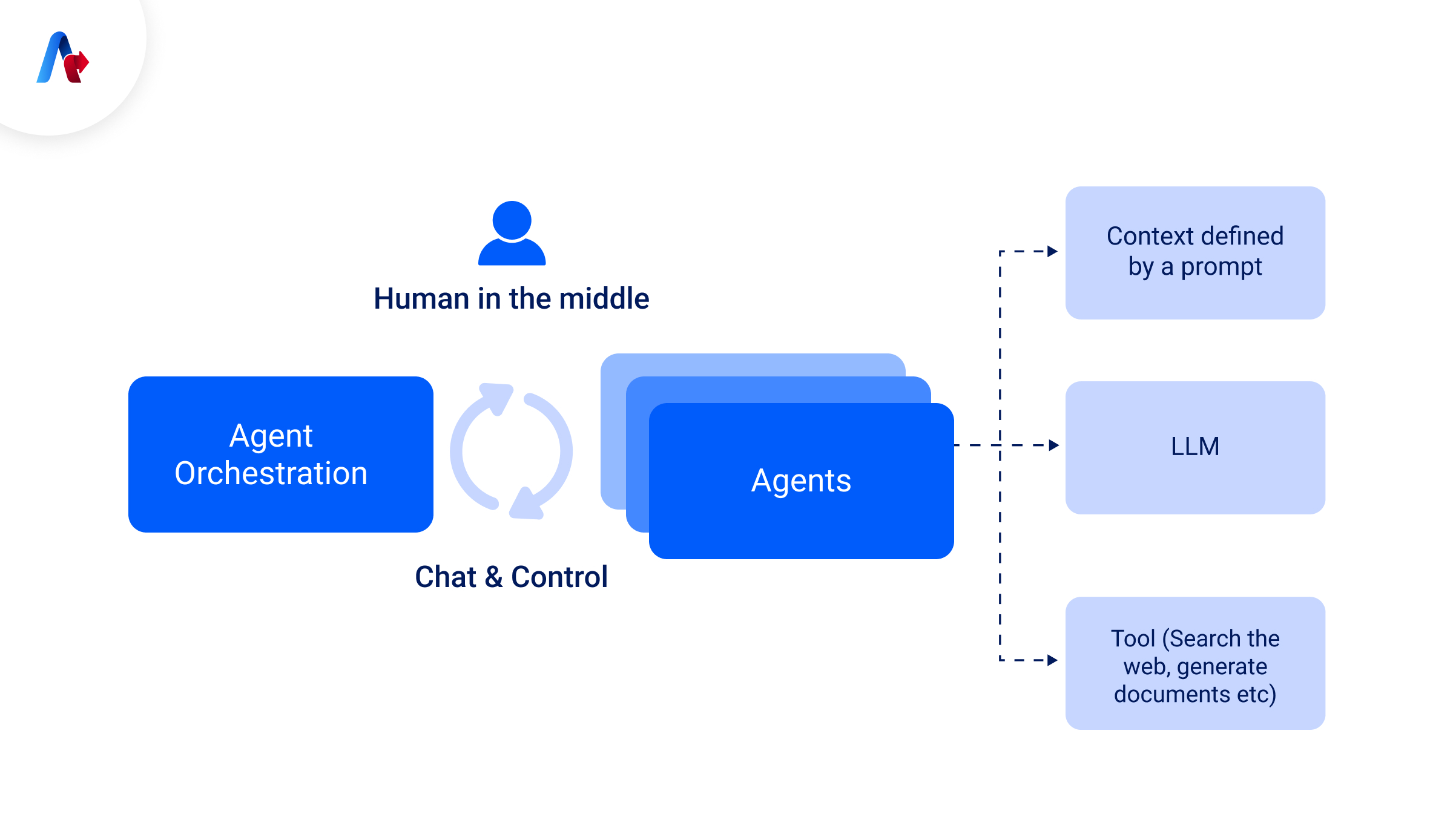
AI Agent Orchestration is a process where multiple agents work cooperatively to achieve a specific goal. It is like a group activity by humans where one takes care of a task while the other takes the next action. The only change here is that AI agents will conduct the same process.
Most of the time, a single bot handles all the queries and organizations feel it is effective. When the use case increases, a single AI cannot handle these issues. Through agent orchestration, these AIs communicate, split tasks, work together, and share data without interruption.
In simple terms, what is agent orchestration? It is an agent orchestration layer that acts as a foundational component for businesses looking to scale automation while managing quality and customized service.
Benefits of AI Agent Orchestration
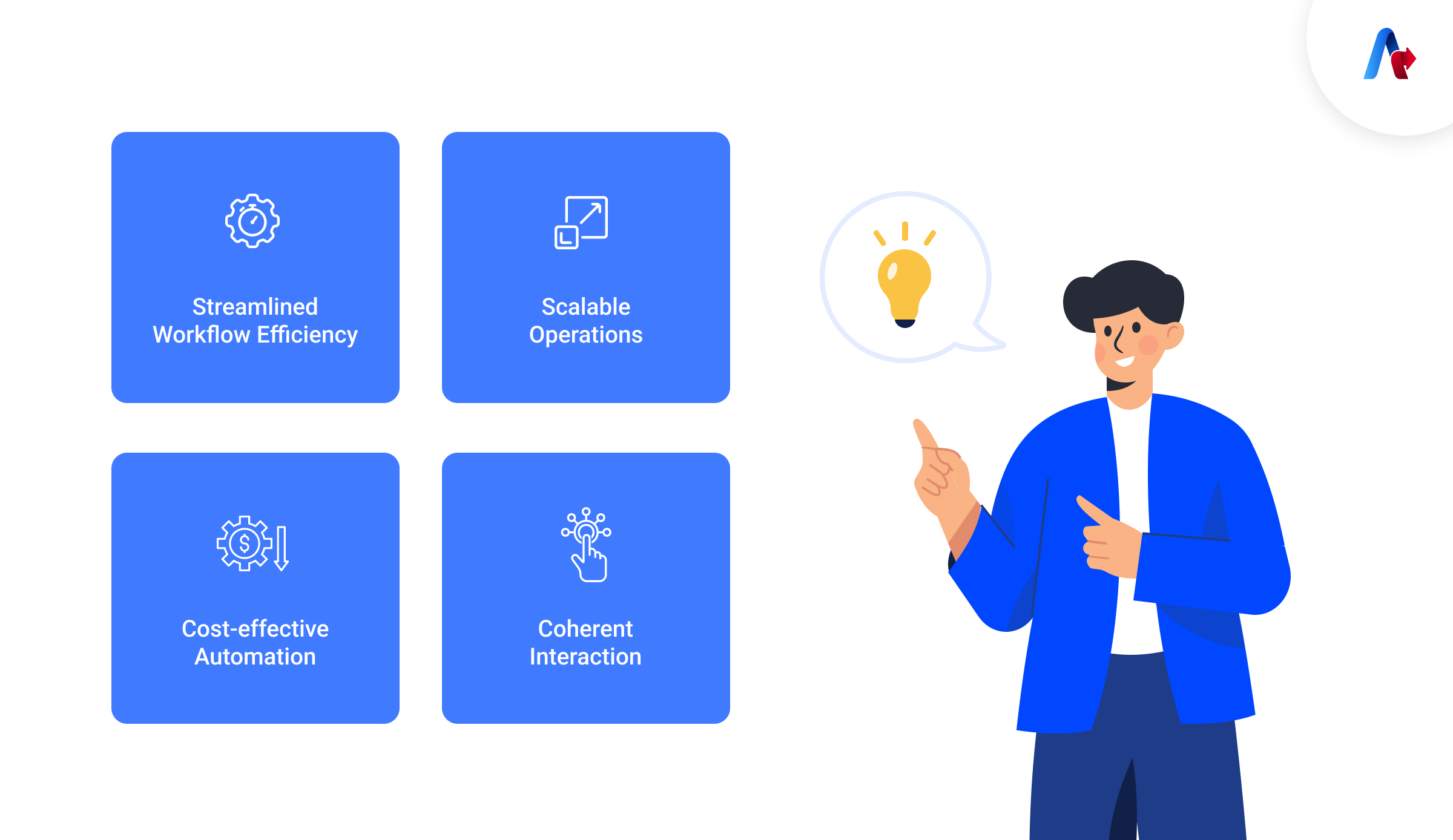
Multi-agent orchestration offers plenty of benefits to your business efficiency, unlocking distinct strategic advantages with the synchronized utilization of multiple AI agents. Let's consider the benefits:
- Streamlined Workflow Efficiency: Orchestration offers task specialization by emphasizing agents based on their functions, such as billing, product recommendations, and troubleshooting, and enhancing the clarity of responses and rapid task completion.
- Scalable Operations: These orchestration frameworks allow easy expansion, helping businesses to incorporate additional AI agents as demand grows in domains like customer service or logistics, causing no disruptions in existing operations. Forrester has highlighted that 56% of businesses experience an increase in scalability while implementing intelligent orchestration frameworks.
- Coherent Interaction: With multi-agent orchestration, agents can share relevant information across domains, contributing to contextual consistency in customer interactions and a smooth user experience. PwC reports the importance of consistent communication, as 75% of customers expect it across different touchpoints, which are empowered by orchestration frameworks, as they share information between agents.
- Cost-effective Automation: Intelligent Orchestration enables businesses to offer more personalized services with less cost by ensuring the understanding of agents from past customer interactions, improving customer engagement and retention.
Different Types of AI Agent Orchestration
A single type of orchestration does not fit all organizations. Since it is different based on the use cases, businesses must use a different type or mix based on their specific needs.
Centralized Orchestration
In this method, a master agent directs all the agents like an orchestra. In this method, a bot works like a manager to assign tasks, make decisions, and direct other agents to run as planned. A structured approach controls other agents and ensures consistency in your organizational work.
Decentralized Orchestration
It is a method where there is no boss or manager, but the team communicates directly for their tasks. That’s how decentralized orchestration works. Agents act independently or agree as a group to perform their functions. This is more flexible and scalable because no single failure can affect their performance.
Hierarchical Orchestration
This one works like an organization where the higher-level agents guarantee the strategy and coordination, whereas the lower-level agents focus on executing tasks. It’s a balanced model that allows autonomy while working. Don't make the hierarchy too rigid since it affects adaptability.
Federated Orchestration
Here, independent agents or different organizations collaborate through an AI agent orchestration framework and control their own data and systems. The difference is that you do not want to share any files with each other, but work as a team to complete the project. These types are famous in sectors like healthcare and finance.
AI Agents vs. AI System Orchestration: Understanding the Relationship
AI agents and AI system orchestration are different in many ways. Even though they are different, they work together to achieve a particular goal. Let’s explore their difference.
AI Agents
These agents are like individual workers at your organization. They take separate tasks based on your instructions and work autonomously. With them, you can perform various tasks from simple to complex and spare your human agents for critical thinking jobs.
They are autonomous and work only based on the script. Not only that, these bots analyze the data, learn from the past and adapt to the future challenges and needs, which makes them ideal for business.
AI System Orchestration
An AI agent orchestration platform can integrate the above agents and ensure their harmonious work with no disruption. It ensures that these agents contribute to the shared goal as instructed.
The orchestration comes with different sets of jobs, like managing data, activities, and using its resources to work with agents. It is like a boss who manages and controls every action of other agents.
Key Components of a Multi-Agent System
Let's investigate the breakdown of the key components of MAS:
| Component | Description |
|---|---|
| Agents | Agents are autonomous actors capable of making decisions and performing activities based on structured goals and objectives. They equip you with the necessary knowledge and decision-making capabilities. |
| Communication protocols | These are the approaches through which agents share information. The common protocols include Foundation for Intelligent Physical Agents- Agent Communication Language (FIPA-ACL) or other customized protocols. |
| Environment | Refers to the common space, where agents operate and interact. It can be physical or virtual, providing content for intelligent data agents to make decisions, like real-time updates on inventory. |
| Coordination mechanisms | Involves the techniques to enable agents to work together without any conflict. The general examples comprise negotiation protocols and consensus foundation algorithms that maximize collective performance. |
| Agent interaction models | Structures the format of how agents are collaborating or competing with one another. For instance, the utilization of market-based approaches to minimize conflicts and streamline resources. |
| Scalability framework | To support growth, these systems provide agents with scaling possibilities. It may include decentralized decision-making or distributed computing models. |
| Data integration layers | Refers to the approaches that process data from different sources within a common format, helping agents to make informed decisions depending on incorporated inputs, particularly in complex environments like retail or logistics. |
| Learning algorithms | Involves advanced learning with time, to enhance the decision-making capabilities of an agent based on experience or feedback, like neural networks or reinforcement learning. |
Discover how orchestration can streamline your operations and drive scalability.
Contact Us NowSteps to Implement AI Agent Orchestration
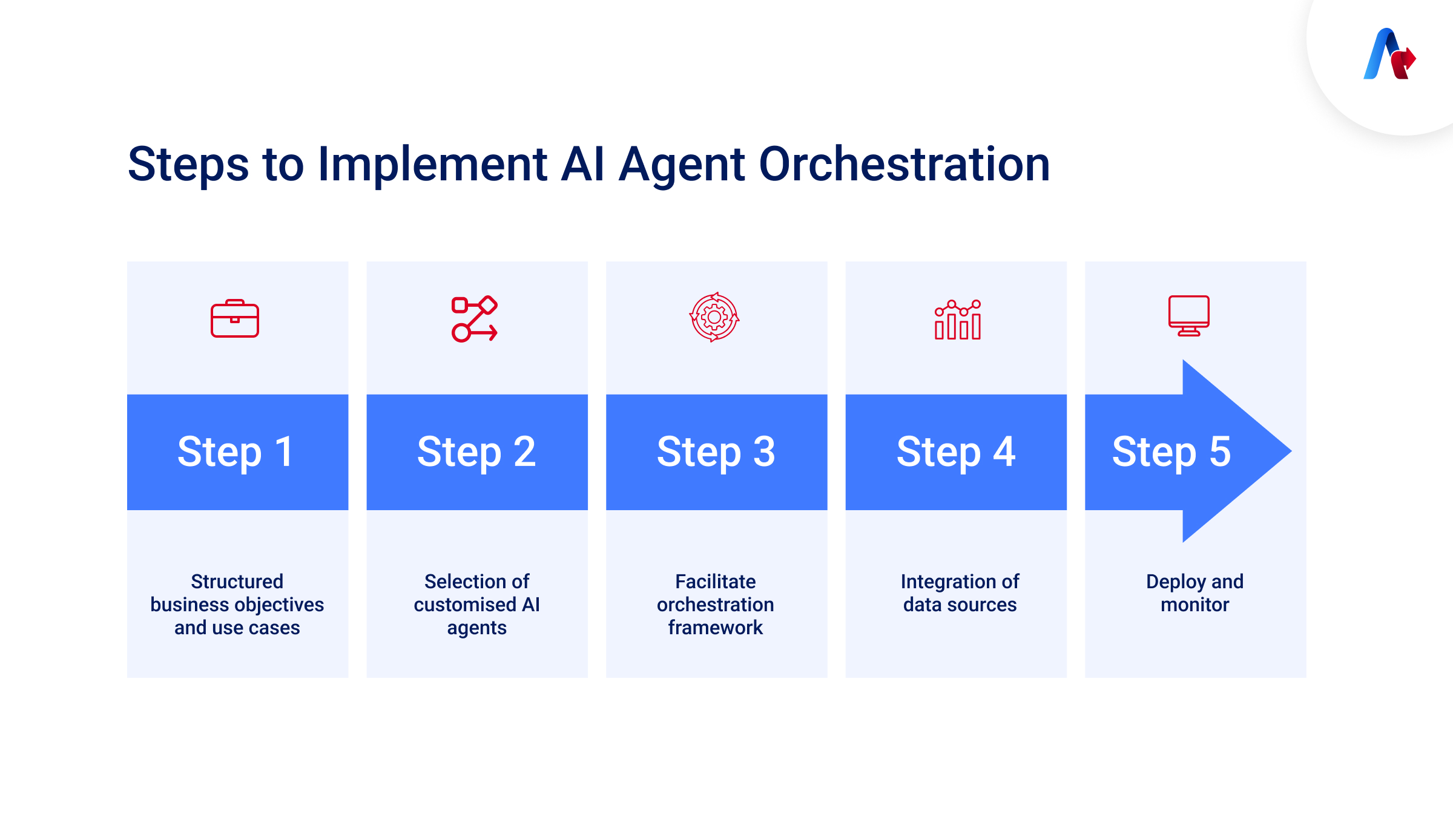
- Structured Business Objectives and Use Cases: Identify business challenges and processes that can benefit from agent orchestration, including customer service and logistics management.
- Selection of Customized AI Agents: Agents need to be chosen based on their tasks, such as troubleshooting, inventory management or billing. These agents should utilize large language models, such as Anthropic Claude or GPT, for advanced functionality.
- Facilitate Orchestration Framework: Involve orchestration framework, including Data Exchange, Communication protocols (FIPA-ACL) and context dependency across agents.
- Integration of Data Sources: Process contextual data from different sources and ensure that agents can access updated and synchronized information to make informed choices.
- Deploy and Monitor: Implementing an orchestration system while continuously monitoring its performance using AI analytics and real-time monitoring tools to track coordination and scalability.
Example of an Orchestrated AI agent
For example, let’s look at a telecommunications setup where an AI agent system supports the customer service industry.
- Billing agent: The customer initially interacts with a billing agent who facilitates account inquiries, payment concerns and subscription management. The agent implements large language models like GPT-4 to identify and resolve queries.
- Technical support agent: In case the customer requires assistance with service concerns like internet connectivity or other issues, the billing agent passes over the interaction to the technical support agent, who can pursue troubleshooting using device diagnostics and network management tools.
- Orchestrator: This is responsible for smooth transitions between agents, managing information with both agents and efficiently resolving concerns. It emphasizes maintaining the context and allowing an uninterrupted customer experience.
Use Cases of Multi-Agent Orchestration in Business
The use of multi-agent systems can benefit in many ways. With AI agent orchestration use cases, your business can simplify tasks, reduce errors, and improve decision-making.
Customer Support
AI agent orchestration is highly influential in the customer support field. It is useful for different customer queries and the integration of specialized AI agents.
- Consider a retail organization that deploys an account management agent to address basic concerns while a fraud detection AI agent tracks complex issues like suspicious account handling.
- The orchestrator helps smooth transitions between agents to provide context and enhance the customer experience (CX).
- Implementing such AI-enabled systems for customers is beneficial. 92% of service teams using AI reduced expenses, and 83% of sales teams documented revenue growth in the past years.
Supply Chain Management
Orchestration is vital in supply chain management, as it optimizes inventory, logistics, and demand forecasting with intelligent coordination. These agents provide adequate information to manage activities like inventory management, shipment tracking and supply-demand matching, with orchestration capabilities to ensure that these agents work together in a unified system.
- AI in the supply chain tracks stock levels, updating the system to eliminate stockouts or overstock situations. They also communicate with demand forecasting agents to accommodate orders.
- AI agents also optimize routes, monitor delivery schedules and allow timely shipments by interacting with inventory systems to accommodate logistics based on real-time inventory levels.
- AI Agents analyze historical data and the latest market trends and use the information in production planning systems. They work continuously to predict levels and anticipate demand fluctuations.
Financial Services
Within financial automation services, AI agent orchestration streamlines operations like fraud detection, assessment and tailored recommendations through the integration of different specialized agents who work in unison.
- AI agents can process transaction patterns, detecting suspicious activities across accounts in real-time. Orchestration helps in seamless communication with other agents, speeding up decision-making and accuracy.
- AI agents monitor data from different sources to identify credit scores, loan risk and market trends. The orchestration of agents reduces risk and allows businesses to make informed decisions rapidly.
- Customer-facing agents examine individual preferences and goals to provide personalized financial plans and product recommendations. According to McKinsey, AI-driven solutions in the financial services reduce operational expenses by up to 30% while enhancing fraud detection by 50% to 80%.
Healthcare
Within the healthcare sector, orchestrate AI agents play a critical role in managing patient data, scheduling and diagnosis. It enables seamless coordination across different functions for better operational efficiency and patient care.
- AI Agents can analyze and store patient data across EHRs, providing Healthcare providers with accurate and updated information.
- AI agents work in unison to automate appointment scheduling by analyzing doctor availability, patient preferences and other factors, such as urgent medical conditions. Orchestrated agents enhance the patient experience by streamlining waiting times and reducing appointment conflicts.
- Diagnostic AI agents process medical images, patient symptoms and lab results. Orchestration helps multi-agent systems collaborate, maximizing diagnostic accuracy by cross-referencing information across departments or specialists.
Take the first step towards implementing AI agent orchestration for your business.
Schedule a consultation todayChallenges in Managing Multi-Agent Orchestration Systems
Managing multi-agent systems has specific challenges that need proper care and supervision. The primary importance is identifying the bottlenecks that cause enterprise inefficiencies:
- Complex coordination: Maintaining communication and synchronization with different agents is complicated, specifically when handling dynamic and other activities.
- Scalability: With the increased number of agents, managing them becomes complex as systems must handle additional workloads without any scope for degradation in performance.
- Data Privacy and Security: AI agents, particularly in the Healthcare or finance domains, can be challenging when it comes to secure and compliant data sharing. Gartner predicts that 17% of the total attacks will involve generative AI.
- Integration: Incorporation of different agents with prevalent legacy systems is challenging, as it requires significant effort and resources.
The Future of AI Agent Orchestration
It looks like the future of agent orchestration connects closely with the advancement of LLM and reinforcement learning. The increasing demand for scalable and adaptive systems powers up orchestration to support multi-agent coordination across different platforms, allowing real-time decision-making and continuous learning.
With the integration of cloud-native technology and edge computing, orchestration platforms will reduce latency and enhance performance. With AI-enabled monitoring and automated conflict resolution, the agent can reach the peak.
Talking of challenges, the concerns over AI ethics and security frameworks will become more critical. Projections highlight a 30% increase in AI orchestration adoption by 2027, enabling this domain to reshape customer experience and operational efficiency.
Conclusion
AI agent orchestration is a smart move for any organization that wants to scale its automation efforts. By using many AI agents, you can improve workflow, achieve faster results, and offer a personalized experience for all customers.
Accelirate AI and Automation is a leading partner in this area, where you can get better outcomes and delivery. Our expertise in agentic automation ensures streamlined processes and reduces your costs.
Give our orchestration service a try and see how you can grow your business.
Get started todayFAQs
Intelligent orchestration will significantly benefit customer support, Financial Services, healthcare, and supply chain management.
Traditional automation involves linear workflows, whereas orchestration strategy incorporates specialized AI agents to enable dynamic decision-making and real-time cooperation across systems, resulting in greater scalability and adaptability.
UiPath has powerful orchestration tools, such as UiPath Orchestrator, that allow Enterprises to manage and coordinate multiple AI agents across workflows.
The success of an orchestration strategy depends on the key performance indicators like response time, task completion rate, system efficiency and customer satisfaction.
One well-known practical example is Uber’s system orchestration. The company uses multiple AI components, where one agent makes demand prediction, another confirms pricing, and the third one looks for ride-matching. These agents work together through this method, so they get the match from the nearby vehicles with the price shown.
It is a system for coordinating multiple AI models, agents, and tools. The layer ensures the agents work together smoothly with the tasks, data flow, and results. It is like a central controller that coordinates everything to get the final result.