



More and more companies are moving towards automation with increased demand to stay relevant and customer focus. Robotic Process Automation (RPA) is an innovative modern technology that makes it easy to build, deploy, and manage software robots. RPA is transforming industries by emulating repetitive tasks and minimizing human errors, and with the rise of agentic AI, these automations are beginning to take on more adaptive, decision-aware responsibilities.
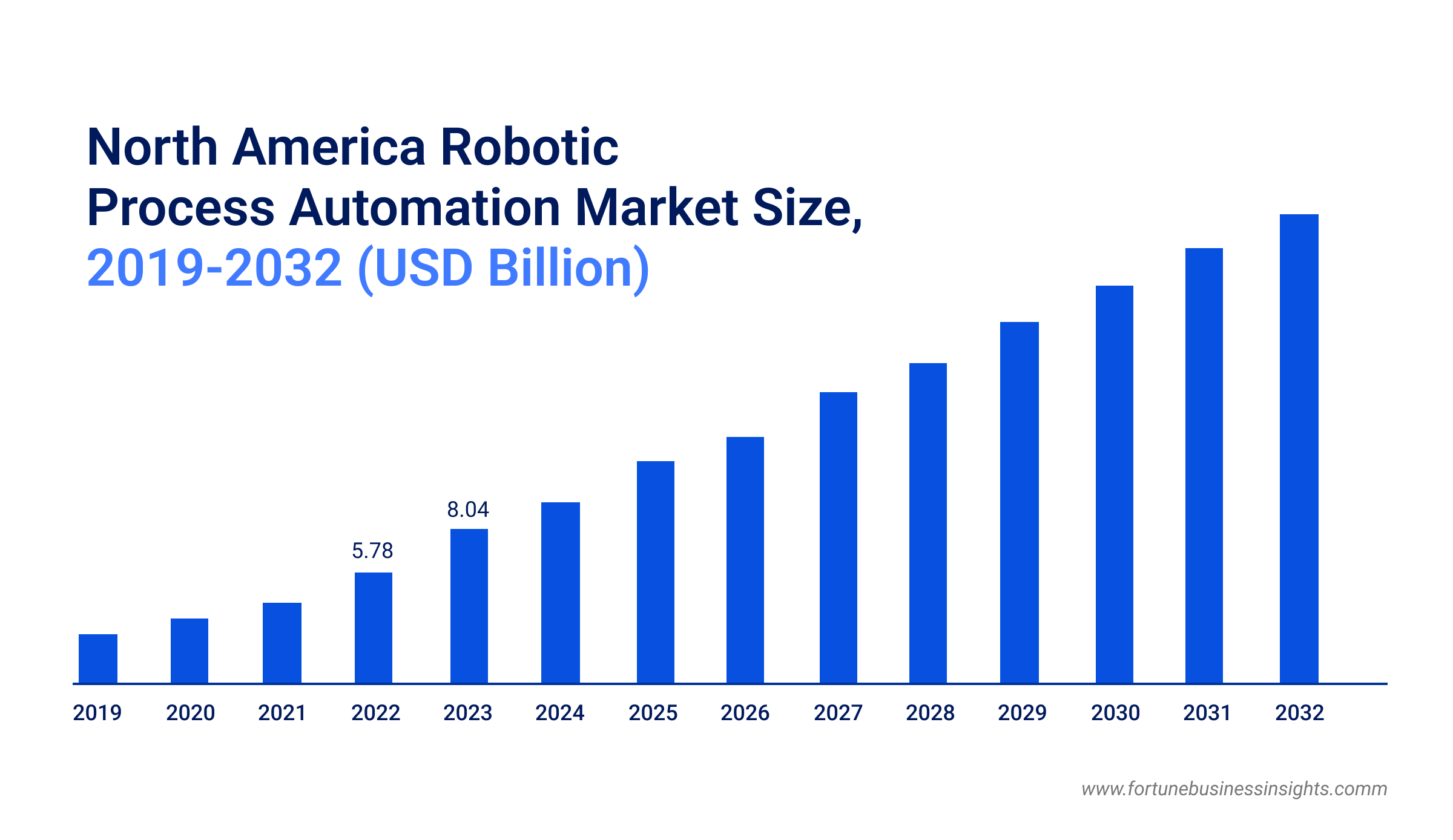
In 2023, the global RPA service market was valued at $13.86 billion. It is estimated to grow by 17.1% CAGR that $18.18 billion in 2024 to $64.47 billion by 2032. The US RPA market is also projected to grow exponentially with estimate value to $22.32 billion by 2032. This will be mostly driven by growth of IoT and automation improvements in different industries, along with early adoption of AI-driven and agentic automation models.
The United States, known for its strong technological innovation, is home to many leading RPA service providers that are helping businesses streamline their processes, cut costs, and improve accuracy as they layer more intelligent, agent-based capabilities on top of traditional automation.
In this article we will take a closer look at the top 12 RPA companies in the USA for 2026, evaluating their industry expertise, unique features, strengths, and potential drawbacks. Each of these companies brings unique value to the table. Ranging from large-scale automation platforms to specialized solutions for specific industries, we have ensured you get the right automation partner for your needs while the market gradually shifts from task automation to more agentic, outcome-driven models.
Top 12 RPA Providers in the USA in 2026
| Company Name | Features | Revenue | Pros | Cons |
|---|---|---|---|---|
| UiPath | Drag-and-drop functionality, AI and ML capabilities, Multi-platform integration | $1.6 billion | User-friendly, Extensive workflow library, Strong community support | High costs for smaller businesses, Complexity in scaling |
| Accelirate | AI and ML integration, Business outcomes focus, Robust customer support | Private | Highly specialized, Excellent customization, Cost-effective for mid-sized businesses | Limited global presence |
| Automation Anywhere | Cloud-native, AI-powered bots, Powerful analytics tools | $500 million | Strong AI capabilities, Scalable, Pre-built solutions | Steeper learning curve |
| SS&C Blue Prism | Enterprise-level security, Scalable, Cloud and on-premises options | $1.5 billion+ | Strong focus on security, Easy integration, Scalable | More expensive than smaller vendors |
| Microsoft Power Automate | Cloud-based automation, Seamless Microsoft integration, Low-code/no-code | N/A | Seamless Microsoft integration, Affordable, Easy for non-developers | Limited capabilities vs specialized RPA vendors |
| AutomationEdge | Hyperautomation platform, AI and ML integrations, IT process automation | N/A | Strong focus on IT automation, Fast deployment, AI-enhanced | Primarily focused on IT sectors |
| EdgeVerve | AI-powered automation, Customizable workflows, Strong analytics tools | Private | Backed by Infosys expertise, Robust AI and ML integration, Focused on finance | Higher costs for small businesses |
| Fortra | Cybersecurity-focused automation, Cloud and on-premises options, AI and ML-powered | $350 million+ | Excellent security capabilities, Flexible deployment, Comprehensive automation | Limited to security-heavy industries |
| Intellias | Custom RPA development, AI and ML-powered automation, Software engineering expertise | $200 million+ | End-to-end transformation expertise, Highly scalable, Personalized strategies | Pricing high for small to mid-sized companies |
| Pega | AI-driven automation, Unified platform combining RPA, BPM, and CRM | $1.2 billion | Industry-leading AI and customer engagement tools, Strong integration | Steep learning curve, High implementation costs |
| WorkFusion | AI-powered automation for compliance-heavy industries, Pre-trained AI bots, Cloud-native | $200 million+ | Focus on compliance, AI-driven automation, Customizable bots | Limited to compliance-heavy industries |
| Nintex | Workflow automation, Drag-and-drop process mapping, Integration with enterprise systems | $250 million+ | User-friendly, Wide range of integrations, Cost-effective | Focus on workflow automation over advanced RPA |
| Itransition | RPA with OCR, computer vision, and ML, supports finance workflows, broad engineering and QA capabilities | ~$313.6M (alt. est. ~$630.2M) | Strong technical depth; scalable for large projects; fast team ramp-up | Scope changes can cause budget overruns; staff turnover may affect continuity |
| Persistent Systems | RPA with Agentic AI, process discovery, ROI analytics, managed services, engineering lifecycle and system integration support | $1.409B FY25; $406.2M in Q2 FY26 | Strong partner ecosystem, deep domain expertise for enterprise-scale efficiency | RPA struggles with dynamic processes without frequent updates |
Let’s look at each of them in detail for a better understanding that can help you select the right RPA service provider.
1. UiPath
Founded: 2005
Overview: UiPath is a leading name in the RPA industry, offering a comprehensive suite of automation tools designed for various industries. Their user-friendly platform empowers businesses to build and deploy automation with their growing focus on agentic automation, UiPath now supports AI agents that can make decisions, self-correct workflows, and operate with greater autonomy across enterprise environments.
Key Features:
- Drag-and-drop functionality for ease of use
- AI and machine learning capabilities for advanced automation
- Multi-platform integration
- Agentic Automation tools including Agent Builder, Healing Agent, and autonomous AI agents for adaptive, decision-driven workflows
Pros:
- Drag-and-drop functionality for ease of use
- AI and machine learning capabilities for advanced automation
- Multi-platform integration
Cons:
- High costs for smaller businesses
- Complexity in scaling large deployments
Industry Expertise: Finance, healthcare, manufacturing, retail, government
Pricing: Custom pricing based on company needs
Revenue: $1.6 billion (2025)
2. Accelirate
Founded: 2016
Overview: Accelirate stands out as a leading agentic automation and AI services partner specializing in business process automation and AI integration. With a strong focus on helping enterprises achieve their automation goals, Accelirate offers end-to-end RPA and AI services starting from strategy to implementation. As one of the top UiPath diamond partners, Accelirate has also expanded into agentic AI systems that enhance testing, operations, and enterprise workflows with adaptive, autonomous decision-making.
Key Features:
- Outcome-driven automation delivery
- Reliable enterprise-grade support
- Agentic AI capabilities for autonomous decisions
- Testing and operations automation services
Pros:
- Excellent customization capabilities
- Highly specialized in Robotic Process Automation and intelligent automation
- Cost-effective for mid-sized businesses
Industry Expertise: Banking, healthcare, insurance
Pricing: Custom pricing
Revenue: Private
Looking for seamless automation and workflow optimization?
Talk to Our Experts Today!
3. Automation Anywhere
Founded: 2003
Overview: A pioneer in the RPA industry, Automation Anywhere has developed a cloud-native, AI-powered platform designed to deliver end-to-end automation solutions. With its recent push toward agentic automation, the platform now supports autonomous, decision-driven workflows that extend beyond traditional bot execution.
Key Features:
- Cloud-native platform
- AI-powered bots for enhanced capabilities
- Easy-to-use interface with powerful analytics tools
- Agentic AI for autonomous, goal-oriented workflow execution
Pros:
- Strong AI capabilities
- Scalable for large enterprises
- Excellent bot store for pre-built solutions
Cons:
- Steeper learning curve compared to other platforms
Industry Expertise: Finance, BPO, retail, manufacturing
Pricing: Based on subscription models
Revenue: $500 million
4. SS&C Blue Prism
Founded: 2001
Overview: Blue Prism, now part of SS&C Technologies, is an RPA industry leader with a focus on scalable enterprise automation. The platform is ideal for businesses seeking secure, reliable, and scalable solutions, and with SS&C’s recent advancements in agentic AI, it now supports autonomous decision flows designed for highly regulated enterprise environments.
Key Features:
- High level of security and compliance
- Scalable capabilities for large enterprises
- Cloud and on-premises options
- Agentic AI governance for autonomous, policy-driven workflows
Pros:
- Strong focus on enterprise-level security
- Easy integration with existing IT systems
- Scalable for multinational operations
Cons:
- Relatively expensive than other RPA vendors
Industry Expertise: Banking, Healthcare, Life sciences, Insurance
Pricing: Enterprise pricing models
Revenue: $1.5 billion+
5. Microsoft Power Automate
Founded: N/A (Product launched in 2019)
Overview: Microsoft Power Automate is a cloud-based RPA platform that integrates seamlessly with Microsoft products like Dynamics 365 and Azure, making it a powerful tool for businesses already within the Microsoft ecosystem. With Microsoft’s growing use of Azure OpenAI, the platform now supports agentic AI capabilities that enable autonomous, decision-driven automation across workflows.
Key Features:
- Cloud-based automation
- Integration with Microsoft 365 and Azure
- Low-code/no-code interface
- Agentic AI support via Azure OpenAI for autonomous bot actions
Pros:
- Seamless integration with Microsoft products
- Affordable for small to medium businesses
- Easy to learn for non-developers
Cons:
- Limited capabilities compared to specialized RPA vendors
Industry Expertise: General, government, finance
Pricing: Subscription-based pricing
Revenue: N/A
6. Automation Edge
Founded: 2015
Overview: AutomationEdge offers hyperautomation solutions, combining RPA with artificial intelligence and machine learning. The platform specializes in IT process automation and service desk automation, and with its expanding agentic AI capabilities, it now supports autonomous agents for real-time financial operations, fraud checks, and IT service workflows.
Key Features:
- Hyperautomation platform
- AI and ML integrations
- IT process automation
- Agentic AI agents
Pros:
- Strong focus on IT and service desk automation
- Fast deployment times
- AI-enhanced automation capabilities
Cons:
- Primarily focused on IT sectors
Industry Expertise: IT services, telecommunications, healthcare
Pricing: Subscription-based
Revenue: Private
7. EdgeVerve
Founded: 2014
Overview: As a subsidiary of Infosys, EdgeVerve offers advanced automation solutions that cater to various industries, with a particular focus on finance and banking. Alongside its AI-powered automation, EdgeVerve is developing a modular agentic AI architecture designed to coordinate multiple autonomous agents.
Key Features:
- AI-powered automation
- Customizable workflows
- Strong analytics tools
- Modular agentic AI architecture
Pros:
- Backed by Infosys expertise
- Robust AI and ML integration
- Focused on finance and banking
Cons:
- Higher costs for small businesses
Industry Expertise: Banking, finance, retail
Pricing: Custom pricing
Revenue: N/A
Got questions?
Let’s Discuss!
8. Fortra (Formerly HelpSystems)
Founded: 1982
Overview: Fortra is an RPA and cybersecurity solution provider that helps businesses automate their processes securely. They focus on both RPA and security automation, making them an excellent choice for enterprises with stringent security needs. With the introduction of their Threat Brain engine, Fortra now incorporates agentic AI that enables autonomous threat detection, contextual analysis, and automated response across security workflows.
Key Features:
- Cybersecurity-focused automation
- Cloud and on-premises options
- AI and ML-powered automation
- Agentic threat detection
Pros:
- Excellent security capabilities
- Flexible deployment options
- Comprehensive automation features
Cons:
- Limited to security-heavy industries
Industry Expertise: Healthcare, finance, insurance
Pricing: Custom pricing
Revenue: $2.4 billion+
9. Intellias
Founded: 2002
Overview: Intellias is a global technology partner offering scalable digital transformation and RPA solutions. Known for its strong engineering expertise and customized automation delivery, Intellias has also adopted agentic AI to support autonomous, data-driven workflows across areas like KYC, AML, and customer operations.
Key Features:
- Custom RPA development and integration
- Strong software engineering and development focus
- Scalable RPA solutions for large enterprises
- Agentic AI strategies for autonomous decisioning
Pros:
- Customizable RPA solutions
- Strong software development background
- Scalable for enterprise-level automation
Cons:
- May not have as deep a focus on specific industries as niche RPA service companies
Industry Expertise: Automotive, financial services, telecommunications, healthcare, and e-commerce.
Pricing: Custom pricing based on project scope
Revenue: $200 million+
10. Pega (Pegasystems)
Founded: 1983
Overview: Pegasystems (Pega) offers a unified BPM, CRM, and automation platform that helps enterprises streamline operations using AI-driven decisioning. With its shift toward agentic AI through Process AI and Decision Hub, Pega now supports autonomous, event-driven workflows that adapt in real time.
Key Features:
- Unified BPM, CRM, and RPA platform
- AI-powered decision-making and automation
- Scalable, low-code automation platform
- Agentic AI via Process AI and Decision Hub
Pros:
- Combines BPM, CRM, and RPA in a single platform
- Strong AI and machine learning capabilities for smarter automation
- Low-code platform for faster deployment and customization
Cons:
- Complex platform may require a learning curve for new users
- Higher pricing for enterprise-scale solutions
Industry Expertise: Financial services, insurance, healthcare, telecommunications, government
Pricing: Custom pricing based on enterprise needs
Revenue: $1.6 billion
11. Itransition
Founded: 1998
Overview: Itransition offers specialized software development and digital transformation, RPA and AI agent development services. They use RPA and other agentic tools to automate tasks in banking, records management, retail, ecommerce, manufacturing, telecom, and logistics. They can do data extraction, processing, and analysis using OCR, computer vision, and machine learning. They also do engineering, R&D, QA, and CRM/ERP solutions.
Key Features:
- RPA combined with OCR, computer vision, and ML
- Supports finance workflows like payroll and invoicing
- Broad engineering and QA capabilities across enterprise systems
Pros:
- Strong technical depth
- Scales well for large, complex projects
- Fast team ramp-up
Cons:
- Scope changes can lead to budget overruns
- Staff turnover may affect continuity
Industry Expertise: Retail and ecommerce, manufacturing, telecom, logistics, banking
Pricing: Custom based on project scope
Revenue: Estimated $313.6M annually (alternative estimate: $630.2M)
12. Persistent Systems
Founded: 1990
Overview: Persistent Systems offers AI-led services, RPA, intelligent automation, cloud, cybersecurity and embedding autonomous AI agent solutions to enterprises all around the world. They focus on modernizing and improving operations.
Key Features:
- RPA combined with Agentic AI for process discovery and ROI analytics
- Managed automation services for scale and reliability
- Support across engineering lifecycle, PLM, and system integration
Pros:
- Strong partner ecosystem
- Deep domain expertise for scaling enterprise efficiency
Cons:
- RPA can struggle with rapidly changing processes unless frequently updated
Industry Expertise: Banking and financial services, insurance, healthcare, life sciences, industrial
Pricing: Custom enterprise pricing
Revenue: $1.409B (FY25); $406.2M in Q2 FY26
Steps to Choose the Right RPA Vendor for Your Business
Automation has become a pivotal component for businesses seeking efficiency, scalability, and a competitive edge. With a variety of automation vendors and solutions available, selecting the right one is often challenging. However, the secret to success is not only in finding the most advanced tools but also aligning them with your business’s specific needs, culture, and goals. Let’s walk through how to simplify the process of selecting the best automation solution.
1. Understanding Your Business Needs: Start with Why
Before diving into vendor comparisons, it’s crucial to reflect on your business’s unique challenges. Automation can streamline operations, reduce costs, and free up human resources, but the right solution will depend on where your pain points are.
Are you looking to automate repetitive tasks? Improve customer experience? Or enhance backend operations? Perhaps you're in a highly regulated industry like healthcare or finance where compliance is key. Define your goals clearly to ensure that the automation vendor aligns with your vision.
Example: For a finance firm, automating invoice processing might bring immense value, reducing human error and speeding up payment cycles. On the other hand, a retail company might focus on chatbots to improve customer engagement.
2. Evaluate the Human Element: Will Your Team Adapt?
Introducing automation often triggers fears of job loss or role displacement among employees. However, the reality is that automation, when approached thoughtfully, enhances roles rather than eliminates them. It allows employees to focus on more strategic tasks, increasing overall job satisfaction.
As you assess potential vendors, consider how the tool will integrate into your company’s culture. Is the solution intuitive? Will employees require extensive training? Does the vendor offer post-implementation support? These human factors are essential in ensuring smooth adoption and maximizing ROI.
Tip: Look for vendors who offer strong onboarding and continuous support services. Change management is critical; the smoother the transition, the more successful the automation deployment will be.
3. Long-Term Scalability: Think Beyond Immediate Gains
When choosing an automation solution, it’s important to think long-term. While some vendors may offer attractive short-term savings, will the solution grow with your business? Scalability ensures that your business won’t outgrow the tool within a few years.
Consideration: Look for vendors who offer modular tools, where additional features can be added seamlessly as the needs of your business grow. This will save you from having to reinvest in new tools down the line.
4. Customization and Flexibility: Tailoring to Your Specific Workflows
No two businesses operate in the same way, and automation solutions shouldn’t be “one-size-fits-all.” A highly flexible and customizable automation tool will enable your organization to adjust it based on specific workflows, policies, and business practices.
When assessing vendors, ask about customization capabilities. Can the solution be tailored to meet industry-specific regulations? Does it offer easy-to-configure workflows that mirror your current processes?
This will not only ensure that the automation solution fits into your existing setup but also allow for faster integration with minimal disruption.
5. Vendor Credibility and Support: Choosing a Trusted Partner
Beyond the technical aspects, the reputation and reliability of the vendor should be a major consideration. A good automation vendor is a long-term partner, helping you navigate challenges as they arise.
Start by evaluating the vendor’s track record in your industry. Have they successfully worked with businesses of similar size and scope? How is their customer support? Vendors that provide fast, reliable support will be invaluable as you encounter technical challenges during implementation.
Advice: Check reviews, request customer testimonials, and evaluate case studies to ensure you are choosing a credible partner. Don’t be afraid to ask for demos or trials, which can give your team a feel for how well the tool fits.
Looking for an RPA service provider who can help you improve productivity and boost ROI?
Let’s Talk!
Latest RPA Market Trends and Insights 2026
The enterprise automation market is progressing away form standalone bots to agents that use AI, orchestration and governance. So now, enterprises are no longer automating solely via RPA but employing it as an execution layer of bigger and more complex automation systems. Here we have listed some of the top RPA market trends for 2026:
1. RPA Is Becoming the Backbone of Execution
Most big companies currently use RPA. The goal in 2026 is not to replace it, but to make it bigger. RPA takes care of work that is predictable and comes in large amounts. AI and agents deal with judgment, exceptions, and data that isn't organized. Together, they make things bigger without making them messy.
RPA is still important when there are no APIs, old systems can't be changed, or when dependability is more important than trying new things.
2. Agentic Automation Is Creating New Demand
AI agents are making people more interested in RPA, not less. Agents still need something reliable to do things across systems. RPA fills that gap.
The best way to win is through hybrid automation:AI agents make decisions and explain the, RPA runs and connects. This keeps prices down and the rules in place.
3. Orchestration and Governance Are Now Deal-Breakers
Companies are putting orchestration layers that coordinate bots, agents, people, and systems at the top of their lists. Automation doesn't work on a large scale without orchestration.
Governance, on the other hand, is now non-negotiable. Buyers want audit trails, access restrictions, exception handling, and compliance to be built in. More and more RPA technologies are able to meet these needs.
4. More and more people are using cloud and low-code
Cloud-native RPA and low-code technologies are making it easier to get started. This is making it more popular with small and medium-sized businesses (SMBs) as well as major businesses.
Business teams are making their own automations, and central teams are working on standards, security, and reuse.
5. Automation that is specific to an industry is growing faster
Generic automation is slowing down. Solutions that specialize on certain industries, including healthcare, banking, insurance, and manufacturing, are rising quicker because they lower compliance risk and speed up time to value.
Pre-built processes, domain logic, and governance models are increasingly important factors in making a purchase.
Download our “2026 Agentic Automation and AI Agents trends” e-book for more details on each of our five predictions.
What Is the Future Scope of RPA?
RPA tools have made significant strides, but their reliance on transactional automation often leads to high management overhead. This complexity arises because managing individual automated processes across multiple systems becomes cumbersome, especially as organizations scale. As a result, a new category of enterprise applications known as autonomous applications has emerged to overcome these limitations. So, how has the evolution from RPA to intelligent autonomous applications worked for businesses? Let’s find out!
Autonomous Applications:
- Cognitive capabilities: Autonomous applications utilize machine learning and natural language processing to handle more complex processes, such as decision-making and predictions.
Intelligent automation: These apps go beyond simple task automation by integrating AI and cognitive capabilities, allowing them to make decisions and adapt processes based on real-time data.
AI-driven efficiency: These systems can analyze patterns, optimize workflows, and reduce human intervention, making them more scalable and manageable than traditional RPA systems.
Scale Your Business with the Right RPA Service Provider Today!
In 2026, companies are increasingly looking for service providers that offer not only robust automation but also capabilities in AI, machine learning, and intelligent automation to enhance business efficiency and productivity.
The global Automation market is estimated to reach 31 million dollars by 2030 and as per McKinsey survey around 70% of organisations are already piloting automation technologies.
This clearly indicates how RPA adoption & implementation can significantly benefit businesses in terms of higher efficiency, cost savings, and smooth business operations.
When choosing the right RPA service provider, businesses must consider several factors, such as industry-specific expertise, scalability, ease of integration, and pricing. Whether you are a small business looking to automate simple processes or a large enterprise seeking complex automation solutions, there is an RPA provider suited to your needs.
Ultimately, the right RPA services company can provide the tools needed to automate business processes, reduce costs, and improve overall efficiency. As the demand for robotic process automation service providers grows, the leaders listed in this article stand out in their ability to drive transformation through cutting-edge technology and expertise.
Whether you’re just beginning your RPA journey or looking to expand your existing automation infrastructure, these top RPA service companies in the USA for 2026 are well-equipped to help you stay ahead in the automation race.
Got more questions?
Contact Us Today!
Related Blogs