


Quick Summary
To secure APIs for agentic AI, enterprises must control who an agent represents, which systems and data it can access, and what actions it can perform. This requires separate user and agent identities, least-privilege access, downstream API authorization and human approval for high-risk actions. Experts can expect more than 30% of the increase in API demand to come from AI and LLM-based tools by 2026.
What changes when AI moves from generating answers to completing work across enterprise systems? Whether an agent retrieves information, updates a record, submits a transaction, or triggers a workflow, the action is ultimately executed through an API request. This makes the API the control point between an agent’s decision and its effect on the business. Enterprises must therefore govern agent access before deploying these systems at scale—a requirement at the core of agentic API security.
What Is Agentic API Security?
Agentic API Security controls how AI agents connect to enterprise systems, data, functions, and other platforms. It verifies users and agents, restricts permissions, secures tokens, validates requests and requires human approval for sensitive actions.
Securing internal APIs has become very important today as many organizations deploy AI agents to retrieve critical information, update records, and trigger workflows. A secure API framework ensures that agent activity is controlled, traceable, and accountable.
Build secure, traceable API access for your AI agents.
Book a demo nowWhy Does Agentic API Security Matter for Enterprises?
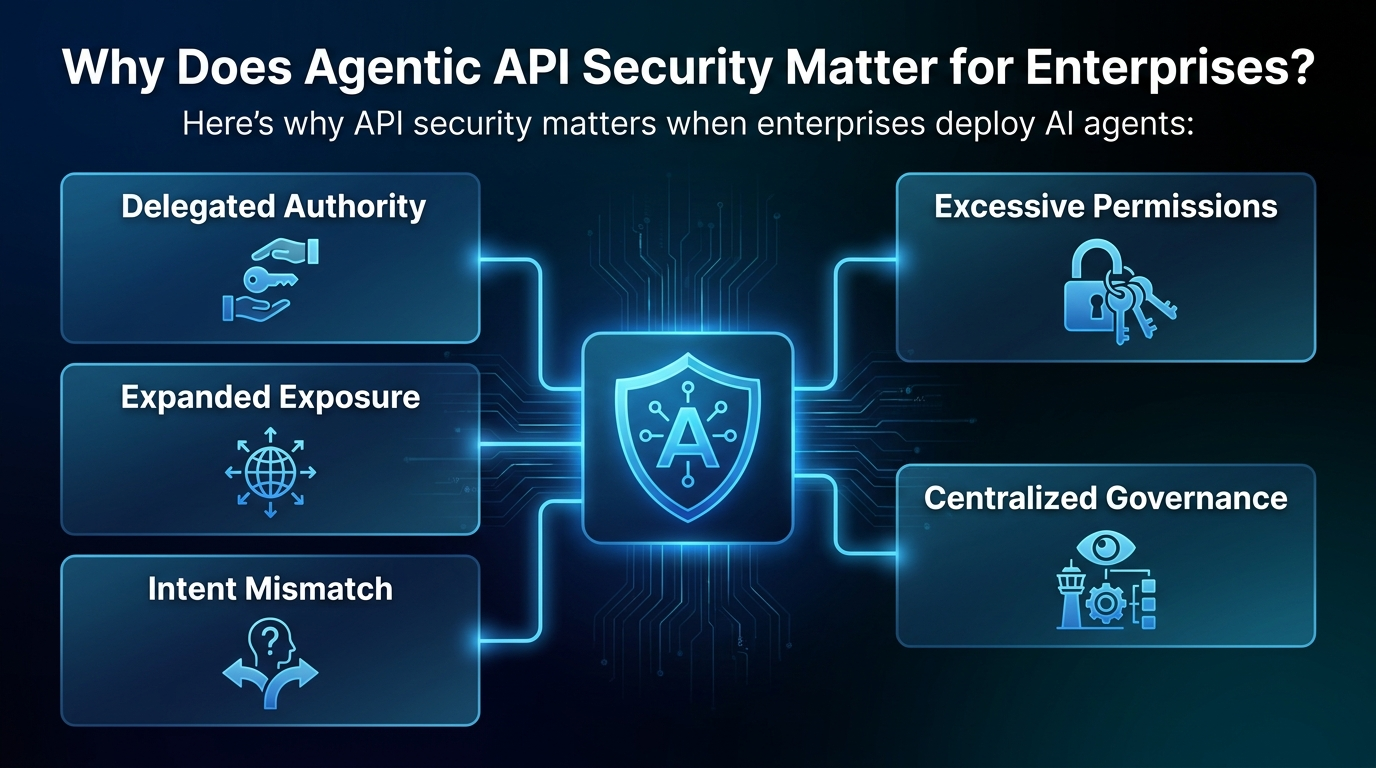
Here's why API security matters when enterprises deploy AI agents:
- Delegated Authority: Secure APIs let agents act independently within the permissions users grant and keeping human in loop while taking sensitive decisions
- Expanded Exposure: API analyse and validates every tool or server that agents connects with to protecting sensitive data from misuse
- Intent Mismatch: API control helps to reduce misinterpretation by limiting or blocking unintended actions
- Excessive Permissions: A secured API control can help reduce risk of malicious instructions by limiting access for agents
- Centralized Governance: Shared API controls help team apply consistent rules, record agent activity and review access for all agents
How Is Agentic API Security Different from Traditional API Security?
Traditional applications generally call APIs through predefined workflows written into application code. AI agents can interpret a user’s goal, select tools, and adjust their sequence of API calls while completing a task. Existing API security controls still apply, but agentic access requires additional identity, delegation, token, approval, and audit context.
Let's understand the difference in detail through this table:
| Comparison Criterion | Traditional API Security | Agentic API Security |
|---|---|---|
| Execution model | Application code follows a predefined sequence of API calls. | The agent dynamically plans tasks and selects tools or APIs during execution. |
| Request initiation | A user action or known system event initiates the request. | A user provides a goal, and the agent determines which requests are needed to achieve it. |
| Identity | The request usually identifies the user or application. | The request should identify the user, agent, workload, and service involved. |
| Delegated authority | The application exercises authority within a fixed workflow. | The agent acts on a user’s behalf, requiring a clear and traceable delegation chain. |
| Permissions | Roles and scopes are configured around predictable application functions. | Access should be limited by the current task, resource, tenant, action, and risk context. |
| Token use | Tokens are issued to known clients for predetermined APIs. | Tokens should be short-lived, task-specific, and restricted to the intended downstream API. |
| Human approval | Approval points are designed into a known workflow. | Approval may be requested dynamically when the agent attempts a sensitive or irreversible action. |
| Auditability | Logs capture the user, application, request, and response. | Logs should also capture the agent, delegated authority, selected tool, policy decision, approval, and outcome. |
What Are the Main Agentic API Security Threats and Their Primary Controls?
AI agents create value by completing work across connected systems. However, their autonomy, delegated authority, and access to multiple tools can allow malicious input, weak permissions, or compromised components to produce unsafe API actions. These primary controls can help enterprises reduce these risks.
| Threat | Enterprise impact | Primary control |
|---|---|---|
| Prompt Injection | Hidden instructions can steer agents into unsafe API actions. | Check tool requests and enforce access rules at the API. |
| Excessive Agency | Too much access lets agents act beyond their assigned work. | Provide essential tools and permissions; require approval for sensitive actions. |
| Token Theft and Replay | Attackers can reuse stolen bearer tokens to access connected systems. | Protect stored tokens, shorten their lifetime, and bind them to clients. |
| Token Pass-Through | Tokens accepted by the wrong service weaken access checks and traceability. | Let the API verify the agent's permission to protect sensitive data |
| Untrusted Tools | Malicious tools can misuse information or alter an agent’s requests. | Use approved tools and have the API verify tools and restrict access to sensitive data |
| Agent Sprawl | Unmanaged agents can still have information and credentials to access enterprise systems | API helps to manage agents, log activities and withdraw permissions when no longer needed |
| Runaway Activity | Repeated execution can duplicate transactions and increase costs. | Cap requests, retries, and spending; recognize repeat requests to avoid duplicate changes |
What Are the Best Practices for Securing APIs Used by AI Agents?
Enterprises can follow these 8 best practices for securing internal APIs:
- Give users and agents separate identities: Help APIs distinguish callers, apply suitable permissions, and trace agent activity.
- Use OAuth and limit permissions: Authorize access through OAuth and give agents only the permissions needed for their tasks.
- Apply scopes and claims at every API: Each API must check allowed actions and data access, even after MCP approval.
- Use short-lived tokens and token exchange: Use short-lived tokens for the intended API and token exchange for downstream access.
- Keep credentials outside model context: Store credentials securely and keep them out of prompts and model inputs to reduce misuse.
- Require approval for sensitive actions: Mark and log agent requests to review access and investigate problems.
- Agent Audit Trails: Mark agent requests and log their actions so teams can review access and investigate problems.
- Limit usage and repeated actions: Limit duplicate transactions and repeated failures by applying rate limits, quotas, and spending caps
Need help securing APIs for AI agents?
Call our experts todayWhat Architecture Is Needed for Securing Internal APIs?
Securing internal APIs requires these controls to work together under shared governance:
- Identity Management: Gives users and agents separate, verifiable identities to trace who requested a task and which agent performed it.
- OAuth Authorization Server: Issues short-lived tokens with limited permissions for the intended API to control access to sensitive data and systems
- API Access Checks: APIs verify tokens and check permissions before processing each request, ensuring agents can access only approved data and perform permitted actions.
- Approval Controls: Agents should take user approval for sensitive actions and have the API or execution layer verify that approval before allowing the action.
- Audit Logging: The authorization server includes trusted token information that identifies requests made by agents, helping teams identify unexpected agent behaviour
- Shared API Management: Brings API discovery, security policies, monitoring, and cost oversight under shared governance to provide better visibility and control
Here’s how Accelirate helped a retail bank connect its existing systems more securely. Using MuleSoft, the team brought fragmented systems together and added checks to control access and protect financial data. They reported a 40% reduction in legacy integration costs and gained a more secure foundation for new digital services while lowering the cost of connecting its existing systems.
API security helps enterprises control how AI agents use their systems. Clear access limits and human oversight help protect sensitive information as automation expands.— Automation Expert, Accelirate

How Should Enterprises Select and Implement API Security Solutions?
Here's what enterprise leaders should look out for while selecting an API security solution for their system:
- API Gateways: Look for a gateway that can support your legacy system, validate incoming requests and help teams apply consistent checks and block excessive traffic
- Authorization Servers: Choose a server that supports OAuth, issues short-lived tokens and supports token exchange to limit access and permissions across connected systems
- Identity Platforms: Check whether it supports agent and service identities alongside your existing user identities to help APIs apply permissions to the correct caller and log activities
- Policy Engines: Choose a solution that lets teams manage access rules centrally while each API enforces them, helping teams maintain consistent restrictions and adjust permissions
- Discovery and Monitoring: Look for tools that provide a shared view of APIs and agents across the enterprise, helping teams review agent activity and spot unusual behaviour.
To implement these solutions successfully, teams should start by listing all agents across the enterprise, their owners, and the APIs they use. Use these details to understand where access should be reduced and where human oversight is needed.
Introduce identification, token, approval, and monitoring controls as a pilot run and track authorization failures, cross-tenant violations and unusual API activity. Set a baseline and target for each KPI to check how well the controls are working.
Baseline and Target KPIs
| KPI | Baseline to Measure | Suggested Target |
|---|---|---|
| Identity coverage | Percentage of active agents with verified identities and owners | 100% coverage |
| Token compliance | Percentage of requests meeting audience and token-lifetime policies | 100% compliance |
| Authorization failures | Denied-request rate and reasons | Log all denials; reduce failures affecting legitimate tasks |
| Cross-tenant violations | Confirmed unauthorized access across tenants | Zero successful unauthorized accesses |
| Abnormal activity | Alert coverage and detection time | Detect defined high-risk activity within agreed time limits |
What Should Enterprise Leaders Do Next?
Enterprise leaders should begin by mapping every agent to the APIs, data, and actions it can access, then establish clear identities, least-privilege permissions, protected token flows, human approval, and complete auditability. Accelirate helps organizations assess their existing API environment, design governed agent-to-API integrations, strengthen authorization, and implement monitoring across existing systems without disrupting operations.
Build a Secure Agentic API Foundation with Accelirate Today. Book a demo now!
FAQs
No; APIs also need limited permissions, token validation, monitoring and human approval for sensitive actions.
Yes, it helps APIs to apply suitable rules and permissions so teams can track their actions.
For better control, teams should use short-lived access tokens without refresh tokens
Agents should take human approval before using sensitive company data or taking high risk action