



Quick Summary
Human-in-the-loop AI is a method that embeds human action and judgment at critical decisions inside the AI workflow. HITL is an essential part in this agentic world to keep the system accurate, compliant and aligned with business intent. This method is especially important for sectors like HR, finance, medicine and in decisions that can have serious consequences. Human suggestions also help AI agents to understand the context and learn from the past history, so that they can reduce their dependency on human agents.
Everyone is talking about AI agents, automation and their positive side. Yet Gartner predicts that over 40% of AI projects will stall by the end of 2027. Accelirate’s 2026 Strategic Reports cites that only 5% companies successfully scale their automation and the rest fail. It is not a problem with the tool, but it is how you approach it.
These reports raise a big question: are organizations moving too fast towards automation without considering humans support, that ensures more accuracy, trust and governance?
The answer to this question is human-in-the-loop AI because leaving every decision to AI can create some issues with safety and accuracy. Instead of that, humans review the output, correct mistakes, and provide guidance when there is a need for critical thinking and problem-solving.
HITL system embeds humans in the decision loop, where they take key roles in training, validation and execution. As an organization, you need to have the right balance while scaling an artificial intelligence tool across the workflow. A method like this can improve the level of accuracy, reduce risk and improve trust among the people.
In this article, we'll learn what human in the loop means, how it works inside agentic systems, where it matters most for enterprise decision-making, how to build it into your AI governance strategy, and what to look for when you select an HITL AI system.
What Is Human in the Loop AI?
HITL is a design where humans take a role in the high-impact decisions and operations within an AI workflow. It means that humans are involved in some areas of decision-making to ensure accuracy, logic, safety and ethics to avoid big errors that may carry real consequences.
The arrival of AI agents to the market is providing astonishing advantages, but even the most advanced model may have its limitations when it encounters logical and ethical issues where real decision-making is necessary. At this point, human-in-the-loop AI can avoid issues and also improve the performance of automation.
What are the Benefits of the HITL Process?
Human in the loop AI workflow is not just for oversight, but it also provides some of the advantages, such as:
- Better Decision-Making: While working with AI, you can improve decision-making, but it lacks contextual and legal understanding. For this reason, we can include HITL, which will improve our decision-making and make it reliable.
- High Accuracy: Feedback from humans is the most important part here, as it can improve the accuracy of the AI. It will correct the model and improve its confidence for future decisions.
- Transparency and Accountability: As AI does not have contextual understanding, human intervention will give more transparency on decisions. Also, including AI-only decisions has no accountability, but using HITL will create an owner for each decision.
Before introducing automation, ensure the people using it understand why it's being introduced. Communicate clearly, prepare for role changes, and never assume alignment — even in an automation company. The biggest lesson? It's not just about the tech; it's about the people Ahmed Zaidi, CEO, Accelirate
Human-in-the-Loop vs. Fully Autonomous AI — A Comparison
People sometimes assume human-in-the-loop and complete automation are related. That's not right. They're different in many aspects. Here’s a comparison table that gives an idea of both.
| Dimension | Human-in-the-Loop AI | Full Automation |
|---|---|---|
| Control | Human approves decision points | System operates end-to-end without human input |
| Speed | Slightly slower at escalation points | Fastest execution |
| Risk exposure | Managed and bounded | High, especially for edge cases |
| Ideal use case | High-stakes, regulated, or context-sensitive decisions | High-volume, predictable, low-consequence tasks |
| Auditability | Full audit trail with human sign-off | Algorithmic logs only |
| Regulatory fit | Aligned with EU AI Act, HIPAA, GDPR | Often requires retrofit for compliance |
What's the Difference Between Human-in-the-Loop vs. Human-on-the-Loop?
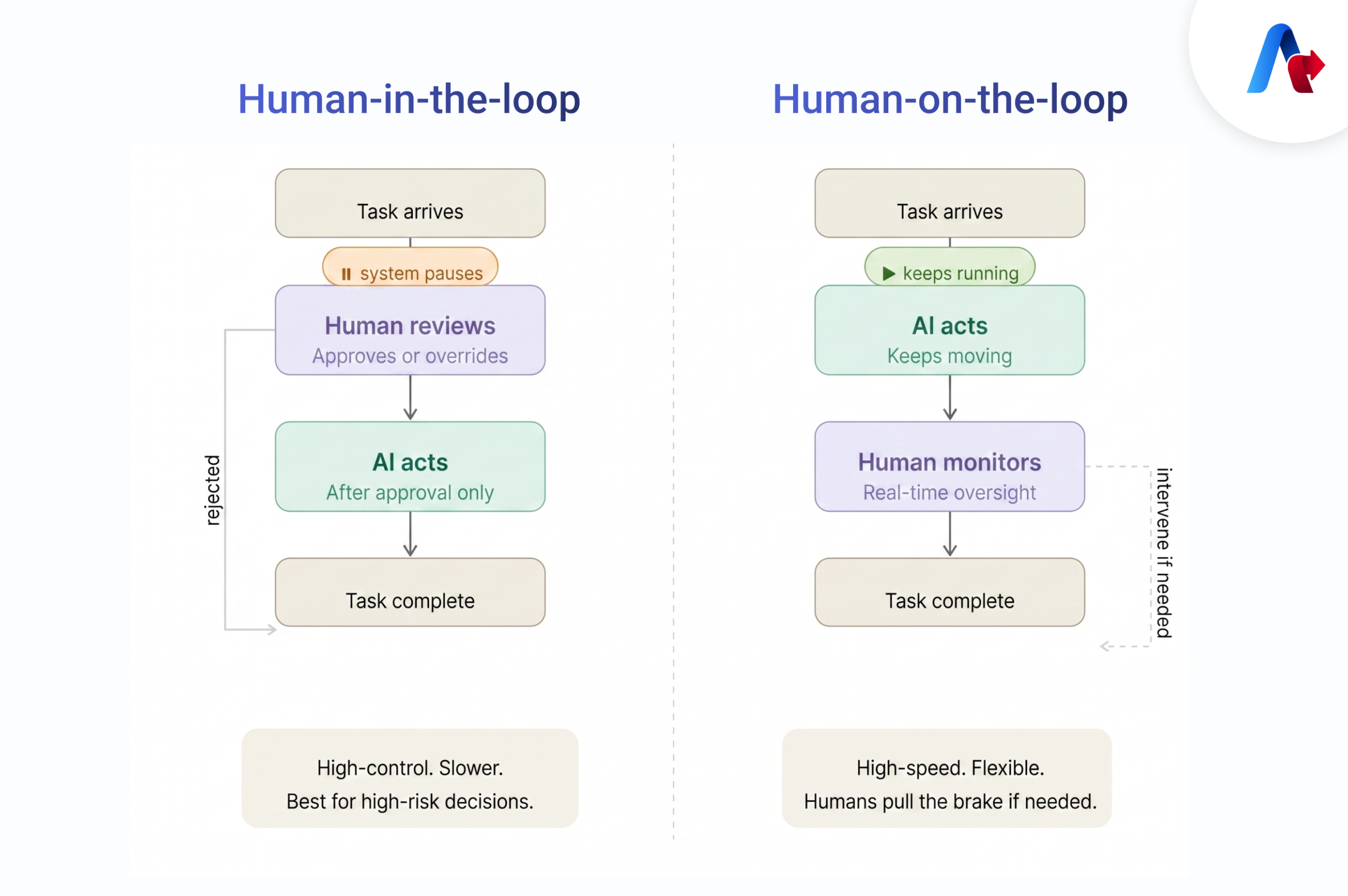
Even within human oversight models, there are two important splits that enterprise buyers often miss. So, it is important to understand the difference between these two before committing to a tool.
- Human-in-the-loop includes human reviews, approvals, and overrides for high-risk decisions. The system pauses for humans’ decisions for these, and the AI agents begin only after human approval.
- Human-on-the-loop is different from the above because it monitors the system in real-time but doesn't intervene for everything unless it is necessary. The AI keeps moving but humans pull the brake only if necessary.
Not sure which method fits your workflows? Accelirate can map your highest-risk AI decisions and help you choose the right one for your needs.
Fix a 30-minute session with our team.
How Does Human-in-the-Loop AI Work? The Workflow Explained
A team now understands what HITL is, but the important matter is to learn how it works inside a live agentic pipeline. This section will explain where humans plug in, what triggers their involvement, and how that involvement will make the system better.
- Trigger: The first process begins when a business event happens. For example, a new insurance claim comes in, or a job application is submitted.
- Agent Perform the Action: AI starts working after collecting necessary information and makes a better decision based on what it finds.
- Confidence Check: Before execution, the AI checks its confidence in action. Here, the agent evaluates how sure it is about its action and decides whether to move or to escalate to humans.
- A Human Review: The task or decision moves to a human expert. Later, the human agent will check what agentic AI was trying, the information it used and what action needs to be taken.
- Human Decides the Next Step: The human approves or, if necessary, modifies the output. The decision is recorded for future action.
- Agent Continues: After the human review, the agent resumes the work. The AI agents also capture the decision and save it for future action.
The Three HITL Touchpoints in an Agentic Pipeline
There are three phases for a well-designed human oversight:
- Pre-Task (Goal Validation): Before the AI starts working, a human agent will review and approve the task details. A method like this is vital for multi-step workflows that can lead to incorrect actions.
- Mid-Task (Exceptional Case): While working, the agent may come up with something unusual. Instead of guessing, it will ask for human help without affecting the entire workflow.
- Post-Task (Output Review): Once the task is complete, a human reviews the result before the final execution. A process like this will ensure the outcome is accurate and appropriate.
This three-level model is essential for enterprises today to avoid unexpected situations. Accelirate UiPath Maestro is one of the tools where you can expect this type of escalation path.
When should an AI Agent Pause and Ask?
Not all situations are fit for human review. An AI solution should know which ones do and which do not. An enterprise should configure this carefully during the time of tool building. There are many situations, such as:
- Low Confidence: In these situations, the autonomous agent is not confident to move forward due to some confusion.
- High-Risk Decisions: Your tool may face high-risk decisions, such as financial transactions, patient information, hiring decisions, and legal commitments. They need human oversight to avoid heavy consequences.
- Unexpected Inputs: In some situations, the AI gets stuck as it cannot understand what to do due to its nature of action that was not included in the trained data. If such a situation arises, it may flag for human review.
- Compliance Requirements: Some decisions, like regulations and governance, only need human intervention as it is mandatory by law.
Setting these rules is harder than it sounds. A small mistake can make everything different and lead to big problems. In Accelirate's experience building and deploying agentic AI programs, setting these rules must happen during the design phase, not after that. Clients who are not serious about the human will face lots of burden within the first 60 days of post-deployment.
How HITL Feedback Loops Improve AI Accuracy Over Time
Most believe that human-in-the-loop AI controls risk, but it actually makes AI better. There is a mechanism called Reinforcement Learning from Human Feedback (RLHF). It means that every time a human comes into play before every AI decision, it modifies it if necessary. This method is embedded in the training data. It allows AI to learn what is good from human judgment and follow it for future decisions.
Think of a situation where automation flagged suspicion on a transaction and sent it to humans for review. Later, it confirmed whether it was correct or why it wasn’t and fed that back into the system. Here, the system gets smarter with every feedback cycle because of the human judgment. This clearly explains that HITL is essential for continuous model improvement.
Human-in-the-Loop AI Decision-Making: Where It Matters Most
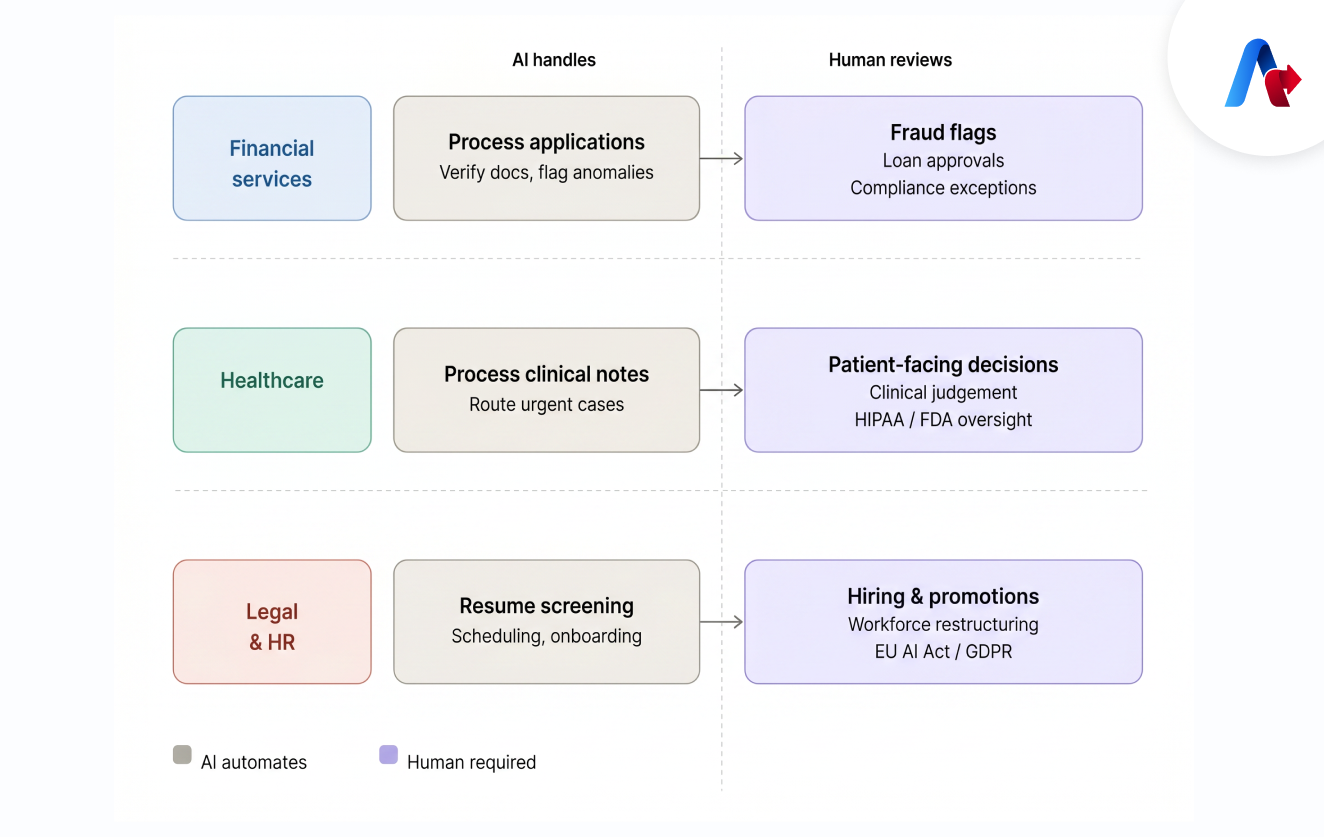
HITL is not important in all areas. It means that automation removes humans from decisions where it is not vital. Decisions that are low-risk and repeatable can be avoided, but where there is risk, we need human support.
Let’s see some of the three important examples of humans in the loop AI:
Financial Services (Fraud Flags, Loan Approvals, and Compliance Exceptions)
In financial services, a false decision such as denying a loan to a creditworthy customer can cause serious issues. Sometimes, the system may fail to detect a fraud signal that costs millions. In some situations, AI may fail to comply with rules and regulations that lead to fines.
There are benefits for AI because it can process thousands of applications in a short time, verify documents and pass them to humans if there is any problem. Among financial decisions, some can be taken by humans, not just because of false issues; it is a regulatory problem.
Healthcare (Clinical Data Processing and Patient-Facing Actions)
In healthcare, it is a legal requirement to appoint a human for important decisions. For example, regulations like HIPAA and FDA guidance clearly explain that AI-powered decisions on the medical side require human oversight, especially if they affect patient care.
An AI agent processing clinical notes and routing urgent cases has tremendous advantages. But the moment that an agent's output affects a patient, a qualified professional must take the final decision. More than compliance requirements, there are some situations that usually fall outside of the AI that need human intervention.
Legal and HR (Sensitive Document Processing and Workforce Decisions)
Most organizations don’t think about this section until a lawsuit arrives. The EU AI Act Article 14 clearly explains that any decisions that influence employment or essential services require human oversight. Similarly, GDPR also restricts fully automated decisions that affect individuals, including performance management, workforce restructuring and compensation decisions.
In terms of HR, AI automation will greatly help in resume screening, scheduling, coordination and onboarding. The decisions about who gets hired and promoted need human review as per legal compliance and to ensure fairness. It is essential because the AI system trained on historical data can make mistakes unintentionally if there is no proper monitoring.
Human-in-the-Loop AI Agents: Designing Safe Agentic Systems
Understanding human in the loop AI agents is one thing, but designing an agentic system is where most enterprises struggle. In this section, let’s see how to build human intervention into agentic AI from the start. It includes decision-making rules, escalation, and a monitoring system for the long term.
When to Use Human-in-the-Loop in AI Agents — A Decision Framework
Not every decision needs the support of humans because reviewing everything will question the purpose of automation. The important matter is to understand where humans come and where automation can work. A team can use this matrix to know whether HITL is essential or not:
| Action Type | Consequence Severity | Reversibility | HITL Required? |
|---|---|---|---|
| Data retrieval / summarization | Low | Fully reversible | No |
| Routine document routing | Low | Easily corrected | No |
| Exception flagging and escalation | Medium | Correctable | Optional |
| Customer-facing communications | Medium-High | Partially reversible | Yes |
| Financial transaction execution | High | Difficult to reverse | Yes |
| Access control changes | High | Reversible but risky | Yes |
| Employment / HR decisions | High | Difficult to reverse | Yes |
| Clinical / patient-facing actions | Critical | Irreversible | Yes — mandatory |
| Regulatory filings | Critical | Difficult to reverse | Yes — mandatory |
A simple rule is to use HITL where there is risk, such as financial, regulatory, reputational, and security issues. If there is a situation where a decision is hard to reverse, you can use strong human support.
Not sure which decisions in your workflows fall into the mandatory category? Our team can walk you through that analysis in a single session.
Schedule a workflow review with Accelirate.
Agentic Orchestration and Human Escalation Paths
In a multi-agent system, there is no problem in deciding when humans get involved. It is about creating a smooth process for handing tasks from AI agents to humans without affecting the whole workflow.
Some orchestration platforms like Accelirate’s UiPath Maestro are built for handling such difficult tasks. A tool like Maestro works smoothly and routes to the right team and resumes the work after a human decision.
This approach is different because in the older automation, the entire process stops when there is an intervention. In the modern agentic orchestration setup, human review is built into the workflow, rather than as an interruption. In this way, enterprises can move faster while still maintaining compliance for human support.
Avoiding "Automation Drift" — Why HITL Keeps Agentic Systems Aligned
Automation drift is one thing that no vendor talks about. It means an enterprise moves from its original business goal gradually. This will not happen soon, but agents make decisions based on the feedback automatically.
For example, an invoice processing agent may start approving more since it does not get any questions about its decision. Another situation is that a recruitment agent may favor certain candidate profiles due to outdated patterns or biases in the past hiring data.
When a human checks in place, you can identify these issues before they become serious problems. Human agents see what is happening, and they can interfere if something is not right. This monitoring will help to see whether agents are aligned with the business and follow the compliance. Continuous monitoring will help to maintain accuracy and avoid any sudden surprises.
What's hardest to detect is silent failure — when the agent gives a plausible but incorrect output. These are not obvious errors and often go unnoticed. Sharad Rastogi, SME, Accelirate Inc, (The State of AI and Automation in Enterprises).
What Is Human-in-the-Loop AI Governance — and Why Enterprises Need It Now
HITL AI governance is a framework that keeps humans involved in high-risk decisions for reviewing and approving. This is essential because AI systems are becoming more autonomous, which will affect the company directly. With humans in control, a business can reduce risks, ensure compliance, and improve accountability.
The HITL is mandatory as per regulations such as:
- According to the EU AI Act Article 14, it is mandatory that high-risk AI systems must be designed with human oversight during their operational period. It comes in many ways, such as manual intervention, overriding outputs, and monitoring its behavior in real-time. Any organization that deploys AI agents for high-risk areas needs to deploy human support, especially if it affects individuals' rights, employment, health, and other essential services.
- The NIST AI Risk Management Framework is where you can find a clear approach to identifying, measuring, and managing AI risk. Human support is part of this framework. Not only that, but organizations should also assign clear responsibility for AI decisions and monitor them to ensure safety and security.
- ISO 42001 is an international level standard for AI management systems that talks about the requirement of human decision-making for a responsible AI operation.
Beyond compliance, a business also needs to ensure that any AI system they use stays aligned with its goals. McKinsey's survey highlights that AI is becoming part of every business operation, and it is unavoidable to have strong oversight and accountability.
Our Strategic Report also finds that the need for governance goes beyond regulations. Many enterprises struggle with a lack of guardrails, unclear ownership, and compliance risks that slow down or completely stall AI scaling efforts. The report clearly explains that building intelligent agents is not enough, but one needs to create governance to manage them responsibly.
Do you want to see where your enterprise AI governance stands now? Talk to our expert team and learn more about it now.
Schedule a free call at your convenience.
What are the challenges of HITL?
There is no doubt that human-in-the-loop AI brings several advantages, but they have their disadvantages, such as cost issues, security, scalability, and human errors.
- Cost: An automation can review thousands of files in five minutes, but human checking needs more time, which may cost thousands of dollars.
- Security Concern: As discussed, humans will review confidential documents that have to be kept secret for some time. Involving human agents may leak sensitive information that will affect the reputation of the company.
- Scalability Issues: Human evaluations are time-consuming, so relying on such sources can affect the scaling and delay the entire process.
- Human Errors: Humans are good at achieving better accuracy, but there is nothing without error. Comparing AI, this option can be better, but there might be a chance of human errors.
Best Practices for Human in the Loop in AI: A Practical Implementation Guide
A successful strategy has more than human approval. In this section, let’s see various steps that we can use to ensure accuracy and safety.
- Have clear escalation rules
- Human review on risky tasks
- Integrate HITL into workflows.
- Accountability for AI decisions
- Continuous improvement
Have Clear Escalation Rules
Set a clear rule for when AI should pause and request human support. For example, the AI is not confident in its decision, the decision has high risk, there are compliance concerns, and the information is incomplete. Clarity in the rules will avoid confusion and costly mistakes.
Human Review on Risky Decisions
AI is capable of taking its own action for many, but it is important to check for actions, such as financial transactions, customer impact, legal obligations, healthcare, and security.
Integrate HITL into Workflows
Build human review directly into existing workflows, not outside of them. When you build an effective workflow, it will allow employees and AI to work together efficiently without unnecessary delays.
Accountability for AI Decisions
As an organization, you should clearly define who is responsible for what. For example, one person can review, approve, and monitor AI actions, or it can be distributed among people.
Continuous Improvement
HITL is an ongoing process, so it must review AI performance to improve its accuracy. This action can reduce risks and keep AI systems aligned with business goals.
Choosing a Human-in-the-Loop AI Solution: What Enterprises Should Look For
Not all human loop solutions are the same, so a company should look for escalation workflow, governance and accountability, integration, scalability, and monitoring.
- Clear escalation workflows allow AI agents to route complex decisions to the right human person at the right moment.
- Governance and accountability are unavoidable when you look for an option. Look for a tool that provides clear action, approval, and ownership for every decision AI makes.
- Easy integration with the existing system is vital, and while fitting into it, it should not create any unnecessary delays.
- A tool must support scalability in case the volume increases, but it should not compromise on effective oversight.
- It is vital to have continuous monitoring in a tool to track performance, identify risks, and refine workflows in the future.
Accelirate governance-first approach for agentic automation is built on Human-in-the-Loop from the beginning onwards. Our agentic AI governance framework focuses on five areas: Authorization, Audit, Data Boundary, Escalation, and Drift Detection. In the human-in-the-loop AI, agents play a big role in escalation and audit pillars, so you can maintain oversight of critical AI decisions.
Deploy AI Agents with Confidence and Control
AI automation without human oversight can be riskier in this agentic world. The reasons are simple: they may move away from your business goals, create compliance issues, or sometimes make mistakes that will cost millions.
Today, human-in-the-loop AI is unavoidable as automation is more autonomous in its decisions. It is what makes adoption responsible, reduces costly mistakes and avoids legal and compliance issues. In this way, leaders and other stakeholders can trust the system that an organization follows.
Enterprises that succeed from AI are not those that adopt first. Instead, companies that scale responsibility with human checking, governance, and strategy can mitigate risks and stay in control in this AI world.
Move faster without losing control. Discover how HITL AI can help you scale agentic automation while maintaining accuracy, compliance, and trust.
Book a Free Assessment.
FAQs
HITL AI system pauses for human approval for certain areas that need special attention. There is a difference in HOTL because AI continues its work, but humans monitor it in real time, where we don’t approve of every action. HITL is fit for high-stakes, regulated, and irreversible decisions, whereas the HOTL suits faster workflows where you can correct the errors if anything goes wrong.
There are two things you need to consider before making this decision: the consequences of the action and the reversibility of the outcome. If the decisions are risky and cannot be reversed, HITL is the right solution. It can be any decisions like medical, financial and employment-related. On the other hand, if the risk is low and the data can be retrieved, full automation is preferable.
During the time of the escalation, it may create some delays, but it will prevent errors and compliance issues that cost money and affect goodwill. In a better-designed environment, artificial intelligence learns from human feedback and improves its accuracy and confidence. In the future, the AI may need only a few escalations as it learns from past actions.
Several regulations and frameworks require human control for certain things, especially for something that has a high risk. The list includes the EU AI Act, GDPR, HIPAA, and ISO 42001. If you are in the U.S, financial regulators also require human support and explainability, especially if you involve AI in credit, fraud, and other high-impact outcomes.
Through Reinforcement Learning from Human Feedback, HITL can improve its accuracy. Here, AI listens when humans review and correct, which will help the model to learn and improve. Finally, the AI agents get better at handling complex cases and reduce the need for human action.