



Quick Summary
Financial AI Agents are much more advanced than traditional RPA by reasoning through tasks, handling exceptions autonomously, and learning from patterns across systems. Organizations are achieving 3-6x ROI in one year through implementation in accounts payable, fraud detection, compliance monitoring, and financial closing. By adopting a four-phase approach of practical execution and proper governance frameworks, finance teams can automate high-volume workflows while maintaining control, transforming operations from routine task processing to planned, impact-driven decision-making.
What would a finance operation look like if routine repetitive tasks, which take up a major fraction of the workforce's productive time, could manage themselves, decisions could be made in real-time, and workflows could be adapted through automation?
This is an extensive resource guide for financial executives interested in learning about AI agents in finance. It introduces the next revolution beyond RPA and rule-based automation. With 98% of CFOs reporting investments in automation resulting in a decrease of 90% in reporting errors, the financial industry is clearly stating a transformative shift in accuracy, efficiency, and operational stability.
Why AI Agents Are a Game Changer in Financial Services
As a CFO or decision-maker, you are aware of the problems that your team is constantly dealing with, such as reconciliations, compliance checks along with month-end close cycles, while ensuring rapid insights, better controls, and greater efficiency.
Finance has always been a data-heavy, rule-driven process. That's exactly why it's one of the first industries to encounter the full impact of AI Agents. But here's the key thing; most finance teams are still stuck using tools built for a different era. RPA promised to fix repetitive tasks, and it did, partially. It could follow a script. What it couldn't do was think, adapt, or make decisions when unexpected circumstances occur.
However, AI Agents work in a unique way. They don't just execute tasks but also reason through them. They can handle exceptions, learn from patterns, coordinate across systems, and flag problems before they escalate into crises. For financial services, that's not a small upgrade but a fundamental shift in how work gets done.
How Finance AI Agents Differ from RPA and Traditional Automation
RPA is designed to follow predefined steps with accuracy. It is limited to a fixed checklist and cannot operate beyond those rules. However, AI Agents are system built to understand goals, context and have the ability to adapt as per their changing environmental situations. Here is a simple illustration to define the key differences:
| Capability | RPA | AI Agents |
|---|---|---|
| Decision-Making | Rule-based only | Reasoning and context-aware |
| Exception Handling | Fails or escalates | Adapts and resolves |
| Learning Over Time | Static | Improves with feedback |
| Multi-system Coordination | Limited | Native & seamless |
| Unstructured Data | Cannot process | Reads, interprets, acts |
What Are AI Agents in Finance?
An AI Agent in finance is a software program that can monitor its environment, make decisions based on objectives, and take autonomous action to fulfil end-to-end workflows either with or without human intervention. This is a drastic change from traditional rule-based systems that require definite programming for each case. AI agents in Finance can be trained to function autonomously within organizational parameters, reacting in real-time to new information while considering the context of a decision.
An AI agent can be presented with an invoice, check it against a purchase order in your ERP system, point out an inconsistency, compose an email to the supplier, and record the exception, all without human interaction. This is no longer a future concept but operating in real workflows right now.
Key Components of a Finance AI Agent
- Perception Layer: Consumes data from invoices, emails, ERP/CRM, and market feeds.
- Reasoning Engine: Employs an LLM to reason about context, policies, and the best course of action.
- Action Layer: Performs actions such as updating a record, sending an alert, or creating a report.
- Memory & Learning: Retains context information across sessions and learns from outcomes.
The Rise of AI Agents For Financial Services
The immense growth of AI agents in the finance industry is quite impossible to ignore. The global market for AI agents in finance is projected to grow from $490.2 million in 2024 to $4,485.5 million in 2030, at a compound annual growth rate of 45.4%. This projection is not a forecast for growth but is rather based on the current returns that financial institutions are already experiencing.
By the end of 2025, 67% of the financial institutions were using AI on a large scale, as compared to 37% in 2023. What triggered this sudden shift? Three things came together. LLMs had developed to the point where they could handle complex financial calculations, cloud computing enabled large-scale deployment, and regulatory agencies started to integrate understandable AI. The leaders are already gaining a competitive advantage.
Benefits Of AI Agents In the Finance Industry
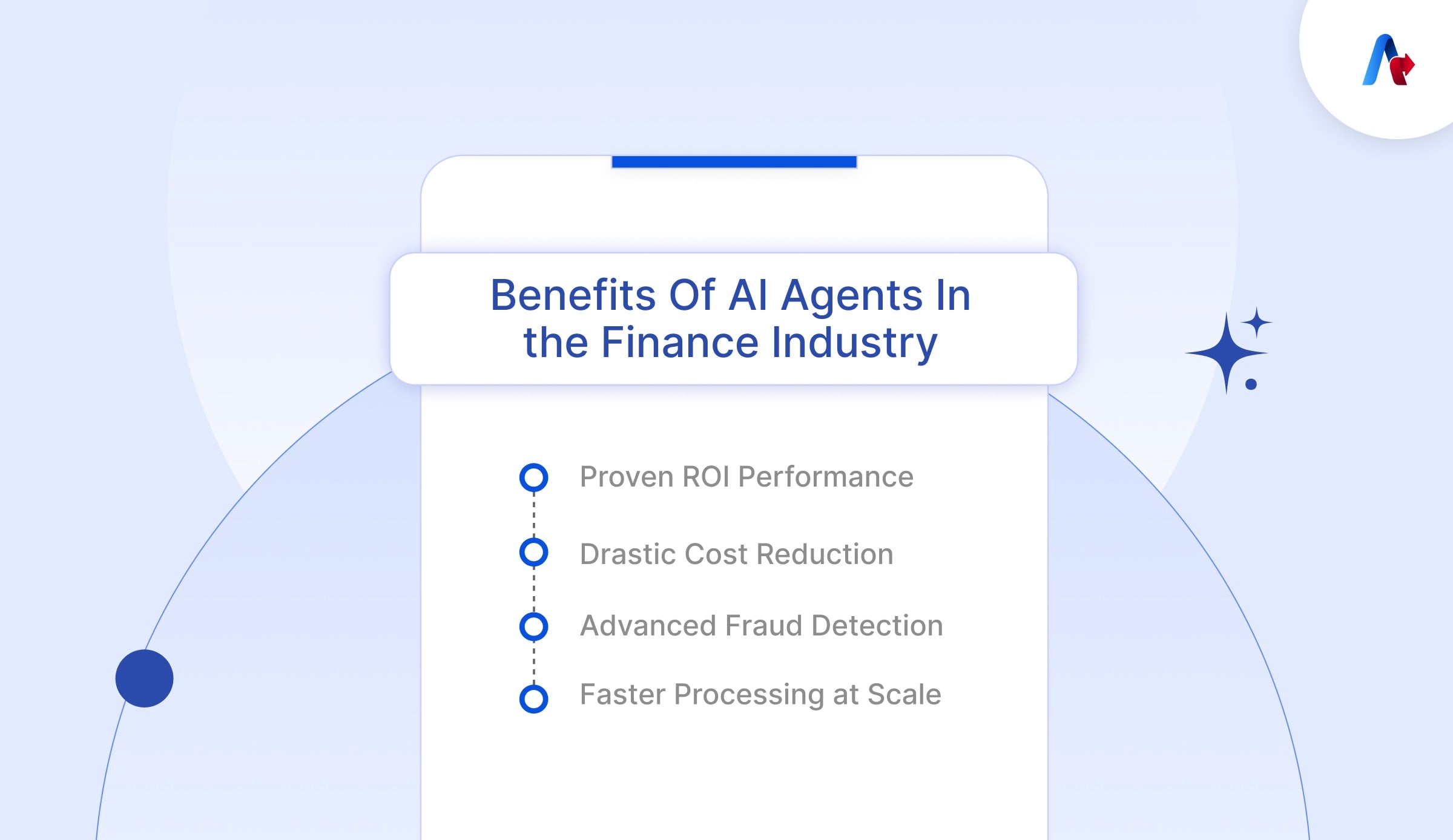
The benefits of AI agents in the finance industry aren’t just about saving time. Here's what finance leaders are actually seeing when they deploy AI agents in finance at scale:
- Proven ROI Performance - Organizations are seeing 3x to 6x returns in the first year of deployment, with 62% of organizations seeing more than 100% ROI from Agentic AI deployments. Autonomous Agents are showing an average ROI of 80%, which is substantially higher than the general AI project ROI of 67%.
- Drastic Cost Reduction - Financial institutions have reported 40-60% efficiency gains and cost savings in areas such as onboarding, compliance and settlement. The average annual expenditure on AML/KYC operations alone is $72.9 million per company. AI agents are directly attacking these cost structures.
- Advanced Fraud Detection - AI-powered fraud detection systems significantly improved accuracy while reducing manual investigation workloads. One financial institution reduced fraud losses by 78% while maintaining 99.2% accuracy. Financial institutions are achieving notable annual savings by utilizing AI for fraud detection.
- Faster Processing at Scale - AI agents can process thousands of transactions in the time it takes for a human analyst to review ten transactions. ABN AMRO Bank achieved an 80% reduction in KYC onboarding time using AI agents. Month-end close cycles that took five days can be compressed to one
Top AI Agents For Financial Services
The market for top-rated AI agents for financial services is maturing quickly, with investment patterns favouring mature, scalable solutions over experimental pilots.
Categories Of Leading AI Agent Solutions
- Agentic ERP Platforms - AI agents are integrated in the enterprise systems that automate AP/AR, close cycles, forecasting, and reporting with native data access. The best platforms include solutions that are coordinated directly with the existing financial infrastructure.
- Transaction Monitoring & Fraud Detection Agent – It continuously tracks financial transactions, flags suspicious patterns, and alerts teams instantly to help prevent fraud and protect customer accounts in real time.
- Regulatory Compliance Reporting Agent - Gathers required data, validates accuracy, and prepares compliance reports on schedule, helping financial institutions stay audit-ready and meet regulatory standards effortlessly.
- Invoice Processing Automation Agents - These agents read, verify, and process invoices automatically, reducing manual work, avoiding payment errors, and accelerating the accounts payable cycle. Organizations deploying these solutions report 60-80% reduction in processing costs.
- Audit Trail Validator Agents - These agents ensure every financial transaction and change is logged correctly, making audits easier and ensuring regulatory transparency throughout the organization.
- Portfolio Management Agents - Solutions that handle trillions of dollars in assets with AI overlays, integrating emotional intelligence via sentiment analysis and adjusting portfolios dynamically based on market data and risk profiles.
Agentic ERP Platforms
The best AI agents aren't just technically capable because they are built for the realities of finance. Financial leaders are advised to look for solutions that offer explainability (agents that can show their reasoning), deep integration with existing ERP and data systems, strong audit trails, proven ROI within 3-6 months, and the ability to operate within regulatory limitations out of the box.
Related Read: Top AI Agents to Boost Productivity & Automate Workflows
AI Agents For Financial Services Use Cases (Practical Examples)
Here are the AI Agents for financial services use cases that are generating the highest impact right now, supported by real deployment data.
Accounts Payable & Receivable Automation
AI Agents in corporate finance automate the processing of invoices and entry of data, which is an everyday activity for 20% of finance teams. AI Agents also identify duplicate invoices, detect fraud, and prevent overpayments. The best AI systems are trained on billions of processed invoices to make context-driven predictions that classify between valid exceptions and errors.
Fraud Detection & Risk Monitoring
Real-time transaction monitoring is an area where AI agents truly excel over traditional systems. They analyze transaction behaviour, user activity, and context information in a combined manner to form an end-to-end risk picture. Financial institutions using AI for fraud analysis have shown an accuracy improvement of up to 80%. AI systems are able to block 92% of fraudulent transactions in real-time, on the other hand, traditional systems typically detect fraud hours or days after the event.
Compliance, KYC & AML
Know Your Customer (KYC) and Anti-Money Laundering (AML) procedures are known to be highly manual, with banks dedicating a significant amount of workforce to KYC and AML activities. The average annual expenditure on AML/KYC operations is $72.9 million per firm. The use of AI agents is changing this reality. The use of advanced AI agents in KYC/AML has seen a sharp increase from 42% in 2024 to 82% in 2025.
Algorithmic Trading & Portfolio Management
AI Agents drive algorithmic trading by processing large amounts of market data to discover trading opportunities. The best portfolio management tools handle trillions of dollars in assets with AI layers that detect investor distress using sentiment analysis. AI Agents automatically capture tax losses by tracking positions in multiple accounts and making trades to maximize tax efficiency.
Financial Close & Reporting
Month-end and year-end close processes involve huge volumes of verification, journal entries, and reporting. AI agents perform sub-ledger reconciliations, analyze and explain differences, prepare draft financial statements, and prepare board-ready summaries and reduce cycle times by 40-60%. Controllers can focus on review and strategy instead of data cleaning.
Measuring ROI of AI Agents in Finance
When looking at AI agents in corporate finance, every CFO asks, "What is the ROI?" and the data is convincing. Within the first year, companies stated that they earned 3X to 6X ROI. For every $1 spent, organizations often see $3 to $6 in measurable value but the real strength of AI agents in finance comes from their ability to compound returns over time.
How to calculate tangible and intangible ROI
Tangible ROI — Quantifiable factors
- Labor hours saved × hourly rate of displaced work
- Error reduction × average cost of a financial error (rework, penalties, audit findings)
- Cycle time reduction × value of faster cash conversion
- Fraud prevented × historical loss rates
- Compliance cost avoidance × regulatory fine benchmarks
Intangible ROI — Strategic factors
- Decision quality
- Talent repositioning
- Employee morale and retention
- Audit and regulatory readiness
- Reputational risk avoidance
- Organizational agility
- Vendor and counterparty trust
- Scalability without proportional cost
Industry-Specific ROI Benchmarks
Banking institutions are seeing a strong ROI in 8-24 months, with large banks preventing $1.5B-$4B of annual fraud losses. Customer service operations attain 4.2x ROI by employing AI agents to respond to 70% of incoming calls. Accounts payable automation achieves a 60-80% reduction in processing expenses with an 80% average ROI. Most companies accomplish tangible ROI in 3-6 months after deployment
The Compounding Effect
The AI Agents enhance themselves and their performance through feedback loops. The accuracy of the fraud detection systems increases by 15-25% every year as more transactions is analyzed. This self-improvement causes the ROI to grow significantly, where $1 invested in the current year could result in $3.60 in Year 1, $6.50 in Year 3, and $12 in Year 5. The infrastructure developed for the initial AI agents cuts the cost of future projects by 30-50%.
Implementation Roadmap for AI Agents in Financial Services
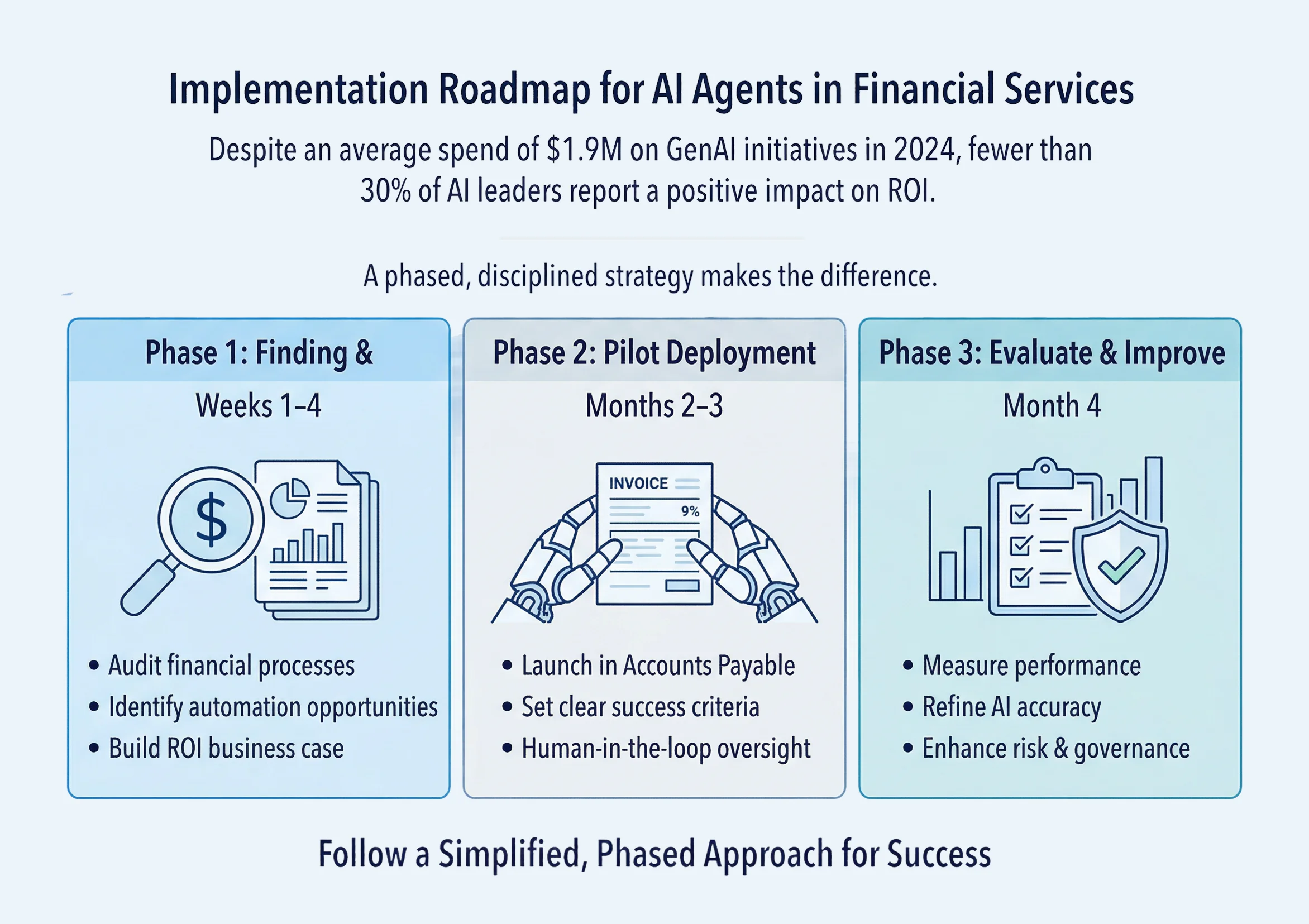
Despite an average spend of $1.9M on GenAI initiatives in 2024, fewer than 30% of AI leaders report a positive impact on ROI. The difference lies with strong returns applied with purpose and discipline. Here's a phased approach that works:
Phase 1 - Finding And Ranking (Weeks 1–4)
Start by doing a structured audit of your current financial processes to find places where you can automate things. Pay special attention to workflows that are high-capacity and have a lot of errors. Move forward to make a disciplined business case with ROI estimates and make sure your current systems can work together before you move on to the application.
Phase 2 - Pilot Deployment (Months 2–3)
Start with one clear and important use case. People often see accounts payable as a test because it gives them scale, control, and responsibility. Set success criteria from the beginning. For exceptions, there will be a human in the loop at first. Companies that use agentic AI systems a lot say they get more money back.
Phase 3 - Evaluate And Improve (Month 4)
Check how well you did compared to your first foundation. Check that agent decisions are correct and that they follow the rules, as well as close combined loops. To be successful, you need to use AI directly in your business processes and treat AI agents the same way you would treat human employees when it comes to accuracy.Combine the paperwork for risk and audit governance.
Phase 4 - Scale And Grow (Months 5–12)
Use in new business areas and use cases. Executives who use agentic AI tools every day for things like accounts payable will get better results than those who only use them to try things out. Training can help you learn more about your own business. Check for changes in models and rules on a regular basis. Include AI agent performance metrics in your regular reports.
Security, Compliance & Risk Considerations
Given the growing focus on regulatory governance in the financial sector and the increasing frequency of deepfake fraud, security and observance are no longer optional. Here is what must be in place:
- Regulatory Alignment - The EU AI Act has categorized AML/KYC AI systems as high risk and demands transparency. The OCC and FinCEN in the U.S. stress the need for explainable and auditable ML practices. In APAC, regulators advocate Responsible AI guidelines. Your AI agents must be aligned with regional regulations.
- Data Governance & Privacy - Given the GDPR's enforcement of stringent data protection requirements, it is necessary to specify what kind of data agents can view, where the data is stored, and who can view the logs. The principle of least privilege should be followed. It is a challenge to balance the need for explainability and model transparency with the need to protect customer data.
- Explainability & Audit Trails - All actions performed by an agent must be recorded along with a reasoning trail. This is not a negotiable requirement from a regulatory perspective. Traceability of AI decisions is now expected by regulators. Most banks are underestimating the effort required for data harmonization before deploying AI.
- Human Oversight & Accountability - Build workflows with significant human checkpoints, especially for high-value decisions. In AI-powered ecosystems, the final accountability is always human. Human-in-the-loop systems maintain judgment and accountability.
Future of AI Agents in Financial Services
By 2029, Agentic AI will automatically and on its own solve 80% of frequent customer service inquiries, which will result in a 30% decrease in operational expenses. The next few years are going to be all about multi-agent orchestration systems, which are basically a series of highly specialized agents that collaborate on the entire finance function.
There's a Financial Planning & Analysis Agent (FP&A) that provides data to a reporting agent, which notifies a compliance agent, which then initiates an action in an Accounts Payable Agent (AP), and all of this happens in real-time and is interconnected. In the long run, we'll see AI agents that function in highly regulated spaces with real-time regulatory updates, which will automatically modify their processing logic when new regulations come out.
Choosing the Right AI Agents for Your Financial Services
For most finance leaders, the real question isn't whether to adopt AI agents rather it's about figuring out where to begin and how to get it right. The proof is already there, teams are using these systems every day for accounts payable, compliance monitoring, financial close, and fraud detection. The difference between those who succeed early and those who struggle later isn't about having access to better technology. Everyone has access to the same tools. What matters is starting smart and picking a use case with real volume, measurable outcomes, and controlled risk. It's about building solid governance from the start and recognizing this isn't just another IT project but a fundamental shift in how your finance function operates.
Finance industry has always valued accuracy, speed, and trust, and Agentic automation provide all three. Solutions like Accelirate's Invoice Processing Automation, Treasury Cash Flow Forecast, and Regulatory Compliance Reporting agents are helping finance teams automate workflows while maintaining control and transparency. Organizations that are starting to adapt AI Agents and gaining institutional knowledge will gain a competitive advantage in the financial markets.
FAQs
Yes, AI agents can produce audit-ready financial reports with complete data path reflecting all sources and decisions. However, the agent’s structure for your particular regulatory environment will determine compliance, and human-in-the-loop is still necessary.
AI agents directly interact with your ERP and financial systems, and then automatically perform tasks such as extracting actuals, comparing them to budgets, preparing difference explanations, and pointing out irregularities. Each step is recorded for analysis and auditing.
The organizations that implement AI agents in accounts payable usually witness a significant decrease in the cost of processing invoices and a substantial reduction in cycle times. The payback usually improves as the agents learn and become more efficient with time.
Key use cases cover all areas of the entire finance operation, including loan origination, KYC and AML compliance, fraud detection, accounts payable and receivable automation, financial close acceleration, FP&A forecasting, algorithmic trading, and customer onboarding processes.
Yes, AI agents are constantly tracking transactions against regulatory requirements, keeping audit trails, and generating documentation for review by examiners much quicker than manual methods. They also alert changes in regulations that need updates to internal processes.
No, AI agents redefine the role of the analyst instead of replacing them. The AI agent takes care of the mechanical process of data gathering and processing, which is what the analyst spends most of their time on. This allows the analyst to concentrate on decision-making and strategy.