



Quick Summary
Retail executives are beset by a triple threat: uncertain demand, fragmented systems, and competitor price changes that occur faster than the review cycle, quietly eroding 5-15% of possible margins. Agentic merchandising employs autonomous AI agents that observe real-time market information like sales velocity, inventory, and external trends and deduce actions such as price fluctuation, inventory transfers, and promotion moves in rapid fresh intervals.
This executive brief explains the essential limitations of traditional merchandising, contrasts agentic scalability, identifies the four essential capabilities that drive P&L outcomes, examines challenges and reduction techniques for implementation, reports actual retailer performance, outlines a pilot plan, and pictures the competitive shape of 2030, where agentic market leaders will hold 30-50% market share.
What is Agentic Merchandising?
Agentic merchandising leverages AI agents that automatically analyze sales, market, and inventory information to make real-time decisions regarding pricing, products, and promotions. Like other assistants that use artificial intelligence, these AI agents do not simply assist but instead work towards achieving business objectives such as maximizing gains while following specific rules.
This approach is particularly suitable in the current context of the rise of e-commerce and the consequent disruption of the supply chain, where the capability of human effort alone is no longer sufficient. This technology brings about a complete revolution in the way the complex retail operations are handled by optimizing complex merchandise tasks into simplified and efficient ones. This is because it maximizes the extraction of profits by minimizing unnecessary operational inefficiencies, thus giving rise to the entirely different landscape of retail merchandising.
Agentic Merchandising Agents optimize the entire product value chain, ranging from acquisition and allocation to devaluation with no extra operational complexity on their part. They forecast trends and external variables and make decisions and implement recommended actions automatically without human intervention.
Traditional Retail Merchandising vs. Agentic Merchandising
Traditional Merchandising process has cycles of activity that revolve around regularly allocated time to collect data, make predictions, discuss these predictions in company meetings, and then apply these decisions, which can take weeks. Prices are updated every week, promotional activities are planned for months, and stock changes are driven by out-of-stocks or overstock of unsold merchandise. This process requires intense manual processing of algorithms.
In contrast, Agentic Merchandising relies on AI agents to execute self-driven and continuous tasks. Such systems work on real-time data streams, entailing predictions for demands, setting optimal pricing, and determining inventory levels in split-minute cycles. The process makes decisions to integrate across various channels automatically. The result provides scalability for millions of SKUs, error-correcting feedback mechanisms for better performance, and micro-segmentation for hyper-personalized recommendations.
| Aspect | Traditional Merchandising | Agentic Merchandising |
|---|---|---|
| Decision-Making | Periodic manual review of aggregated reports is prone to delays and cognitive biases. | Autonomous continuous reasoning on live data streams, integrated with probabilistic models |
| Speed | Weekly or longer cycles of adjustments, including approval workflows | Loops of real-time prediction, decision, and action, typically sub-minute for changes in prices |
| Scalability | Limited by team bandwidth; usually 100-500 SKUs per analyst | Handles seamless portfolio-wide operations scaling to millions of SKUs across channels. |
| Error Mitigation | Dependent on human judgment with error rates derived from missed supervision or lack of complete visibility | Self-improvement via iterated learning and feedback loops, reducing errors over generations. |
| Personalization Scope | Broad customer segments are based on demographics or basic RFM analysis. | Individual-level adaptations by means of real-time behavioural analysis and micro-segmentation. |
Get Your Custom Agentic Roadmap
Speak to Our AI TeamCore Capabilities of Agentic Merchandising

Agentic systems have a definite predict-decide-act cycle. They predict demand at SKU & geography based on sales and external inputs, and execute specific decisions (not just order quantities, markdowns, but also other actions) through established boundaries (e.g., order, price, campaign).
The strengths of a company are
- Dynamic pricing Adjusting prices in real-time based on sales speed, competitor prices, and demand signals to maximize profits during high demand while maintaining minimum profit levels to protect brand values.
- Inventory refill It helps in managing the product category effectively by analyzing the demand for each item, thus making way for accurate replenishments.
- Promo budget allocation Uses performance metrics to dynamically allocate budgets to high-velocity areas or products to maximize ROI on promotions and avoid allocation guesswork.
- Supplier negotiations Enables efficient negotiations for purchase orders within set parameters such as volume limits or lead times, thereby cutting down email threads by 50% or more in procurement negotiations.
In-built guardrails ensure that all activities always remain on strategy, while fully auditable trails enable reviewing and intervening at any time.
Why Agentic Merchandising Is the Next Evolution in Retail Automation
Automation in retail has passed through various generations of technology, from rule-based automation tools to predictive forecasting, which enabled accurate demand forecasting. Currently, Agentic AI is the most modern form of automation in retail, in which there is autonomy of action. With such automation, all merchandising will be a constantly ongoing process without having to wait for regularly scheduled reviews.
In effect, a significant amount of time, often estimated to be 40% of their current spend, can be regained by merchants to focus on bigger efforts such as developing a long-term strategy, discovering new products, and optimizing their relationships with vendors, allowing for rapid responses to market fluctuations, seamless execution in offline and online channels, and making informed business decisions based on total, current knowledge instead of historic data points.
Business Benefits and Competitive Advantage
The real competitive advantage of agentic merchandising comes from unbeatable speed. In fast-moving categories like fashion, electronics, or groceries, trends and demand may change within hours. Agentic systems immediately detect the signals, test a small response overnight, and scale the winners across thousands of products or stores almost instantly. Retailers still thinking on a weekly cycle miss these critical windows of time, lose market share, and are always reacting instead of leading.
This speed, added to consistently sharp data-driven decisions and continuous learning, is creating a growing gap structurally.
Early movers, over time, achieve the following:
- Higher sell-through rates
- Lower markdown spending
- Improve Gross Margins
These begins to get difficult, if not impossible, for traditional teams to replicate without the same technology. What begins as an advantage in speed shifts into a durable and intelligent capability which only gets more powerful with every cycle.
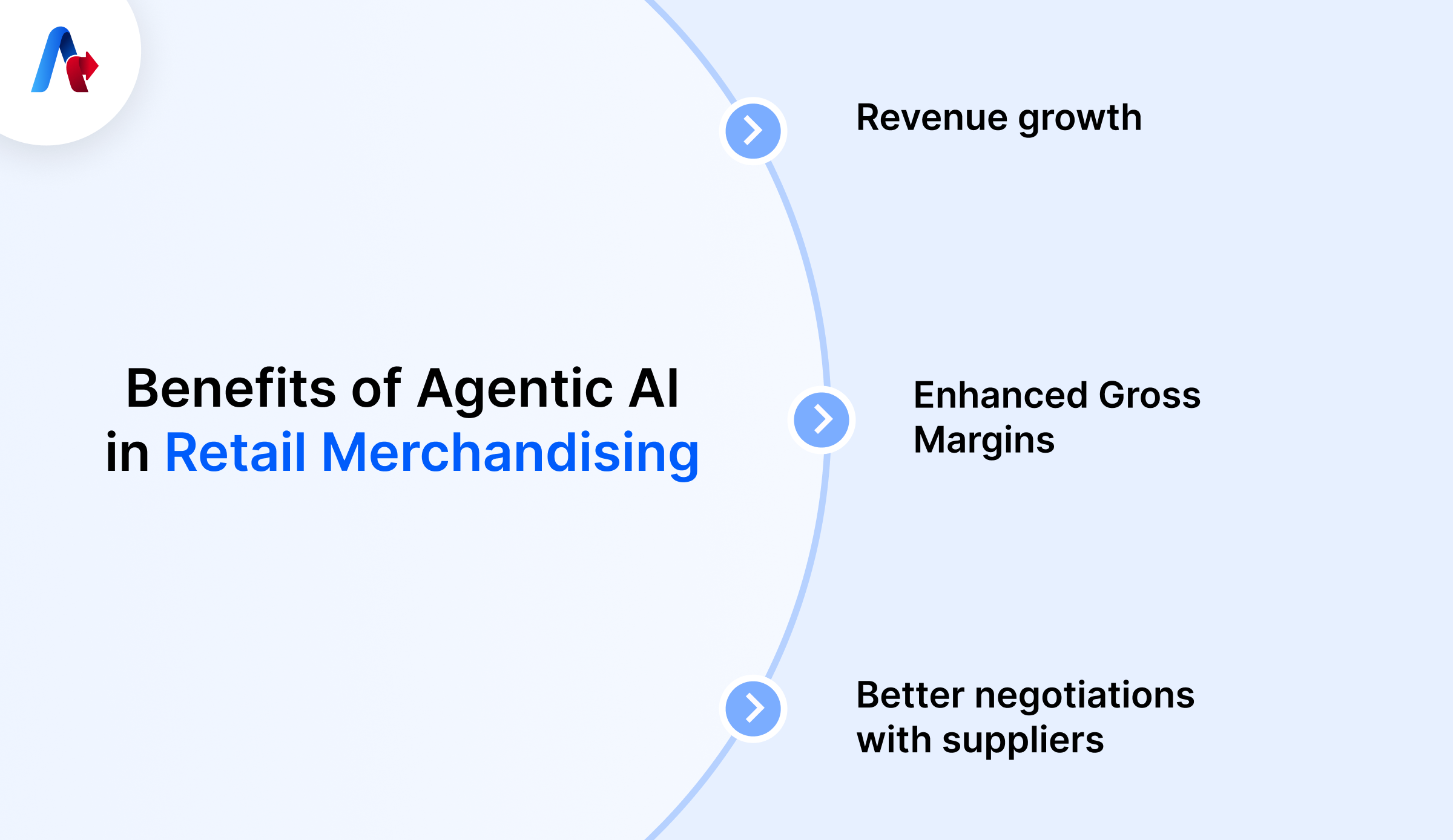
Benefits of agentic AI in retail merchandising provide rather clear, measurable gains across the P&L:
- Revenue growth More informed assortment decisions combined with strategic promotions and dynamic pricing that tap into hidden pockets of demand which will be driving revenue growth of 5%-15% while securing margins through real-time elasticity adjustments.
- Enhanced Gross Margins Reduces waste through optimized inventory movements, eliminates discounts from fire sales, and achieves optimal stock levels, which reduces overstock/stockout expenses by as much as 50%.
- Better negotiations with suppliers Provides clear, precise insights, such as the precise frequency of stockouts and their impact on lost sales, to negotiate better conditions, terms, and priority fulfillment with suppliers.
Together, these improvements create a virtuous cycle of higher top-line performance, healthier profitability, and more effective use of capital.
Transform Merchandising with Agentic AI
Get Started TodayChallenges and Considerations While Implementing Agentic Merchandising
Agentic merchandising holds the key to immense autonomy but requires active measures to mitigate potential drawbacks—to approach these issues as problems to be solved, not as roadblocks.
- Insufficient guardrails Unchecked price volatility or sharp reductions can destroy brand trust in a single night; bake in tough limits such as margin floors and promotion caps from launch day one.
- Data quality issues Garbage in, garbage out. Focus on cleaning up data pipelines and validation processes for sound AI reasoning.
- Lack of training Teams will not resist if they are trained on how to use the tool; provide training sessions to interpret the results and move the roles of the teams to a strategic level, which will increase adoption.
- Security vulnerabilities Agents handling sensitive information are susceptible to breaches; implement role-based access, encryption, and audit trails for compliance and assurance.
Retailers have not been fully prepared for this shift. Industry surveys have found that 71% of organizations have experienced little impact from their past AI projects, and 61% say they do not have success in mind for more sophisticated uses of AI.
Risks of Agent-Based AI Retail Automation: They essentially revolve around three main themes:
- Strong governance processes for ensuring all strategic decisions remain focused on brand guidelines and boundaries
- High integrity of the data to provide assured and dependable output
- The crucial cultural transition needed involves shifting teams from manual control handling to new roles as supervisors and guides for intelligent systems.
These issues must be addressed proactively to convert what might become obstacles into structured steps towards successful adoption.
Real-World Use Cases of Agentic Merchandising
The Agentic AI achieves concrete outcomes for all retailers. Supermarket executives use McKinsey-type signal briefs for immediate solutions based on tasks such as rebalancing the promotion budget on energy drinks or correcting prices for food items through huddles conducted on a minute-by-minute basis.
Apparel teams use Peak.ai rebuy agents to negotiate supplier POs through automated emails, cutting communication time by 50%+ when dealing with budget escalations. Peak.ai also auto-executes campaigns and replenishes inventory.
McKinsey spotlights vendor sessions on AI-driven benchmarking for margins and scripts, converting reviews to monthly plans for growth. Syntheum.ai improves search and personalization on e-commerce platforms to increase conversions on their sites
How to Get Started with Agentic Merchandising
To begin with, a successful start with Agentic Merchandising involves overlaying AI agents onto your retail operations to automatically complete “predict-decide-act" loops, thereby improving profitability with increased speed, rather than attending futile meetings. The implementation takes a trust-building case-by-case approach by starting small to demonstrate its effectiveness in certain domains, such as dynamic pricing or inventory balancing.
Identify Biggest Pain Points
Get Your Custom Agentic Roadmap NowFuture Trends in Agentic Retail Automation
Looking forward, agentic retail automation technology is set to develop at a rapid pace due to these key points:
- Increased cross-functional integration, linking the supply chain to the shelf in real time
- Common protocols for secure, effortless sharing of context among systems, including partners.
- Rapidly increasing level of autonomy based on improving data quality and models learning quickly from results
- Humans maintain strategic control and the normal implementation process is totally automated
The competitiveness gap will increase dramatically. Those who have perfected AI Orchestration will be racing well ahead, and those who have yet to move beyond human processing will be lagging behind. It is estimated that by the year 2030, agentic systems will have a direct influence or control over a significant percentage (30% to 50%) of total sales in progressive enterprises.
Ready to Solve Your Retail Challenges with AI
Book a Strategy CallUnlock Agentic Merchandising for Retail Success
Agentic merchandising evolves retail automation by empowering AI agents to handle “predict-decide-act" cycles autonomously, slashing overstock by up to 50%, reclaiming thousands of manual hours and delivering real-time personalization as seen in streamlined inventory and POS optimizations. Retailers that address demand instability, disconnected systems, and slow decisions with the above-mentioned approach realize better sell-through, lower markdowns, and continued margin gains, positioning teams to lead rather than react in fast-moving markets. For your unique inventory gaps, pricing challenges, or supply chain hurdles, take advantage of custom AI frameworks and agent orchestration with Accelirate's experts for a precise, actionable roadmap.
FAQs
AI agents provide hyper-personalized recommendations based on real-time behavioural analysis. Dynamic pricing aligns with the demand of each individual while also maintaining consistency across omnichannel. This results in increased conversions and the end of cross-platform frustration.
Price fluctuations can weaken brand trust without appropriate safeguards.
Low data quality often leads to poor decision-making, while resistance to change in teams blocks adoption. Security violation poses risk to sensitive data which train and uses access contracts to minimize
Yes, supermarkets adjust promo budgets minute-to-minute. Apparel brands auto-negotiate supplier purchase orders and cut email time by 50%+. E-commerce platforms boost conversions through AI-driven personalization.
Agents integrate online, stores, and wholesale with real-time inventory synchronization. Consistent pricing eliminates cross-channel disputes and inventory mismatches. Promotion optimization integrates perfectly with all customer touchpoints.
The agents analyze stockout and lead time information to create optimized purchase orders. Automated emails deal with negotiations that are within the volume and term guidelines. Reduces manual purchasing communication by more than 50% while securing better terms.
The full audit trail traces all the pricing and inventory decisions that have been made. GDPR/CCPA compliance and PCI-DSS for protecting payment data. Role-based access helps to ensure that governance is in line with legal and brand requirements.