



Quick Summary
As AI agents move from pilots to production, enterprises face a new operational challenge; visibility. Agentforce Observability gives business and IT leaders clear insight into how AI agents behave, make decisions, and impact outcomes. But before that it’s pivotal to understand why observability matters, what leaders should monitor, and how it helps organizations scale AI agents safely, control costs, and maintain trust.
As enterprises adopt Agentforce-powered AI agents to automate customer support, IT operations, and business workflows, a new challenge emerges: How do you monitor, govern, and trust AI-driven decisions?
Agentforce Observability provides the visibility, governance, and control required to operate AI agents as reliable digital workers. It allows organizations to track decisions, understand intent, measure performance, and manage risk, all in real time.
This guide outlines the business value of observability, the risks of operating without it, and how leaders can protect revenue, compliance, and customer trust while scaling AI agents across the enterprise.
Understand what your AI agents are really doing before it becomes a problem.
Talk to our experts todayWhy Observability Is Necessary for AI Agents
AI agents behave very differently from traditional automation tools. Before exploring observability, it’s important to understand what has changed.
Traditional systems execute predefined rules. If something fails, the failure is usually deterministic and traceable. AI agents, however, operate with far more independence and variability.
AI agents today:
- Make autonomous decisions
- Use large language models (LLMs)
- Interact with multiple enterprise systems
- Adapt behavior based on context and outcomes
- Operate continuously without human supervision
This autonomy creates new business risks if left unmanaged.
Key Risks Without Observability
- Unexpected or inaccurate responses to customers
- Silent failures that go unnoticed
- Rising cloud, API, and LLM costs
- Difficulty explaining decisions during audits
- Loss of trust from customers, regulators, and leadership
According to Gartner, by 2026, organizations that fail to implement AI governance and observability will experience twice the operational risk compared to those that do.
Observability is not about limiting AI; it’s about keeping AI accountable.
What Is Agentforce Observability (In Business Terms)?
Observability is often misunderstood as a technical concept. In business terms, Agentforce Observability answers four simple but critical questions:
- What is the AI agent doing right now?
- Why did it make a specific decision or response?
- Is it delivering the expected business outcome?
- Is it operating safely, efficiently, and compliantly?
Agentforce Observability turns AI agents from opaque systems into measurable, governable digital workers.
Instead of guessing why something went wrong, leaders gain direct insight into agent behavior, confidence levels, decision paths, and outcomes.
Key Business Benefits of Agentforce Observability
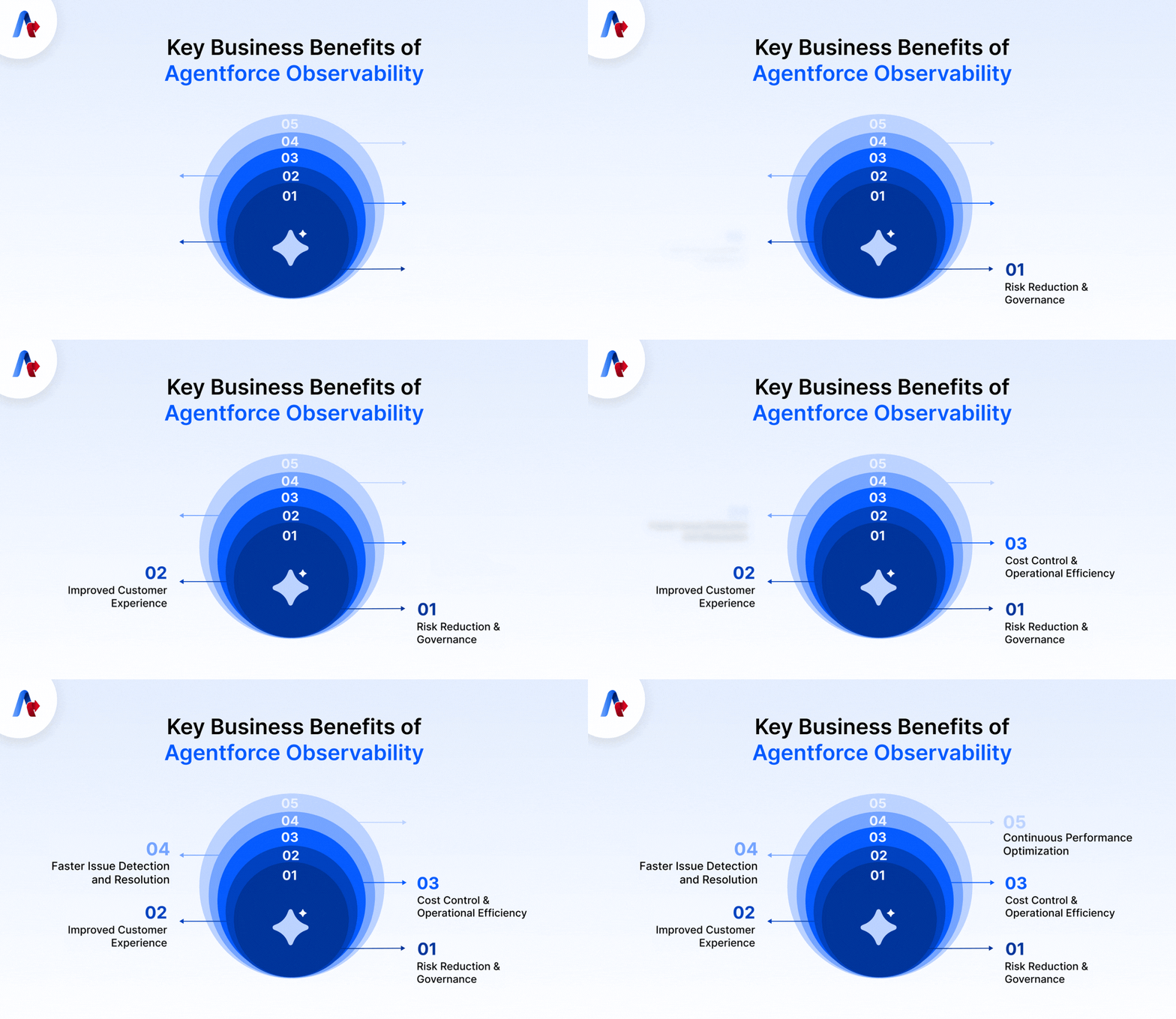
Let’s look at some of the core benefits of observability that can secure your AI agents.
1. Risk Reduction & Governance
As AI agents handle sensitive tasks, governance becomes non-negotiable. Agentforce Observability ensures that:
- AI responses align with company policies
- Sensitive data is handled correctly
- Escalations happen when confidence is low
- Full traceability for audits and regulators
This is especially important in regulated industries such as finance, healthcare, and insurance. What’s the business impact here? Reduced legal exposure, fewer compliance gaps, and stronger audit readiness.
According to Deloitte, organizations with mature AI governance frameworks reduce compliance incidents by 30–40%.
2. Improved Customer Experience
AI agents now interact directly with customers, making observability a customer experience priority not just a technical one. With observability, teams can monitor:
- Response accuracy
- First-contact resolution rates
- Repeated or failed interactions
- Sentiment indicators triggering escalation
This allows organizations to detect friction early and intervene before customer trust erodes. What’s the business impact here? Faster resolutions, higher CSAT, and reduced churn.
3. Cost Control & Operational Efficiency
AI agents can quietly increase costs if left unchecked. Common cost drivers include, excessive LLM calls, unnecessary retries, inefficient workflows, repeated API calls, and more. Agentforce Observability provides visibility into:
- Token usage tracking
- API consumption visibility
- Cost-per-interaction insights
- ROI by use case
This allows organizations to detect friction early and intervene before customer trust erodes. What’s the business impact here? Faster resolutions, higher CSAT, and reduced churn.
Business impact: Predictable AI spend and higher ROI. McKinsey reports that organizations with AI cost observability reduce AI-related spend overruns by 25% or more.
Related Read: The Real Cost of AI Agents: Hidden, Operational, and Scaling Costs Enterprises Must Know
4. Faster Issue Detection and Resolution
When something goes wrong, Agentforce observability enables teams to:
- Replay agent decisions step-by-step
- Identify prompt, policy, or integration issues
- Resolve failures without disabling agents
- Restore service faster
Instead of lengthy investigations, teams can pinpoint issues in minutes. Business impact includes lower downtime, faster recovery, and reduced operational disruption.
5. Continuous Performance Optimization
AI agents should improve over time but only if performance is measured. With Agentforce Observability, businesses can measure:
- Agent success rates
- Task completion time
- Accuracy vs. human handoff rates
- Agent productivity benchmarks
This data enables teams to refine prompts, policies, and workflows continuously. Business impact includes better outcomes from the same AI investment.
What Enterprise Leaders Should Monitor?
Observability is most effective when aligned with business priorities.
| Business Area | What to Observe |
|---|---|
| Customer Support | Resolution accuracy, escalation frequency |
| IT & Ops | Automation success rate, error trends |
| Security & Compliance | Data access, policy violations |
| Finance | Cost per interaction, LLM usage |
| Operations | End-to-end workflow completion |
Agentforce Observability vs Traditional Monitoring: What Are the Differences
Traditional monitoring tools were built for systems not autonomous decision-makers. Observability shifts monitoring from systems health to business behavior.
| Traditional Monitoring | Agentforce Observability |
|---|---|
| Tracks system uptime | Tracks AI decisions |
| Focuses on errors | Focuses on intent & outcomes |
| Reactive | Predictive |
| Limited context | Full decision trace |
When Do Businesses Need Agentforce Observability?
If AI actions can’t be explained, they shouldn’t be scaled. Organizations should prioritize observability when:
- AI agents interact directly with customers
- Decisions impact revenue or compliance
- Multiple systems are orchestrated by AI
- You plan to scale AI beyond pilots
- Leadership demands accountability for AI actions
Business Outcomes Enabled by Agentforce Observability
With Agentforce observability in place, organizations unlock:
- Trustworthy AI adoption
- Confident scaling of AI agents
- Reduced operational risk
- Measurable AI ROI
- Stronger governance and compliance
Agentforce Observability Is the Foundation of Scalable AI
AI agents are no longer experimental tools. They are business-critical assets. Without observability, organizations risk losing control, trust, and transparency. With it, AI agents become accountable contributors to business outcomes.
Agentforce Observability ensures AI agents remain accountable, cost-effective, and aligned with business goals turning innovation into sustainable value.
Got more questions?
Talk to our experts today!FAQs
It is a framework that provides visibility into AI agent decisions, behavior, performance, and compliance.
Because AI agents act autonomously, organizations must understand and govern their actions to manage risk and trust.
No. It supports business leaders, compliance teams, finance, and operations by linking AI behavior to outcomes.
No. It enables controlled autonomy without limiting performance.
Yes. It tracks usage, inefficiencies, and ROI per use case.