



Quick Summary
Thinking that the cost of AI Agents is limited to the license is not the right approach. The real cost extends beyond it, including visible and hidden operational costs. For example, an enterprise should find the cost for development, data readiness, orchestration, operations, and scaling. With the proper approach, governance, and the right partner, an organization can mitigate AI agent costs and achieve measurable ROI.
At one glance, the cost of AI Agents looks affordable until you get the first invoice after deployment.
This is the story many organizations are experiencing now. It typically starts with a low-cost pilot or a simple per-agent license. Later, agentic automation turns into a complex web that drains most of their budget. At this time, top-level leaders will think about where this money is going.
Don’t think of it as a problem with your AI system. It’s the problem with how people misunderstand the cost and its structure. Most of the time, you will see the license fees on the surface, but the real challenge begins when enterprises try to break down pricing metrics such as model usage, orchestration, scaling, monitoring, and long-term maintenance. And this becomes harder if there is multi-model pricing and unclear billing models.
Today, enterprises are looking for clear pricing structures because they directly impact business decisions, outcomes, and ROI. We will discuss here the real agent’s cost for enterprises, including hidden costs many miss, operational and scaling expenses, so you can concentrate on the real ROIs, instead of financial surprises.
Understanding the True Cost of AI Agents (Beyond the License)
Companies adopting automation will see only the license price at first. The provider who offers the service may charge per agent, per workflow and per action. Agent’s cost feels okay in this stage, especially when you see “pay only for what you use”. But this will change when you move forward with full potential.
In practice, the license fee is just an entry ticket, not the total cost.
According to IDC research, around 96% of enterprises going with GenAI and agentic automation agree that the cost is higher than expected. It means the cost may look simpler initially, but as integration and usage increase, the real cost will emerge.
Gartner also highlights that AI adoption faces real challenges, such as cost overruns and unclear ROI. There are many reasons for these expenses, such as underestimating costs, data cleansing issues, infrastructure consumption, compliance, and experimentation.
A clear understanding is necessary for the adoption because these agents do not work in isolation, but they rely on:
- Large language models (Sometimes multiple models)
- Continuous data access and integration
- Orchestration layers (For managing agent behavior)
- Monitoring, security, and governance controls
Each of these tools, integrated into your AI system, increases the cost of AI Agents. Many businesses use cross-models that increase the billing. Multi-model pricing confusion also mitigates confidence among leaders.
For example, mixing GPT-based models with a domain-specific model is different because each is billed differently based on tokens, calls, or compute time.
The cost to build AI Agents goes up when the adoption grows. In the pilot, the whole team may use 500 tasks a month, but when it becomes an enterprise model, it may reach 50,000, so the Agentic AI development costs can rise quietly but rapidly.
Not sure what AI agents would really cost in your environment? Get a quick assessment from our experts on your workflows, data readiness, and scale plans.
Get StartedCore Components of AI Agents Cost
The cost of building an agent is mostly dependent on two core components that account for most of the spending when you build an agent. These are not optional expenses but necessary for building artificial intelligence that works for your enterprise.
Cost of AI Agents in the Development & Setup
If you are thinking of building AI agents, make them based on your real business workflows. This method includes everything, including what it can do, what it cannot, how it interacts with the system and finally, when a human agent can step in. There are several costs that come with it, such as:
- Mapping workflows and decision logic
- Connecting agents to the existing system and the data sources
- Cleaning data for safe use
- Adding guardrails, approvals, and fallback mechanisms
Model & Compute Costs
Every action an agentic AI needs infrastructure, especially cloud systems and computing. Today, people use automation in such systems to improve speed and achieve better results.
These costs come from the following areas:
- How often do people use the agent
- The complexity of prompts and tasks
- The number of models involved
- Whether agents run sequentially or in parallel
When you have many agents in use, it is difficult to track the cost. Most providers charge differently. For example, one may charge per token, while another may charge per call. Without proper controls and optimization, this may go out of your control, draining most of your AI budget.
Hidden Cost of AI Agents Enterprises Often Miss (and How to Control Them)

Even well-planned AI agent building can sometimes be expensive. They are not obvious during the pilots or demos, but they surface when you start the real work with them. Understanding these costs early is essential to staying in control and avoiding other related consequences.
Let’s see what hidden costs people have encountered when deploying AI agents.
1. Data Cleaning, Preparation, and Continuous Updates
Data is one of the important parts of an AI agent’s function. Taking them from different parts, like the CRM and other systems, may take weeks or months. Sometimes, you need to deal with outdated and inconsistent data. More than that, it is a continuous process that takes time and effort.
How to manage it:
Prioritize critical data sources first, and sort them according to the priorities. Apply automation where necessary and avoid feeding agents with unnecessary data inputs.
2. Unplanned Integration
An enterprise uses plenty of legacy tools, including CRMs, ERPs, internal tools, and APIs. It is essential to coordinate such systems to get the correct output. In some situations, you may have to see the expense for refixing the integration when it breaks.
How to control it:
Always look for standardized API integration and design agents. It will adapt to system changes, so you can avoid a complete rebuild.
3. Employee Training Cost and Change Management
If you think the adoption of AI should be successful, training for employees is a must-have factor. It is new technology, and knowing how to use it can fuel the success of your plan and reduce the cost of AI Agents. When they go for training, it not only costs them, but also affects their normal routine work.
Change management is essential to avoid resistance and to ensure smooth adoption among the employees. For this, you need to announce early adoption incentives and QA sessions to address concerns that cost extra money from your pocket.
How can you manage it:
Announce early, communicate clearly, and invest in training before complete adoption. More than that, management should be the ambassador of this technology and encourage workers to adopt it.
4. Security, Compliance, and Audit Readiness
There are industries, like finance, health, and legal, where we need security and compliance audits before deployment. These industries are special because they handle sensitive information that requires compliance with regulations such as GDPR and HIPAA. So, it is imperative to use encryption, access control and human audit.
How to control it:
While building, you need to embed these governance and access policies into agents. Don’t think that you can fix it later, as it may lead to fines and legal issues.
Control hidden AI costs before they affect. Explore our agent's option with built-in cost governance from day one.
Get StartedOperational Cost of AI Agents at Scale
Agentic AI development cost is not just limited to the building but also extends to the operational side. Once the automation becomes part of your operation, this will shift from pilot to the next level.
The first cost comes from the runtime usage. All interactions count here. Whether it is a query, answering, or processing, it adds more cost. Just imagine this, a team that uses this daily in their work, and these small usages accumulate quickly.
Another issue is with reliability management to ensure that the system is not producing unpredictable behavior or facing downtime. It means an enterprise should invest in monitoring and escalation when it produces unintended results.
The next one is for maintenance and upgrade, because the technology you see today will not be the same after a year. For this, organizations need funds for updates, integration support, changes, and model improvements. Keeping agents updated as your business grows is essential for accurate information and fit with context.
Enterprises should also find the cost for customer support and troubleshooting. When agents interact with employees or customers, they should resolve issues faster to maintain trust and adoption.
Scaling Costs: What Happens When AI Agents Expand Across the Enterprise
The ROI for AI Agents will increase when you see the results. At this time, the cost of Agentic AI development may change more than anticipated. Scaling needs additional orchestration and deployment, and leads to high-volume usage. Understanding this cost is essential to avoid sudden surprises.
- Multi-Agent Orchestration Costs: For some firms, the scaling leads to a multi-agent system. The coordination of these tools increases usage, compute consumption and infrastructure requirements. The monitoring and governance are also essential, which increases the AI Agents' cost.
- Enterprise-Wide Deployment Considerations: The first stage of implementation may go with one team, but later it goes to the next level with other departments. This setup needs customization, security alignments, maintenance and other related support.
- Global & High-Volume Usage Scenarios: This is another scenario where the cost of building AI Agents increases. When people operate AI across regions, the computing demand increases and infrastructure changes. In some situations, enterprises need local customization and compliance that further change your budget.
Cost vs Value: What Enterprises Gain in Return
While evaluating the cost of AI Agents, organizations should not focus only on licenses, usage charges, and infrastructure spend. If the concentration goes to them, they miss the real question: What business outcome does this agent improve?
Including AI Agents at work will change many things, such as:
- Improving the speed and quality of the work
- Reduce operational costs
- Client satisfaction increases through personalization and recommendations.
- Employees can free up time for valuable tasks.
If you look at the monthly book alone initially, things go differently, and it looks expensive. Think about how to replace repetitive work, prevent errors, and accelerate revenue-generating processes. Implementing intelligent automation for low-value tasks can deliver less value and increase costs.
Evaluating AI from different perspectives can change everything, improve gains, and impact revenue. With the right cost-optimization strategy, your investment delivers better outcomes.
Common Myths About the Cost of Building AI Agents
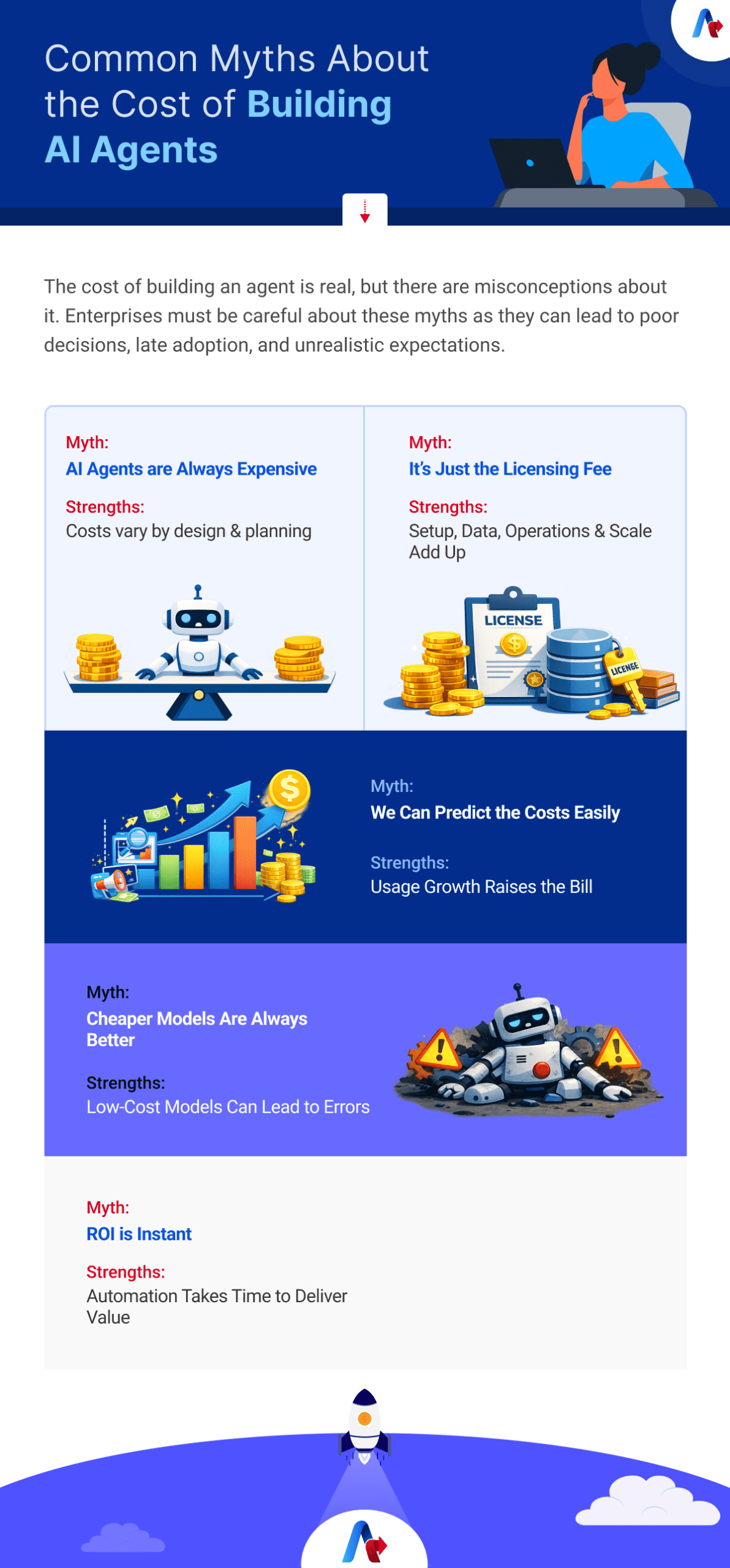
The cost of building an agent is real, but there are misconceptions about it. Enterprises must be careful about these myths as they can lead to poor decisions, late adoption, and sometimes unrealistic expectations.
- The first myth is that AI Agents are expensive. In reality, the cost depends on design, usage, and governance. If you have poorly planned agents, the cost will be higher, but if it is planned well, it will be otherwise.
- Most companies adopting automation think there is only a licensing cost. It is only the beginning, but the cost also comes from setup, data readiness, operations, and scale.
- Many believe they can predict the cost of AI Agents once they go live. The fact is that usage grows when more people use it. The bill goes high when you use per-action and consumption-based billing.
- Some believe that cheaper models are better to reduce costs. This type of model can lower your costs in the initial stage, but it increases errors, rework, and human intervention, which can change the overall cost.
- There are users who believe the ROI appears immediately. Automation delivers value progressively as the adoption matures. Evaluating success too early can lead to incorrect conclusions.
How Enterprises Can Optimize AI Agent Costs from Day One
Optimizing the cost of AI Agents is vital from day one onwards. Starting early on use cases, architecture, and execution can help control costs and improve ROI.
Start with High-Impact, Low-Complexity Use Cases
Many typically use automation across multiple workflows at once. This method looks easier, but it increases complexity and costs, and delays the outcomes of use cases that are already clear and repetitive. Using this method to get early wins helps leaders understand the pattern, cost assumptions, and improve confidence.
Design for Cost Efficiency
Plan cost efficiency in the design stage. Be precise about well-structured workflows, concise prompts, and the right model choices. Considering them is vital to reduce unnecessary model calls and computing consumption.
Clear decisions prevent agents from over-processing tasks, so the enterprises can avoid wastage. Always compare per-agent vs per-workflow vs per-action pricing and opt for the best fit.
Connect with an AI Agent Service Provider
Building an AI agent from scratch requires expertise in several areas, including data engineering, AI operations, security, and governance. Without proper experience, it may lead to errors and more cost. Partnering with a reputable service provider can avoid pitfalls, improve value, and help scale costs under control.
Future Outlook: How AI Agent Costs Will Evolve
The expense, including the hidden cost of AI Agents, is not stable. When technology improves, and enterprise adoption grows, the cost structure can have an impact and planning them will help in the future.
It is critical to understand that proper optimization can provide better competitiveness. At the same time, enterprises can also mix models based on task complexity rather than relying on a single option.
We can also think about the AI in management that will reduce operational effort. A tool like this can help with monitoring, orchestration, and governance. More than that, it can help enterprises control usage, improve reliability, and limit costs according to the situation.
The unit costs of AI may decrease, but overall spending may rise as your AI Agents take more responsibility in the future. Enterprises planning well in terms of cost can benefit from automation and success in their business.
AI Agents Are an Investment — Not a Cost Center
Treating AI automation as another technology expense is not the right approach. They are a strategic investment where you can isolate yourself from the crowd in terms of speed, decisions and efficiency.
Enterprises that use AI Agents can act early, and they move beyond license comparisons to focus on outcomes. Companies that want to be with the latest trend design for efficiency, plan for scale, and put governance in place before problems arise. Most importantly, they measure success through the time saved, errors reduced, and the revenue accumulated.
The cost of AI Agents is obvious, and it has an impact if you don’t have a better strategy and optimization. Organizations that act with the right use cases, discipline, and partnering with experienced providers, such as Accelirate, can make big differences and improve ROI. AI Agents are not expense creators but an investment that helps today and tomorrow.
Ready to move from cost overburden to measurable ROI? Explore how our AI agent strategies help you without financial surprises.
Schedule a Free ConsultationFAQs
The actual cost is difficult to estimate, but it is certain to exceed subscription fees. It happens due to integration support, data cleaning, security, and computing expenses. Total implementation costs also change based on complexity, customization, and scale. Always calculate the license, setup effort, infrastructure, and recurring operational costs to get the overall cost.
Consider hidden costs of AI, such as system integration, data cleaning, employee training, change management, compliance, and ongoing effort to optimize. Typically, these costs come across 15–25% in your budgets, especially when they connect with CRMs, ERPs, and other legacy systems. Leaving this cost can affect your budget and delay the ROI of AI Agents.
It is not expensive if you have a better strategy and approach, especially with governance. This plan includes controlling higher model interactions, computing costs, additional orchestration and infrastructure upgrades. Deploying to all areas without necessity also increases the workload, including monitoring, security, and compliance support. It will increase the overall cost of scaling, but better usage controls reduce those costs and improve ROI.
Reducing operations costs is easy if you have an efficient workflow. It can be even better if you optimize prompts, limit unnecessary model calls, and use cost-aware architectures. Always choose cost-effective models, set usage thresholds, and actively monitor consumption to avoid expensive bills. There are other ways, such as reusing components across agents and using a no-code/low-code platform to reduce ongoing expenses.
Yes, it is costly due to longer timelines, greater development effort, and ongoing support. Building in-house requires specialized skills across data engineering, security, and integration. An experienced service provider brings expertise, reusable frameworks, and governance practices that not only reduce cost but also improve value.
Data cleaning and integration are unavoidable here. The collected data will be raw, so you need to standardize it and ensure quality takes more investment. Most of the time, it may add 15–40% in total implementation costs.