How an AI Agent-Driven Healthcare Assistant Enables 90% Automated Appointment Scheduling and Seamless Patient Interactions

90%

Coverage in automated appointment scheduling

95%

Accuracy in reminder automation and AI query handling

100%

Coverage for safe home remedy and wellness guidance

5–6 Mins

Time saved per appointment scheduling task

Client Overview

Project Baymax was built for the overall healthcare ecosystem that faces significant challenges like long patient queues, doctor overload, and limited personalized care. This AI-driven healthcare companion automates non-clinical tasks such as reminders, appointment scheduling, and guidance, helping both patients and doctors save valuable time. Baymax acted as a bridge between patients and healthcare providers, ensuring smoother, smarter, and faster healthcare interactions.

Key Takeaways

  • Automated scheduling and reminders reduce manual effort
  • Conversational AI provides instant healthcare guidance
  • Structured interactions improve consultation preparedness
  • Privacy-first approach without clinical diagnosis
Healthcare teams continue to face pressure from unstructured patient interactions and manual coordination. Patients often arrive without organized symptom details or appointment planning, while staff manage scheduling, reminders, and basic guidance through disconnected, manual processes. These gaps lead to longer wait times, overloaded doctors, and inefficient patient–provider communication.
To address this, an AI healthcare assistant was introduced to automate non-clinical tasks such as appointment scheduling, reminders, and general wellness guidance. By simplifying patient interactions before consultations, the solution helps reduce administrative effort, improve preparedness, and enable smoother healthcare experiences.

Solving Patient Coordination and Scheduling Gaps with an AI Healthcare Assistant

Healthcare workflows often break down before a patient even meets a doctor. Manual appointment booking, missed reminders, and unstructured symptom sharing increase wait times and administrative load. To address this, an AI healthcare assistant was implemented to automate non-clinical interactions and streamline patient coordination through a conversational interface.
Conversational Healthcare Assistant

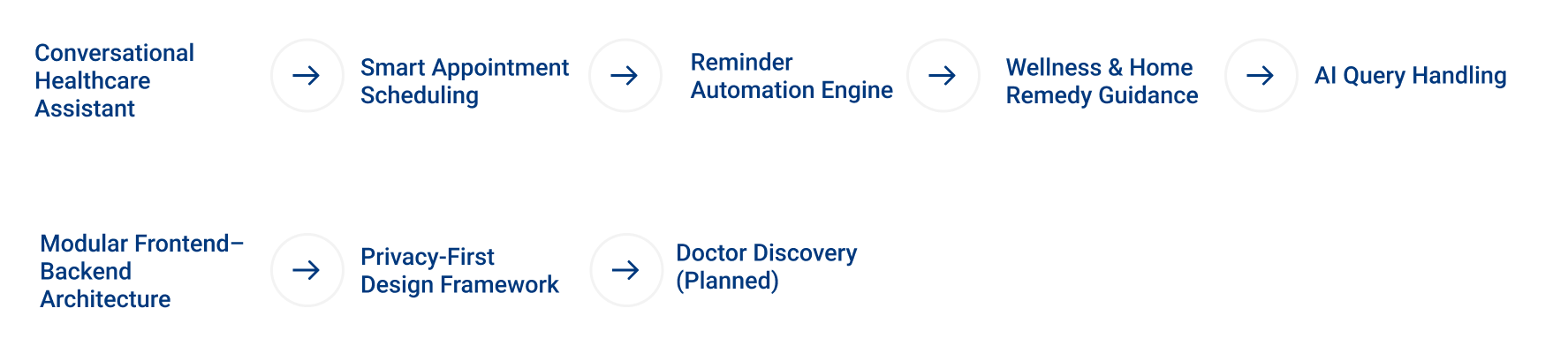
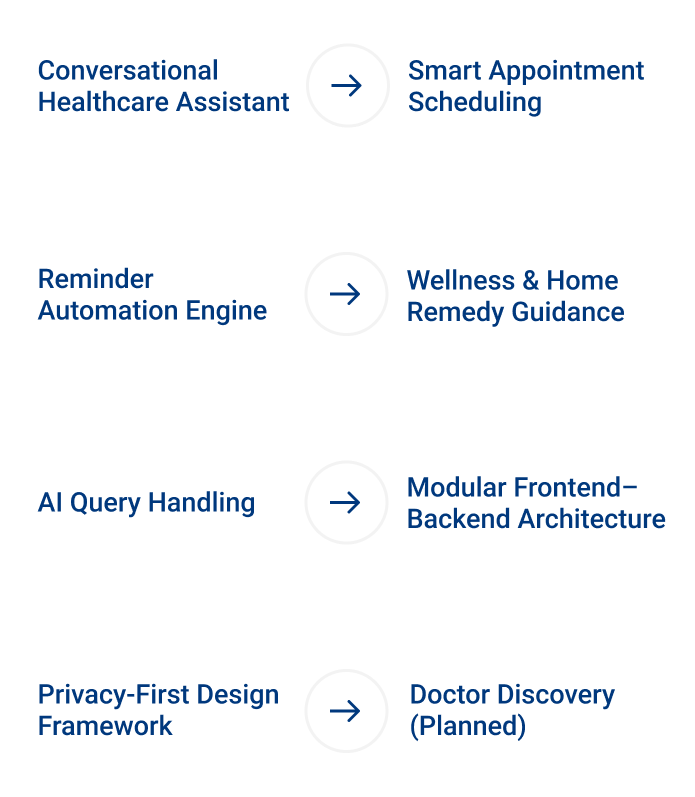
01 – Conversational Healthcare Assistant

Enabled natural, chat-based interaction for patients using a conversational AI interface built with Gemini SDK and FastAPI, allowing users to ask questions, set reminders, and manage appointments seamlessly.

02 – Smart Appointment Scheduling

Automated appointment planning and calendar coordination, reducing manual scheduling effort and improving coverage across patient interactions.

03 – Reminder Automation Engine

Integrated with calendar APIs to automatically set reminders for medications, appointments, and health-related activities based on simple user prompts.

04 – Wellness & Home Remedy Guidance

Provided safe, non-prescriptive home remedies and general wellness tips for common, low-risk conditions, ensuring guidance without clinical diagnosis.

05 – AI Query Handling

Delivered instant responses to healthcare-related queries, improving accessibility and reducing dependency on manual support for basic guidance.

06 – Modular Frontend–Backend Architecture

Designed frontend and backend systems independently to support scalability, faster iterations, and future integrations without disrupting existing workflows.

07 – Privacy-First Design Framework

Avoided collection or interpretation of personal medical data, supported by clear disclaimers to maintain ethical AI use and user trust.

08 – Doctor Discovery (Planned)

Future-ready integration planned to enable location-based doctor and healthcare facility discovery using mapping APIs.


What Was Unique About the Solution That Was Implemented?

The solution stood out by simplifying patient coordination and healthcare assistance without interfering with clinical workflows or existing systems. Instead of introducing complex medical decisioning, the AI assistant focused on automating high-volume, non-clinical tasks such as appointment scheduling, reminders, and basic wellness guidance, areas that often consume time but add little clinical value.
The key differentiator was the conversational, real-time interaction layer. Patients could trigger actions like scheduling reminders or seeking guidance through natural language, with the system responding instantly via calendar integrations and AI query handling. This reduced manual follow-ups, improved preparedness before consultations, and created a scalable foundation for future healthcare integrations, without compromising privacy or trust.

Delivering Faster Patient Coordination and Smarter Healthcare Assistance with AI

The AI healthcare assistant streamlined non-clinical healthcare workflows by automating scheduling, reminders, and patient guidance. This reduced administrative effort, improved preparedness before consultations, and enabled faster, more consistent patient interactions. Key outcomes include:

01 – 90% Coverage in Appointment Scheduling

Automated scheduling reduced manual coordination and improved appointment planning consistency.

02 – 95% Accuracy in Reminder Automatio

Medication, appointment, and health activity reminders were reliably triggered through calendar integrations.

03 – 5–6 Minutes Saved per Scheduling Task

Automation eliminated repetitive manual steps in appointment booking and follow-ups.

04 – 100% Coverage for Wellness & Home Remedy Guidance

Patients received instant, safe guidance for common, low-risk conditions without clinical intervention.

05 – Instant AI Query Resolution

Healthcare-related queries were handled in real time, reducing dependency on manual support.

06 – Reduced Administrative Load for Healthcare Teams

Non-clinical tasks were offloaded to AI, allowing staff to focus on patient care.

07 – Scalable, Privacy-First Architecture

Modular design and ethical AI principles created a foundation for future healthcare integrations.
AI Health Assistant

Simplifying Healthcare Coordination with AI-Driven Assistance

This case demonstrates how an AI healthcare assistant can streamline patient coordination by automating non-clinical workflows such as appointment scheduling, reminders, and basic wellness guidance. By removing manual friction from these everyday interactions, the solution reduced administrative effort, improved patient preparedness, and enabled faster, more consistent healthcare experiences. Through conversational AI, real-time reminders, and a privacy-first design, healthcare teams gained a scalable foundation that supports better patient engagement without interfering with clinical decision-making.
Looking to simplify scheduling, reduce administrative load, and improve patient coordination with Agentic AI? Partner with Accelirate to explore how our Agentic AI solutions can transform your workflows. Let’s connect today.

Need a Quick Reference?

Download the mini version of our case study for easy sharing with your team.

Ask Acceliagent