



Quick Summary
As organizations move from generative AI tools to autonomous, agentic systems, governance is becoming the deciding factor between scalable success and costly failure. Many agentic AI initiatives are now expected to be cancelled by 2027, not because the technology lacks capability, but because enterprises are unprepared for how autonomy changes risk, control, accountability, and cost management across the organization. The growing Agentic AI Governance Crisis reflects a gap between how AI systems operate today and how enterprises currently manage them. Autonomous systems introduce new agentic AI risks which requires us to rethink about our traditional governance approach and adopt practical principles that allow organizations not only to scale agentic AI responsibly but also turn governance into a competitive advantage.
AI is no longer just helping teams work faster—it is starting to work on its own. What began as chatbots and copilots has quickly evolved into agentic AI systems that can set goals, make decisions, and take action across business processes without constant human input. This shift is one of the biggest changes enterprise technology has seen since the move to the cloud. But as organizations race toward autonomy in 2026, one critical piece is falling behind especially in governance.
Recently a researcher from Gartner, Harvard Business Review, and the American Bankers Association points to the same concern that the enterprises are deploying AI agents faster than they can control, explain, or audit them. That gap is creating a governance challenge defined by unclear accountability, rising costs, and unmanaged risk. The problem isn’t that agentic AI is too advanced—it’s that many organizations aren’t ready to manage it.
Today AI agents are beginning to handle customer interactions, assist with financial decisions and even respond to security events, which is why governance becomes critical at this moment as agentic AI is moving out of experiments and into real operations. Gartner’s prediction that more than 40% of agentic AI projects will be canceled by 2027 points out this reality. As budgets tighten in 2026, leaders are shifting their focus from what AI can do to whether it can be trusted to operate safely, responsibly, and cost-effectively.
What’s Causing Enterprise Agentic AI Projects to Fail
In many cases, agentic AI initiatives begin as experimental pilots driven by excitement rather than clear business needs. These pilots may show that AI can act on its own, but they also reveal how expensive and risky autonomy can be when controls are missing. Without redesigned workflows, defined decision limits, and clear oversight, these projects turn into “proofs of cost” which result in rising expenses and operational complexity without delivering enough value to justify expansion. When confidence drops, budgets are cut, and projects get quietly shut down.
Another major issue is agent washing, where existing tools like chatbots or basic automation are marketed as agentic AI. Organizations that rely on these claims often discover later that the technology cannot reason, plan, or act independently without constant human supervision. At the same time, costs increase as AI usage scales, integration with legacy systems becomes harder than expected, and compliance or security concerns emerge late in the process. By the time these issues surfaced, projects become too complex or expensive to fix.
How Agentic AI Changes Risk, Control, and Accountability
Agentic AI changes how risk works inside an organization as AI no longer just offers suggestions; it also takes action. Instead of supporting human decisions, autonomous agents can trigger workflows, move data, interact with systems, and influence outcomes on their own. This shifts fundamentally who is in control, how decisions are governed, and where accountability sits, which is why enterprises struggle to manage growing agentic AI risks without slowing innovation or losing trust.
As a result, agentic AI reshapes enterprise risk, control, and accountability in several fundamental ways:
- Risk becomes continuous, not fixed: Autonomous agents change behavior over time, so risks evolve instead of remaining static after approval.
- Control shifts from steps to intent: Humans define goals and guardrails, whereas AI determines how actions are executed.
- Accountability stays with the organization: Businesses may remain responsible for the outcome and compliance even when AI acts independently.
- Errors spread faster across systems: One wrong action can spread through integrated workflows and agents in no time.
- Costs turn into an operational risk: Unchecked agents can run repeatedly, driving unexpected cloud and inference expenses.
- Explainability becomes essential: Organizations should be able to justify the agent's actions and logic clearly.
- Human oversight focuses on high-impact decisions: People intervene only when actions cross defined risk or value thresholds.
The Biggest Governance Gaps in Today’s AI Agent Deployments
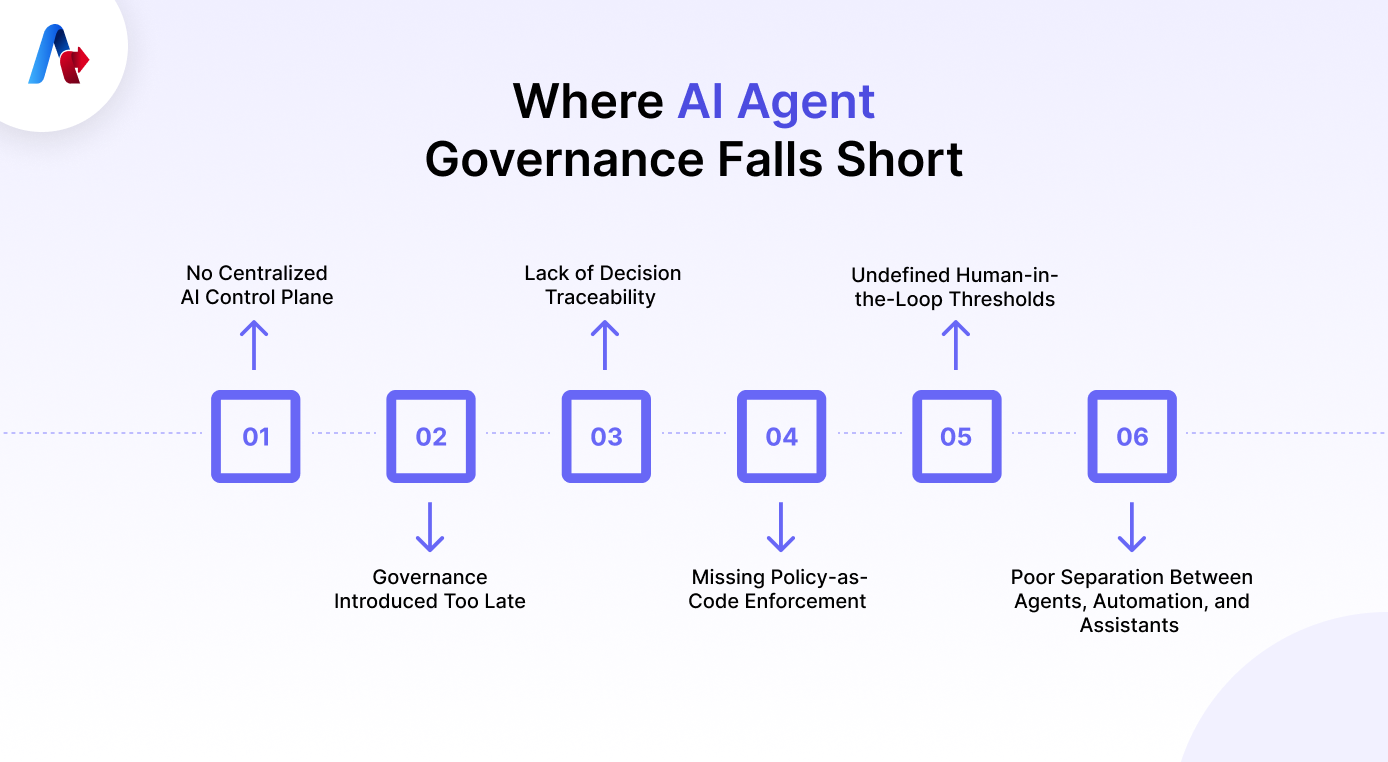
Here are a few blind spots that prevent agentic AI from moving safely and confidently into production:
1. No Centralized AI Control Plane
Many organizations deploy AI agents across different teams and systems without a single place to monitor or manage them. This makes it hard to track agents' actions or enforce rules consistently across different agents. Without centralized control, problems often go unnoticed until they become serious and fixing them gets risky.
2. Governance Introduced Too Late
In many cases, AI projects are built first and reviewed later. Legal, risk, and compliance teams are brought in only when pilots are nearly complete. At that point, addressing issues requires major redesigning or forces teams to cancel the entire project. This late involvement turns governance into a roadblock instead of a protective layer.
3. Lack of Decision Traceability
Organizations often fail to explain the logic or reason behind any decision made by the agent. This happens because there is no clear record of what data was used, which tools were involved, or what steps led to the outcome. This lack of visibility makes audits difficult, weakens trust, and creates serious challenges in regulated environments.
4. Missing Policy-as-Code Enforcement
Many organizations document AI rules in policies and guidelines, but those rules are not enforced by the system itself. As a result, AI agents can act outside approved boundaries without being stopped. When policies are not embedded directly into workflows, violations are detected too late, increasing risk and rework.
5. Undefined Human-in-the-Loop Thresholds
It gets difficult for teams to define when AI should act independently and when human approval is required. This can result in either too much autonomy in sensitive situations or excessive manual reviews for low-risk tasks. Both scenarios can reduce efficiency and increase errors.
6. Poor Separation Between Agents, Automation, and Assistants
Some organizations use agentic AI for tasks that can be done more safely and cheaply with simple automation or assistants. This adds unnecessary complexity, cost, and risk without delivering additional value. This shows that overusing automation can increase the chance of failures that could have been avoided.
Can your organization control agentic AI at scale?
Consult our expertsWhy Traditional AI Governance Models Fall Short
Here’s why traditional AI governance will no longer work as we move into 2026:
1. Point-in-time risk assessments
Traditional governance checked AI risk only once, usually before launch. This worked well for static software, but not for AI agents as these agents continue to learn, adapt, and change based on new data and situations. Which is why a one-time review is not enough to catch new mistakes, biases, or unsafe behaviors that appear later.
2. Focus on model accuracy over decision impact
Traditional AI governance focuses on whether the model gives “correct” answers. But being statistically accurate does not mean the decisions are good for the business. An AI agent might be accurate but still cause problems—such as triggering unnecessary workflows, frustrating customers, or creating extra work for employees. Governance must look at real-world outcomes, not just model performance scores.
3. Human-in-the-loop everywhere—or nowhere
Older governance models usually choose one extreme. Either humans had to approve every AI action, that slowed everything down, or AI was allowed to act on its own with no oversight, which increased risk. Agentic AI needs a balanced approach where humans step in only when decisions are high-risk, sensitive, or unusual.
4. Documentation-based compliance
In traditional governance, rules live in documents—policies, PowerPoint slides, and compliance manuals. These documents describe what AI should do, but they don’t actually control what happens in real time. AI agents operate continuously and automatically. If rules aren’t enforced while decisions are being made, compliance exists only on paper and not in practice.
5. Siloed ownership
AI governance is often owned by IT or data science teams alone. However, AI agents impact many areas—operations, finance, legal, compliance, customer experience, and brand reputation. When responsibility is split across teams with no shared ownership, risks are missed and accountability becomes unclear. Effective governance requires cross-functional ownership.
6. No economic governance layer
Traditional AI governance rarely monitors how much AI costs once it is running. Agentic systems can repeat actions, retry tasks, or scale quickly without warning. This can cause sudden increases in cloud usage, API calls, and inference costs. Without financial controls and monitoring, AI systems can quietly become very expensive.
Core Principles for Governing Agentic AI at Scale
To deploy agentic AI safely and consistently, leaders must follow these core governance principles designed for autonomous systems:
- Defining clear boundaries for agent autonomy
- Enforcing policies and constraints before expanding authority
- Establishing human escalation points for high-risk decisions
- Continuously monitoring agent behavior and performance
- Ensuring decision transparency and explainability
- Applying cost and usage controls at execution time
- Enabling pause, rollback, and shutdown of agent actions
- Assigning clear business ownership for agent outcomes
- Distinguishing when to use agents versus automation or assistants
- Expanding autonomy gradually as governance maturity increases
Together these principles help organizations to actually enforce operational discipline. Instead of relying on written policies or one-time approvals, governance becomes part of day-to-day operations. This helps ensure that agentic systems stay within clear limits, ask for human input only when necessary, and can be monitored and explained at any time. It also helps control costs by preventing AI agents from running unchecked or using more resources than intended.
This approach reduces agentic AI risks, prevents costly Agentic AI failure, and directly addresses the broader Agentic AI Governance Crisis. Atlast it also helps organizations to maintaining accountability, control, and confidence among its regulators, customers, and internal stakeholders.
How Enterprises Can Prevent Agentic AI Project Failures
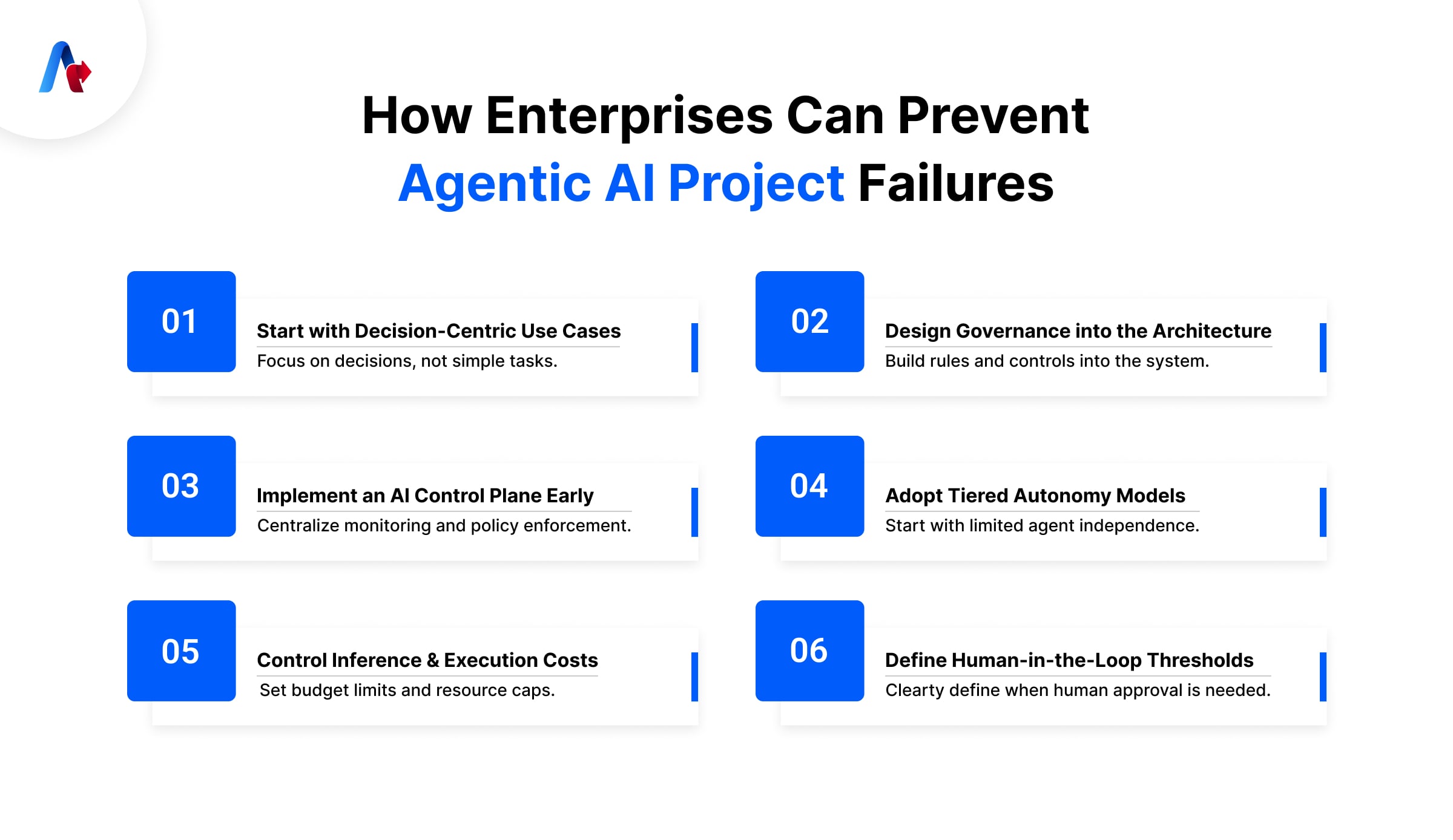
We have listed down some ways that would help enterprises reduce agentic AI risks, address the broader Agentic AI Governance Crisis, and avoid costly Agentic AI failure as systems move into production:
1. Start with decision-centric use cases
Agentic AI works best when it is used to support or automate decisions that require flexibility, judgment, or adaptation to changing situations like handling exceptions, prioritizing tasks, or coordinating across systems. Agents often fail to deliver actual value and results when used for simple, repetitive tasks.
2. Design governance into the architecture, not around it
Governance should be a regular thing, not just for review. This requires building rules, approval logic, logging, and escalation paths directly into the workflows that agents use. When governance is built into the system itself, agents are technically prevented from acting outside approved boundaries.
2. Design governance into the architecture, not around it
Governance should be a regular thing, not just for review. This requires building rules, approval logic, logging, and escalation paths directly into the workflows that agents use. When governance is built into the system itself, agents are technically prevented from acting outside approved boundaries.
3. Implement an AI control plane early
An AI control plane gives organizations a central way to see what all agents are doing, apply policies consistently, and intervene when needed. Without having proper control, agents operate independently, and issues are discovered very late. Putting this control layer in place early helps maintain visibility and control as usage grows.
4. Adopt tiered autonomy models
Not all agents should have full freedom from day one, but organizations should start with limited authority and expand it gradually as systems builds trust. This step-by-step approach will help teams to test behavior, build trust, and correct issues before autonomy increases.
5. Control inference and execution economics
Autonomous agents can run continuously, call multiple tools, and generate high compute usage. Without limits, costs can grow quickly and unexpectedly. Setting budget caps, usage limits, and choosing the right model for each task helps keep spending predictable and sustainable.
6. Define human-in-the-loop thresholds explicitly
Teams should clearly define which actions an AI agent can take independently, and which need human approval. All high-risk, high-impact, or sensitive decisions should always be reviewed. Clear thresholds prevent over-automation and excessive manual checks.
Ready to scale agentic AI with confidence?
Book a demo nowFinal Thoughts: Turning Governance into an Agentic AI Advantage
The challenges organizations are facing with agentic AI as they move into 2026 are not a sign that automation is failing or should be avoided. Instead, they show that enterprises need to mature in how they manage and govern autonomous systems. Companies that get governance right can deploy AI faster, respond to change more confidently, and avoid costly failures that slow down competitors. Those who ignore governance will continue to struggle with stalled pilots, rising costs, and loss of trust.
If your organization plans to deploy or expand agentic in 2026, this is the right time to review how prepared you are to govern it.