



Quick Summary
Enterprises expanding their automation efforts today are realizing that intelligence alone is no longer enough. The major bottleneck is effective coordination across multiple systems and teams. AI Agent Swarms address this challenge by moving away from a single centralized system toward a group of specialized agents working together to multiply operational efficiency.
Today for most enterprises the real bottleneck is not the work, it’s the right coordination. Systems don’t interact with each other in smoothly, requiring extra workforce to transfer data from one place to another. For example: there will always be someone who is always watching over spreadsheets, fixing fields that don't match, or pushing a process that got stuck between Step 3 and Step 4. Agent Swarms are introduced to solve these problems across various sectors.
Now instead of just relying one smart system to handle everything, you can create specialised mini smart systems that cooperate the way strong teams do in real life. They split up the work, stay on the same page, pass things off when they need to, and keep going until the job is done. At Accelirate, we see agent swarms as the logical next step after workflow automation and RPA. The goal here is not to replace what you already have but to add smart teammates to those systems who can fill in the gaps, make decisions, and do the work from start to finish without needing constant human supervision.
What Are AI Agent Swarms?
To put it simply, an AI agent is a digital coworker that knows what the goal is, how to get there, and can work within your systems without needing to be told what to do. A single agent can read incoming data, make a choice, take action, and keep track of what has already happened.
AI agent swarm is a team of AI agents and not just one hero agent. Each member has a specific area of expertise. Say, one agent's job is to read files or emails. Another one gets information from your systems. One agent’s job is to make choice. Another agent makes changes to the ERP or CRM. Another agent looks over the results and marks anything that seems strange. So when they work as single agent they aren’t extraordinary but when they work together as a well-coordinated team.
The foundation of AI agent swarm rests on four core principles:
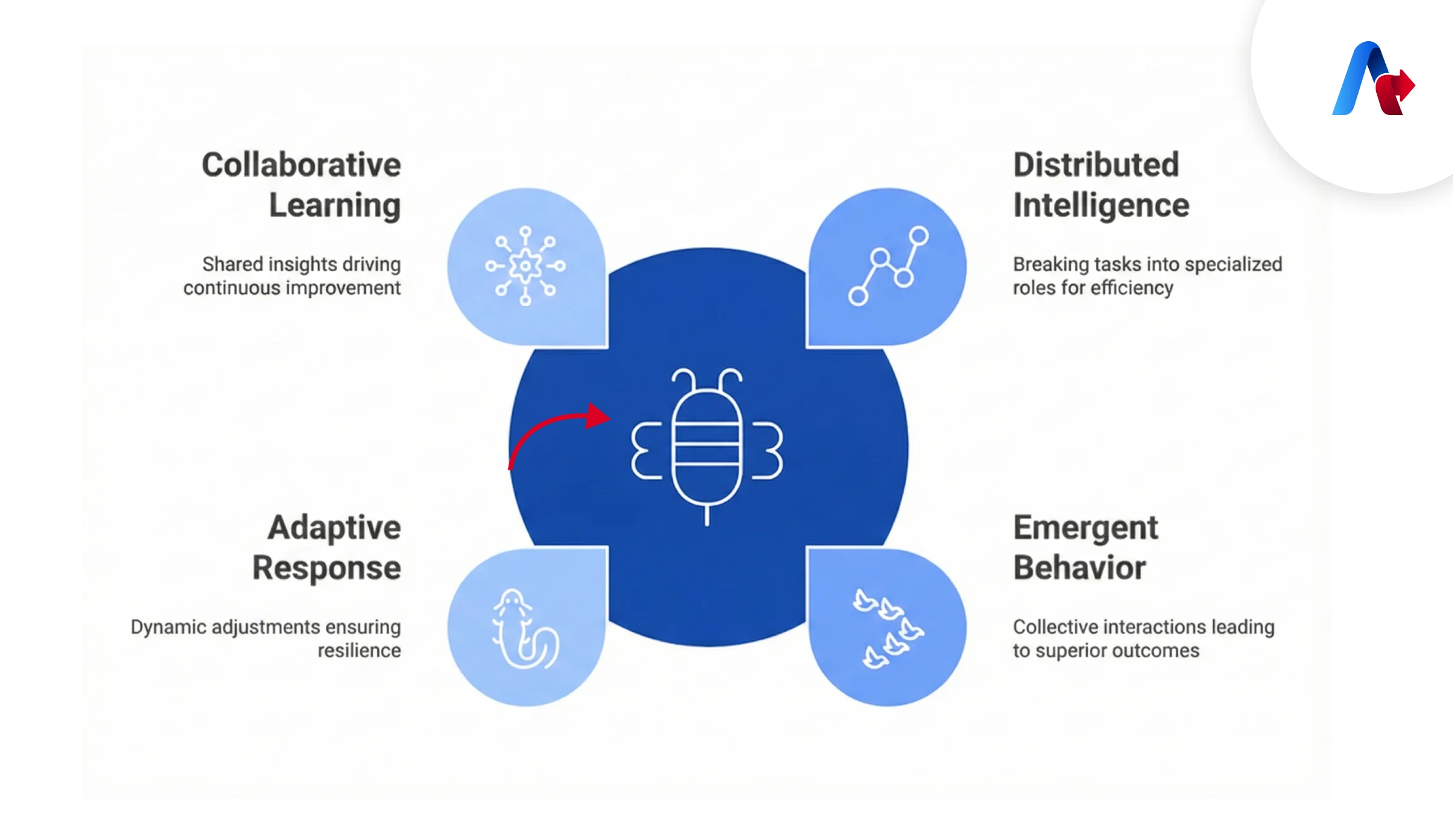
1. Distributed Intelligence:
Instead of putting all of your logic into one big "brain," you spread it out over several smaller agents. Each one does its job very well. This cuts down on mistakes and stops one failure from ruining the whole process.
2. Emergent Behaviour:
Even though each agent is only doing one simple thing, the work they do together makes the result seem much more complex. No one agent "gets" the whole path. The result, though, is a clean, complete onboarding packet that a person can approve in just a few minutes.
3. Adaptive Response:
Since each agent works on a different part of the process, they naturally report delays, move on to more complicated cases, or speed up simple ones. Swarms don't follow strict rules. They act like a flexible operations team that responds to what's going on around them.
4. Collaborative Learning:
Your swarm gets more accurate and confident over time as agents start to keep track of what worked, what didn't, and what people fixed. You don't need to be an expert at "self-learning" for this. Even well-kept historical logs can make a big difference.
Struggling to scale automation across systems and teams?
Talk to Our Intelligent Automation ExpertsCore Swarm Architecture for Intelligent Automation

After you decide on individual agents, the next big choice is how to organize and run those agents. Agent swarm architecture types tell us how to share control, how decisions are made, and how work moves from one agent to another.
Centralized Swarm Architecture
There is a strong central controller that makes decisions, manages state, and assigns work. Agents do not do anything outside of what they are supposed to do. This happens a lot in fields like finance, healthcare, and insurance that are heavily regulated and where traceability and control are important.
Decentralized Swarm Architecture
Agents work more independently and talk to each other directly. There isn't much or any central power. This model is more resilient and flexible, but it is harder to control and audit. This makes it better for research, simulations, or exploratory systems.
Hybrid Swarm Architecture
This is the most common way that businesses work. A central controller sets the rules for workflow and policy, but agents are free to choose how they do their jobs. It strikes a good balance between control and flexibility and works well with current business systems.
Layered Swarm Architecture
Agents are put into logical groups, like data intake, decision-making, execution, and feedback. There could be more than one agent in each layer. This model works best for complicated business processes where it is important to be clear, responsible, and able to audit.
How Agent Swarms Work in Practice
Agent swarms can feel abstract until you see how they behave inside real business workflows. In practice, they do not operate as a collection of clever ideas or isolated models. They function more like a coordinated operations team, where each member knows their responsibility and understands when to pass work to the next person.
Work Begins With a Trigger
Every swarm-driven process starts with a clear signal. This could be a new invoice landing in an inbox, a claim entering a processing queue, a customer submitting a form, or a data update inside a core system. The swarm controller receives this trigger and creates a case that all agents can reference. From that point onward, the work moves through the system with context preserved, rather than being recreated at every step.
Building Context and Data Intake
Initial agents perform the role of taking intakes. It understands the input and makes it ready for the rest of swarm. It further creates a structure by reading the data in form of documents, messages or structured data. This is all done to prevent downstream agents from wasting time on the inaccurate data inputs.
Early Checks and Validation
The next steps are handled by agents that can do validation, once the basics are confirmed. They verify if the records are correct, required fields are present and basic rules are met. If the swarm find any discrepancies, they redirect the case, request additional information or even route to different scenarios rather than quitting or failing.
Decision Making and Risk Assessment
Decision-oriented agents come into play when judgment is required. Their job is to apply logic consistently across large volumes of work. They assess risk, classify cases, and determine whether the task can proceed automatically or should be reviewed by a human. Simple, low-risk cases move forward without friction. More complex or sensitive cases are flagged with clear reasoning, so human reviewers are not starting from scratch.
Execution Inside Enterprise Systems
Execution agents are responsible for taking action inside core systems. They update records, trigger workflows, post transactions, or send notifications. Because they operate with full context from previous steps, their actions are precise and situation-aware. This is where agent swarms go beyond traditional automation, which often follows rigid scripts without understanding the broader process.
Monitoring, Feedback, and Continuous Improvement
The final stage is oversight. Monitoring agents verify that outcomes match expectations, record what happened, and capture signals that can improve future runs. Over time, this feedback helps the swarm become more accurate, more stable, and easier to supervise. Patterns emerge, edge cases become clearer, and the system gradually requires less manual intervention.
Agent swarms can seem abstract until you see them in action in real business processes. In reality, they don't work as a group of smart ideas or separate models. They work more like a coordinated operations team, where everyone knows what they need to do and when to give work to someone else.
Plan Your First AI Agent Swarm with the Right Architecture
Get expert guidance from AccelirateEnterprise Use Cases: Agent Swarms in Action Across Industries
Agent swarms are most useful when work is complex, repetitive, and spread out over multiple systems. These are the kinds of places where traditional automation starts to break down and human teams start to feel overworked.
Content and Knowledge Operations
In content-heavy teams, work almost never goes in a straight line. Writing is based on research. Writing helps reviews. Look over the changes to the feeds. This loop is a good place for an agent swarm to fit in.
For example:
One agent collects background information and source material. Another person works on the first draft. A third checks for tone, clarity, and structure. A fourth checks facts and consistency. The swarm works like human editorial teams do, but faster and without losing context between steps.
Business Intelligence and Analysis
Analytics workflows often fail not because they don't have enough data, but because the insights come too late or in a way that no one can use. Agent swarms fix this by splitting up the work in a smart way.
For example:
One agent's job is to gather information from different systems. Another looks at patterns and strange things. A third person turns those results into summaries or suggestions. A fourth person makes dashboards or reports for different groups of people.
Customer Service and Case Management
The swarm takes care of the coordination instead of agents having to switch between tools by hand. When people need to show empathy, make a decision, or negotiate, they step in. Everything else goes smoothly, and the context stays the same across systems.
For example:
Agent swarms are a good fit for customer service because no two cases are the same. A swarm can sort through incoming requests, write replies, check policies, move sensitive cases up the chain of command, and follow up on its own.
Challenges in Deploying Agent Swarms — And How to Overcome Them
Agent swarms are strong, but they don't work right away. The best teams are the ones that plan ahead and start small.
Coordination Across Agents
As you add more agents, coordination becomes more and more important. When there aren't clear handoff rules, systems can get noisy or act in ways that are hard to predict. Every agent needs to know what their job is, what they need to do, and what they will get in return. Here, being unclear can cause things to be done twice, take longer, or be done in different ways.
Cost and Resource Management
AI-powered systems can grow quickly, which is a good thing and a bad thing. Without controls, agents might run more often than they need to or use expensive features when simple logic would work just as well. Resource governance is very important from the start, especially in businesses.
Handling Errors
There is no such thing as a perfect system. Agents will have to deal with missing data, signals that don't match up, or edge cases. How a system deals with failure is what makes it fragile or strong. Strong swarms are meant to stop, speed up, or change the direction of work instead of breaking quietly.
Maintaining Output Quality
It matters that things are the same. Quality must always be the same, whether it's a financial transaction, a message from a customer, or an internal report. Before work can move forward, there must be validation steps, cross-checks between agents, and clear quality thresholds.
How to Start Implementing Agent Swarms in Your Organization
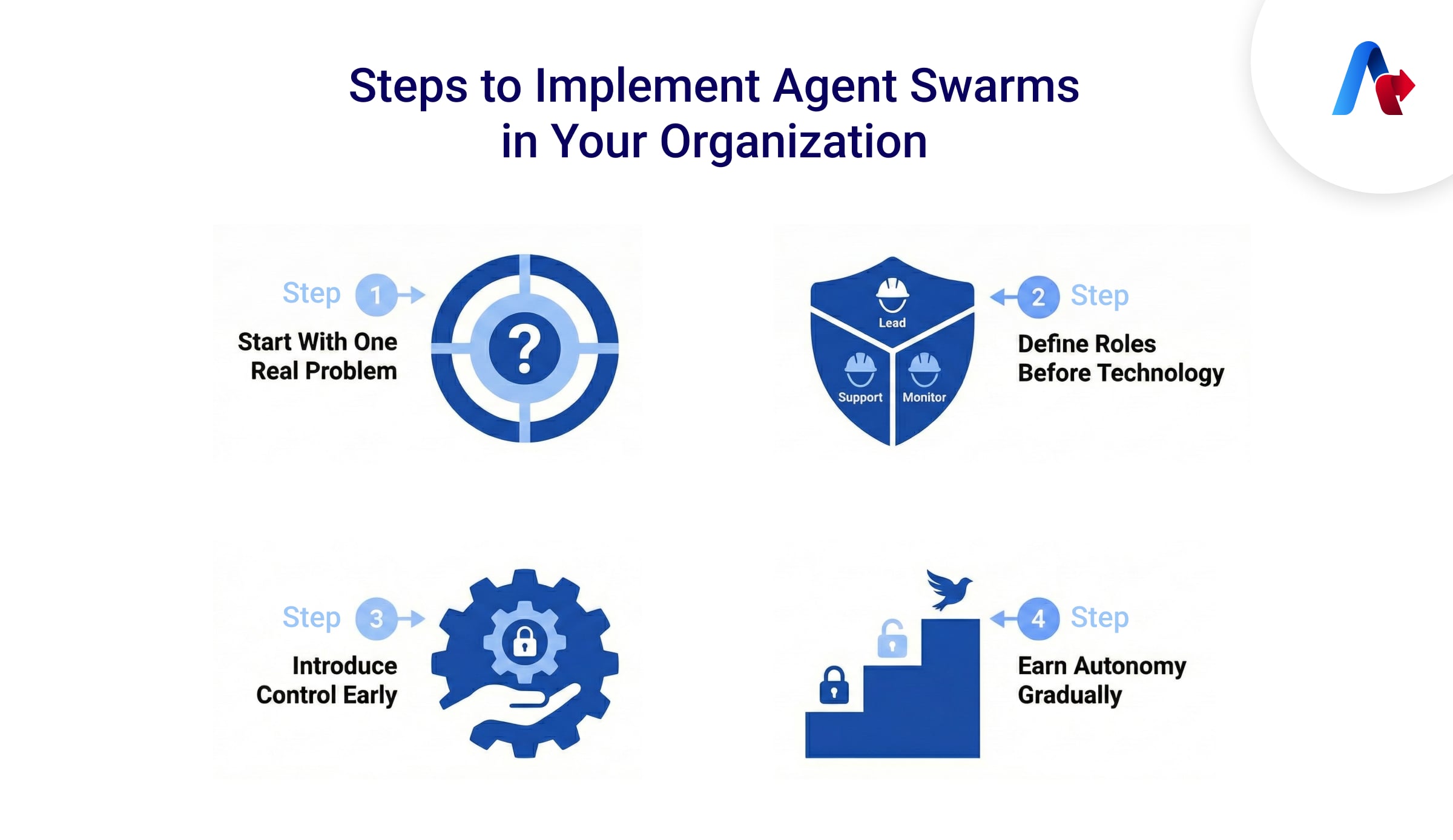
Start With One Real Problem
Teams make the biggest mistake with agent swarms when they try to do too much too quickly. A strong implementation usually starts with one workflow that is already causing problems. Look for processes where work moves between different systems, decisions are made over and over again, and people spend more time coordinating than making decisions. These are great places to start a first swarm.
Define Roles Before Technology
Break the workflow down into tasks before you start thinking about tools or models. Find out who collects information, who checks it, who makes choices, and who does things. Each duty can become an agent later on. At this point, being clear is much more important than being smart.
Introduce Control Early
Once everyone knows their role, add a simple controller to keep track of progress and manage handoffs. Early agents should be small and easy to understand. It's much better to have a small group of reliable agents than one agent that tries to do everything. From the start, there should be a way to see what the swarm is doing and why.
Earn Autonomy Gradually
Early swarms should work under supervision. Allow people to look at results, change decisions, and give feedback. As people become more confident, they naturally need less supervision. The best agent swarms don't rush into being independent; they earn it by being consistent and trustworthy.
The Future of Intelligent Automation with Agent Swarms
Agent swarms are still changing, and the next step will be less about intelligence and more about trust and coordination.
Self-Organising Systems
In the future, swarms will assign roles based on the workload and the situation. Agents will change how they work together in real time instead of following set paths.
Smarter Learning Across Agents
Agents will share what they learn with each other instead of learning alone. Patterns discovered in one workflow will inform decisions in another, improving performance system-wide.
Deeper Human–AI Collaboration
The best swarms won't take the place of people instead they'll work with them. People will make plans, set limits, and make decisions that are hard to judge. Agents will be in charge of execution, coordination, and growth.
Build governed, enterprise-ready AI Agent Swarms.
Talk to our Agentic Automation expertsThe Shift to Orchestrated Intelligence with Agent Swarms
Agent swarms are a new way for enterprises to think about automation. The goal is no longer to automate each step separately, but to manage work from start to finish with clear goals, control, and flexibility. We at Accelirate see this as a natural step forward for digital operations. Not more automation. Not more dashboards. Only systems that work together without problems, dependably, and on a large scale. There won't be one smarter tool that AI can use in the business world. It's a lot of focused digital coworkers who work together, are watched carefully, and are meant to make work more meaningful for people.
FAQs
Yes, a lot of the time. Swarms cut down on mistakes by spreading work across experts and adding natural checks along the way. This makes results more reliable, especially when there are a lot of steps involved.
Agent swarms will take care of planning and making routine decisions, while people will focus on strategy and judgment. Instead of managing every step, teams are in charge of outcomes.
Agentic AI is a type of AI that can make its own decisions. Agent swarms are a way to talk about how several agents work together to reach the same goals.
They are more reliable, can grow more easily, and can handle change better. Swarms also fit well into business processes that involve more than one system.
A common example is processing invoices. One agent gets the data, another checks it, another checks the risk, and another updates the ERP. The swarm behavior is the result of all the parts working together.