



Quick Summary
Before building multi-agent AI systems, enterprises today should ask 10 practical questions about whether the work can run in parallel, the cost of orchestration, how agents will share state, what happens if one fails, how to test, and whether separate agents are essential for security alone. Along with that, you can also consider fallback options, scalability options, whether a single agent with better tools is enough, and how coordination will affect response time. These questions help companies decide whether to use a single-agent, multi-agent, or hybrid method.
Two years ago, the question was whether to use an agent, but now it has moved to single-agent vs multi-agent AI systems. Many think that it is necessary, but with the right tools, a single agent may handle complex workflows. Adding more AI agents to the work is helpful because it can perform reasoning and benefit from separate context. But using multi-agent systems increases cost, testing effort, and points of failure.
A survey by PwC shows that 88% of senior executives plan to increase their AI-related budgets in the next 12 months because of agentic AI. There is always pressure to move fast to multi agent AI systems, but more agents do not guarantee better performance.
So, before you decide between a single-agent vs. multi-agent architecture, look at what is technically possible.
The following 10 questions are really going to help you know that. They give leaders a way to decide whether a single agent, multi-agent system, or hybrid system works for them before making the final decision.
Why Is the Multi-Agent AI Systems Question Coming Up Now?
The multi-agent AI system is coming into the picture as enterprise AI is moving from simple assistance to a system that can work with other tools, applications and complete multi-step tasks. If the workflow becomes more complex, teams need to decide whether to go with one agent or a multi agent system. This new shift is changing how companies think about AI architecture.
Nvidia CEO Jensen Huang predicted this shift clearly in an interview with Fortune:
The mental model for AI and enterprise is really AI agents
AI Is Taking More Complex Work
A single agent can handle many tasks when integrated with the right APIs, data, automation tools, and instructions. But what if something more complex comes? The single AI must do everything from searching to making decisions. That’s where teams usually think about multi-agent AI systems.
Agentic AI Helps with Parallel Work and Specialization
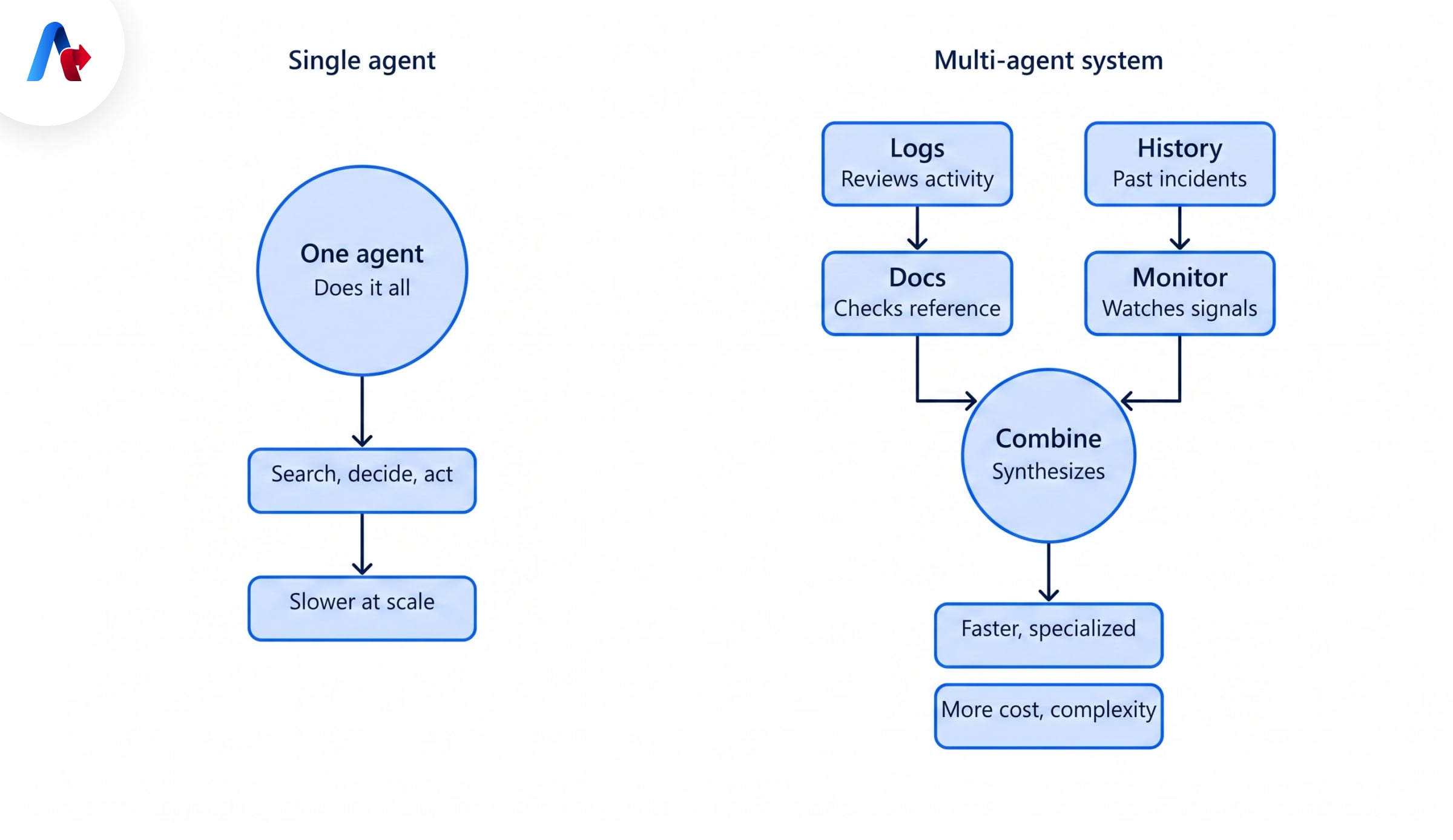
Think about an IT incident workflow with a multi-agent system in AI where one could review logs, another research previous incidents, the third one check technical documentation, and the last one combine all findings. This is what many agents can do.
More Agents Means Not Always the Better Choice.
Using many agents will add more cost and complexity. So, organizations should ask, “Where a single agent is struggling and adding another one solves that problem?” The answer to this could be parallel execution, context separation, specialization, and security. If not, the system may need better tools, data, and workflow design.
Single-Agent vs Multi-Agent Architecture — What's Actually Different
A single agent is alone and uses its ability to understand a goal, use tools, access data, and complete the work. Multi-agent AI systems comprise many agents that divide work between agents to separate roles and continue the work. When comparing multi-agent systems vs single agent setups, a company can choose one based on the complexity, cost, and specialization requirement.
A single agent means it is not a simple chatbot because it can connect to APIs, use automation, and complete a workflow of multiple tasks. If the work is simple, this would be a great choice.
This is not the case with multi-agent systems because different agents can do different parts of the work. If the job needs expertise, context, and can possible only with parallel work, this is the best choice.
The difference between these agents is not just the number alone but the separation of work and coordination. Multi-agent systems can perform different work by sharing but a simple AI system will perform everything on its own.
| Area | Single Agent | Multi-Agent System |
|---|---|---|
| Reasoning | One primary reasoning flow | Multiple specialized reasoning flows |
| Context | Mostly shared | Can be separated by role |
| Coordination | Limited | Requires agent-to-agent orchestration |
| Cost | Usually easier to control | Often higher because of added model calls |
| Testing | Simpler | More interaction paths to evaluate |
| Best fit | Sequential, connected workflows | Parallel, specialized, or highly complex workflows |
The 10 Questions Every Enterprise Should Ask Before Choosing Between Single-Agent and Multiple- Agent
Choosing a single-agent vs multi-agent architecture should not be based on the agent count alone. A team must assess their workflow, the risks, and the outcome the business needs before choosing one.
1. Is the Task Actually Parallelizable, or Are We Adding Agents to a Sequential Problem?
A multi-agent system is a choice for any organization that has different parts of a task at the same time. If each step must wait for the previous one to finish, adding more agents may only add extra work, cost, and complexity.
Parallel Work Is Where Multiple Agents Can Add Real Value
Think about a situation where you have a research-heavy workflow. In this situation, the first agent reviews market data, the second one examines customer feedback, and a third agent analyzes technical documentation. All these tasks do not depend on each other, so they can run in parallel, and finally, a coordinating agent can give the result. Here, you can use multi-agent AI systems.
Sequential Work Is Different
Another situation is where one step must finish before the next can begin. For example:
- Validate an incoming request.
- Retrieve the required data.
- Check business rules.
- Get approval.
- Execute the action.
In this scenario, splitting those five steps will not make the work faster since one waits for another action to complete. So, before creating a new agent, you must ask:
- Can this task start without waiting for another one?
- Does parallel running reduce the total completion time?
- Does it require separate context?
- Can a single agent with the right tools handle this well?
The answers you get from these questions help you reach a conclusion.
2. What Will Multi-Agent Orchestration Cost in Tokens, Latency, and Infrastructure?
Multi-agent AI systems are usually costlier than single-agent systems because each agent adds model calls, context, communication, and orchestration. More than that, they also increase latency when agents depend on one another. An organization should compare the total cost and response time of completing the workflow instead of just the cost of an individual agent.
More Model Calls
When you are using a single agent, it receives requests, gathers information, uses tools and produces the result. This is not the case with multi-agent systems because the same request passes through an orchestrator, special agents, a validation agent and back to the orchestrator for the final output. This will cost more than a single agent, but it is ideal for complex scenarios.
Latency Depends on Coordination
Using many agents for tasks may improve the speed compared to a single agent. For example, three agents searching data sources in parallel can finish faster than one agent searching each source sequentially. But if any agent waits for others' actions, it will increase the time. So, check latency end to end, from the user's request to the completed outcome.
Measure Cost by Outcome
It is not ideal to ask how much each agent costs. Instead, ask, what does it cost to complete this workflow? Always compare simple agent and multi-agent system AI with token usage, cost of infrastructure, tools, end-to-end response time, failure run, and cost to complete the task successfully. Multi-agent design may deliver better speed, accuracy and coverage, but if the outcome is the same, it is better to use single-agent AI.
Not sure about the cost of AI agents? Understand the operational, orchestration and scaling costs before you build,
Explore the Costs3. How Will Agents Communicate, Share, and Avoid Duplicating Each Other?
Multi-agent systems should have every rule from communication to sharing details. Each agent in the network needs to know what it has, what it can update, what to pass on, and what it should do when there is disagreement with other input.
For example, coordination is a big problem if everyone works with different information, repeats the task, and makes changes without telling anyone. This will happen with the AI agents too.
What Can Go Wrong?
Consider a scenario where two agents work on the same customer case: one reviews the account and recommends an action. After some time, the second agent gets updated information and recommends something different. Now, there are many questions to answer here:
- Which information is current?
- Which agent's recommendation should be trusted?
- Has the updated state reached the other agents?
- Who makes the final decision?
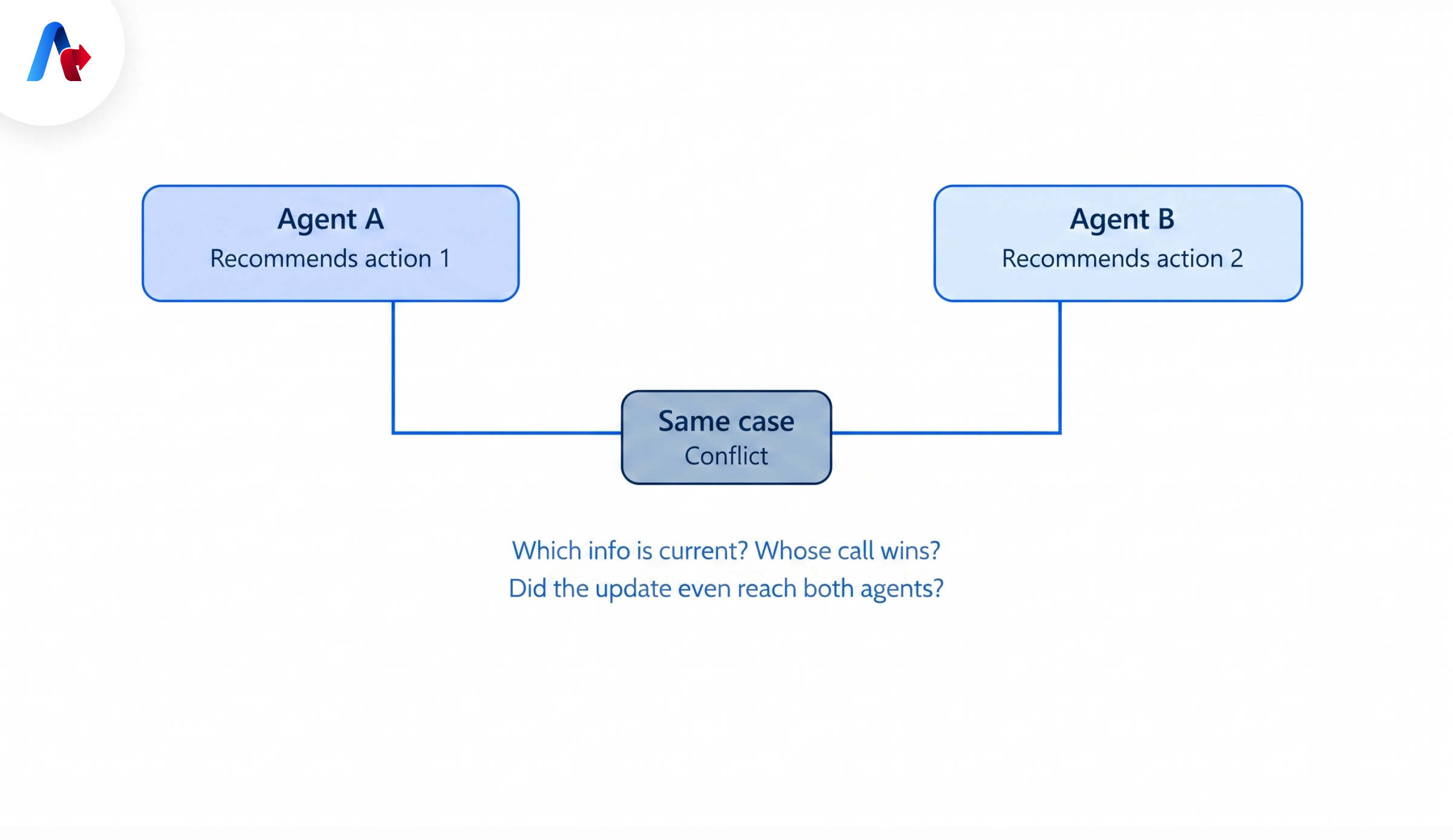
A situation like this can create confusion, and without clear answers, one small mistake can affect everything that happens in the future.
Give Every Agent a Clear Role
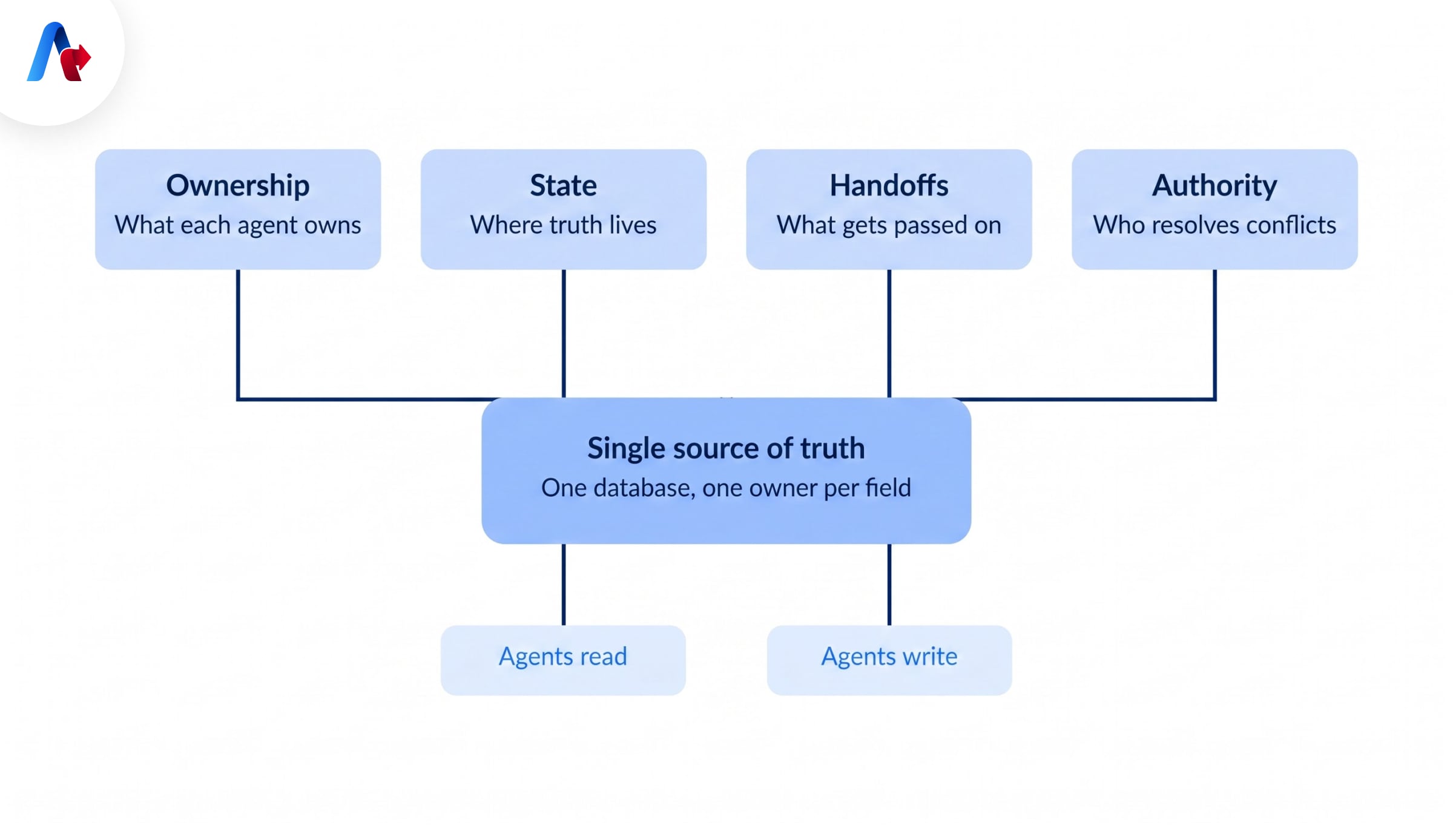
An enterprise using multi-agent AI systems must explain the following four things before they exchange information.
- Ownership: What is each agent responsible for?
- State: Where is the latest information stored in the system?
- Handoffs: What exactly should one agent send to another?
- Decision Authority: Who resolves conflicts, if any?
Keep One Source of Truth
It is important that the workflow data comes from one trusted place. For this, a company can define sources such as databases, orchestration layers and clarify which agent can read them and change them. Otherwise, the system spends more time coordinating than on its own tasks.
4. What Happens to the Rest of the System When One Agent Fails?
In a multi-agent AI system, failing or wrong answers can affect the rest of the workflow. To avoid this, companies need clear rules to handle such situations, so they will not quietly affect other agents. Failure means not stopping every system. Sometimes moving with them can create bigger risks.
Example:
An agent may classify a request incorrectly, and the next agent will retrieve the wrong data. The third agent works on it and creates a recommendation based on it. The problem is that this type of error happens quietly, and when you notice it, it already affects several steps.
Creating a Plan for Partial Failures
An enterprise that works with multi-agent systems must handle situations such as:
- Agent timing out
- Incomplete and incorrect output
- Conflicting responses
- A failed tool call
- Missing data
A system should know when to retry, stop, use fallback and send to human review. Everything should be mentioned clearly to avoid big consequences.
Stop Errors Spreading
Basic checks are necessary for every automation move, especially for high-impact areas. Based on the workflow, the rules should include validating data, checking confidence, comparing outputs and approval of human support.
A failure must be designed before production. Ask what happens when an agent is unavailable, what if something goes wrong, or what if it gets insufficient information. Also make sure that your system recovers without affecting the entire workflow.
5. Can We Debug and Evaluate a Multi Agent AI System with Confidence?
Compared to a single AI, multi-agent AI systems are a little difficult to debug because the errors may come from one agent, orchestration or data. A team needs to track the entire workflow, so they can quickly find out where the problem is.
A simple way to think about this is to ask yourself: if the final answer is wrong, can we explain why? A company that uses one agent can easily understand the problem. With several agents in hand, it is difficult to identify them.
The gap between experimenting and operating AI reliably still matters today. Deloitte report, The Emerging Technology Trends in 2025 says that 38% of surveyed organizations were piloting agentic AI, but only 11% were actively using it in production.
For example:
Agent 1 reads the wrong data → Agent 2 trusts it → Agent 3 works on it → the result looks trustworthy but is still wrong. This is why testing each agent is not a complete solution.
What Should Your Teams Test?
A team can test various things, such as:
- Correct routing between agents
- Accurate data sharing
- Reliable tool use
- Clean handoffs
- Recovery after failure
- Quality of the outcome
Logs also greatly help here because they show what each agent saw, decided and passed to the next step. Automation does not avoid human support. There are many areas where human testers are vital to catch unusual behavior, edge cases that may be missed by AI agents.
Multi-agent testing gets harder as interactions grow. Let’s examine how dedicated testing agents and well-defined responsibilities can help teams validate better.
Explore Multi-Agent Testing6. Do Security Rules Really Require Separate Agents?
It is not important to use separate agents for everything. If the tasks need different access levels, you can consider using multi-agent AI systems. There are situations where one agent can handle tasks with better permissions and tools.
Some areas like HR and finance may need access to very different data, so using separate agents can make things better here due to:
- System access
- Data limits
- Approval rules
- Business responsibility
For example, it may be allowed to read employee data but not change it. In such cases, strong permission controls may provide better results without adding another agent.
A distinction matters when you select an agent for security reasons. So, you need to ask if this task needs a separate reasoning role or just needs access control. Using more agents can create clear boundaries, but they also can create more identities, permissions, logs and access points to manage.
If this fails to deliver value, can we fall back to a single agent without re-architecting everything?
7. Can We Return to a Single Agent Without Rebuilding Everything?
A multi-agent system should not lock the enterprise into sticking with one architecture. If it is not giving the expected values, such as improving performance and reducing cost, teams can move to a single-agent system without rebuilding the entire workflow.
This requirement is sometimes missed by the team. They build everything around the agents; important rules end up inside prompts, and workflows become connected in one setup. That method may work at first, but if you want to remove or replace, things will be a little difficult.
Build Flexible Workflow
The core parts of the process should always be different from the agent structure wherever possible.
For example:
Business rules → tools and APIs → permissions → agent or orchestrator.
An approach like this can be replaced, removed, or even combined when necessary, without changing the whole application. On the other hand, the opposite approach will create a connected system where changing one affects the others.
Why This Matters
Multi-agent AI systems may look like a better choice in the beginning but may be expensive and difficult to manage in the future. As the tool improves, a task that needs several agents today may later be handled by one agent with better tools, so the architecture should be flexible.
Check Reversibility
Before moving, ask:
- Can one agent take care of the present work?
- Can we replace an agent without changing the entire workflow?
- Are tools and business rules reusable outside the orchestration layer?
- Is shared data stored independently of individual agents?
8. Can We Add New Agents Without Retesting the Whole System?
Introducing a new agent may not add any major changes to the rest of the system. Sometimes, you need to test the full workflow, but most testing should focus on the new agent introduced and the steps connected to it.
Difference Between Good Design vs. Bad Design
Good design:
A newly introduced compliance agent gets its clear input, completes its task, and returns a structured result. The rest of the workflow continues to work the same way without any problem.
Bad design:
A bad design will be different here because adding the same agent can change prompts, routing rules, memory, and other connected agents.
So, a team can retest most of the parts affected by the agents, such as:
- The agent itself
- The data it receives and returns
- How it passes work to other agents
- The tools and systems it can use
- The steps that depend on its output.
After finishing them, run an end-to-end test to ensure everything works as expected.
9. Have We Tested a Single Agent With More Tools Before Deciding on Multiple Agents?
Before deciding to use a multi-agent system, it is essential to test whether one agent can help with better tools, design and data. In many cases, a single agent can work well, but what it lacks is the right support around it.
With better planning, it can also look for documents you need, call APIs, use databases, check business rules, and ask for human approval for complex issues. Always check what the present agent is struggling with to conclude.
- If the agent misses information, improve its retrieval.
- If it cannot complete an action, give it the right tool.
- If the workflow is too long, you can break it into different steps.
- If the context is too large, improve how information is passed.
- If the output is not stable, improve testing, validation, and guardrails.
Only after checking these areas can a team come to a conclusion, not before that. A secondary agent is essential when the problem is difficult to handle by the present agent. You need an additional agent when:
- Two tasks need to run at the same time.
- One task needs a separate context.
- A specialist role clearly improves the result,
- An independent review is valuable.
The idea is simple: add more agents only when they solve problems. Don’t use them because of trends or to make your system more advanced.
Still confused about whether your workflow needs one agent or several? Start with the use case, integration, and business outcome before choosing the architecture.
Assess Your Architecture10. Will Multi-Agent Coordination Slow Down Response Time?
Yes, it will slow down if one agent waits for another action. A team must test the response time across the workflow to know how it is working, not agent by agent. If three agents can work on independent tasks in parallel and a fourth agent combines their results, the workflow may finish faster than one agent completing all three tasks one after another.
The problem starts when agents depend on each other. In this situation, B waits for agent A, and C waits for agent B. It will create a chain of delays, and users will check only how long it takes to finish a task.
A team can check several things to understand the speed, such as total response time, waiting period between agents, retry delays, response time and total time to finish the task.
What Common Mistakes Should Enterprises Avoid When Choosing an AI Agent Architecture?
Some of the common mistakes are adding many agents early, using agents for simple tasks, ignoring handoffs, testing agents separately, giving agents more access, and building a system that is hard to change. Making the architecture simple is a safer method, and add extra agents only when they solve a clear problem.
1. Adding More Agents Early
It does not mean that a multi-agent AI system can only have a complex workflow. In some cases, one agent with cleaner data and instructions will do a better job. Simply adding too many agents can increase the cost and make everything harder to manage.
2. Using Agents for Every Step
A simple step does not need multiple agents. If the steps are simple, use APIs or RPA. Using several agents for a simple and predictable task is not a good idea, as it can add complexity without adding value.
3. Ignoring the Handoffs
Agents are dependent on agents to pass information. If the handoffs are not clear, they repeat every work, use old data and misunderstand the previous actions. It is vital to define what information can move between agents and who owns the latest versions.
4. Testing Agents Separately
An agent works well alone, but when it is connected to other agents, there can be some issues. So, it is better to test the complete workflow from start to finish instead of checking individual agents.
5. Giving Agents Too Much Access
Agents should only have access where it is necessary, and to the tools and data they need. Giving more access sometimes creates security and compliance issues.
6. Making the System Complex
If the multi-agent AI systems are not as valuable as expected, you should be able to come back without many changes. If the agents are connected too much, this will make it more complex, so prepare an easy-to-change architecture to avoid such issues.
Should You Choose a Single Agent, Multi-Agent System, or Hybrid Architecture?
Choose a single agent for a simple workflow, especially for predictable work. The multi-AI system is better if you have parallel tasks and need different areas of expertise. A hybrid situation is different, where a single agent can do simple jobs, whereas the multi-system handles complex parts.
When do you need to choose a Single Agent?
A single agent is more than enough if your work follows a clear order, the agent can use the tools it needs to produce better answers, and the amount of information is less. Using a single agent is also a choice when a team wants simple testing, lower cost and easier debugging.
When to Choose Multiple Agents
A multi-agent system is a choice if a company wants different tasks at the same time. It is also vital if enterprises need different skills, have too much information to handle and need another agent reviewing work. In these cases, splitting the work is necessary, and it is possible with many agents.
When Does a Hybrid Approach Make Sense?
A hybrid approach works in special scenarios where one agent can handle most of the work, but a few tasks need the special hands of agents. In this situation, the main agent in a system can call the special one when it is necessary, so you can reduce the cost and handle complex scenarios.
Start Simple, Then Add Agents Where They Add Value
There is always a question between choosing a single-agent and multi-agent system. The answer is simple: choose one agent for the simplest job and use a multi-agent setup where you need specialization, context, control, and reliability. Using multi-agent AI systems is useful, but they can bring more handoffs, testing, coordination, and cost.
That is why the decision should be based on your workflow. Always ask these questions before choosing:
- Can one agent handle the task with the right tools?
- Can the work run in parallel?
- Do different parts need separate skills?
- Can the system recover when one agent fails?
- Can your team still test and manage it easily?
- If one agent can meet the need, keep it simple.
If multi-agent AI systems solve problems and add value, choose it. And if you need specialization for a few areas, a hybrid approach will be better. The goal here is to solve the issues, not add more agents, and they should be reliable, manageable, and useful to the business.
Are you ready to move from questions to a practical AI agent plan? Build around the workflow, governance, and outcomes your enterprise needs.
Build Your Agent Strategy with UsFAQs
A single agent uses only one agent to manage all its tasks, use tools, and make decisions. A multi-agent system splits the work among other agents and finishes the tasks. The use of this system is based on the workflow, complexity and context involved. A business can choose a system according to its needs.
Using more agents does not mean that they improve accuracy. A multi-agent method is useful when different agents bring separate skills and review each other's work. Also remember that it can create more handoffs and costs. A team should test the accuracy on the workflow with single and multi-agent before finalizing one.
Usually, the cost of a multi-agent system is more than using a single one because they involve more model calls, uses more tokens, coordinates with other agents and uses more infrastructure. The exact cost is difficult to say as it depends on the design. Always compare the cost with the workflow, not with the single agent.
Moving to multiple agents should not be a trend or to feel like you have the most advanced system. The main reason for moving is that the present agent cannot handle everything well now. Some of the other reasons include parallel tasks, separate roles, contextual issues, and the need for a separate agent for review. If a single agent can do a better job with scripts and tools, keep the simple one.
Yes, they work. This is called a hybrid system where one main agent handles most of the workflow and calls specialist agents for the special cases where there is complexity. A system like this is useful for teams without adding unnecessary complexity to every step.