



Quick Summary
Agentic AI is changing how organizations automate and make decisions now. Unlike traditional AI that analyzes data or answers questions, Agentic AI systems can think, act, and improve autonomously. But instead of starting big, implementing them successfully starts with a structured, risk-aware approach with the Agentic AI Pilot. This can ensure a practical roadmap for business and technology leaders to plan, test, and scale their first Agentic AI pilot. Start by defining objectives, selecting the right architecture, designing the agent framework, evaluating performance, and expanding safely across the enterprise. Whether you are using Salesforce Agentforce, MuleSoft IDP, or custom LLM frameworks, you can launch the Agentic AI pilot with confidence and measurable business outcomes.
Artificial Intelligence has evolved beyond prediction and pattern recognition. The next leap is Agentic AI, AI systems that don’t just respond but act, reason, and collaborate with humans.
These agents can connect to enterprise data, perform transactions, and continuously improve from user interactions. Yet, as promising as they sound, many organizations hesitate because of one common question: “Where do we even begin?”
The answer is simple: Start small but start strategically.
An Agentic AI pilot allows teams to validate business value, ensure data safety, and measure performance all without disrupting pivotal operations. Launching an AI pilot the right way is less about experimentation and more about building a repeatable, scalable model for intelligent automation. This guide provides a practical roadmap for business and technology leaders to plan, test, and scale their first Agentic AI pilot. You will learn how to define objectives, select the right architecture, design the agent framework, evaluate performance, and expand safely across the enterprise with measurable business outcomes.
Start Your Agentic AI Pilot Today.
Talk to Our ExpertsWhat Is Agentic AI Pilot and Why It Matters

Agentic AI refers to AI systems, often powered by large language models and orchestration frameworks like Salesforce Agentforce, LangChain, or MuleSoft IDP integrations, that can reason, decide, act autonomously and not just generate text.
Unlike traditional AI that provides insights or suggestions, Agentic AI can take actions from CRM records, triaging cases, or executing workflows across systems.
Key Characteristics of Agentic AI
- Intent Comprehension: Understands what users mean, not just what they say, and dynamically breaks down tasks into sub-goals.
- System Integrations: Interacts with enterprise data and connects with APIs, CRMs, and ERPs to fetch or update information for operational continuity.
- Autonomous Action: Executes actions and workflows on behalf of the user, like creating service cases or updating billing records.
- Learning Ability: Improves continuously through user feedback, contextual memory, and new data.
According to McKinsey (2024), AI-driven automation can reduce operational effort by up to 45% and improve response times by over 60% in service functions. Agentic AI is how these numbers move from theory to practice.
How to Launch an Agentic AI Pilot: Step-by-Step Guide
Now, let’s look at the detailed expert guide to launch your Agentic AI pilot.
Step 1 – Define Your Pilot Vision
Before writing code or provisioning models, start by defining why you are launching a pilot. This is where most successful AI initiatives get clarity and direction. Clarify business objectives and outcomes by asking:
- What problem will the agent solve?
- Who are the end users (employees, customers, partners)?
- What KPIs define success — response time, accuracy, cost savings, or customer satisfaction?
Example pilot goals:
- Automate claims triage in healthcare.
- Enable self-service billing dispute resolution in finance.
- Streamline IT service requests via intelligent chat interfaces.
Start with a “high-impact, low-risk” process. A workflow that adds measurable value but won’t disrupt operations if issues occur is ideal for pilot validation.
Step 2 – Choose the Right AI Foundation
Your choice of AI platform and integration layer determines how fast and safely you can move from pilot to production. Choose platforms that balance flexibility with security and enterprise readiness.
Core Components to Include:
- LLM Provider: Use trusted enterprise-grade models such as OpenAI, Anthropic, or Salesforce Einstein GPT for contextual understanding and compliance support.
- Agent Orchestration Layer: Frameworks like Agentforce or LangChain that manage reasoning, planning, API orchestration and tool invocation.
- Integration Middleware: MuleSoft, for securely connecting the agent with your CRM, ERP, or data warehouses.
- Governance Tools: Platforms like Gearset or Copado to handle metadata versioning and controlled deployment.
Ensure your foundation/platform supports secure prompt injection prevention, data masking, and audit logging, especially for industries bound by regulations like GDPR, HIPAA, or SOC2.
Step 3 – Design the Agent Architecture
Once the platform is chosen, it’s time to design a structure that can adapt and grow. The Agentic AI pilot needs to be modular, scalable, and observable.
The Four-Layer Key Design:
- Perception Layer – Captures user input (voice, text, or API call).
- Cognition Layer – Uses LLMs and planners to understand intent and break tasks into actions.
- Action Layer – Executes operations via APIs, databases, or automation flows.
- Feedback Layer – Collects metrics and user feedback and logs to refine behavior reasoning.
Other Design Essentials:
- Use Metadata-driven configuration for flexible updates.
- Include context variables and agent memory to preserve conversation history.
- Standardize prompt templates for tone, safety, and brand consistency across domains.
How can your agent leverage historical interactions to provide smarter responses next time?
Find out nowStep 4 – Build and Test in a Controlled Environment
This stage is where your idea becomes reality but in a safe sandbox environment. A pilot must test functionality, safety, and compliance before going live.
Recommended Testing Steps
- Deploy the agent in a sandbox or staging environment.
- Simulate real-world scenarios with synthetic data or anonymized datasets.
- Measure key metrics like accuracy of intent recognition, success rate of actions executed, response latency and system uptime, and compliance checks and data privacy adherence.
Human-in-the-Loop (HITL) Integration
In early pilots, introduce human approval checkpoints. These build trust while letting the AI learn operational nuances. According to Gartner (2025), HITL adoption reduces production AI errors by 35–40%. For example:
- Before submitting a financial transaction.
- Before sending customer-facing communication.
Step 5 – Evaluate, Learn, and Optimize
Once your pilot runs for 4–6 weeks, gather both quantitative and qualitative insights. Here's what to evaluate:
- ROI metrics: Did it reduce manual effort or increase throughput?
- User sentiment: Were end-users satisfied or frustrated with responses and interventions?
- Error analysis: Where did reasoning fail or need more context?
Use these findings to refine:
- The prompt templates or reasoning strategies for clarity and contextuality.
- The integration flow with downstream systems to ensure seamless data exchange.
- The governance framework for approvals, retraining, version control.
Iterative improvement ensures your AI agent grows smarter and more reliable with each deployment.
Step 6 – Scale with Confidence
Once your pilot shows consistent performance and value, you can scale horizontally and vertically.
Two Paths to Scaling
- Horizontal Scaling: Replicate successful agents across departments (e.g., customer service → finance → HR).
- Vertical Scaling: Expand one agent’s skillset, such as from handling simple queries/ FAQs to managing complex claims and workflows like dispute resolution or predictive recommendations.
Governed Deployment Pipeline
Use DevOps pipelines to version, test, and deploy new AI models and actions just like software. Platforms such as MuleSoft, Salesforce Agentforce, Copado/Gearset provide a secure and governed pathway to production.
Business Impact: From Pilot to Productivity
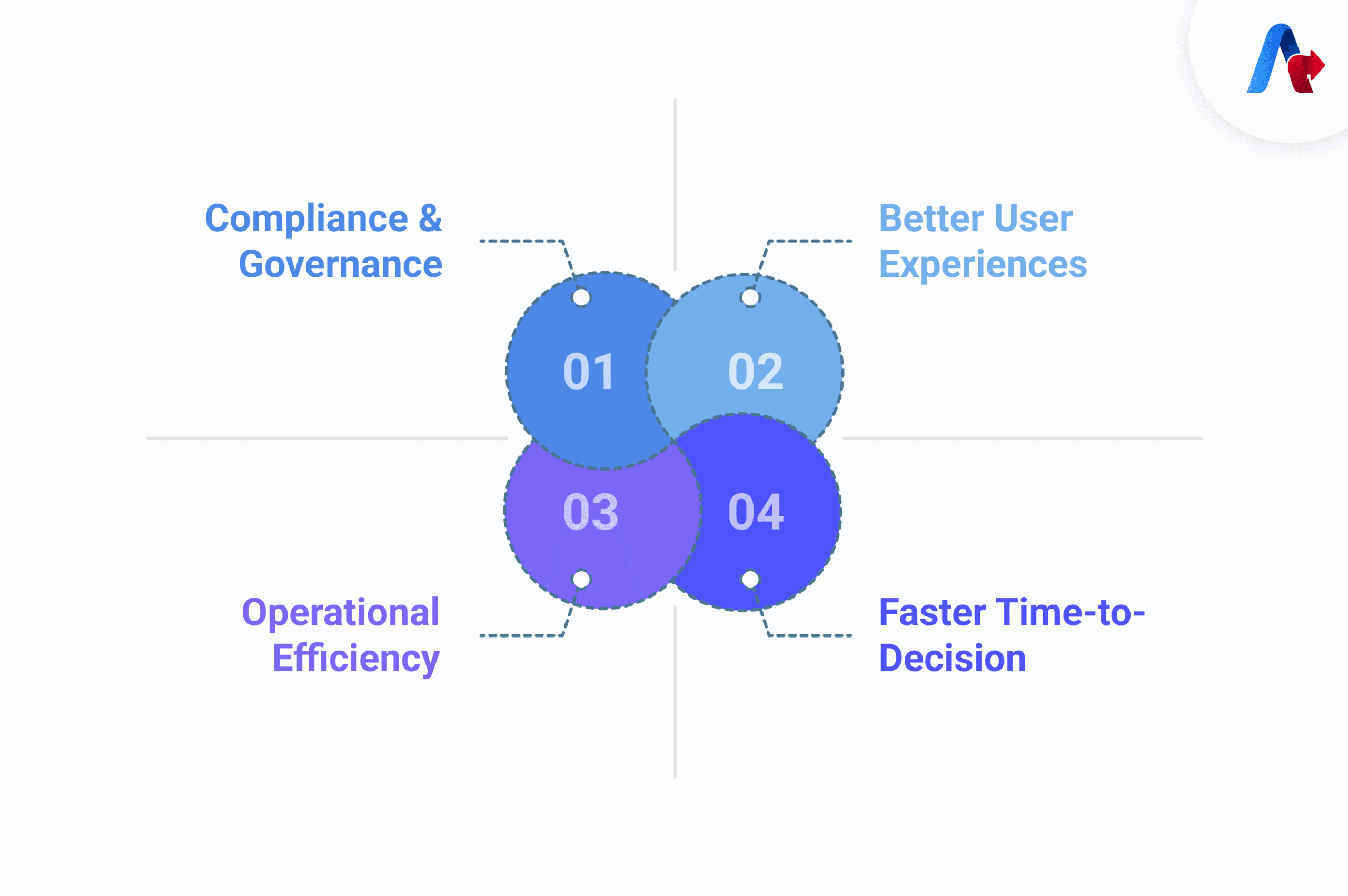
A well-executed pilot when done right delivers more than just automation or proof-of-concept. It becomes the foundation for AI maturity across the enterprise. When Agentic AI is aligned with real business goals, it creates a continuous value loop where each deployment informs the next, steadily building enterprise intelligence. Here are the tangible outcomes:
- Faster time-to-decision: Agents act in seconds, not hours
- Faster time-to-decision: Agents act in seconds, not hours
- Operational efficiency: Reduces repetitive workload by 40–70%.
- Compliance & governance: Enterprise-grade control from day one.
From Experimentation to Enterprise Adoption
Launching an Agentic AI pilot isn’t about experimenting with technology, it’s about shaping the future of intelligent operations. Whether you’re exploring Salesforce Agentforce, MuleSoft IDP integrations, or custom GenAI workflows, we help organizations design, deploy, and scale AI agents safely and effectively. Start your Agentic AI journey from pilot to production, with measurable business impact at every step. Connect with us today!
FAQs
Start with a repetitive, high-volume process that requires reasoning but limited risk like claim validation, customer onboarding, or internal helpdesk queries.
Typically, 4–8 weeks is ideal to capture baseline metrics, feedback, and process variations.
Not always. Most modern Agentic frameworks like Agentforce or LangChain are low-code or declarative. However, AI engineers or architects help ensure governance and scalability.
Chatbots follow scripted rules; Agentic AI uses reasoning and data to act autonomously, learn from context, and improve performance over time.
Track metrics such as time saved, manual effort reduced, accuracy rate, customer satisfaction scores, and SLA adherence.
Data leakage, prompt injection, and lack of explainability. Use controlled environments, access management, and audit trails to mitigate them.