



Quick Summary
AI once started with automation, but it has now evolved into autonomous agents that make their own decisions with little human support. It is really an advantage, but there are many responsibilities associated with this action, and these can be managed only with an AI governance framework. With clear control and automation, agentic automation can improve trust, security, and compliance, so an enterprise can scale artificial intelligence without any risks.
Generative AI and intelligent agents are rapidly becoming an integral part of businesses' daily operations. Today, they analyze information, make decisions and act on their own with limited support. It benefits in many ways, but it also comes with many challenges.
When AI starts working in financial decision-making and security, the risks become more visible, such as bias, data misuse, and compliance issues. As adoption of artificial intelligence systems is increasing rapidly, make sure that your systems adhere to moral principles and comply with legal requirements through an AI governance framework.
Clear AI governance helps organizations set rules, define responsibilities, mitigate risks, and ensure autonomous systems are ethical and safe. According to the latest McKinsey Global Survey on AI, 65 percent of organizations are now regularly using Generative AI, nearly double the percentage from just a few months ago, underscoring the need for effective AI frameworks.
What is AI Governance?
The set of guidelines that ensures the responsible development and deployment of artificial intelligence is known as AI governance. In addition to its ability to transform industries and automate processes, AI has significant organizational, ethical, and legal ramifications.

The increase in the use of AI in our daily lives and work tells us about the need for a strong governance structure. Without it, businesses may face problems like privacy and biased algorithms that will lead to negative consequences. For this reason, creating a strong framework for AI governance is essential to guaranteeing accountability, transparency, and responsible application of AI.
In short, an AI governance framework provides organizations with a structured way to manage and navigate the ethical challenges that come with AI implementation.
Explore our guide to AI agent governance: AI Agent Governance for Enterprise Leaders: A Complete Guide
Why is AI Governance Important for an Organization?
Although the definition of AI governance has already been discussed, the main question lies in: Why is AI governance such an important part of an organization? It is vital because governance creates a framework to guarantee the ethical and responsible use of artificial intelligence.
The following are some of the points that can be considered to sum up the significance of AI governance.
1. Ensuring Safety and Fairness
AI governance aids in the management of the risks that come with AI technologies, including potential privacy violations and decision-making biases. Prominent events show how AI can seriously affect society in the absence of adequate control, such as the skewed results from AI tools (like the Tay chatbot and the COMPAS software).
According to a recent post published by Dataversity, the purpose of AI governance is to encourage the ethical application of technology in a way that makes its use transparent, safe, private, responsible, and impartial.
2. Establishing Trust
Establishing robust artificial intelligence governance frameworks within enterprises cultivates stakeholder confidence. Gaining the trust of clients and staff requires transparency into how AI systems function and make decisions. This trust is crucial, as companies increasingly depend on AI to handle vital tasks such as fraud and cybersecurity.
3. Compliance with Regulations
Organizations must abide by the restrictions imposed by governments worldwide on the use of AI to avoid legal implications. A strong enterprise AI governance framework encourages ethical behavior within the company and helps ensure compliance with these laws.
4. Promoting Accountability
Clear duties and responsibilities for the usage of AI inside a business are made possible by a well-structured framework for AI governance. In order to guarantee that AI technologies are applied morally and sensibly throughout their lifecycle, accountability is crucial.
5. Encouraging Innovation
Through the implementation of strong AI data governance, enterprises may efficiently manage risks and foster innovation. This equilibrium enables businesses to take advantage of AI while limiting its drawbacks.
Are you planning to scale AI safely? Let’s design a framework that works for your enterprise.
Start building responsiblyHow Should Businesses Handle AI Governance?
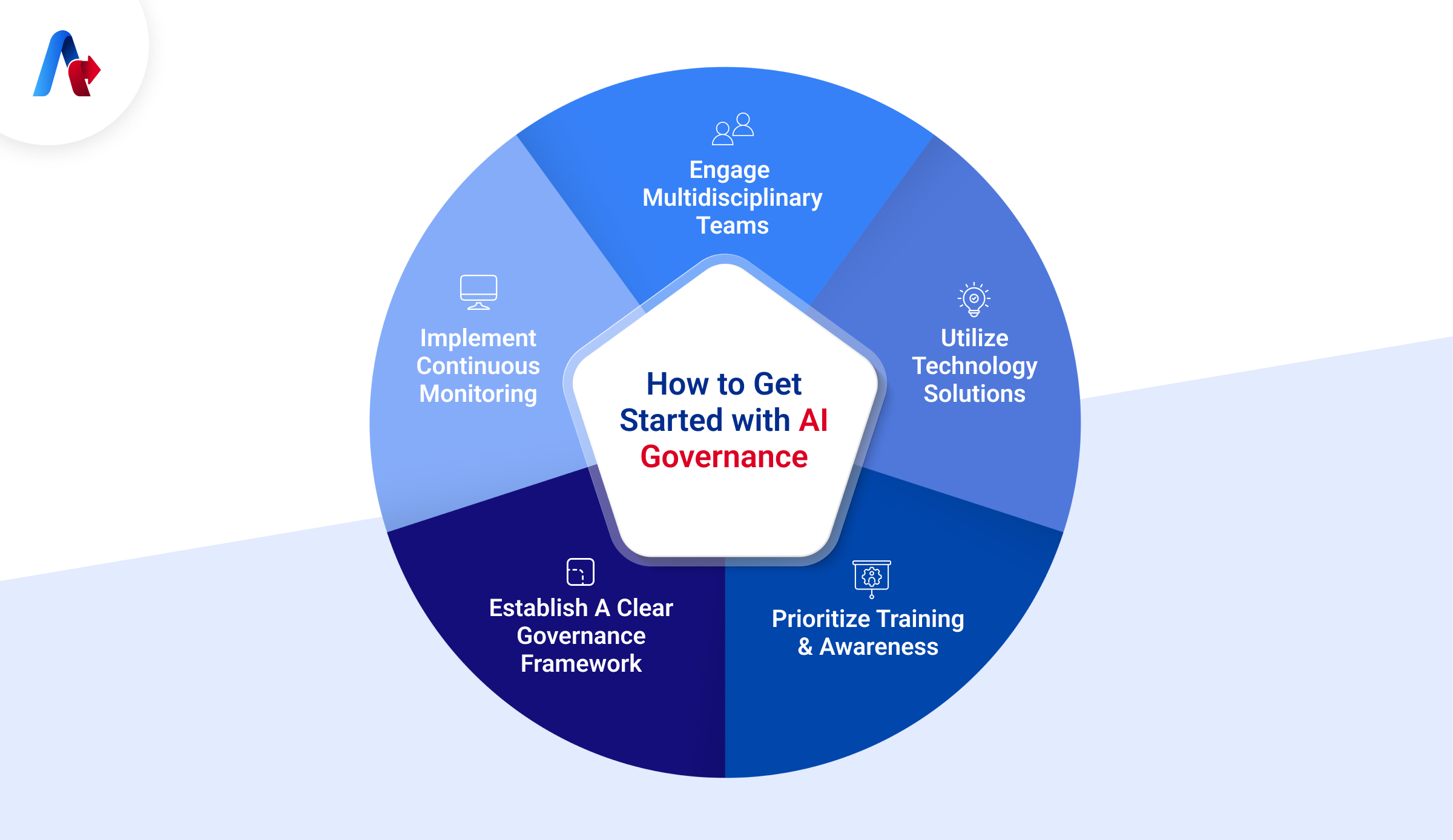
Organizations often ask how to implement AI governance effectively. To do this, they should follow systematic tactics that protect them from threats and improve the overall efficacy of AI deployments.
Let's examine a doable strategy for implementing AI governance in businesses.
1. Establish a Clear Governance Framework
Establishing a comprehensive AI governance framework that delineates roles, regulations, and procedures for overseeing AI systems throughout their lifecycle is important for organizations. Guidelines for the creation and application of ethics should be part of this framework.
2. Involve Multidisciplinary Teams
Effective governance needs cooperation between technology, law, ethics, and business. Incorporating diverse viewpoints ensures comprehensive support and addresses the complex issues that you may encounter with artificial intelligence.
3. Continuous Monitoring
It is recommended that organizations establish procedures for continuous assessment of their AI automation to ensure compliance with legal and ethical requirements. Frequent audits can help identify risks early.
4. Make Training and Awareness Your Top Priority
It is imperative to allocate resources towards employee education programs that cover AI governance principles. A culture of accountability is established within the company when staff members are aware of their responsibility to employ AI properly.
5. Make Use of Technology Solutions
Organizations can utilize technology tools for governance, such as dashboards that provide real-time insights into the effectiveness and compliance of AI models. These tools promote transparency and help monitor the success of governance initiatives.
‘Forrester projects that spending on AI governance software will grow at a 30% compound annual growth rate from 2024 to 2030. It is a clear indication of how organizations are increasing investment in governance tools as AI adoption scales.’
AI Governance Frameworks for 2026
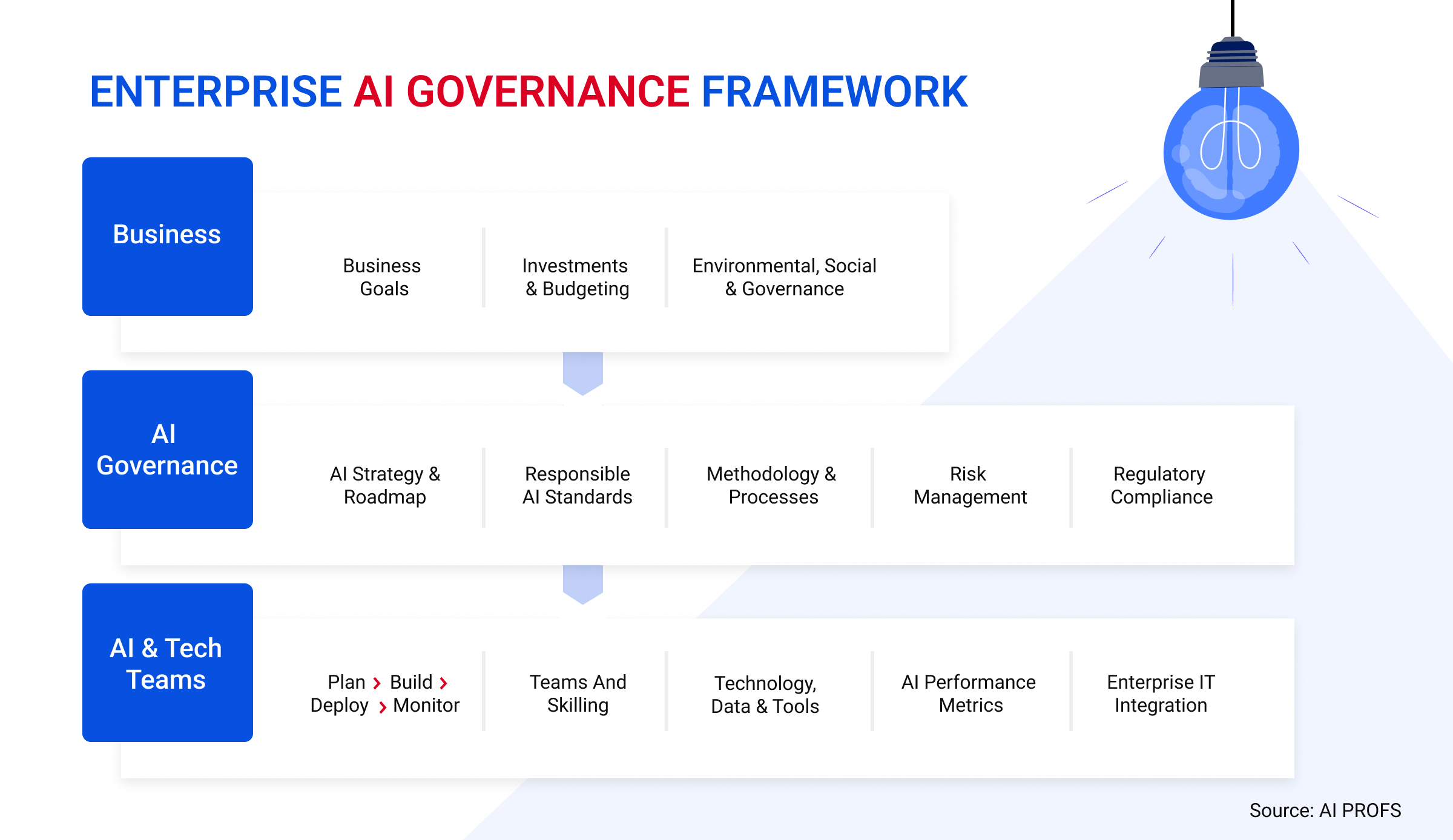
AI governance in 2026 is not just for aligning with internal policies. It is about following global regulations, managing enterprise governance risks and AI challenges, and preparing for the future autonomous AI systems.
Enterprises cannot keep AI governance and regulations aside anymore. It is becoming a necessity as many of the acts have moved from discussion to action. Let’s look at some of the AI frameworks in 2026 you should care about.
1. Alignment With Global Regulations
As an enterprise using AI and automation worldwide, it is necessary to comply with key regulations to avoid consequences. Some of the global standards are:
- The EU AI Act: It is the first risk-based classification of AI systems in the world that was formally adopted in August 2024. Most of its provisions will come into effect only in August 2026, as the companies are piloting and scaling AI
- The NIST AI Risk Management Framework (AI RMF): It is a framework that was formed in 2023 by the National Institute of Standards and Technology (USA). This framework addresses the design and use of AI responsibly.
- OECD AI Principles: These principles came into effect in 2019 and promote responsible AI development and emphasize human-centered values, transparency, fairness, robustness, and accountability.
- Canada’s Directive on Automated Decision-Making: This law, introduced in 2019, explains the assessment scoring system to determine requirements for human oversight, peer review, transparency, monitoring, and contingency planning for automated decision systems.
‘A recent Gartner poll found that 37% of organizations have established formal AI governance and risk oversight, and 58% are still building capabilities.’
2. Enterprise-Wide AI Oversight
Earlier, AI governance focused on model validation alone. A new system covers:
- AI accountability
- Cross-functional committees
- Legal, compliance, security, and IT collaboration
- Clear ownership of AI systems
Apart from that, an enterprise should also discuss design and data collection, development and validation, deployment strategy and integration, how it monitors and audits automation, and continuous improvement.
Another challenge is the arrival of agentic AI, a system that is autonomous in taking actions, making decisions, and interacting with other systems. An agentic AI governance framework must include:
- Strict access controls
- Human-in-the-loop checkpoints
- Activity logging and audit trails
- Runtime behavior monitoring
How to Implement an AI Governance Framework (Step-by-Step)
Implementing data governance for AI requires a structured plan that explains everything from start to finish. And this plan must fit all, including leaders, the compliance team, designers, and other stakeholders.
1. Explain Purpose and Objectives
Define what your governance is going to achieve. It can be anything, such as compliance, risk reduction, bias control, data protection, or secure AI deployment. These goals can help avoid confusion later.
2. Prepare a Framework
This side includes many aspects, such as roles, responsibilities, ownership, and support decisions. It can provide end-to-end detail on oversight across development, deployment, compliance, and monitoring.
3. Create AI Policies and Inventory
In this step, you should mention what is permitted and what is not in the AI development and use. This also includes the use of internal models, tools, third-party solutions, and agentic systems.
4. Classify Risk Levels
There is a risk while developing an autonomous system. Here, you need them based on impact and sensitivity. High-risk systems (such as financial decisions or autonomous agents) require stricter controls and human oversight, and the other is the second priority.
5. Build Guardrails
The data is one of the most important factors in AI. So, there should be a rule about its use, testing, and other details. More than that, there are risks from vendors and from biased testing. Establish a rule for teams to follow.
6. Include Governance in the development
Once you have a set, everything moves to a practical session. Developers review all the mandatory factors and ensure they follow them. They build and test it to ensure it works and that nothing is missing from day one onwards. The team continuously monitors everything and checks that everything works as expected after development.
7. Measure and Improve
Once you create a governance model, it is not set in stone but must evolve after measuring. A team can use metrics like compliance rate, incident frequency, and bias detection and review everything periodically.
If you want to turn principles into practice, you require structure, tools, and the right expertise. Accelirate is the right partner to provide that.
Get started with a governance roadmap9 Principles of an AI Governance Framework
The cornerstone of prudent AI use is good governance. It ensures that artificial intelligence (AI) tools are used ethically to improve decision-making. It is more than just following the rules, as agentic AI governance provides firms with a mechanism to manage the ethical considerations surrounding AI. The goal of the AI governance framework is to increase stakeholder and user confidence.
Let's examine the nine fundamental tenets of ethical AI, along with examples of AI governance that can guide you toward a more secure and effective AI deployment.
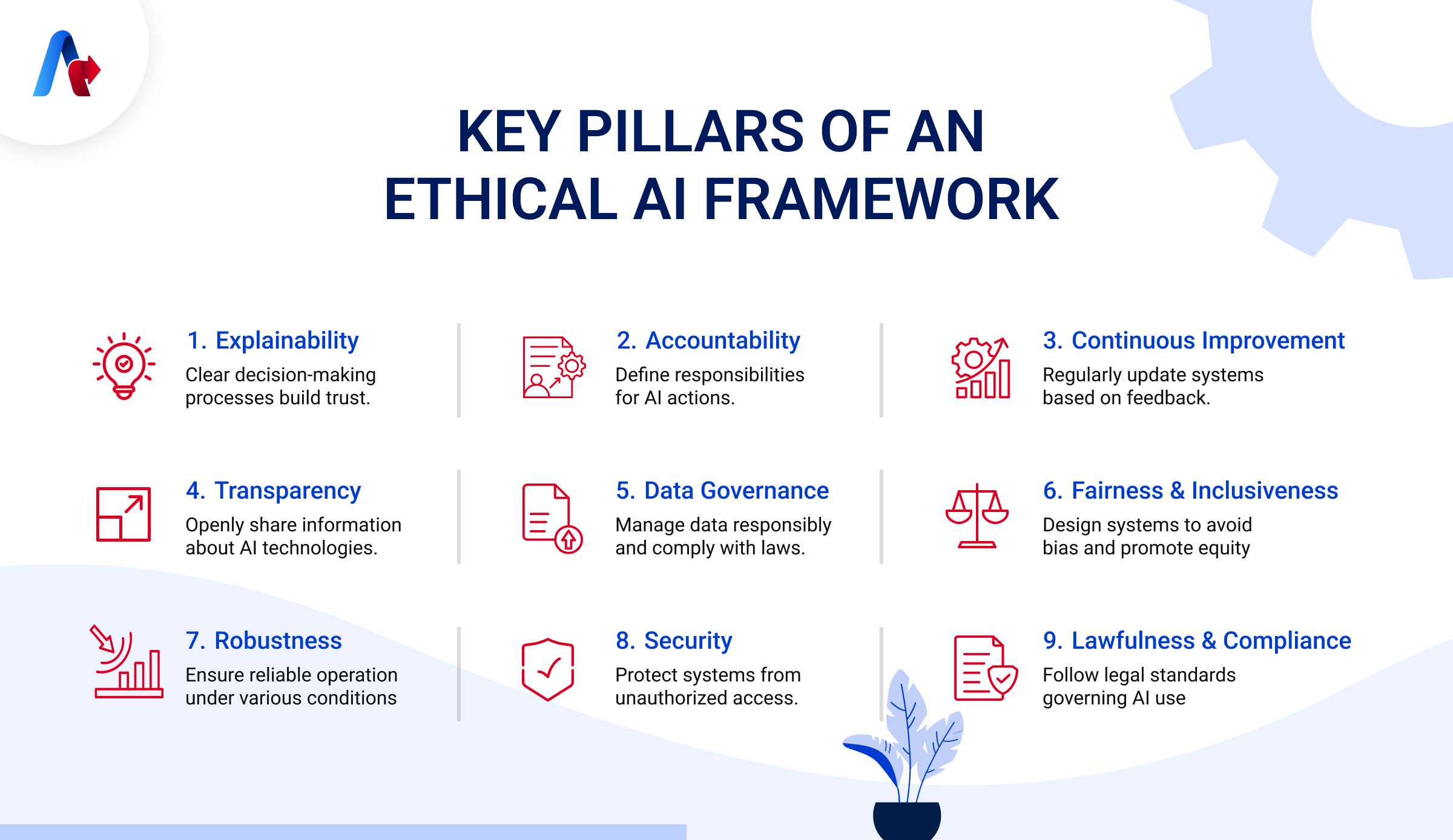
1. Explainability
A key component of explainability is ensuring that AI systems can articulate their decision-making processes. Users are more inclined to trust the system when they are aware of how results are determined.
- Why it Matters: People are more comfortable using technology when they understand the decision-making process.
- Example: In credit scoring systems, candidates should know which factors affect their scores.
2. Accountability
To ensure accountability, it's important to identify who is responsible for decisions made by AI systems. If something goes wrong, such as biased results, there ought to be a defined procedure in place for handling it.
- Why it Matters: Establishing accountability makes it possible to hold wrongdoers accountable.
- Example: If an autonomous vehicle causes an accident, there ought to be a procedure in place to determine who is responsible.
3. Security
Data integrity and protection against unwanted access are two aspects of security for AI systems. Users are more likely to trust technology in a secure environment.
- Why it Matters: As cyber threats grow more complex, strong security measures are essential.
- Example: Using encryption can help protect sensitive data processed by AI systems.
4. Transparency
Organizations must be transparent before sharing information about their AI technologies with users. This transparency can promote trust and encourage its use.
- Why it Matters: Users can improve decision-making processes when firms are open and honest about how their systems operate.
- Example: Companies can disclose the way their algorithms function and what data they use.
5. Inclusivity and Fairness
AI systems need to be fair and impartial to all their users. This principle encourages people from diverse demographics to use it actively.
- Why it Matters: Biased algorithms can result in discrimination and social inequalities.
- Example: An organization can check its algorithms to prevent bias against certain groups.
6. Information Management
Personal data, such as financial information, is important to protect while feeding intelligent agents. This is vital to ensure compliance within a country in which you operate and internationally.
- Why it Matters: Individual rights are important to protect, or one may face legal issues.
- Example: Organizations should anonymize user data before using it for training purposes.
7. Robustness
Ensure your AI agents function consistently across different areas.
- Why it Matters: A reliable system reduces the risks and improves security.
- Example: An autonomous system should have a safe procedure in place to handle technical malfunctions safely.
8. Legality and Adherence
Any Organization using AI technologies must follow rules such as GDPR.
- Why it Matters: If any artificial intelligence violates the law, it can harm reputation and lead to a fine.
- Example: Companies should regularly check their AI systems for compliance with relevant international laws.
9. Continuous Enhancement
This idea emphasizes routinely reviewing and updating AI systems based on new information or user input.
- Why it Matters: Constant improvement ensures that systems are still efficient and compliant with moral principles.
- Example: Organizations might conduct periodic reviews of their algorithms based on user feedback to identify areas for improvement.
AI Security Governance: Protecting Enterprise Systems from AI Risk
The risk is increasing in this AI landscape, especially when it handles sensitive data and takes autonomous decisions. Let’s see some of the areas you should focus on in the AI governance framework:
- Why it Matters:Secure Data Management: Data is the foundation of AI training, but ensure that it is not dangerous to individuals and companies. For that, you can use encryption, limit access, and anonymize personal information.
- Why it Matters:Model Integrity Protection: It is also essential to protect models from tampering, adversarial attacks, and unauthorized usage. In this situation, companies can use version control and validation checks to maintain reliability.
- Why it Matters:Access Control and Monitoring: If you want to keep AI safe, allow only role-based access, multi-factor authentication, and activity logging. Continuous monitoring of the AI model also helps you detect unusual behavior, so you can act early.
- Why it Matters:Third-Party AI Risk Management: Always assess vendors and external AI tools before deploying them into your system. Many organizations can face risks through unmanaged third-party integrations.
- Why it Matters:Incident Response Planning: This rule is significant when something goes wrong unexpectedly. Define clear response procedures for AI security incidents, so you can take quick action to minimize reputational damage.
AI risks evolve as systems grow more autonomous and connected. Build a strong strategy to stay secure and resilient.
Strengthen your AI defenses todayGovernance Metrics: How to Measure AI Governance Effectiveness
Having an agentic AI governance framework in place is important for your organization. But the real question is: how do you measure AI governance success? Let’s see that.
1. Compliance and Policy Adherence
Measure how your AI systems align with internal policies and external regulations. If any of the following points are missing, there is a gap in your adoption.
What do you need to track?
- Percentage of AI systems documented in your inventory.
- Audit completion rates
- Regulatory compliance status
- Policy violation incidents
2. Model Bias Detection
AI systems must be consistent and reliable while in use. It can improve trust and mitigate legal issues. So a team must evaluate and monitor:
- Bias detection results
- Drift in model outcomes
- Frequency of fairness reviews
3. Model Performance and Accuracy
Governance is not just about following the rules. There must be an outcome for it, and checking its operational reliability is the most important in testing its ability. You need to check:
- Model accuracy trends
- Performance degradation
- Data drift alerts
- Frequency of model retraining
4. Security and Risk
AI security governance and risk assessment should track:
- Number of AI-related security incidents
- Response time to AI incidents
- Unauthorized access attempts
- Third-party risk assessments completed
5. Ethical and Social Impact
A system design can have its ethical and social issues. It is important to assess:
- Fairness scores
- Adherence to ethical rules
- Transparency in the results and explainability
6. Governance Maturity Score
Many enterprises adopt a maturity model to evaluate their progress. Tracking this can help leaders understand where they need to focus more. So, it is vital to ask:
- Is governance centralized or fragmented?
- Are controls automated or manual?
- Is monitoring proactive or reactive?
Build a Responsible AI Governance with Accelirate Expertise
The use of AI in enterprise systems, such as customer support and decision-making, is increasing. As adoption increases on one side, there is also responsibility on the other side. An AI governance framework is imperative in this situation to ensure there are no legal, ethical and security risks.
With clear principles for implementation, controls, metrics and safety measures, enterprises must have a clear structured approach. Governance is not something that slows down; rather, it ensures your business is sustainable and scalable without issues.
In today’s AI era, organizations that invest in AI governance can handle regulatory changes, autonomous AI systems, and rising expectations. This method of control ensures that a business combines innovation with accountability, and that starts with better-designed governance with a trusted Gen AI service provider like Accelirate onboard.
The future of AI belongs to those who govern it wisely. Build a responsible strategy that helps today and tomorrow.
Take control of your AI journey todayFAQs
The nine AI governance principles include explainability, accountability, security, transparency, fairness, strong data management, robustness, legal compliance, and continuous improvement. With these together, a team can ensure AI systems are safe, reliable and ethical. By following them, any organization can mitigate bias, protect sensitive data, and follow compliance.
Good governance should be systematic, transparent, and wide. It must clearly explain the ownership, define policies and risk, and ensure continuous monitoring. If there is a high risk, human oversight is necessary. Everything should have documentation, an audit, and must strictly follow compliance.
There is a systematic method to start the AI governance framework. First, define what you are trying to achieve and prepare a clear framework for roles and responsibilities. The next process is to prepare a policy that explains what is permitted and what is not. The rules you prepare should also explain the risk level, guardrails, and a continuous improvement plan.
Some practices include maintaining AI inventory, applying risk-based classification, and continuing to monitor for bias and drift. Your plan should also consider access controls, vendor risk assessments, and regular audits. With a disciplined approach, you can easily scale it across all departments.
Globally, AI governance is being applied in a variety of ways. Among the more effective instances are:
AI Bill of Rights (USA): The USA's AI Bill of Rights proposal highlights the need for transparent, secure, and accountable AI systems.
Canada’s AI and Data Act: The AI and Data Act of Canada is a framework designed to control the advancement and application of AI in the country.
EU AI Act: The EU AI Act is a comprehensive regulation that assigns higher risks to AI systems and places more stringent guidelines on those applications.
OECD AI Principles: Adopted by over 40 nations, these principles promote ethical and trustworthy AI systems, concentrating on transparency, justice, and accountability.
Singapore’s Model AI Governance Framework: Offers instructions and guidelines to businesses on how to implement ethical AI policies that prioritize transparency and responsibility.
Within an enterprise, AI governance is a shared duty. Important participants consist of:
CEO and Senior Leadership: They are ultimately responsible for ensuring and implementing an efficient AI governance framework and its ethical use.
Audit Teams: These teams evaluate the accuracy and consistency of the data utilized in AI systems to make sure there are no biases or mistakes.
CFO: In charge of overseeing the financial elements of AI projects, including risk and budget management.
Cross-Departmental Collaboration: Effective governance includes input from multiple departments, including IT, legal, ethics, and compliance teams.