



FEB 26, 2026 |
What Agentic QA Testing Brings to Your Organization

Quick Summary
Outdated automated testing models don't add value to your business. Instead, they just elongate the entire software testing process for your team. Even a small update could lead to big troubles. Modern QA teams need agentic QA testing that reduces pressure and costs and improves efficiency through its autonomous action. Through agentic AI testing, a team can get stable testing, faster regression cycle, and measurable ROI without increasing headcount.
What if you get a tool that generates test cases and fixes the errors before they affect your whole application? That’s not a futuristic promise; it's a reality with the rise of agentic QA testing.
When automation was introduced, enterprises invested heavily, thinking that it would reduce effort and speed up releases. Even though it improved development, many teams still spend days maintaining scripts, troubleshooting, and fixing defects. Traditional automation is good at running steps, but it doesn’t think autonomously.
Agentic AI changed this scenario by helping teams write scripts, understand context, adapt to application changes, and ensure everything works as expected by making real-time decisions.
If you are an organization under pressure to release faster with limited QA budgets, you are in the right place. This article explains what QA testing is and how it reduces costs without compromising quality.
Let’s learn what this means for your enterprise.
What is Agentic QA Testing?
Agentic QA is a software testing method that uses artificial intelligence systems to provide autonomy, adaptability, and reasoning to conduct testing with minimal human intervention. This autonomy is not part of traditional automation that follows only fixed steps. If something changes in the old method, the whole software system breaks, so someone must fix it manually.
This problem does not occur with autonomous testing because it does not blindly follow instructions but understands the test's goal and adjusts when changes occur during updates. The main advantage of this system is that it can analyze failures, recover minor UI changes, and continue its work without affecting the system.
Rather than just identifying elements, agentic systems look for the context, prioritize risks, and decide what to execute next. A team with this type of ability can avoid problems in advance, reducing costs by up to 40%.
Pitfalls of Traditional Software Testing
Let’s understand that testing models built early did their job well, but today the situation is different. The delivery time is shrinking, risk is increasing, and the teams must mitigate their costs to sustain this competitive world.
Moreover, many organizations still operate with large QA teams of 50 to 70 engineers to maintain frameworks, update scripts, and manage regression packs. This structure looks good on paper, but it's expensive.
Here’s what happens with traditional testing:
- Test scripts break after small UI changes.
- When a test fails, it affects the trust in the team.
- Maintenance consumes more time.
- Regression cycles slow down releases.
- Vendors need to add more people rather than improve efficiency.
Gartner research indicates that 16% of organizations view high maintenance costs as a significant challenge to automated testing. Think of one situation where you focus only on old methods that increase production and maintenance costs.
And that’s where the QA team's frustration increases, and this is where agentic testing in QA helps enterprises.
Functions of Agentic AI in Software Testing
Now, let’s move from the problem to the solutions that agentic QA testing can change. Just imagine it like a QA staff that works 24/7. Let’s understand what it can do in the testing process.
-
Self-Healing Execution:
With test automation, agents can automatically adapt to UI and element changes. If a locator fails, the system uses an alternative path rather than failing immediately. It can reduce maintenance effort significantly.
-
Smart Test Generation:
Intelligent test automation can analyze user journeys, production logs, and code changes to dynamically update test cases. When this tool is by your side, a team can avoid writing hundreds of scripts manually. In this way, teams get smarter coverage with less effort.
-
Failure Analysis:
This is what makes AI different from other testing. When a test fails, it doesn't just give a report “failed.” It thoroughly examines the reasons for the failure and determines whether the issues are environmental, data-related, or otherwise.
-
Risk-based Execution:
Not every test is important at all times, and not every test has top priority. Agents prioritize high-risk areas first, where fixes are necessary now, and fix issues faster before they affect the whole application.
-
Integrate CI/CD Pipeline:
AI-driven QA services integrate easily into DevOps pipelines and support QA testing across stages without constant manual monitoring.
Don't allow outdated methods to slow down your process. Move to testing that can think and take autonomous action.
Talk to our testing experts nowHow Agentic Testing in QA Improves the Software Development Lifecycle (SDLC)

Agentic QA testing is not limited to a single phase. It flows through the entire lifecycle instead of acting at the end.
Discovery Phase
In most enterprises, they write user stories, but the edge case is different. In this scenario, the acceptance criteria are unclear. Using agentic AI, it can analyze user stories, historical defects, and other features to automatically generate test scenarios. With this, teams catch it before development goes too far.
Shift-Left Engineering Stage
Developers are under pressure to finish on time, but writing unit and integration tests is still a challenge for them. Intelligent agents are smarter in this stage as they can suggest code and generate test cases. They analyze the patterns, identify areas that require coverage and strengthen quality before code even reaches the formal QA cycles.
Testing Phase
During testing, traditional automation can struggle, especially when the scripts break. Such a situation can increase costs, so a team must spend more time fixing tests rather than what really matters. An autonomous execution can adapt to changes and data variation with minimal manual effort.
Release Readiness Stage
As a modern enterprise, relying on only CI/CD pipelines for validation is risky. Artificial intelligence software testing validation goes to this pipeline and analyzes changes before they are released. Instead of waiting for a full regression cycle, AI intelligently triggers based on impact analysis.
According to Forrester’s DevOps research, high-performing teams in the software field and testing deploy 208 times more frequently than low-performing teams. The main difference is not talent, but automation maturity across the pipeline. By using agentic AI, any enterprise can ensure speed and improve stability.
Maintenance and Monitoring Phase
Maintenance is a big problem with traditional automation. When an agent is testing, everything becomes smarter because they check production logs, past defects, anomalies, and high-risk. This predictive approach prevents repetitive failures and reduces your monitoring and maintenance effort.
Read: Agentic AI Software Testing: A Leadership Guide to Building Trust and Scaling Safely
If your team still spends time fixing broken scripts, this is the best time for a smarter model.
Consult our expert team for freeBenefits of Autonomous Software Testing Agents
An organization will benefit from agentic QA testing in many ways. The advantage does not just comprise speed but also cost reduction and accountability.
Let’s move with what leadership really cares about in QA testing.
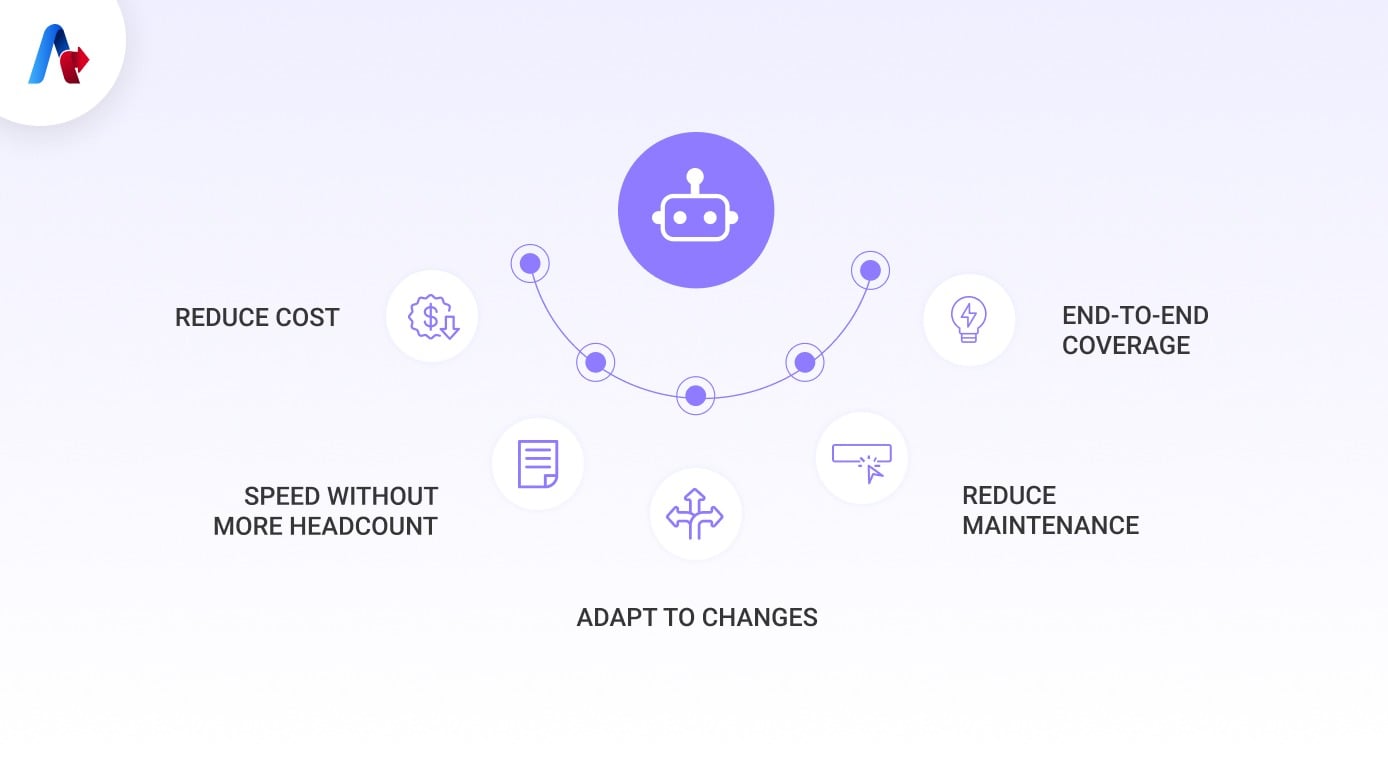
Reduce Cost
Most large vendors hesitate to provide agent-based execution because it drains their pockets. They justify using traditional methods because they generate more profit for them.
Implementing agentic testing in QA workflows can deliver up to 30% costs reduction compared to conventional models, without sacrificing coverage. In this method, you are paying only for outcomes, not for effort.
Speed Without More Headcount
If you are a larger organization, you need a QA team of 50-70 members. This happens because of the many applications you use. This is a different perspective where you have 20 agents for quality assurance and 5 skilled operators for execution. It improves speed without compromising quality. Here, you are not scaling people but scaling intelligence.
Adapt to changes
Changes occur due to frequent updates, but they should not affect the entire application. While using the older method, a team must work physically during the change, but the AI agents' autonomy can adapt to the situation.
Reduce maintenance
The cost of maintenance and the time a software team spends is more in the static method. While using a self-healing method, you can reduce maintenance effort, save time, and lower costs. Reducing manual intervention can increase operational efficiency and boost ROI by up to 40%.
End-to-end coverage
Beyond the testing tasks, artificial intelligence also checks users' journeys and ensures everything functions as planned. This will ensure that everything works effectively without much human intervention.
Use cases of Agentic Testing
Agent-based testing is no longer limited to a single industry today. There are many areas where testing agents can help improve release speed and maintain stability.
Banking and Financial Services
In this sector, there are frequent regulatory updates and complex integrations. By using artificial agents, an organization can validate transaction flows, API integrations, and compliance issues. Doing such things manually takes time and effort, but AI agents reduce regression time during core banking upgrades.
Healthcare and Insurance
Healthcare and insurance are two areas where we need greater accuracy and stronger data privacy protections. The use of autonomous validation in these sectors helps test patient workflows, claims processing systems, and portal updates without additional manual maintenance.
Retail and E-commerce
These are a few sectors where frequent updates happen, and a small change in the UI can affect everything if you are using traditional methods. Automation adapts to layout and element changes, ensuring everything works as expected.
SaaS Product Teams
Product companies that frequently update their products benefit from software testing. AI-led testing aligns directly with CI/CD pipelines and improves coverage without slowing velocity.
Must Read: Top 35 Agentic AI Use Cases with Real-World Applications Across Industries
Prepare your Enterprise for Self-Healing Test Automation with Accelirate
The QA leaders are under pressure due to frequent releases, and there is always pressure to reduce the budget. This is where agentic QA testing can help enterprises meet what top leadership really expects.
The companies that adopt this system benefit from faster regression testing, lower maintenance costs, and greater confidence in releases. Those who use more headcounts will struggle to justify their QA cost.
Accelirate helps companies start with one application to prove cost reduction and stability, so you can scale with proven ROI. Our goal is not just automation but to prove value, provide clarity and offer measurable improvement.