


Quick Summary
A dark testing factory is an emerging software model that connects AI agents, testing tools and humans in the loop in a coordinated process. Unlike traditional automation, which executes pre-defined tests, this evaluation method helps QA teams manage decisions across the development cycle. It does not remove human QA engineers, who are still necessary for verifying results and making critical decisions.
Some software updates that took days before can be completed faster with the help of AI, but testing everything takes more time. The reasons are simple: the team needs to figure out what changed, which tests to run and making sense of failure takes more time than expected.
Every software update brings new risks. Even with automated testing and CI/CD pipelines, QA teams in organizations have to spend time reviewing changes, updating test cases, and debugging failures. Development may move faster, but testing is still a problem, as teams cannot keep up with the speed.
This is what UiPath's vision of the dark testing factory is trying to solve. The goal with this new update is simple: go beyond continuous test execution to a new system that can coordinate testing activities, respond to application changes, and learn from previous outcomes.
But how far can AI take software testing on its own? Can your teams completely rely on its outcome? Do we need to use human judgment to make sure the software is ready for release? Let's find out.
What Is a Dark Testing Factory?
A dark testing concept is an approach in the software testing area that coordinates AI agents, automation tools, and human expertise to manage quality throughout software development. The idea behind this method is to avoid repeated manual work, combine activities and make testing more independent.
The term "dark factories" is derived from the manufacturing sector. In such facilities, everything is automated with a little human presence. The idea is mostly the same here, but the work involves ensuring software quality. This is also different from an AI software factory because it can cover coding, testing, and deployment.
What Is the Difference Between Dark Testing and Traditional Test Automation?
The main difference is that it can take on the responsibility of testing. Traditional testing uses predefined rules to check an app's behavior, but changes must be reviewed by a QA engineer and updated manually.
It can do more than that, as it employs AI agents to generate test cases and to fix broken test selectors. They are independent but may still be limited in their activities. The testing factory brings all these capabilities together and coordinates testing with agents, automation tools, and finally uses human intelligence when necessary.
| Capability | Traditional Test Automation | Autonomous Testing | Dark Testing Factory |
|---|---|---|---|
| Test creation | Engineers write test scripts | AI can generate tests | Coordinated with application changes and risks |
| Test execution | Runs predefined tests | Agents can select and run tests | Execution is coordinated across testing activities |
| Test maintenance | Engineers update broken scripts | Agents can suggest or repairs | Test maintenance is a continuous process |
| Decision-making | Mostly human-led | Agents make decisions within assigned tasks | Decisions follow defined policies and risk thresholds |
| Human support | Frequent supervision | Oversight depends on the task | Humans manage exceptions, risks, and critical approvals |
| Main limitation | Requires ongoing manual maintenance | Individual agents may work in isolation | Some areas are still developing |
For a closer look, read Accelirate's comparison of agentic AI testing vs. traditional test automation.
Moving everything to a new setup is not a good idea. Better to go for a mixed strategy where you can use traditional automation for stable and repeatable tests. Introduce AI agents where you have more manual testing, such as test creation, failure analysis, and maintenance. When you feel it is reliable, move into connecting them with new processes with clear human support policies.
How Does a Dark Testing Factory Work?
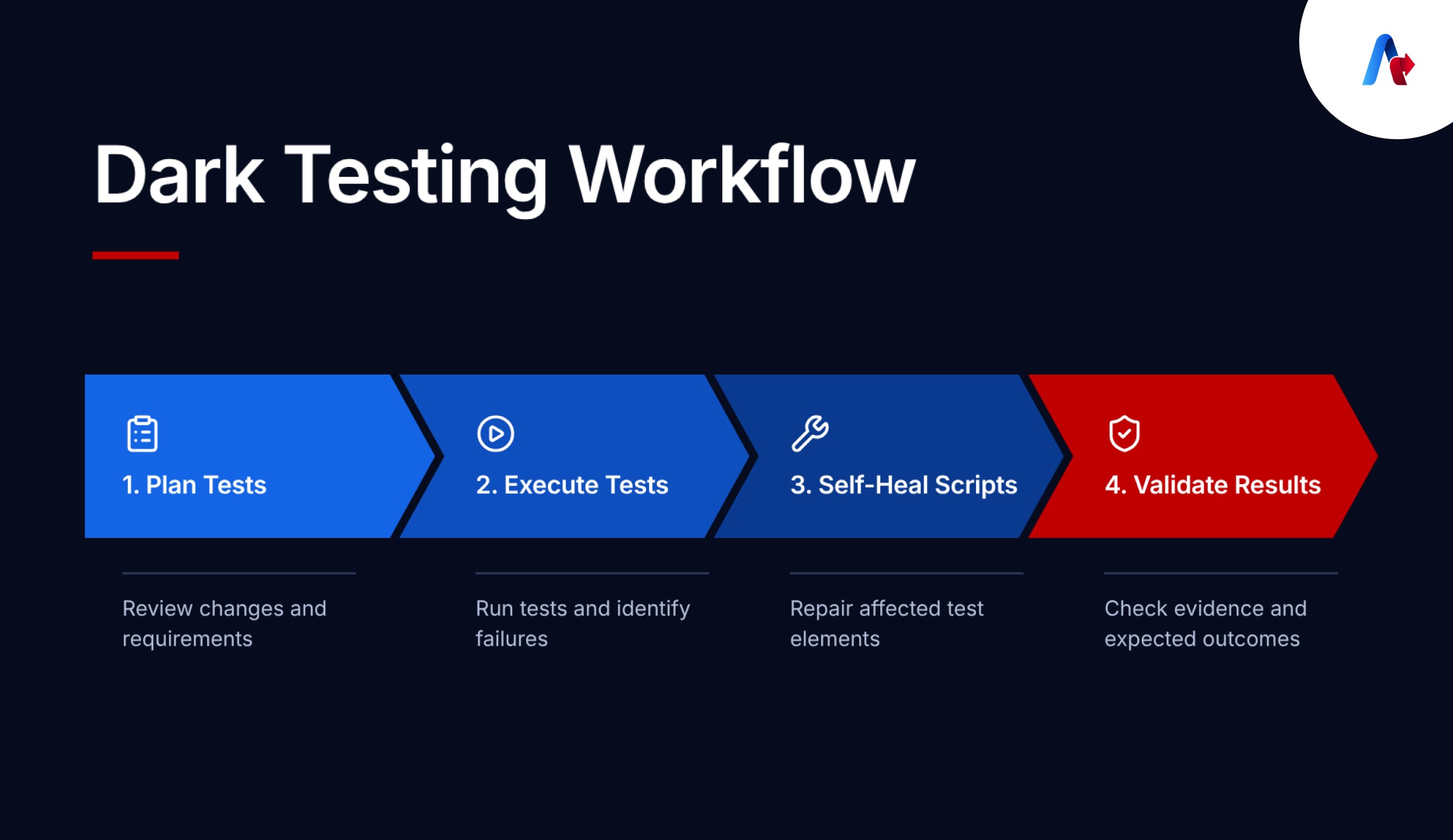
The main working principle of this testing is to connect automation tools, AI agents and testing into a continuous workflow. When software enters the development pipeline, this system can assess it, prepare the tests, run them, and decide what to do next. Instead of someone coordinating every step, the tool itself completes the work autonomously.
How Do AI Agents Plan and Generate Software Tests?
The first step is that the AI agents start by understanding what has changed in the application. Then later they read the requirements, the user stories, the existing tests and the recent code changes to detect which features could be affected. Then they can suggest test scenarios depending on the risks involved.
- Example: When an application is part of a new refund rule, an agent can understand different things, such as partial refunds, canceled orders, and incorrect payment amounts. AI agents for software testing also check the business rules, write tests, and give you the expected results. QA still needs to make sure the results are correct.
How Do AI Agents Execute Tests and Find Failures?
Automation runs the tests against the application after preparing for the tests. At this time, AI agents can select tests, navigate application interfaces, and investigate if there is any unexpected behavior.
- Example: Think of a situation where insurance applications failed to submit. An agent doesn’t just report the failure; it dives into application responses, execution logs and available screenshots to understand what happened. It also tells you whether the issue was with the application or with the test itself.
How Do AI Agents Maintain and Self-Heal Test Scripts?
Tests are hard to maintain when they change often. It can be anything from a renamed button, an updated form, or a modified navigation path, but it causes failure. The self-healing testing agents have the capability to detect a broken element locator and fix it on their own.
- Example: When a UI update changes a button identifier, AI is able to still locate the correct element using other available information. Know that changing a locator is different from changing what a test is supposed to be verified. If the application behavior has changed, your QA team should review it before the repair.
How Are Test Results Validated and Reported?
After completing the auto-healing, a team needs to know whether the test checked the intended behavior and the evidence supports its results. The main advantage of the dark testing factory is to provide execution logs, test results, screenshots, and failure details, so QA teams can review them to ensure their accuracy.
- Example: A payment system may pass the test, but if the test never checked the charged amount, the result would provide limited confidence. This is where we need an independent validation and human review.
AI testing is designed to work with existing CI/CD pipelines and testing frameworks. It means that a team does not need to replace their current tools. The main purpose is to connect testing into a single place, so testing can respond to a change with less manual coordination.
Dark Testing in a Real Software Testing Workflow
The easiest way to understand this testing method is to look at where AI agents could help with everyday testing work. The following examples can give you an idea of how this method works in real-time scenarios.
Example 1: Continuous Regression Testing After Application Changes
This is a scenario that happens in an e-commerce company where the company has to update its checkout process to support a new payment option. Making a change can affect the payment confirmation, order records, refunds, and tax calculations. Testing only the new payment option may not catch all the problems in these connected features.
A situation like this can be managed with a dark testing factory. The agent could review the change here, find the affected workflows and select relevant regression tests. It can also propose more scenarios that are not covered by the existing test suite.
The test may fail in this process. At that time, it can investigate the result and provide supporting evidence for the QA team.
What Does This Mean for QA Teams?
Introducing this method can help the testing focus more on the risks that happened due to the change rather than relying on a fixed regression suite.
Example 2: Self-Healing Tests When Interfaces Change
This is the story of a healthcare application where a patient registration form is updated. The development team changes several field identifiers and moves the insurance details section to a different screen. In a situation like this, the existing automated tests may fail because they cannot locate the original fields.
While using agentic testing in this process, the healthcare system can inspect the updated interface, identify the correct fields, and later suggest changes to the affected test scripts. The agents also need to check whether the form still works as expected.
How Does This Help the QA Team?
AI is able to cut down on routine script maintenance work. At this time, QA engineers in your organization can focus on whether the test is verifying the behavior.
Example 3: Testing Complex Workflows Across Enterprise Applications
Imagine an insurance company that is passing claims through a variety of systems. In this situation, one app checks claim details, another verifies policy information, and the third handles the payment. The problem is that a change in one system can affect data passed to the next, even after each application works correctly on its own.
By using a dark testing factory, a QA team can coordinate testing in all these applications. It can create test data, run connected workflows, and validate that claim details are consistent across systems.
Think of a situation where a claim was approved for $ 2,000, and the payment system received $1800 without a valid adjustment. A situation like this should flag the mismatch. For this, a business system would need reliable business rules and expected results to determine whether the difference is a defect.
Why Does This Matter to the QA?
With this testing, a company can cover complete business processes, including problems that individual application tests might miss.
Read this case study: How Accelirate’s Agentic AI-Led COE Saves Over 40K Hrs and 65% Costs in Testing for a Global Bank
Still spending more time maintaining test scripts? Talk to our experts to learn where QA can reduce manual effort in your existing QA workflows.
Let's Discuss Your Testing ChallengesCan a Dark Testing Factory Operate Without Human Oversight?
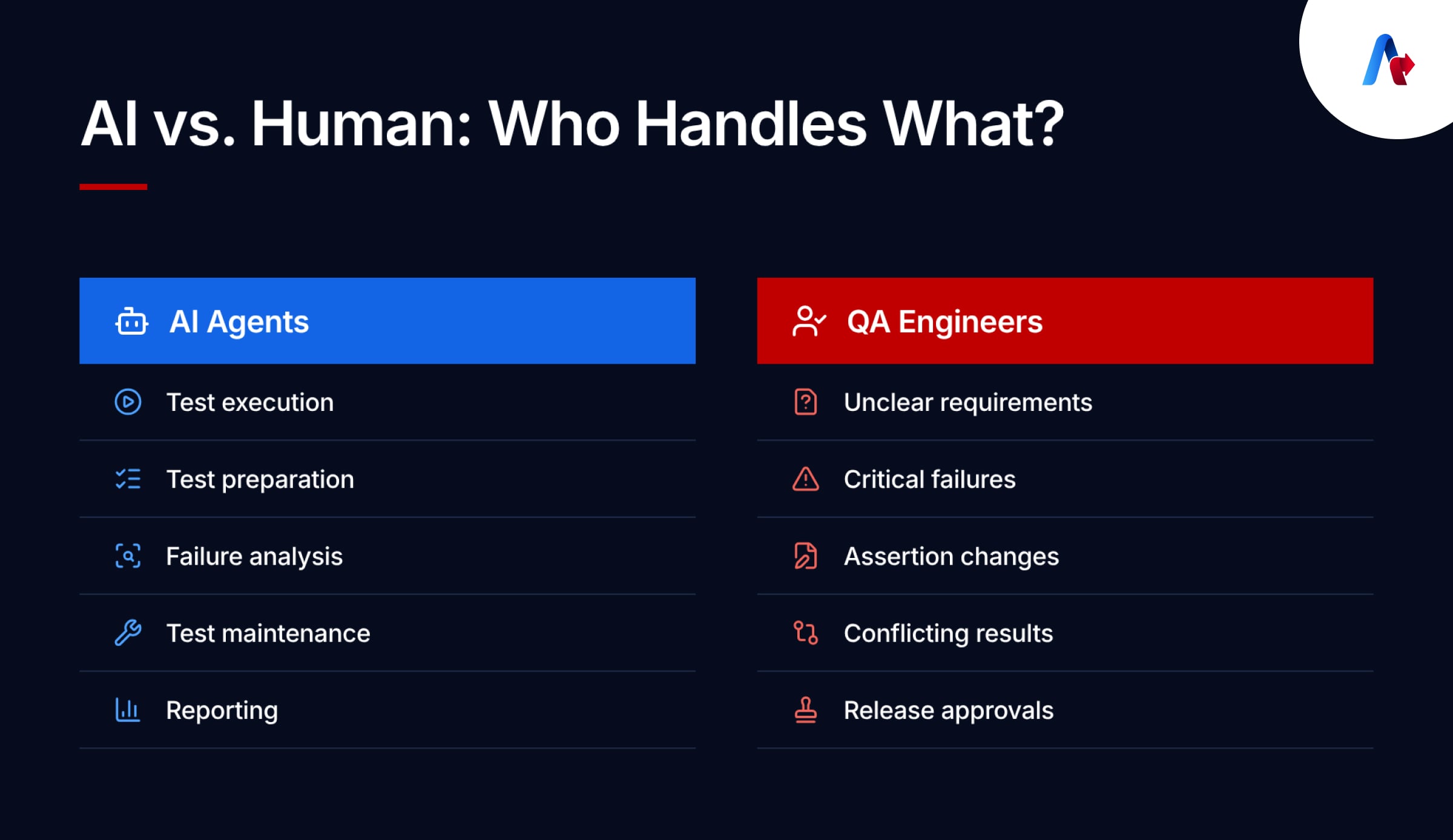
A dark testing method does not need constant human involvement for all, but it cannot complete all tasks, especially high-risk areas. There are other areas where we need human support, where results are unclear or in any area that affects customers directly.
Which Testing Activities Can AI Agents Handle Independently?
- Test execution
- Test preparation
- Failure analysis
- Test maintenance
- Reporting
When Do QA Engineers Still Need to Intervene?
- Areas where requirements are unclear.
- Problems that affect payments, patient info and other sensitive workflows.
- Cases where an agent suggests changing an assertion instead of fixing a broken script.
- In a scenario, you get inconsistent outcomes.
- An area where you think unresolved defects create an acceptable business risk.
PwC's 2026 research in the Middle East found that 34.2% of teams selected database administrators and QA engineers as the second most affected roles in the software development lifecycle due to GenAI adoption. This is a clear example of how AI is changing the way QA teams work, but human experts are still needed for reviewing critical areas.
Who Tests the AI Agents That Are Testing Your Software?
QA engineers usually validate AI testing agents against criteria, such as test coverage, expected results, and execution of evidence against approved requirements. More than that, they also use independent checks to confirm whether agents identify real problems. There is also a chance agents might miss critical errors. To avoid such situations, dark testing factories verify the software behavior and the accuracy of agent testing.
How Can QA Teams Verify AI-Generated Tests and Assertions?
AI-generated tests move faster than normal test creation. The difference is that agents can finish a lot of tests quickly, so it's harder for your team to pick each one for testing manually.
QA teams can focus on three things:
- Does the test cover the business requirement in reality, including important exceptions?
- Does it check the expected result, not just that an action completed?
- If the test is applied under the same conditions and circumstances, will the test provide the same results?
Example
An agent testing an insurance claim may check that the system accepts a claim submission. In some situations, the testing does not check the claim amount according to the policy rules. The test may be incomplete if something happens like this. QA engineers can use generated tests and compare them to approved requirements and known results to identify these gaps.
What Happens When an AI Agent Reports a False Pass?
False Pass – A test that passes regardless of whether the application may be defective.
Think about an online payment app that enters payment details, submits the transaction and checks for a confirmation with the help of agents. The confirmation appears, and the test passes. However, the application has double-charged the customer.
The agent missed the problem because the test never checked the actual transaction records. And the QA teams need to check the results beyond the steps performed by the agent to find such errors. In this case, that means looking at the transaction records and verifying that the customer was charged only once. That’s why passing a test shouldn’t mean that the software is ready for release.
How Independent Validation Can Help Avoid Mistakes in AI Testing
Independent validation is the process of comparing the test results to a reliable source that is not completely dependent on the AI agent’s own judgment.
One important technique is to use a test oracle. This can give an idea of how the software is working. With a test oracle, the QA team can determine whether software behavior is correct.
For example, a banking application may have an approved rule for interest calculation. QA teams can independently verify against the test-creator agent with that rule.
Other helpful practices are:
- Known-Defect Testing: Seed known defects and test for detection by agents.
- Execution Traceability: Record test steps, application responses and evidence to support.
- Retest Changes View: Check that important assertions have not been removed by self-healing agents.
- Human Review: Report ambiguous findings to the human testers.
How Is UiPath Bringing the Dark Testing Factory Concept to Life?
UiPath's dark testing, along with Test Cloud, brings AI agents, automation, and test management to a connected place. The main purpose is to allow testing to handle more activities independently and keep humans only for important decisions. UiPath has introduced several building blocks for this approach, but the complete capability of this testing remains a longer-term vision.
What Role Does UiPath Test Cloud Play in Autonomous Software Testing?
Test Cloud works as a central platform for managing and coordinating software testing across enterprise applications. With AI testing included in Test Cloud, a team can cut down on manual effort, including running tests, exploring applications and maintaining automation.
Key capabilities include:
- Autonomous Test Execution: Autopilot understands the manual steps of a test and runs them without the need to write an automation script.
- Autonomous Exploration: In this capability, AI explores applications with a testing goal, investigates issues and reports if there are any issues.
- Playwright Integration: Integrate with existing Playwright tests using Test Manager, enabling the team to leverage their existing automation investments.
- Testing AI-Powered Applications: It applies semantic and AI-based verification to test applications and agents that may behave differently.
How Does UiPath Support Continuous Testing and Human Oversight?
The UiPath way is different in that it focuses on coupling autonomous testing with controls on what agents can do.
For example, an agent may be permitted to perform approved testing and investigate failures on its own. However, it has limitations in its ability to modify a critical business rule and approve a high-risk task requiring human review.
UiPath’s testing vision has three important controls:
- Role-based authorization
- Decision thresholds
- Traceability
How to Prepare Enterprises for a Dark Testing Factory?
Be sure to evaluate your existing testing processes before you begin to bring in AI agents. Test environments, business requirements and rules for autonomous decisions are important to verify.
According to Gartner's 2026 research, only 5% of software engineering leaders rated their current AI maturity as high. This means that enterprises should assess their readiness before giving AI agents more responsibility. The list should contain:
- Clear requirements
- Code coverage
- Example data
- Integration of tools
- Access control
- Checking of results
Real-Life Scenario
If there are no rules for patient registration in a healthcare application, the AI agents can create tests that do not contain the required validation checks. Before you move forward, identify these gaps to get better results. Starting with one workflow or application is always good.
The following points can help a company start with a controlled autonomous testing pilot:
- Choose a stable application feature with repeatable testing needs.
- Measure current test execution time, maintenance, and defect detection.
- Allow agents to generate or execute tests.
- Compare agent findings with human review.
- Find missed items and incorrect test results.
- Expand gradually after checking performance.
QA teams should track these metrics during the Agentic testing pilot:
| Metrics | What it measures |
|---|---|
| Defect detection rate | How many known defects the tests identify |
| False-pass rate | How often tests pass despite an existing defect |
| Flaky-test rate | How often tests give inconsistent results under the same conditions |
| Test maintenance effort | Time spent reviewing and fixing test scripts |
| Execution time | Time required to complete testing workflows |
| Human escalation rate | How often agents need human intervention |
Considering autonomous testing, but not sure where to begin? We have experts to evaluate your current testing process and identify where human opportunities exist.
Plan Your Next Step With AccelirateWhat Does Accelirate Recommend for Building Trustworthy Autonomous Testing?
Accelirate recommends testing with a gradual rollout and clear dos and don'ts for the agents. The testing is focused on reliability and reducing the manual effort with visibility.
Better to follow an established testing workflow and use agents where they can reduce repetition. For important decisions, especially for high-risk areas, humans should check the outcome. An approach like this can improve confidence along with quality.
Autonomous testing is fit for the testing activities, whereas the AI agents check the behavior and produce trustworthy results. Accelirate’s approach focuses on three key areas:
- Behavior Testing: Test whether agents follow instructions, use tools correctly, and deal with unexpected situations.
- Independent Verification: Review test evidence, expected results, and key agent decisions.
- Governance: Review permissions, approvals and escalation processes for high-risk activities.
Read this guide for a better understanding: What’s AI Agent-Driven Quality Engineering: The New Growth Engine for Enterprises
How to Take the First Step Toward a Dark Testing Factory
Dark Testing concept from UiPath is a method that can keep up with the pace of software changes without QA teams managing every step. This tool is available, but the end-to-end model is still under development. With this, AI agents can take on more testing tasks, but also understand complex business rules, verify unexpected results, and send complex decisions to humans.
The main purpose of a dark testing factory is to bring autonomous testing and agents together in a single place to produce better and more trustworthy results. If you are a QA leader, the next step is to find out where it adds value. Later, start with a pilot that helps the team get an idea of where to automate and where humans can take control. Accelirate is a partner of UiPath that helps enterprises move toward autonomous testing through AI quality engineering and agent assurance.
Are you ready to test our UiPath quality engineering solutions that can improve testing efficiency without losing software quality?
Explore Our SolutionFAQs
Continuous testing is the concept of dark testing by UiPath. This enables the QA team to orchestrate AI agents and automation that can identify testing needs, execute tests, validate failures and maintain coverage. A method like this can do so without manual coordination, keep testing faster with software changes and maintain control over quality.
No, they are not the same. Autonomous testing is independent, as it has the ability to independently perform specific testing tasks. Dark testing is a broader operating model that links these tasks through orchestration, common information and governance. It is designed to drive the testing lifecycle, not automate isolation.
No, it doesn't. Dark testing is only to reduce repetitive testing work. Humans are still required for high-risk areas and for approving critical releases. AI agents do repeated activities, whereas engineers make sure the software is good and approve critical details.
Agents can compare test results with rules, such as acceptance criteria, expected outputs, and business rules. They also look into the application responses, screenshots and logs to see if the software is behaving as it should. Sometimes the results of the tests need to be independently verified. This is especially true if the results are ambiguous.

