



Quick Summary
Self-healing automation is a method that repairs broken selectors and helps your scripts survive application changes. Self-thinking testing with AI agents goes further because it interprets requirement changes, evaluates business risk, identifies missing scenarios, and recommends what QA should test next. An enterprise needs them both in today’s scenario. Self healing tests are necessary to protect execution continuity, and self-thinking protects your test relevance. This new addition will not replace the testers but give them a system that connects requirements, code, tests, defects, and production signals, so your team can receive the right coverage.
A test can auto-heal itself and run everything successfully but still test the wrong thing. It is an issue that every QA team should look beyond test automation.
For years, test automation just focused on one goal: reduce manual effort. This was mostly achieved after the arrival of self healing tests. When a button, field or locator changed, a tool with this capacity could find an alternative and help you continue running. That helped the QA team a lot as they needed to spend less time fixing problems. But the testing issues have now moved beyond fixing broken locators.
Research by McKinsey in 2025 found that top-performing companies using AI in software development reported a 31% to 45% improvement in software quality. The highlight is that these companies were not using AI only for coding but also in other areas such as development, testing, deployment, and operations.
This is vital for the QA teams because software is changing faster, and testing also needs to keep up with this speed. A self-healing test is significant to find a new “Place Order” button after the UI changes. But what if the change also affects the payment options, fraud rules, and customer eligibility? In this situation, a locator can be fixed, and the test may pass.
This is the question self-healing automation cannot answer alone, and that’s where the next stage of enterprise testing begins.
What Is the Difference Between Self-Healing Tests and Self-Thinking Tests?
Self-healing testing focuses on existing automation running. If a button moves, the tool will adapt to the situation. Self-thinking testing looks different because it can consider that the shift in the application also changes what needs to be tested.
For example, a UI update can change the button, and self-healing testing can solve it immediately. But think that the same release also adds a new payment option, changes rules, and updates customer eligibility logic. With the help of auto-healing, you can continue the tests, but it cannot automatically tell you that new test scenarios may now be needed.
For Example:
Traditional test automation: “Can I execute this test?”
Self healing tests: “Can I recover when something changes?”
Self-thinking testing: “Should I still be testing this, and what else should I test because of what changed?”
In short, self-healing keeps the test running, but self-thinking finds out whether the test is worth running and what you want to test.
| Capability | Self-healing tests | Self-thinking tests |
|---|---|---|
| Repair broken selectors | Yes | Yes |
| Adapt to UI changes | Yes | Yes |
| Interpret requirement changes | Limited | Core capacity |
| Identify missing scenarios | No | Yes |
| Detect obsolete or redundant tests | Limited | Yes |
| Prioritize tests by business risk | Limited | Yes |
| Learn from defects and production incidents | Limited | Yes |
| Recommend new coverage | No | Yes |
| Final quality decision | Limited | Yes, with human review |
How Does Testing Move From Automation to Test Intelligence?
The next generation of testing is not just something that writes more automated tests. It is something that gives testing context to understand what changed and what that means for quality.
Traditional tests mainly follow predefined instructions because they can run the test cases that have already been created. This is not the case with self-thinking testing with AI agents, which go further after tooling at the changes, such as:
- What changed in the requirement?
- Which business process could be affected by this change?
- Which existing tests are still useful?
- Which test scenarios are now missing after the change?
- Is a failure a real defect or an expected application change?
- Which areas carry the highest business risk?
- Have we seen a similar issue in a past defect like this?
For example, a requirement changed in Jira. A normal tool may wait for testers in a scenario like this, but self-thinking agentic testing can read the updated requirement, identify the affected areas, check the existing test coverage, and highlight possible gaps to the testers to make the final decisions. This is an important part of this tool.
Self-thinking testing is not about removing the QA team. Instead, it can reduce the time they spend manually connecting requirements, tests, defects, and risks every time something changes. In this way, they can spend time on other areas that need more human attention.
Explore agentic testing and see how it can support smarter test planning, execution, and quality decisions.
Why This Is Suddenly Possible
Test building blocks in 2026 are getting more capable with new technologies. Today, large language models can understand the meaning of requirements, user stories, API contracts, and other information that was once capable of looking only for keywords. By using agentic AI systems, it can then connect that information across tools.
For instance, an agent can read a changed requirement in Azure DevOps, find the related tests, detect the affected service, check earlier defects, and recommend where you need to put more attention. If you are an enterprise that has years of test results, defect records, and production data, you can connect that context to learn what failed and what needs more attention in the next release.
The change is not the smart test script but something that can connect requirements, application changes, test coverage, defects and production behavior. Finally, they help companies make better testing decisions.
Why Does Self-Thinking Testing Matter More for Enterprises?
Large enterprises usually have plenty of automated tests, and it is difficult to understand which tests matter for a specific release. Forrester reports that many organizations have plateaued around 25% test automation, a clear example showing the limitation of traditional test automation. It also further explains that more testing platforms using AI and intelligent agents can make testing more flexible and focus on reducing risk.
When the impact is not clear, many QA teams run everything, which needs longer pipelines, infrastructure, and slower feedback. More automation does not mean you get better quality. Sometimes, it gives faster execution with outdated testing decisions.
With self-thinking testing by your side, an enterprise can identify which tests need more attention and which do not and where new coverage is vital. The goal with this capacity is not to run a few tests but to test what matters the most.
What Could a Self-Thinking Testing Ecosystem Look Like?
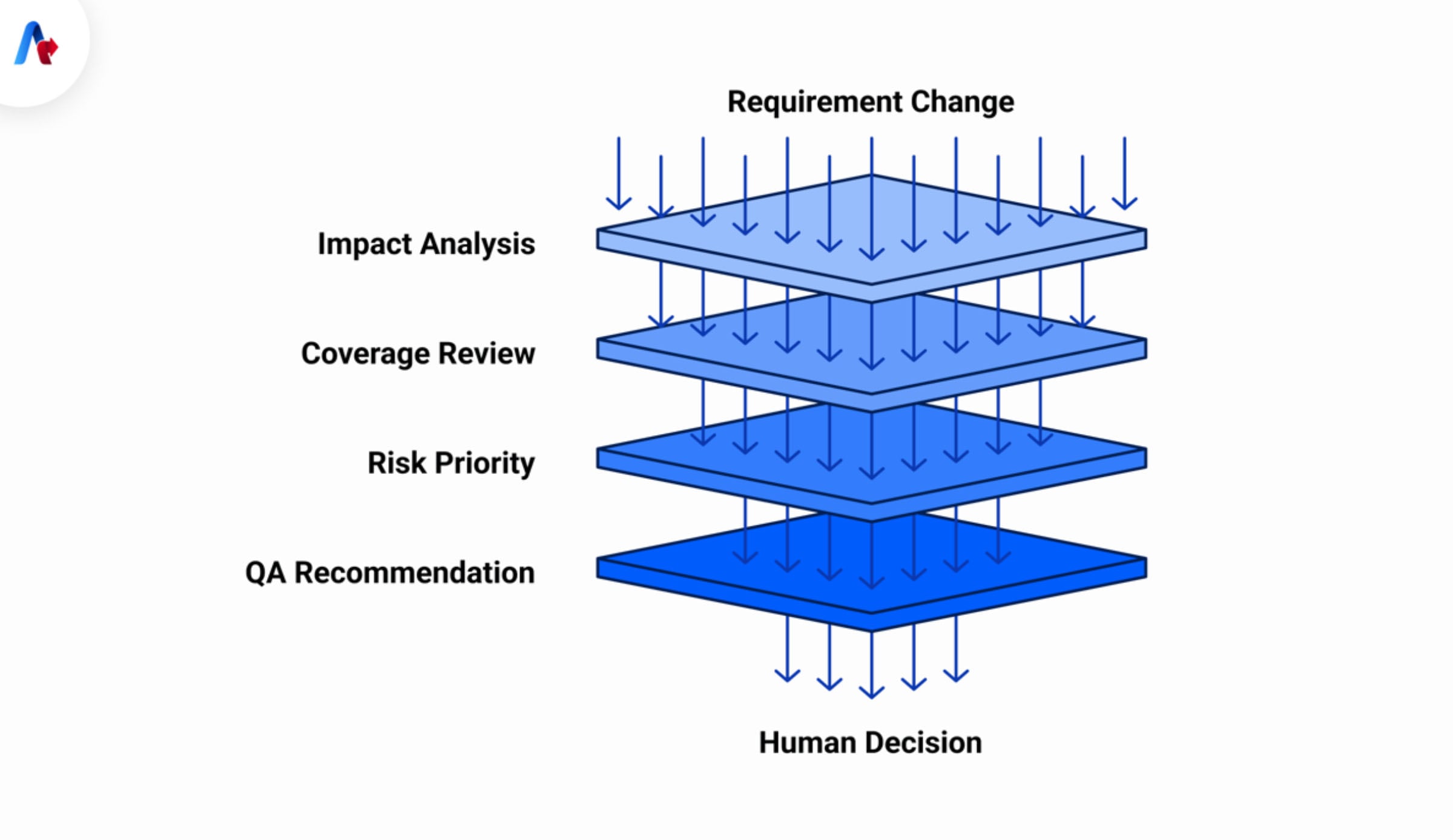
Think about a situation where there is a requirement change in Jira. In normal conditions, someone should review it manually, but a self-thinking system can assess the change, identify the affected business area, APIs, rules, existing tests and even highlight the gap for coverage.
This testing method may help you find that two tests are not relevant, three new scenarios are missing and notify you of similar changes that caused issues earlier. The system also recommends something like this:
High Priority
- Validate existing-customer onboarding.
- Validate duplicate-identity handling.
- Test the downstream KYC API failure path.
Medium Priority
- Run the related UI regression.
Low Priority
- Skip the unrelated onboarding tests this cycle.
Finally, the engineer reviews the recommendation and takes the final action. Earlier, the system was helping to test, but now a self-thinking system will help you decide what you want to test.
Read a related case study: How Accelirate’s Agentic AI-Led COE Saves Over 40K Hrs and 65% Costs in Testing for a Global Bank.
Where Can Self-Thinking Testing Go Wrong and Why Does Human Review Still Matter?
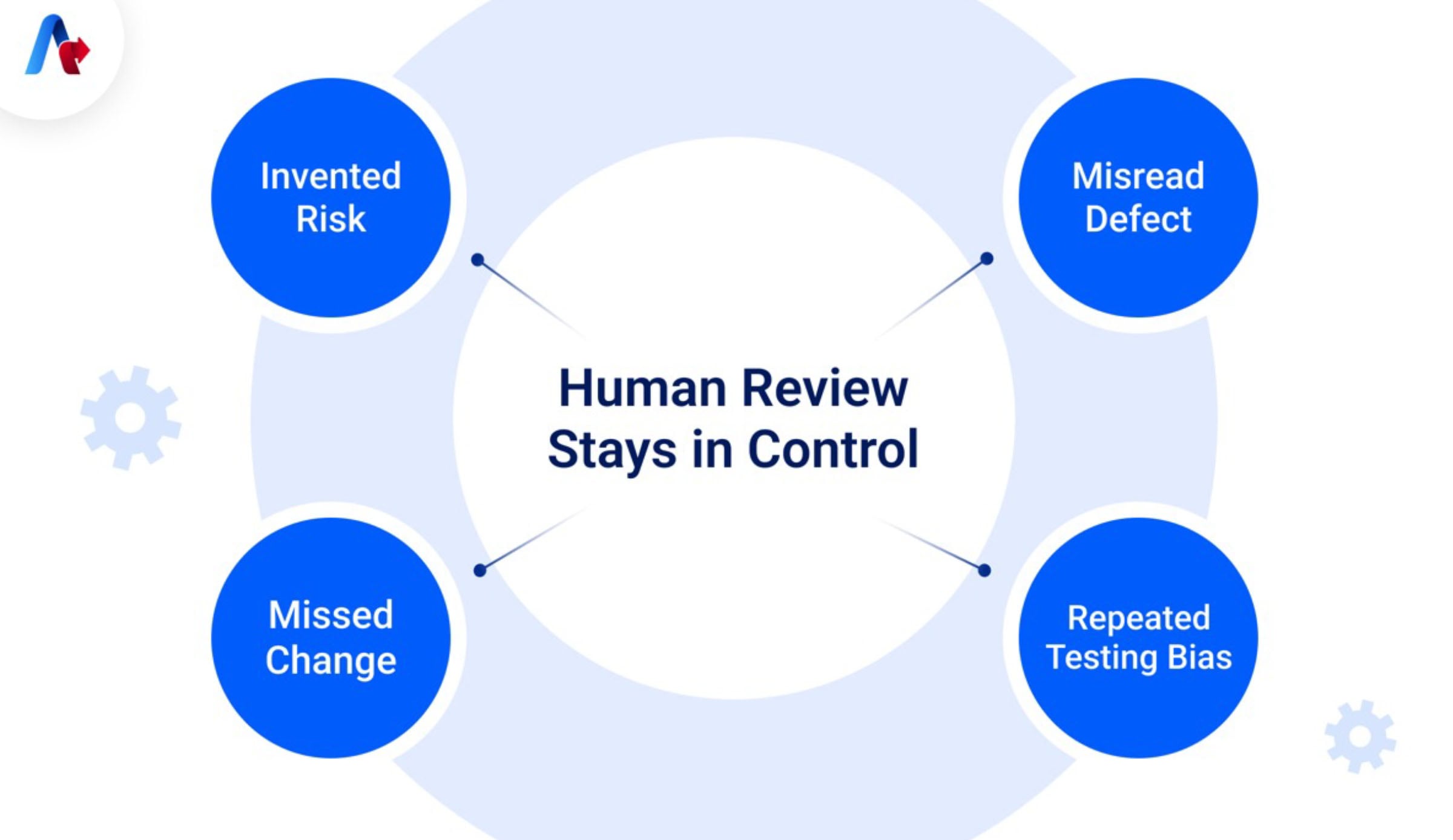
Self-thinking QA is important for improving decision-making, but there are limitations to it, like every testing method. In some situations, it might misread risk and miss important changes. That is why human review is still vital today.
McKinsey’s 2025 State of AI Research found that 47% of the organizations using AI experienced at least one negative consequence. The same research further explains that 27% of enterprises using generative AI review all automated content before using it. This is a clear example that AI decisions are not final and should be reviewed by humans.
- It Can Invent Risk: A model might flag something confidently as high-risk even when it is not. A situation like this may cause the team to spend more time on what is not adding value.
- Miss Critical Change:A small change may carry more business impact, but if the system takes it as low priority, it can make a big problem.
- Misread a Defect: The system sometimes calls a necessary change a bug or vice versa. Whether it calls an important one a bug or a low-priority one an important one, it will affect trust in the system.
- Repeat Existing Testing Bias: If the current test suite focuses too much on low-value areas, the system may misinterpret and keep recommending similar things in the future.
This is why the human-in-the-loop is unavoidable. A self-thinking system is to improve speed, not to replace human action. Think of it as recommendations from your juniors, but always review before making the final decision. It is fast and useful but occasionally goes wrong.
Want to discuss how human review should fit into AI-assisted testing?
Talk to our QA expertsHow Does the QA Role Change with Self-Thinking Testing?
The QA role is now shifting from maintaining test scripts to making decisions that are connected to risk, coverage, and quality after the use of self-thinking AI. Now, testers spend more time understanding risk, reviewing automated recommendations, and deciding what should be tested instead of repetitive testing work.
In an interview with Fortune, the CEO of Dropbox said that “Delegating your judgment to a machine, it’s a problem.” It means the AI can take more repetitive work, but deciding what matters and what carries risks still needs human intervention.
Less Script Maintenance, but More Time for Quality Engineering
A QA professional in organizations should spend more time understanding business risk, finding failure patterns and questioning unclear requirements. This quality engineering will also help to understand what good coverage looks like and where humans are required.
Automation in testing is still important, but knowing what to test, why it is significant and when to test is more important than writing scripts. The purpose is simple here: use AI agents for mechanical work and let the testers focus on decision-making and where context is vital.
Which QA Metrics May Need to Change?
Self healing tests metrics concentrate only on test count, automation coverage, pass rate, execution time, and defect count still matter. But as testing becomes more intelligent, teams may also need to measure how well their test strategy responds to change and risk.
From Automation Coverage to Quality Intelligence
Instead of only asking the number of automated tests, QA leaders can start asking:
- How many production defects could our suite have predicted?
- How quickly does the suite adapt when a requirement changes?
- How much of each regression run is relevant to that release?
- How accurately are tests prioritized by business risk?
- How often are missing scenarios caught before production?
These questions are not going to replace the AI QA platforms with self-healing tests. It is going to add another layer of protection that helps the QA team become more relevant and responsive. By using this method, the focus may shift from coverage to quality intelligence.
Where Should Enterprises Start with Self-Thinking Testing?
Enterprises should start with high-change and high-risk areas. It is also important to introduce self-thinking testing in stages. Always start with traceability and move AI recommendations with human approval, and improve future testing decisions based on that.
Crawl: Make Change Visible
An organization can begin by connecting requirements in Jira or Azure DevOps to the tests they affect. At this stage, the goal is only traceability. With this option, teams should be able to see how a requirement change connects to existing test coverage.
Walk: Recommend, Don’t Decide
In this process, let the AI suggest which tests should run and find where coverage may be missing. After the recommendation, a tester can review and approve. You can also check how often the suggestions are accepted to measure the trust in the system.
Run: Close the Learning Loop
Finally, the QA team can feed defects and production incidents back into the testing process. This will help the system to learn from the failure and improve future recommendations. Keep human review for important decisions.
Move Beyond Keeping Tests Alive
The QA team has already moved from manual work to automation and then from automation to self-healing. The next level is to make testing aware of changes, risk and context.
It does not mean that AI powered self-healing tests are out. Self healing tests can reduce the team's burden and keep tests running when there is any change in the application. But in the new world, that alone is not enough if the requirements, business rules and customer journey change.
That's where this self-thinking testing matters. This system can connect from test design to production into one loop. The goal here is to make testing more autonomous, so the team can use valuable time for better decision-making.
So, the question for QA leaders is not about automation running. It is whether your automation has started thinking about quality or just executing yesterday's decision.
Start with a QA assessment to identify where self-thinking QA can add value without replacing your existing test automation.
FAQs
Self healing tests are important with broken selectors and modified UI elements. Self-Thinking Testing is different because it sees whether the test is still relevant, what changes the requirement, and checks whether new test scenarios are needed. In short, testing with self-healing keeps tests running, whereas testing with self-thinking keeps your testing relevant.
Self-Thinking AI in testing is a method that uses artificial intelligence for context, requirements, test coverage, defects, and application changes. Instead of only running existing tests, this new method can help with what changed, risks, and consider additional test scenarios.
No, it is not. The main purpose is to remove repetitive work that comes after UI changes. This is vital because testers like re-deriving what to test after every change, so testers can focus on judgment-related work, such as exploratory testing, reviewing, and risk assessment.
The best platforms you choose should do more than repair broken selectors that you see in normal tools. Always check for test maintenance options, AI test generation, integration options, risk testing, and human review for important decisions.
There is no single AI QA tool in the market for every need. Mostly, the choice depends on your applications, testing environment, and governance needs. As an organization, you should also check capabilities, such as test generation, risk-based testing, and human decision systems.