



Quick Summary
Agentic AI in insurance uses large language models, workflow orchestration, APIs, and memory to understand goals, make decisions, and act across claims, underwriting, servicing, and customer support. With AI leaders generating 6.1 times the shareholder returns of laggards, insurers are moving beyond RPA toward end-to-end orchestration, helping them manage exceptions, support human oversight, and maintain secure, audit-ready governance.
Nearly every insurer has started using AI, yet only a small group has turned it into a real competitive advantage. McKinsey found that insurance AI leaders generated 6.1 times the shareholder returns of AI laggards over five years. So, what are they doing differently—and what role do AI agents play in that gap? Let’s start with understanding the basics.
What Are AI Agents in Insurance?
Agentic AI in insurance is a system that can understand a goal, decide what steps are needed, and take action across workflows such as claims, underwriting, policy servicing, and customer support. These agents do more than respond to questions. Unlike chatbots, AI agents can interpret data, call APIs, update insurance systems, and carry a workflow forward from one step to the next.
What makes them “agentic” is their ability to plan actions, select the right tools, retain workflow context, and adjust when new information or exceptions appear. They can move routine cases forward autonomously while escalating complex, high-risk, or uncertain decisions to human reviewers with the relevant data and action history.
Key Components of an Insurance AI Agent
Here are four core components of AI agents for insurance claims
- Large Language Model (LLM): Helps to interpret unstructured data, understands instructions, and supports reasoning across workflows
- Workflow Orchestration: Plans and coordinates multi-step processes across teams, systems, and specialized AI agents.
- Tools and APIs: Connect the agent to policy, claims, CRM, payment, and third-party data systems so it can take action.
- Memory and Context: Helps system store data, context and workflow history to maintain continuity and support better decisions.
Ready to use AI agents in your insurance workflows?
Call our experts todayWhy the Insurance Industry Is Adopting AI Agents Now
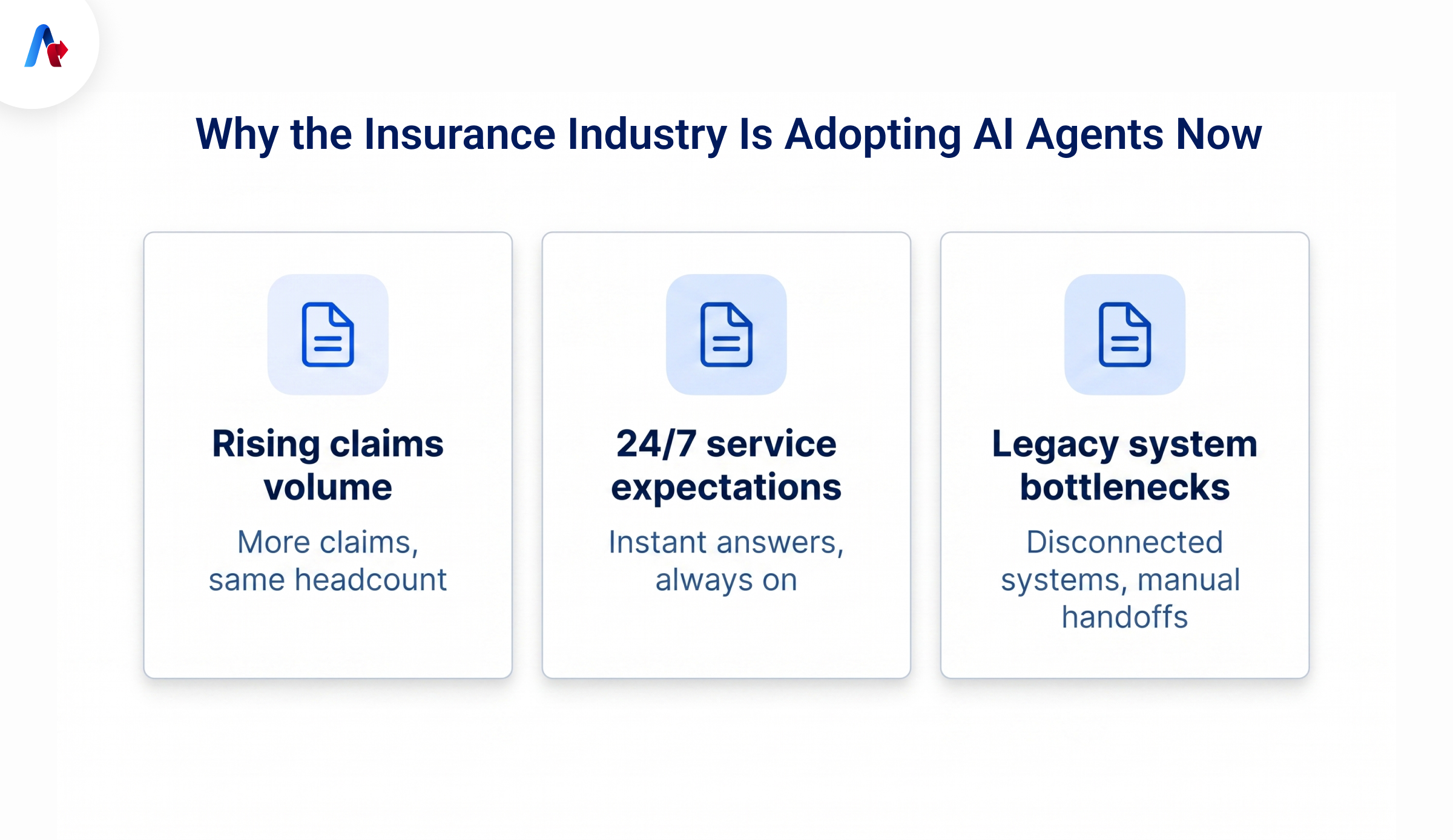
That covers the three pressures at a glance. Here's a quick visual for the results these agents are driving:

While AI adoption in insurance has been growing steadily, these three pressures are pushing insurers to move faster
Rising Claims Volume and Operational Cost Pressure
With increasing claims volume, teams have to spend majority of their time reviewing documents, checking policy data, routing cases, and resolving exceptions manually. Insurance AI automation helps to automate these steps without adding more staff. These agents can understand claim context, decide the next step, use connected systems to complete routine actions, and escalate complex cases with the right information. This helps insurers process more claims without increasing operational cost.
Customer Expectations for 24/7, Instant Service
Customer experience is a key differentiator in today’s insurance market, where policyholders expect fast, consistent, and always-available support. Traditional system will no longer work due to its long waiting time, limited staff availability, and skills. Agentic AI solves this problem by answering common queries, giving real-time updates, and gathering missing information. This has helped insurers deliver faster and more consistent experience while supporting an 11% increase in policy purchases.
Legacy Systems and Manual Workflow Bottlenecks
Many insurers have long relied on disconnected core systems, documents, and manual handoffs. AI agents help to connect these processes by using APIs and workflow orchestration that help to move data between systems and trigger the next tasks. This helps insurers to reduce manual handoffs, speed up processing, and improve workflows without replacing their existing systems.
These benefits are already showing up in real business results. According to a recent McKinsey report, insurers implementing AI across their workflows were able to improve sales conversion by 10% to 20% while reducing their onboarding cost. This shows why many insurers are expanding AI across more use cases today.
AI for the Insurance Industry: Where It’s Being Used Across the Value Chain
Let's look at some of the key use cases of Agentic AI in insurance
- Underwriting and Risk Assessment: AI analyzes applications, third-party data, and risk signals to improve pricing accuracy and speed up underwriting decisions.
- Claims Processing and FNOL: AI captures FNOL data, validates documents, routes claims, and recommends next steps to reduce claim cycle times.
- Policy Administration, Issuance, and Renewals: AI helps to coordinate policy creation, amendments, billing triggers, renewals, and supporting documentation across systems.
- Fraud Detection and Investigation: AI identifies anomalies, compares claims with historical patterns, and prioritizes suspicious cases for investigation.
- Customer Service and Policyholder Engagement: Insurers implement agentic ai to provide 24/7 support, personalized responses, claim updates, and self-service guidance across channels.
- Sales, Quoting, and Lead Qualification: AI qualifies leads, generates quotes, and recommends coverage to identify cross-sell or upsell opportunities.
AI Agents for Insurance Claims: A Closer Look
Claims have become one of the best use cases since the process involves multiple documents, decisions, checks, and handoffs. AI agents help insurers to streamline this process by collecting initial claims details, validating active policies, and reviewing supporting documents. It also helps to compares the case against the coverage rules to spot errors and missing information. Agents also update claim systems, create follow-up tasks, and route complex cases to the right adjuster with full context.
Let's look at the recent case study where Accelirate deployed UiPath-led AI agents to improve these workflows for a healthcare insurer. The solution automated prior authorization, eligibility checks, medical code validation, and follow-up tasks. As a result prior authorization time fell by up to 70%, and claims could be processed in under 24 hours.
Here's how AI supported each stage of the workflow
Document Intake, Extraction, and Validation
AI reads claim forms, emails, images, medical records, and policy documents while flagging missing, duplicate, or incorrect information before the claim moves forward.
Automated Claims Triage and Routing
AI reviews each claim based on its type, urgency, value, and complexity to decide which claims should be sent for processing and which should be routed to the right adjuster for human review
Fraud Flagging During Claims Review
Agents identify suspicious patterns by comparing claim details with policy data, historical claims, external sources, and known fraud indicators. It routes claims for investigation rather than triggering automatic rejection
Claims Cycle Time and Cost Reduction
As AI agents help automate the entire claims process, insurers can catch errors earlier, improve claims accuracy by 3% to 5%, and reduce the time and cost spent on manual work.
Make your claim process faster and easier to manage
Book a demo todayAI for Insurance Agents: How Individual Agents and Brokers Benefit
We have seen how AI agents improve insurance workflows; now let’s look at how they also benefit agents and brokers
- AI Copilots for Policy Recommendations and Quoting: AI copilot helps insurance agents suggest suitable coverage plans for customers by reviewing their details and comparing their plans with price, benefits and deductibles.
- Automated Meeting Notes, Follow-Ups, and CRM Updates: AI summarizes customer calls, drafts follow-ups, sets reminders, and updates the CRM so agents can personalize future conversations and keep customer records accurate.
- Cross-Sell and Upsell Opportunity Identification: AI reviews customer profiles, current policies, coverage gaps, claims history, and life changes to help agents recommend coverage that better matches each customer’s needs.
- Freeing Agents for High-Value Client Relationships: By automating repetitive work agents can find more time to build trust and maintain stronger relationships with the customers
Traditional Automation vs. AI Agents vs. Agentic AI
Let’s see how RPA, AI agents, and agentic AI handle insurance workflows under real conditions
| Feature | Traditional RPA | AI Agents | Agentic AI |
|---|---|---|---|
| Core function | Fixed task automation | Context-aware task completion | End-to-end workflow execution |
| Decision-making | Follows preset rules | Recommends the next action | Adapts across workflow steps |
| Learning capability | Requires manual updates | Improves through feedback | Adapts from past outcomes |
| Workflow coordination | One task or system | Connects multiple business systems | Coordinates agents and systems |
| Exception handling | Stops when issues occur | Routes issues with context | Resolves or escalates exceptions |
Ready to implement Agentic AI into your workflow?
Call our experts todayHow to Implement AI Agents in Your Insurance Workflow
Insurers can follow this step-by-step process to automate their existing systems:
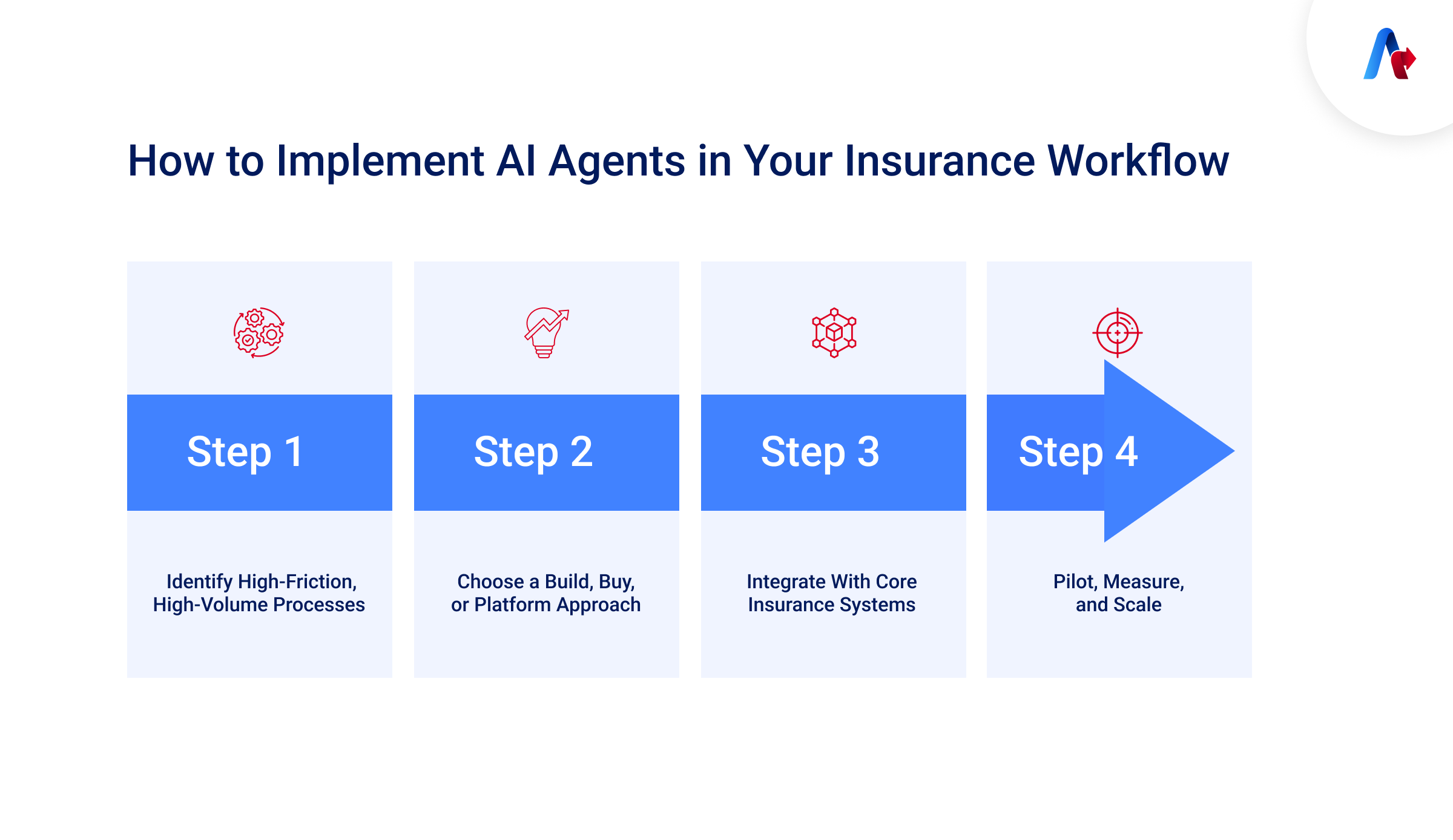
Common Implementation Pitfalls to Avoid
Here’s what you need to avoid while implementing these agents:
- Avoid automating just one task; instead focus on improving the full workflow.
- Don’t add AI to a broken process, as it can make existing issues harder to fix
- Avoid using incomplete or scattered data cause it can result in poor decisions.
- Agents should not handle exceptions without having clear rules for approvals and human review
- Don’t overlook governance and security, as it can put customer data and business decisions at risk in the long run
Benefits of Insurance AI Automation
So how does AI actually give insurers a competitive advantage?
- Faster Claims Resolution and Payout Times: Teams have been able to minimize errors, reduce time and fast-track review process by using AI to collect and review data and route cases automatically.
- Lower Operational and Labor Costs: AI helps to reduce operational and labour costs by automating routine work and allowing teams to focus on high-value cases that need human judgement.
- Improved Underwriting Accuracy and Fraud Detection: Teams are able to make reliable data-backed decisions by using AI to detect fraud and errors
- Higher Customer Satisfaction and Retention: AI helps teams to improve customer satisfaction and retention rate by providing faster response, timely updates and issue resolution
Risks, Compliance, and Human Oversight in Insurance AI
While many insurers are excited about implementing AI in their workflows, it is important to make sure that these systems are running under guidance and control. Insurers must follow NAIC, state insurance departments, and privacy laws while designing and implementing these agents into the system.
Along with this AI decisions must also be tested, especially in underwriting and claims, where decisions directly affect coverage, pricing, and payouts. Regular monitoring and fairness checks will help to reduce risk and error.
Human oversight becomes equally important when a case becomes complex. The agent should send these cases to qualified professionals with the supporting documents, risk signals, and case history. Audit trails are also required to check what data, rules, recommendations and actions helped to shape each outcome. This helped to resolve disputes and check compliance.
Is AI Replacing Insurance Agents and Claims Adjusters?
The biggest concern insurance agents and claim adjusters have today is whether AI is going to replace them. The answer is no. The main purpose of AI is to support insurance professionals by handling their repetitive work to help them reduce manual effort, provide right information and minimize errors.
Insurance agents and claims adjusters remain essential for complex claims, disputed decisions, regulatory judgment, negotiation, empathy, and policyholder relationships. AI gives them more time and better information to handle these responsibilities more efficiently.
The real value of AI is not removing people from insurance workflows. It is giving them better context, reducing repetitive work, and helping them make faster, more consistent decisions.— Accelirate Automation Engineer
How to Choose the Right AI Agent Platform for Your Insurance Business
Here's how leaders can find top ai agents for insurance automation:
Must-Have Features Checklist
A checklist can help insurers compare the capabilities of different AI platforms against business requirements. It helps to evaluate whether the solution can manage the entire workflow, connect with existing systems and protect customer data while giving them control over important decisions. The checklist should include:
- End-to-end workflow orchestration
- Insurance document intelligence
- Human-in-the-loop controls
- Smart exception handling
- Audit trails and governance
- Reusable agent components
- Enterprise-grade scalability
Integration and Data-Security Requirements
Integration and data security are two major factors that insurers should check while choosing the right platform. It helps to check whether an agent can work safely within the existing environment and supports encryption, role-based access, privacy controls, and complete activity logs. Insurers should ensure that the system integrates securely without causing major disruptions or data errors.
Vendor Questions to Ask Before Buying
Asking right questions matters the most while choosing the right platform to understand how well it can perform under real business conditions. These questions should help insurers estimate the effort, time and support required to implement the solution securely. Reviewing these areas early helps insurers avoid unexpected costs, weak performance, and compliance risks after implementation. Here's what insurers should ask:
- Can the platform manage the entire workflow?
- How well can it connect with our existing system?
- Will the team have control over its actions for important decisions?
- Can we expand it for other workflows?
Ready to shape the future of insurance with agentic AI?
Call our experts todayThe Future of Agentic AI in Insurance
In the coming years, AI for insurance industry will go beyond automating individual tasks to making the process faster and smoother for both employees and policyholders. Autonomous claims settlement will help insurers automate majority of the routine work, enabling them to focus on complex cases. AI will also help insurers access risk more accurately through predictive risk modeling and dynamic pricing. This will help underwriters offer better pricing and coverage to each policyholder.
Fully AI-orchestrated policyholder journeys will connect onboarding, servicing, renewals, claims, and customer support, helping insurers reduce delays and confusions. This will help to build trust and stronger relations with the customers. Insurers who adapt these capabilities early can gain a competitive advantage through faster operations, better decisions, and stronger customer experiences in the future.
Bringing AI Agents Into Insurance Operations
For insurers, the goal is not simply adopting AI. It is creating better customer experiences, earning long-term trust, and building stronger revenue growth. Accelirate helps insurers turn that goal into real business value. Agents will not just help to streamline operations but will become a path to build stronger relationships and sustainable growth.
Ready to explore AI agents for your insurance workflows?
Book a demo NowFAQs
Regular automation can usually manage one task at a time, whereas agentic AI helps to manage entire workflow by understanding context, taking actions and escalating exceptions to the right professional.
Insurers can realise ROI through faster claim processing, fewer manual errors and lower operational cost.
AI helps teams detect fraud by comparing claims, policies, documents, and external data to flag suspicious cases for investigation.
It takes a few weeks for a single workflow, but for a wider rollout, it takes several months depending on the system connection, data quality and approval requirements.
No, AI helps insurance agents to focus on complex cases and build stronger customer relations by automating their routine tasks
The cost of automation varies depending on workflow, complexity, integration, claim volume, security needs and ongoing platform usage.