



Quick Summary
iPaaS agents are changing how enterprises handle system integrations. Instead of manually building and maintaining connections between hundreds of business applications, AI now handles the heavy lifting — designing workflows, mapping data, fixing errors, and even predicting failures before they happen. Platforms like MuleSoft, Boomi, and Informatica have already embedded these capabilities into their core infrastructure. The result is faster deployments, fewer outages, and integration teams that spend less time firefighting and more time building what actually moves the business forward.
Digital transformation is moving faster than most integration teams can keep up with. The number of SaaS applications in the average enterprise has grown to between 250 and 300 and stitching them together with traditional rule-based tools is no longer sustainable. Schemas change. APIs evolve. Data volumes spike unpredictably. And the integration work that used to take weeks is now expected to take hours.
This is the environment that gave rise to iPaaS agents, an evolution in how integration platforms work that is happening right now across the industry.
Platforms like MuleSoft Anypoint Platform, Boomi, and Informatica are no longer just connectors and flow builders. They are becoming intelligent ecosystems where AI agents help design integrations, map data automatically, detect and fix failures before humans notice, and respond to natural language instructions. The category has a name now: AI iPaaS, or iPaaS for AI agents, and it is quickly becoming the default expectation for enterprise integration infrastructure.
This guide explains what iPaaS agents are, how they work, which platforms are leading the space, and what the real-world impact looks like for integration teams and the enterprises that depend on them.
The iPaaS Market Is Growing Fast, and AI Is Why
Before getting into the technical specifics of how iPaaS agents work, it helps to understand the scale of what is happening in this market.
The iPaaS market was valued at $12.81 billion in 2025 and is projected to reach $237.69 billion in 2035, growing at a compound annual growth rate of 33.92% (Global Growth Insights, 2026). Gartner reports that iPaaS market revenue exceeded $9 billion in 2024 and is expected to exceed $17 billion by 2028, with integration demand at an all-time high.
That growth is being driven primarily by AI adoption. According to Boomi's research, 88% of executives plan to increase AI-related budgets in the next 12 months due to agentic AI, and 86% of enterprises acknowledge they need technology stack upgrades to properly deploy AI agents.
The reason is straightforward. As enterprises deploy AI agents across their operations, those agents need real-time access to data from CRM systems, ERP platforms, databases, and third-party APIs. Traditional batch-based or manually configured integrations cannot support that. AI agents need instant, reliable, governed access to live data, and that is exactly the gap modern iPaaS platforms are being redesigned to fill.
What Are iPaaS Agents?
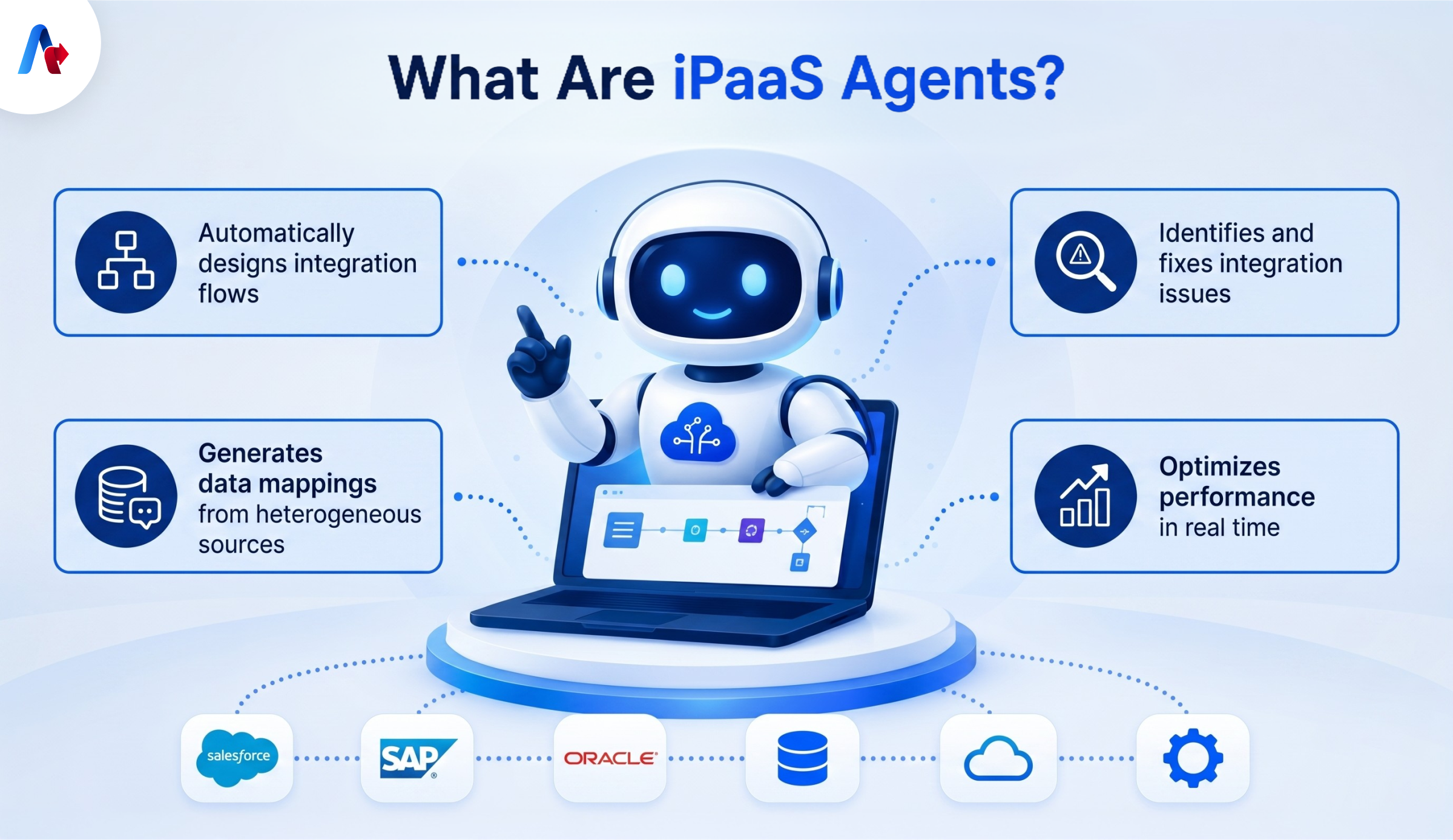
iPaaS agents are AI-powered pieces that reside on integration platforms to streamline and automate integration processes. They serve as a smart “co-pilot” for an integration engineer, learning from interactions, patterns, and operational data to improve outcomes over time.
iPaaS agents' capabilities include:
- Automatically designing integration flows from high‑level intent
- Generating data mappings from heterogeneous sources
- Identifying and fixing integration issues
- Optimizing performance in real time based on load and data patterns
At its core, iPaaS agents turn integration platforms from mere tools to smart, self-optimizing systems that evolve to fit the business and technical requirements.
Ready to accelerate integration delivery with AI?
Talk to an Integration Expert
Why AI in Integration Matters Right Now
Traditional integration approaches are often:
- Manual, which requires code of flows and mappings by the developers.
- Time‑consuming, particularly for complex schemas and edge cases.
- Difficult to scale across hundreds or thousands of APIs and systems.
By introducing AI into integration:
- Development speeds up because agents are able to create boiler plate flows and transforms.
- Errors are reduced through pattern‑based validation and anomaly detection
- Systems self‑optimize with the correct retry logic, throttle, and route automatically.
The use of technologies such as Salesforce Einstein is already promoting intelligent decision making in enterprise platforms. When paired with iPaaS, AI can help to not only orchestrate data movement, but also business logic, governance, and operational responses.
Key Features of iPaaS Agents
1. Intelligent Flow Design
AI agents can generate end‑to‑end integration flows based on high‑level business intent instead of low‑level configuration.
Example:
A user specifies: “Integrate Salesforce with SAP for customer data sync”
The system can automatically:
- Identify appropriate connectors (Salesforce, SAP, protocol, etc.)
- Propose a logical API structure (e.g., sync frequency, idempotency, error handling)
- Suggest transformations and data enrichment steps
This turns natural language or loosely defined requirements into working, production-ready integration logic.
2. Automated Data Mapping
Data transformation is one of the most challenging and susceptible to error aspects of integration. The following are just some of the ways that iPaaS agents alleviate that burden:
- Analyzing source and target schemas (REST, SOAP, EDI, JSON, XML)
- Suggesting mappings including field‑level transformations
- Tackling edge cases like null values, missing fields, and type mismatches
Based on the developers feedback, over time agents can learn from others and use the mapping patterns in other systems, thereby building a library of re-usable mapping logic. This can greatly decrease development time.
3. Self-Healing Integrations
Rather than just dealing with failure, AI powering iPaaS agents assists with building self-healing integrations.
Agents can:
- Detect recurring issues (e.g., repeated HTTP 429 errors, timeouts, schema drift)
- Retry requests with intelligent backoff and fallback paths
- Suggest remediation steps or even generate patches to flows
This results in more resilient and reliable integrations, which need less manual effort from operations teams.
4. Predictive Monitoring
AI‑powered monitoring goes beyond passive dashboards and alerting into predictive observability.
Agents can:
- Forecasting failure in advance by examining latency, failures, and resource utilization.
- Identify traffic pattern changes (e.g. sudden traffic spike, silent failures)
- Recommend scaling strategies or traffic‑shaping rules
This proactive approach ensures that business processes remain more stable and are less prone to downtime in the integration process.
5. Natural Language Integration
Today, new platforms such as Agentforce are making it possible for integration engineers to engage the platform using natural language.
Example:
“Create an API to fetch orders and expose it securely”
The agent can:
- Translate this intent into concrete API specifications
- Generate the underlying iPaaS flow (listeners, transformers, security policies)
- Attach authentication and authorization configurations
This lowers the cognitive load on developers and enables non‑technical stakeholders to participate in defining integration requirements.
Leading iPaaS Platforms Embracing AI Agents
Several platforms are actively building AI agent capabilities into their core infrastructure. Here is how the leading ones compare:
MuleSoft Anypoint Platform
MCP and A2A protocol support, Einstein for code generation, MuleSoft Vibes AI agent, natural language API spec creation, multi-agent orchestration with governance.
Boomi
Boomi GPT for natural language integration building, Boomi DataDetective for sensitive data classification, Boomi DesignGen for auto-generating processes, Boomi Agentstudio for full agent lifecycle management.
Informatica
AI-powered data mapping, anomaly detection in data flows, predictive maintenance of integration processes, agentic AI for autonomous workflow execution.
Boomi's numbers give a sense of the scale at which this is already operating. The platform has deployed over 33,000 AI agents and draws on 200 million integration patterns to power its machine learning models. That is production infrastructure, not a roadmap item.
Benefits of iPaaS Agents for Enterprise Teams
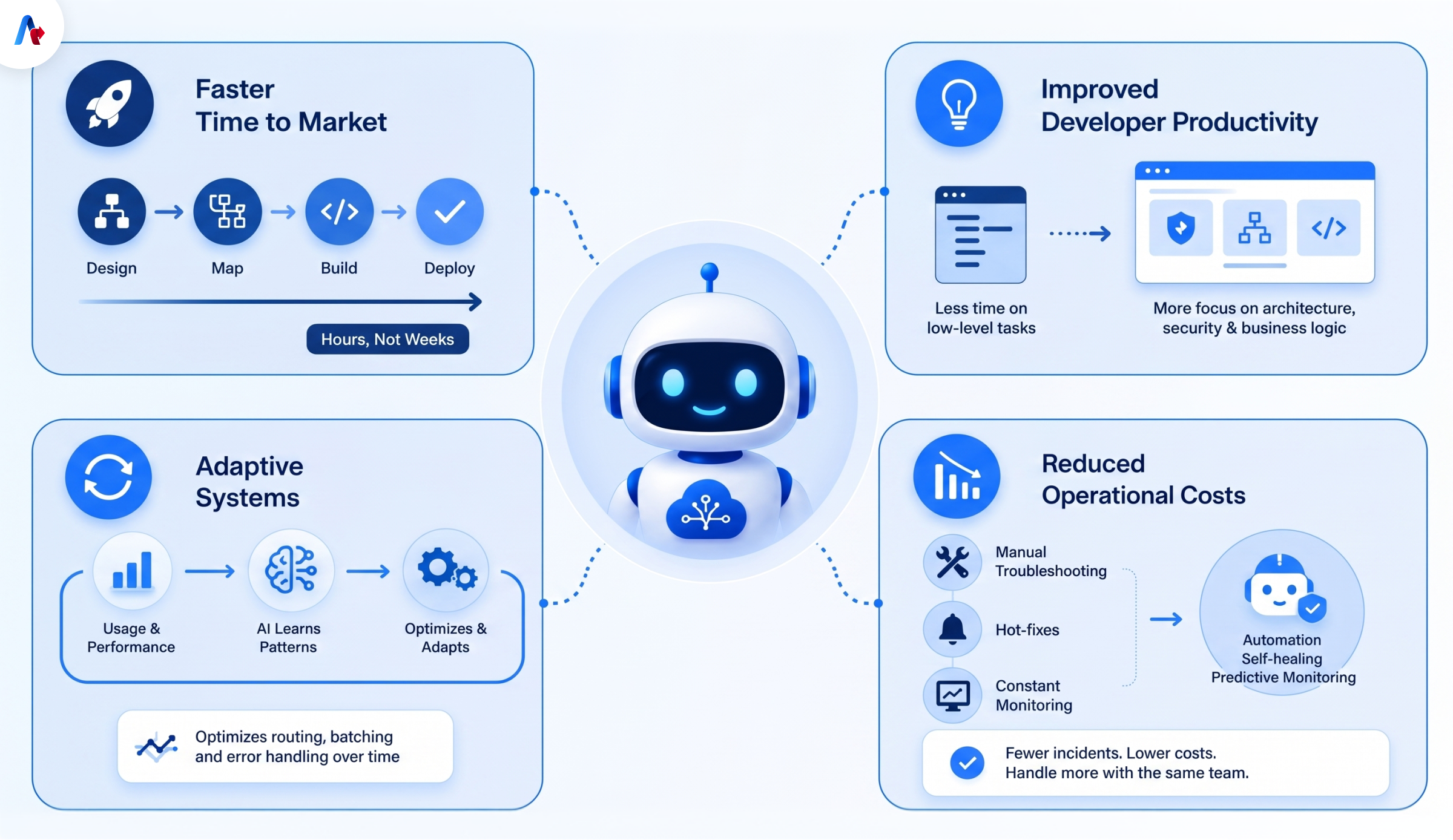
Faster Time to Market
iPaaS agents can significantly shorten development cycles by automating repetitive tasks like flow design, mapping, and boilerplate code generation. New integrations can be built, tested and deployed in hours, not days or weeks.
Improved Developer Productivity
Developers spend less time on low‑level plumbing and more time on architecture, security, and business logic. This shift allows teams to focus on strategic integration patterns rather than manual execution.
Adaptive Systems
Integrations are subject to evolution and development depending on usage, performance and feedback loops. As time passes, the AI agents become familiar with the patterns that are consistent, those that are prone to failure, and how to optimize routing, batching, and handling errors.
Reduced Operational Costs
Manual troubleshooting, hot-fixes and constant monitoring are reduced through automation. Self-healing logic and predictive monitoring reduces the number of incidents and enable teams to handle larger integration landscapes efficiently with the same staff.
Preparing Your Integration Strategy for the Age of AI?
Schedule a Strategy Session
Real-World Use Cases for iPaaS Agents
API Development Automation
AI‑generated API scaffolding accelerates the delivery of customer‑facing or partner‑facing APIs. Agents can:
- Generate specifications (OpenAPI / RAML) from high‑level requirements
- Create security policies and rate‑limiting rules
- Document flows and expose them in a developer portal
This reduces the time from idea to API‑enabled capability.
Legacy System Integration
In order to connect to legacy systems, one needs a lot of domain knowledge and manual reverse engineering.
iPaaS agents can:
- Analyze interfaces and message formats (e.g., EDI, flat files, mainframe screens)
- Recommend integration strategies (e.g., API facades, batch vs. real‑time)
- Generate initial wrapper APIs that modernize legacy access
This reduces risk and accelerates the retirement of brittle, point‑to‑point integrations.
Intelligent Data Synchronization
Data synchronization in multi‑system environments is difficult and inconsistent. iPaaS agents can:
- Determine sync frequency and direction based on business rules
- Implement conflict resolution logic (e.g., last‑write‑wins, version‑based, or business‑logic‑driven)
- Monitor data quality and drift over time
This ensures that downstream systems operate on a consistent, trustworthy view of data.
Incident Management
When integration issues occur, agents can:
- Automatically correlate logs, metrics, and traces
- Detect root causes (e.g., downstream latency, schema changes, rate‑limiting)
- Trigger remediation workflows or notify the right team
This reduces mean time to resolution (MTTR) and improves service reliability.
Challenges of AI in Integration: What to Watch Out For
iPaaS agents are genuinely powerful, but there are important considerations that teams need to take seriously before deploying them in production.
Accuracy and validation
Code and flows produced by AI require human review, especially where production systems or regulatory requirements are involved. The output is a starting point, not a finished product.
Governance
Changes introduced by AI agents need the same version control, approval workflows, and audit trails as manually created changes. Gartner predicts that by 2028, 25% of enterprise breaches will be traced to AI agent abuse, which means governance is not optional.
Security
Sensitive data must be protected at every stage. Prompt inputs and AI-generated outputs can inadvertently expose data if not handled carefully.
Skills shift
Developers moving to AI-augmented integration need to shift from writing configuration code to prompt engineering and output validation. That is a different skill set that teams need to develop deliberately.
The right framing is to treat AI-augmented integrations as co-pilots within your organization, not as black-box solutions that operate without oversight.
The Future of iPaaS and AI Agents
The integration landscape is moving in a clear direction. The question for most enterprises is not whether AI will be central to their integration infrastructure, but how quickly they want to get there.
The emerging capabilities point toward:
- Autonomous integration platforms that can self-configure, self-heal, and self-optimize with minimal human intervention across the full integration lifecycle
- Real-time adaptive APIs that adjust their behavior based on usage patterns, latency conditions, and shifting business rules
- AI-driven decision-making systems that orchestrate not just data movement but entire business workflows and outcomes across connected systems
MuleSoft's direction is a useful indicator of where the market is heading. With MCP and A2A protocol support now available, any existing Salesforce integration or API can be made accessible to AI agents in a few clicks. MuleSoft Vibes, the platform's AI integration agent, can generate API specifications, create and edit flows, optimize deployments, and troubleshoot issues without a developer manually initiating each step.
As AI capabilities mature, iPaaS agents will increasingly become the default way enterprises build and operate integration infrastructure at scale. The teams building familiarity with these capabilities now will have a significant head start when that shift completes.
Need Help Implementing AI-Powered Integration Solutions?
Contact Our Integration Experts
Conclusion
iPaaS agents are transforming integration platforms from static, configuration-heavy systems into intelligent, autonomous ecosystems. By combining AI, automation, and API-centric design, they enable enterprises to innovate faster, operate more reliably, and scale integration across complex hybrid landscapes.
The platforms leading this shift, MuleSoft Anypoint Platform, Boomi, Informatica, and others, are not waiting for the market to catch up. They are shipping AI agent capabilities now, and the enterprises adopting them early are already seeing the benefits in development speed, operational resilience, and the ability to support the growing wave of AI agent deployments across their organizations.
As businesses evaluate and implement these next-generation integration capabilities, partnering with an experienced AI and automation provider can accelerate success. Accelirate helps enterprises design, deploy, and optimize intelligent integration strategies that combine iPaaS, APIs, automation, and AI agents to drive scalable digital transformation. Whether you're modernizing legacy integrations or building an AI-ready enterprise architecture, Accelirate's expertise can help you unlock the full potential of iPaaS agents and intelligent automation.
FAQs
iPaaS agents are autonomous AI components for optimising integration operations in integration platforms. The agents help create process flow, map data, fix faults and optimise performance.
AI automates flow design, optimises data mapping, predictive monitoring and self-healing.
Integration platforms with names such as MuleSoft Anypoint Platform and Salesforce ecosystems are deploying AI functionality into their solutions.
Traditional iPaaS platforms like MuleSoft and Boomi are optimized for governed, fixed enterprise workflows with strong compliance controls and audit trails. Agent-native platforms are built for dynamic, LLM-driven workflows where the execution path is not predetermined. For most enterprises, the practical approach is to use their existing iPaaS investment with AI augmentation rather than building a parallel agent-native stack. As iPaaS platforms add more AI agent support, the distinction is narrowing.
What are the best iPaaS platforms with AI capabilities in 2025? MuleSoft Anypoint Platform, Boomi, and Informatica are the best iPaaS platforms with AI capabilities in 2025, leading the way in AI-enhanced iPaaS. MuleSoft offers Einstein-powered code generation, MCP and A2A support, and the MuleSoft Vibes AI agent.

Related Blogs