



Quick Summary
The most important AI agent security features are runtime monitoring, identity-based access control, audit logging, human escalation workflows, and compliance governance. These controls are vital for organizations to mitigate security risks, improve visibility, and maintain compliance as they adopt AI in the enterprise. In Accelirate’s AI deployments experience, we found that organizations implementing these controls early can mitigate operational risks, improve audit readiness, and scale AI adoption faster than others.
AI agents are not just for experimentation today because they are really doing great jobs across various enterprise operations. Companies have already proven they are working well at processing invoices, reviewing claims, handling customer requests, onboarding employees and analyzing data.
AI agent security is always a consideration as adoption moves forward. This tool is not like the traditional bot because it can make decisions, access multiple systems and act with limited human involvement. It has its advantages, but it also creates other challenges.
According to Forrester's Survey, 50% of organizations are piloting agentic AI, and 24% have it in production. After the adoption, the security teams are catching up on readiness and compliance issues.
Our own research backs this up. Accelirate's 2026 Strategic Report found that only 19% of enterprise leaders have made significant investments in agentic AI, and around 40% of AI projects are expected to be canceled by 2027 due to inadequate risk controls.
This guide explains clearly the AI security and compliance features enterprises should prioritize before scaling AI adoption, how they differ from other systems, and the best practices.
What Is AI Agent Security?
AI security is a method of protecting autonomous AI systems from external threats and ensuring that those agents don't become threats themselves, and to the organizations that use them.
Autonomous agents are not like traditional software applications that wait for humans to click a button. They understand their environment and decide what to do next with limited human action. While making a decision, it might pull data from CRM, email, ERP, and flag if human action is required.
Without proper security controls, the agent may access unauthorized systems, reveal sensitive data and create compliance issues that affect your organization's goodwill.
AI Agent Security Is Different From Traditional Application Security
Traditional application security was a simple model: humans use tools, and they secure the boundary between them. Things like firewalls, access controls, and vulnerability scans are predictable, and the final action is taken by a human. Agentic AI breaks that model in three specific ways.
- First, agents act autonomously with maximum speed, and they don't wait for human approval on every action. If there is no security and control, it can make transactions in seconds and share personal data before a traditional monitoring tool would find it.
- Second, agents have a larger attack surface because they are connected to several things, such as APIs, databases, cloud services, and other AI systems. Every connection point is a potential vulnerability. In a connected system, compromising a single agent can disrupt the entire workflow.
- Third, agent behavior is probabilistic, not deterministic. The old system does the same thing every time you run it, but agents are not like this. Their outputs can vary based on context. It means the output can vary according to the situation, which makes the conventional method vulnerable here.
It is clearly showing that the existing security playbook does not work here. You need a new layer of security that is specially designed for autonomous AI systems.
The State of Enterprise AI Agent Security in 2026
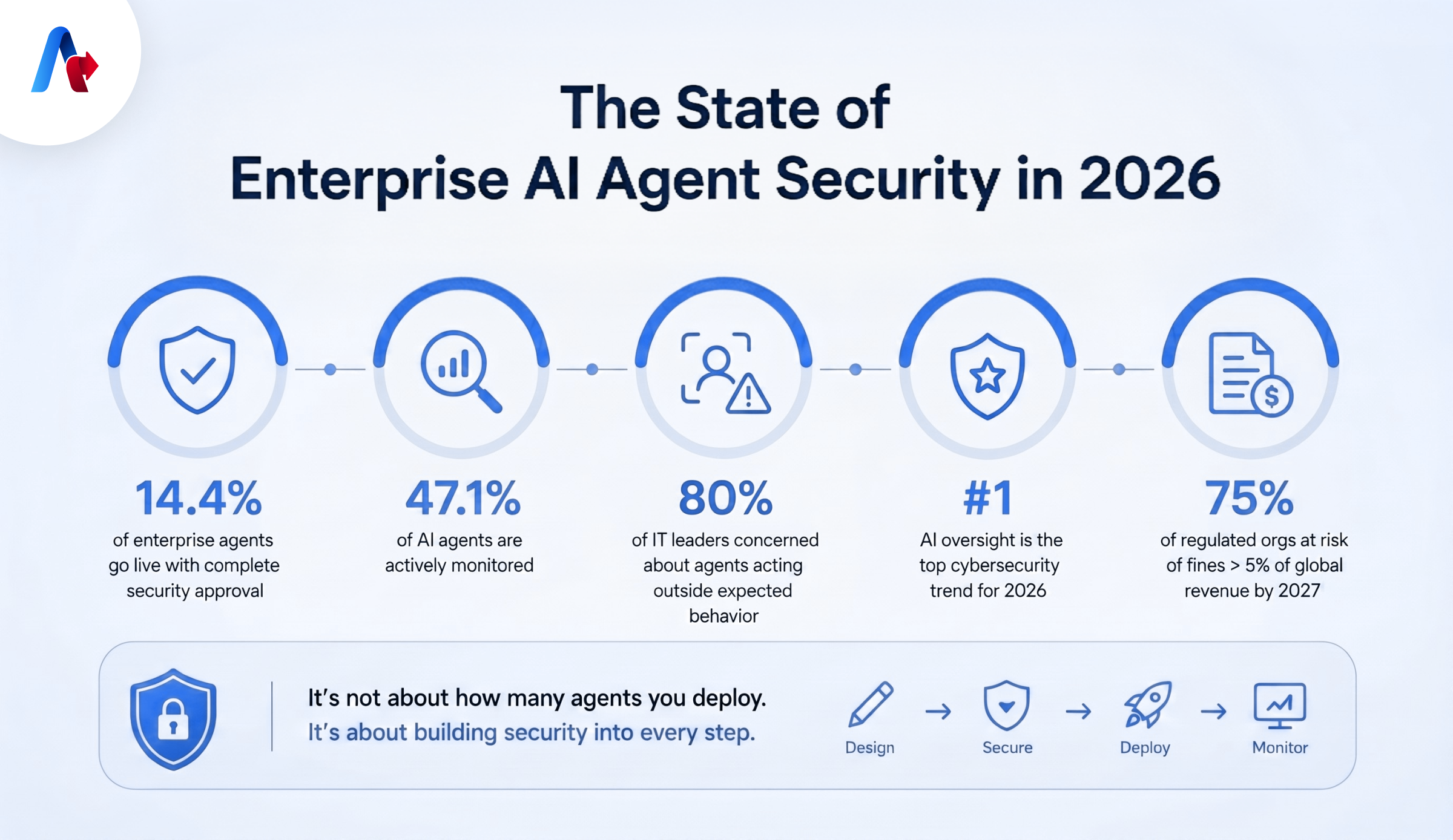
It is a fact that AI adoption is growing faster than governance. Many authentic reports talk more about security issues.
Gravitee's “The State of AI Agent Security 2026” reports highlight major security concerns that only 14.4% of enterprise agents go live with complete security approval. That means many of the automation currently running in enterprises are now completely secure.
The same report also says that only 47.1% of AIs are actively monitored. The rest are running in the background, taking actions, accessing data, with no one watching. It means there is a greater possibility of security and compliance issues.
Gravitee also explains that nearly 80% of IT leaders report concerns around agents acting outside expected behavior. It is not a small number but a majority experience.
Gartner predicts AI oversight as the number one cybersecurity trend for 2026. It is not because of the hot topic, but because of the gap between deployment pace and security readiness.
Another report from Gartner predicts that by 2027, manual AI compliance processes will expose 75% of regulated organizations to fines exceeding 5% of their global revenue.
Today, it is not important how many agents you deploy in your organization; it matters how you build security into your deployment from the design onward.
Speed comes from reducing scope, not reducing controls. The most successful organizations treat control as an accelerator of scale - Ahmed Zaidi, CEO, Accelirate Inc.
Not sure if your agents went live with proper security approval? Accelirate can help you find out quickly.
Let's talk
What Are the Most Important AI Agent Security Features for Enterprises?
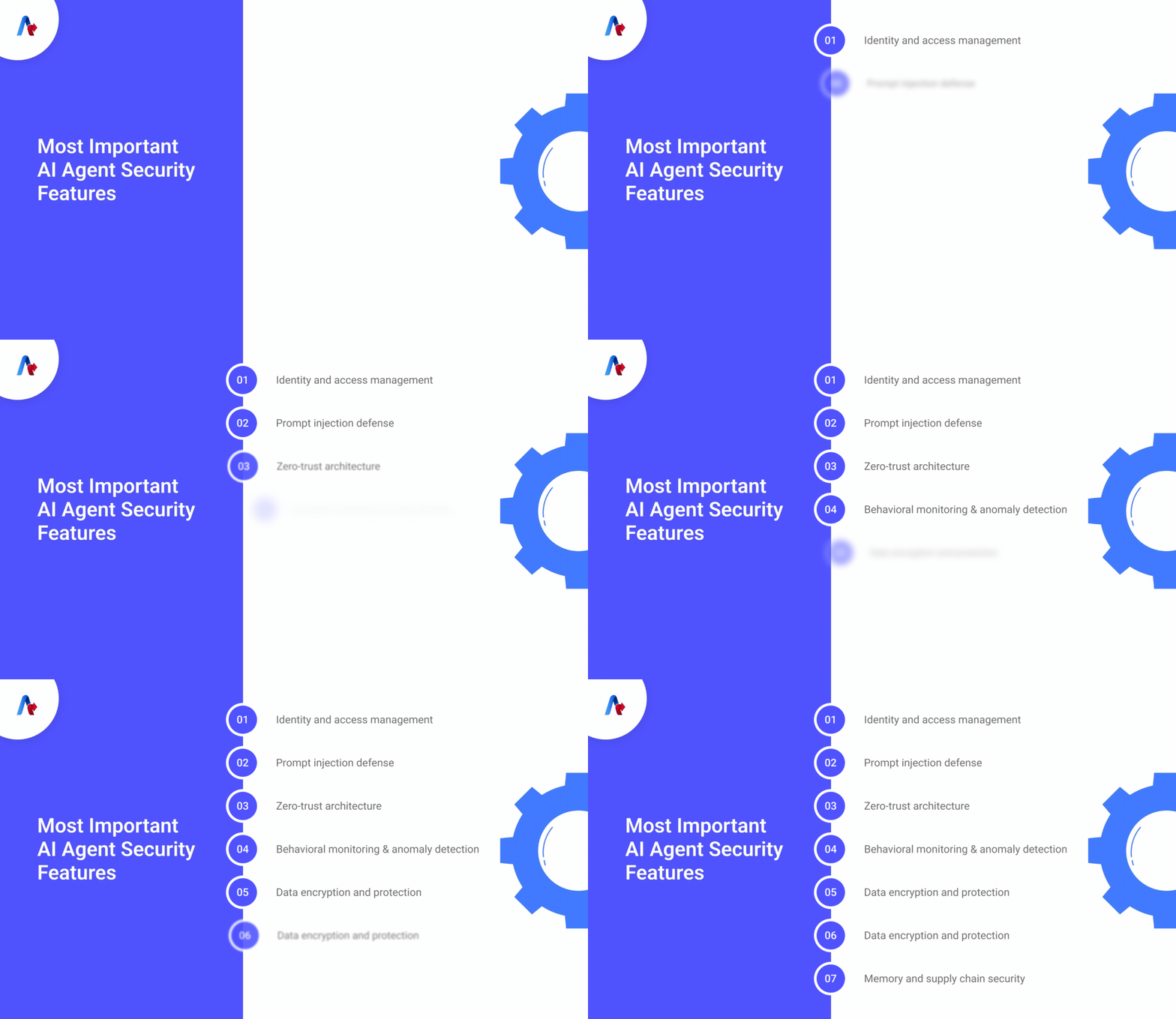
Identity and Access Management
Your agents need identities identical to those of the human user. It means each agent has a unique, authenticated identity. Role-based access control (RBAC) and attribute-based access control (ABAC) clearly define what each agent is allowed to access and what it is not.
Giving limited access can reduce security risks. Even if an AI agent is attacked, the damage stays limited because the agent cannot access other critical systems beyond its assigned role.
Prompt Injection Defense
Prompt injection is the biggest security risk LLM Applications face in 2025. In this type of attack, a hacker hides harmful instructions inside content that an AI agent reads, such as a web page, email, or document. The problem is that intelligent agents may follow those instructions because they think that they came from a trusted source.
A company can use multiple layers of protection to avoid this problem. Prompt hardening gives AI clear and limited instructions, so they mostly don't follow harmful commands. Prompt validation also checks all incoming data against safety rules before it reaches the agent. Output validation is another method that reviews the agent’s responses before any action.
Zero Trust Architecture
Zero trust is a method where no device, agent, or service is trusted by default. It means every access request authorization must be made before processing. For AI agents, this mandate requires continuous verification at every step of the workflow, not just at login. Systems like multi-factor authentication, micro segmentation, and strict runtime controls keep a boundary for agents' operation.
Behavioral Monitoring and Anomaly Detection
If you're not monitoring what your agents do, it is a big mistake. It is vital to track agent actions against expected baselines and fire alerts. This is how you catch an agent that is moving away from expected behavior before it causes significant damage.
In the enterprise deployments Accelirate managed, the most common failure is not from the initial setup. The real problem often comes later when organizations fail to monitor AI’s behavior. It looks good in the initial level, but slowly the behavior can change.
Even if AI agents are properly configured at the beginning, their behavior can slowly change over time as the data and systems around them evolve. Any organization that creates behavioral baselines in advance and reviews them every month can detect unusual behavior faster than others.
What's hardest to detect is silent failure — when the agent gives a plausible but incorrect output. These are not obvious errors and often go unnoticed." Sharad Rastogi, SME, Accelirate Inc.
Data Encryption and Protection
Strong encryption is necessary to protect the data while transferring and storing it. The recommended standard is AES-256 encryption or an equivalent level of security.
Personally identifiable information (PII) and sensitive business data should also be anonymized whenever possible because this will reduce privacy and security risks.
Following these rules is not just for AI agent security but also a requirement.
These practices are not only important for security but are also basic requirements for regulations such as GDPR, HIPAA and many other compliance frameworks.
Memory and Supply Chain Security
Memory poisoning is a growing but overlooked AI security risk in companies. In this, hackers manipulate the AI agent's memory to track its past actions and decisions. The agent may behave incorrectly in the future due to changes in its previous activities.
The supply chain area faces many risks because it uses various tools, software libraries and APIs. More external dependencies lead to unsafe conditions, and attackers may use them to enter the system. Any external dependency is unsafe; it can become a path for attackers to enter the system. Always review external dependencies carefully before use to avoid the consequences.
Wondering which of these controls you are missing? We will help to map it out for you with a call.
Book a security review Call.
What Compliance Controls Do Regulated Enterprises Need for AI Agents?
Knowing how compliance works when working with autonomous agents is a real question you need to ask. Industries such as healthcare, finance and insurance need human accountability for decisions.
Here are the features that help an organization to handle this challenge effectively:
- Audit trails
- Human-in-the-loop controls
- Regulatory framework alignment
- Governance documentation
Audit Trails
Every action taken by an AI agent, including data access, decisions, and external system calls, should be recorded. This is not only for investigating issues later but is also vital for regulated industries. The audit log will show what the agent did, when it happened, what data was accessed, and the result.
For compliance like HIPAA, this type of thing is unavoidable, and it is even stricter than others. When agentic automation accesses patient information, the audit trail must record the agent’s identity, the record accessed, the reason for access, and the timestamp. Without this tracking, compliance with this law is difficult.
Human-in-the-Loop Controls
Not every decision should go through an agent. Well-designed AI agent security systems define in advance the situations that require human review. It is important for high-value transactions and decisions affecting sensitive data.
From several enterprise agent deployments, Accelirate experienced that more than half of our clients underestimated the complexity of escalation trigger design. Some agents escalated issues too frequently, while others failed to escalate. These situations create compliance and operational risks.
Regulatory Framework Alignment
There are many compliances in this world, and each requires different requirements. For example:
- The famous EU GDPR concentrates more on data privacy. It means artificial intelligence handling EU personal data must follow consent management, data minimization, deletion requests, and audit logging.
- HIPAA is strict on encryption for all patient data. Here, you need to follow strict access controls and detailed audit logs to show who or what accessed to protect sensitive information.
- SOX differs because it requires audit trails for AI in financial reporting. While using it, you need to enforce access controls and document your work.
- PCI DSS needs secure handling of payment data and monitoring for unauthorized access. It is also essential to separate payment systems from other networks.
Read a case study: How Accelirate’s HIPAA Compliance Automation Delivers Significant ROI for Legal Services Firm with 87% Faster Doc Creation.
Governance Documentation
For those who audit your AI agent security, having control in place is only part of the requirement, but how it is planned, tested and reviewed is essential as proof.
Because of this, AI governance documentation should include everything, such as the scope, access permissions and the reason, escalation rules, behavioral monitoring methods, and incident response procedures when AI fails.
How Do You Build an Enterprise AI Agent Security Framework?
A framework is not a policy document. It is the structure of complete operation that will help to make security-related decisions consistent and repeatable whenever you deploy agents.
Let’s see the five pillars of the AI governance framework.
- Authorization: Every agent has a clearly documented permission action. Anything outside of that is not allowed by the AI.
- Audit: A log is where companies can see the actions of the AI system. Nobody should change, including accurate timestamps. It is also stored based on the compliance and regulatory rules of your industry.
- Data Boundary: Automated tool must have a data boundary, and anything outside of that needs special authorization and logged separately.
- Escalation: It is essential to mention how escalation happens before deployment, not after. Each trigger needs to go to a particular human reviewer, and it should be documented.
- Drift Detection: Organizations need to measure and record intelligent systems' behavior to create a baseline. After that, continuously monitor AI for unusual changes. If the behavior is different from the baseline, it should be reviewed.
Got an audit coming up soon? We have helped hundreds of clients from healthcare, insurance, and financial services teams get agent-ready fast.
Talk to a compliance specialist.
AI Agent Security Best Practices: The Implementation Roadmap
While using AI-powered systems, the safest best practice method is to go with phased deployment that includes five important measures, such as:
- Discovery and architecture
- Build and configure controls
- Testing and validation
- Production and ongoing monitoring
Discovery and Architecture
Before you go into the security controls, ensure you fully understand what you need to secure. Map every AI agent currently running in your environment, including shadow AI. The team must document what it accesses, what data it touches, what actions it can take, and what human sight currently exists.
This is what is called an inventory baseline. An organization can govern what it can see. At the same time, begin designing the security architecture. Here, you need to define the identity model for each agent and assign their roles and access permissions. Also, explain the data boundaries and the escalation path criteria.
Build and Configure Controls
For this, a team must implement identity and access management for all agents. Along with that, configure prompt hardening and input validation for better security. It is vital to capture activity data to monitor behavior and set up audit logging.
Sandbox environments are essential for AI agents that can execute code. Even though an agent is compromised, it ensures no impact on other production systems' operations.
Testing and Validation
AI agent security is only effective with proper agentic testing. Organizations should test security, including prompt injection and other attacks. The team also needs to ensure the escalation triggers work as planned and to confirm that audit logs are complete and easy to review, if necessary.
This is also the stage where companies should validate compliance with regulations such as HIPAA, GDPR, SOX, and PCI DSS. If there is any compliance issue, fix it before the AI system goes live.
Production and Ongoing Monitoring
Deploying AI applications to production after monitoring systems are fully active from day one. But continuous monitoring helps organizations detect unusual behavior, security risks, and other performance issues.
It is better to review behavior baselines every month to ensure agents work as expected. In addition, quarterly security audits also help to identify vulnerabilities and improve security controls.
Interesting Read: How UiPath’s AI Advancements Are Powering Agentic Automation at Scale.
AI Agent Security Maturity Model: Where Does Your Enterprise Stand?
Most enterprises fall into one of four maturity levels when it comes to AI security. Knowing where you are presently will help you to take the next step.
| Maturity Level | Characteristics | Risk Level |
|---|---|---|
| Reactive | Minimal monitoring and governance | High |
| Managed | Basic permissions and approvals | Moderate |
| Proactive | Runtime monitoring and escalation policies | Lower |
| Optimized | Continuous governance and behavioral analytics | Mature |
Level 1- Reactive
What it looks like
- Agents were deployed quickly (Mostly by individual teams without IT security involvement).
- Address security issues only after something goes wrong.
- There are no formal audit trails.
- No behavioral monitoring.
- Escalation happens informally.
Key indicators
- No complete list of all AI agents running in your environment.
- One AI agent has behaved unexpectedly, and the team is not sure how to stop such incidents in the future.
Level 2- Managed
What it looks like
- IT security is involved in new agent deployments.
- Basic access controls are in place.
- Audit logs exist, but are incomplete.
- Escalation triggers exist, but not for all.
Key indicators
- You have an inventory of AI agents, but they are not fully up to date.
- Monitoring is available, but not for all.
- It is mostly reactive instead of proactive.
- Compliance documents exist, but they still need major improvements to meet audit requirements.
Level 3 -Proactive
What it looks like
- A formal security review process exists for every new agent before deployment.
- There is a system to monitor baseline behavior.
- Clearly defined AI escalation, documentation, and testing. Audit logs are complete, immutable, and regularly reviewed. Compliance controls are mapped to specific regulatory requirements.
Key indicators
- A team can produce an audit-ready report for any agent in your environment within hours.
- Security incidents are detected through monitoring, so they do not affect users.
Level 4 - Optimized
What it looks like
- Security is designed into the agent development process.
- Guardian agents monitor other agents in real time.
- There are automated compliance checks run continuously.
- Your AI governance framework is documented, versioned, and reviewed according to a schedule.
- Your team treats agent security and features as part of their operational discipline, not a periodic compliance exercise.
Key indicators
- Completed at least one external audit of your AI agent security posture.
- There is an incident response playbook specifically for AI agent failures.
- You have a proactive tracking system for the regulatory environment and update controls accordingly.
According to Accelirate experience, most companies work with Level 1 or Level 2 and reach Level 3 within a structured 90-day program. The Level 4 usually takes at least six months, depending on the complexity of your agents and workflow.
Build a Secure Foundation Before Scaling AI Agents
Automated tools are becoming part of everyday enterprise operations. Implementing AI tools can improve speed, reduce manual work, and help teams make faster decisions. Despite their advantages, there are also some problems with proper security and compliance controls. Without them, they can create serious operational and regulatory risks.
The question in 2026 is not whether to adopt AI agents or not. The question is how you deploy them safely and responsibly. A small number of groups are succeeding in AI implementation by building governance early. More than that, they also concentrate on monitoring, access, auditing, compliance, and escalation workflow from the beginning onwards.
At Accelirate, we believe enterprise AI adoption should balance innovation with control. We provide an AI governance framework and services to our clients that help them scale AI with more visibility, accountability and confidence.
If your enterprise is planning to expand AI adoption, now is the right time to assess whether your current security and governance model is ready for autonomous AI systems.
Ready to see where your AI agent security actually stands? Our free 2-hour assessment gives you a clear answer.
Book your free assessment.
FAQs
An AI agent is built to protect autonomous systems from external threats. This security measure ensures those systems don't become security risks for the organization that uses them. On the other hand, traditional cybersecurity is built for human-to-application interactions. It cannot handle machine-to-machine workflows.
The most significant risks in production deployments are prompt injection attacks, privilege escalation, behavioral drift, and memory poisoning. Among them, prompt injection and privilege escalation are the biggest risks today.
An AI audit requires four components. First, an immutable audit log that records every agent action (data accessed, decisions made, and external calls placed). Second, a behavioral baseline deployment, so you can identify deviations. Third, regular review cycles (monthly and quarterly). Fourth is the documented escalation and incident response protocol to investigate if something goes wrong.
For HIPAA compliance, a company must demonstrate five requirements when using an intelligent assistant. The first is to have a secure, verified identity, not a shared one. The second one is to prove that AI accesses only the minimum amount of patient data necessary for its task. The third one is to record every access to protected health information (agent’s identity, the patient record accessed, the task performed, and the timestamp). The fourth is to store access logs for at least 6 years, as required by HIPAA. The fifth one is that there should be a human reviewer to approve the agent’s role and permissions before deployment, in case it handles patient data.